The extinction of the non-avian dinosaurs at the end of the Cretaceous Period, about 66 million years ago, is often imagined as an ending—a dramatic curtain fall after which the world grew smaller and less spectacular. In reality, it was a beginning. The disappearance of dominant dinosaur lineages opened ecological space on land, in the oceans, and in the skies. Over the next tens of millions of years, life did not merely recover; it reinvented itself. Mammals, birds, reptiles, and even insects began to explore body sizes, lifestyles, and ecological roles that had previously been monopolized by dinosaurs.
This post-dinosaur world, spanning much of the Cenozoic Era, was home to giants that rivaled or even exceeded many dinosaurs in mass, height, and ecological influence. These creatures were not evolutionary accidents. They were the products of physics, physiology, climate, and ecology working together under new conditions. High oxygen availability, warm global climates, and abundant resources allowed life to grow large again—though in very different forms.
The following eleven creatures represent some of the most impressive giants to emerge after the dinosaurs. Each ruled its domain for a time, shaping ecosystems and leaving behind fossil evidence that continues to reshape our understanding of life’s resilience and creativity.
1. Paraceratherium – The Largest Land Mammal That Ever Lived
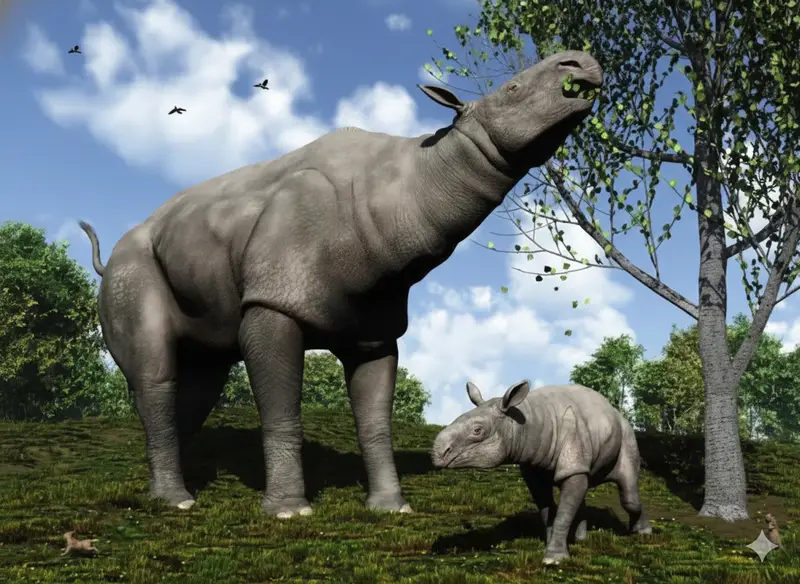
Paraceratherium stands as an almost unbelievable achievement of mammalian evolution. Living between roughly 34 and 23 million years ago, this colossal relative of modern rhinoceroses is widely regarded as the largest land mammal in Earth’s history. Estimates suggest it stood over five meters tall at the shoulder when its long neck was raised, with a body mass that may have exceeded 15 to 20 metric tons.
Despite its immense size, Paraceratherium was not a brute built for aggression. Its anatomy suggests a peaceful browser, feeding on leaves and branches high above the ground. Its elongated neck and relatively slender legs allowed it to reach vegetation inaccessible to other herbivores, reducing competition. This feeding strategy mirrors, in some ways, that of long-necked sauropod dinosaurs, demonstrating how similar ecological pressures can produce comparable solutions across very different evolutionary lineages.
Physics played a crucial role in shaping Paraceratherium. Supporting such mass required column-like limbs and a skeletal structure optimized for distributing weight efficiently. Its slow metabolism and large gut likely allowed it to process vast quantities of low-nutrient plant material, a common strategy among giant herbivores.
Paraceratherium ruled the open woodlands and floodplains of Eurasia for millions of years. Its eventual extinction was likely driven by climatic cooling and habitat change rather than direct competition or predation. In its time, however, it was a living monument to how large mammals could become once dinosaurs were gone.
2. Basilosaurus – The Serpent King of the Ancient Seas
While mammals on land were growing larger, the oceans were undergoing their own transformation. Basilosaurus, which lived around 40 million years ago, was one of the earliest fully aquatic whales and among the largest predators of its time. Reaching lengths of up to 18 meters, this ancient whale rivaled some of the largest marine reptiles of the Mesozoic.
Despite its name, which means “king lizard,” Basilosaurus was not a reptile but a mammal, retaining unmistakable mammalian features such as differentiated teeth and evidence of live birth. Its long, eel-like body was unlike that of modern whales, reflecting an early stage in whale evolution when body plans were still experimental.
Basilosaurus was an apex predator. Its jaws were powerful, and its teeth were adapted for slicing flesh, indicating a diet of large fish and other marine vertebrates, including smaller whales. Its elongated body allowed for powerful lateral movements, making it an efficient hunter in warm, shallow seas.
The rise of Basilosaurus illustrates how mammals rapidly moved into ecological roles once occupied by marine reptiles. By exploiting the physics of buoyancy and water-supported mass, marine mammals could grow far larger than terrestrial ones, setting the stage for the even greater whales that would appear later in Earth’s history.
3. Megalodon – The Ultimate Post-Dinosaur Predator
Among all post-dinosaur giants, few capture the imagination like Otodus megalodon. Living from about 23 to 3.6 million years ago, this colossal shark was the largest predatory fish to ever exist. Estimates suggest megalodon reached lengths of 15 to 20 meters, with jaws capable of exerting bite forces far exceeding those of any living shark.
Megalodon’s success was rooted in both biology and physics. Water buoyancy allowed such immense size, while its cartilaginous skeleton provided strength without excessive weight. Its teeth, some larger than a human hand, were designed for crushing bone, indicating a diet that included large marine mammals such as whales.
The oceans of the Miocene Epoch were rich in large prey, providing the energy resources necessary to sustain such a massive predator. Megalodon likely played a crucial role in regulating marine ecosystems by controlling populations of large herbivores and smaller predators.
Its extinction coincided with global cooling, changes in sea level, and the decline of its prey base. When energy flows through the ecosystem shifted, even the most formidable predator could not adapt quickly enough. Megalodon’s reign reminds us that size and power offer no immunity from environmental change.
4. Argentavis – The Giant of the Skies
The skies of the Miocene were once ruled by Argentavis magnificens, one of the largest flying birds to ever exist. With a wingspan exceeding seven meters and a body mass approaching 70 kilograms, Argentavis pushed the physical limits of powered flight.
Flight at such scales is only possible under specific conditions. Argentavis lived during a time when global climates were warmer, and atmospheric density may have been slightly higher than today, aiding lift generation. Its enormous wings allowed it to soar efficiently, relying on thermal currents and minimal flapping to conserve energy.
Argentavis was likely a scavenger and opportunistic predator, feeding on carrion and small animals. Its beak and talons were powerful, but its size suggests it avoided frequent flapping flight, instead launching from elevated terrain and gliding for long distances.
This giant bird demonstrates how the absence of large flying reptiles after the dinosaurs allowed birds to experiment with extreme body sizes. Argentavis was not fast or agile compared to smaller birds, but it was supreme in endurance and reach, dominating open landscapes from above.
5. Gigantopithecus – The Largest Primate That Ever Lived
Gigantopithecus, a massive ape that lived in Asia between about 2 million and 300,000 years ago, represents the upper limit of primate size. Standing perhaps three meters tall when upright and weighing over 300 kilograms, it dwarfed all living primates, including gorillas.
Fossil evidence of Gigantopithecus consists mainly of teeth and jaw fragments, yet these remains reveal a creature adapted for processing tough plant material. Its massive jaws and thick enamel suggest a diet rich in fibrous vegetation, possibly including bamboo.
Gigantopithecus lived in forested environments, where its size offered protection from predators but also imposed constraints. Large body size requires abundant, reliable food sources. As climates shifted and forests contracted during the Pleistocene, Gigantopithecus may have been unable to adapt quickly enough to changing conditions.
The existence of such a giant primate highlights the evolutionary flexibility of mammals in the post-dinosaur world. It also underscores a recurring pattern: gigantism thrives under stable, resource-rich conditions but becomes a liability when environments change.
6. Indricotherium – A Twin Titan of Paraceratherium
Often considered synonymous or closely related to Paraceratherium, Indricotherium represents the same lineage of giant hornless rhinoceroses and reinforces just how dominant these animals were. Fossils found across Eurasia indicate a widespread distribution, suggesting these giants were highly successful.
Indricotherium shared many traits with Paraceratherium, including long legs, an elongated neck, and massive body size. Together, they formed a lineage that effectively replaced large dinosaurian herbivores in many ecosystems.
Their dominance reshaped vegetation patterns, influencing plant evolution through browsing pressure. Large herbivores act as ecosystem engineers, altering landscapes simply by feeding, moving, and excreting. Indricotherium’s impact on its environment would have been profound.
This lineage exemplifies how, once freed from dinosaur competition, mammals rapidly expanded into the largest possible niches available to terrestrial life.
7. Deinosuchus (Late Survivors into the Cenozoic)
Although Deinosuchus originated in the Late Cretaceous, close relatives of these giant crocodilians persisted into the early Cenozoic, and their lineage deserves mention as rulers of post-dinosaur ecosystems. Some post-Cretaceous crocodilians reached lengths exceeding 10 meters, dominating rivers and wetlands.
These animals benefited from a semi-aquatic lifestyle, which allowed them to support massive bodies using water buoyancy. Their slow metabolism and ambush hunting strategy made them energy-efficient predators capable of taking down large prey.
Crocodilians changed little after the dinosaurs, a testament to the effectiveness of their body plan. In many post-dinosaur ecosystems, giant crocodilians were apex predators, filling roles once occupied by large theropod dinosaurs.
8. Diprotodon – Australia’s Giant Wombat
Diprotodon was the largest marsupial to ever exist, living in Australia until about 25,000 years ago. Resembling a colossal wombat, it could reach lengths of three meters and weigh over 2,500 kilograms.
Australia’s long isolation allowed marsupials to evolve into roles filled elsewhere by placental mammals. Diprotodon was a dominant herbivore, grazing and browsing across open woodlands and grasslands.
Its size offered protection from predators, but like many megafauna, Diprotodon was vulnerable to rapid environmental change. Climate fluctuations and human arrival likely contributed to its extinction.
Diprotodon illustrates how gigantism was not limited to placental mammals. Under the right conditions, marsupials too could produce giants that shaped entire ecosystems.
9. Titanoboa – The Giant Snake of a Greenhouse World
About 60 million years ago, during a period of intense global warmth, the largest snake known to science slithered through tropical forests. Titanoboa reached lengths of over 12 meters and weighed more than a metric ton.
As a cold-blooded reptile, Titanoboa’s size was directly linked to temperature. Warmer climates allow ectotherms to grow larger by supporting higher metabolic rates. Titanoboa’s existence is strong evidence that Paleocene temperatures were significantly warmer than today.
This giant snake was an apex predator, feeding on large fish and possibly crocodilians. Its sheer size allowed it to overpower prey through constriction, a method that scales effectively with body mass.
Titanoboa’s reign ended as global temperatures cooled, reinforcing the tight connection between climate and biological possibility.
10. Mammuthus columbi – The Columbian Mammoth
The Columbian mammoth was one of the largest members of the elephant family, roaming North America during the Pleistocene. Standing over four meters tall at the shoulder and weighing up to 10 metric tons, it rivaled many dinosaurs in mass.
These mammoths were highly social, intelligent animals, living in complex groups and adapting to diverse environments. Their size helped them survive cold climates and deter predators.
Mammoths were ecosystem engineers, shaping landscapes through grazing, trampling, and nutrient cycling. Their extinction profoundly altered the ecosystems they once dominated.
The Columbian mammoth represents the culmination of mammalian gigantism in the post-dinosaur world, just before human influence became a dominant evolutionary force.
11. Phorusrhacids – The Terror Birds
The terror birds of South America were flightless predatory birds that filled apex predator roles for millions of years. Some species stood over three meters tall, with massive skulls and powerful beaks adapted for killing large prey.
These birds evolved in isolation, in a continent without large placental predators for much of the Cenozoic. Their speed, strength, and weaponized beaks made them dominant hunters.
Terror birds demonstrate that after the dinosaurs, birds did not merely become small and fragile. In some places, they became the rulers of the land, inheriting the predatory legacy of their dinosaur ancestors.
Conclusion: Giants in a World Reborn
The world after the dinosaurs was not diminished—it was transformed. Freed from ancient constraints, life explored new extremes of size, power, and ecological dominance. These eleven giants ruled land, sea, and sky, each shaped by the physical laws and environmental conditions of their time.
Their stories remind us that evolution is not a march toward smaller, safer forms. It is an ongoing experiment, capable of producing awe-inspiring giants whenever the balance of climate, energy, and opportunity allows. The post-dinosaur Earth was, in many ways, a golden age of giants—one that continues to shape the world we inherit today.