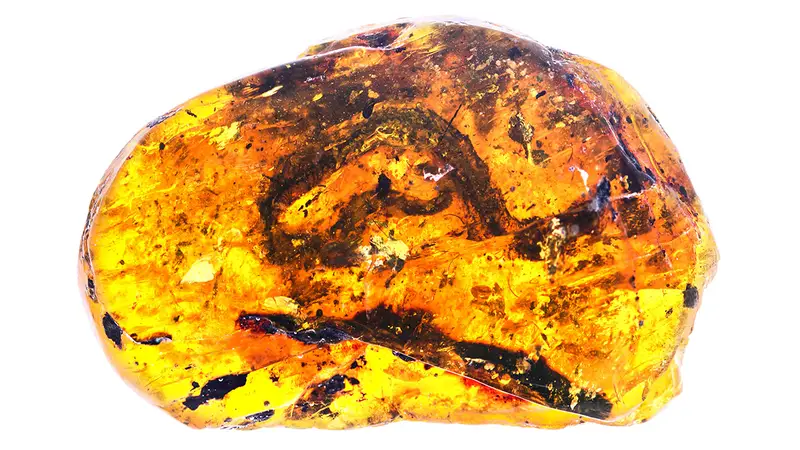
Amber is often described as time made visible. Formed from the hardened resin of ancient trees, amber captures moments of life with an intimacy unmatched by any other fossil record. A drop of sticky resin oozes from bark, traps whatever brushes against it, and then—through burial, pressure, and time measured in millions of years—transforms into a golden archive of vanished worlds. Unlike bones pressed into stone or shells flattened into rock, amber preserves life in three dimensions, sometimes down to microscopic detail. Feathers retain their delicate branching, insect eyes preserve the structure of individual facets, and even soft tissues can survive in astonishing condition.
For scientists, amber is not merely beautiful. It is a scientific instrument, a natural data storage medium that records ecosystems, climates, and biological interactions long erased from the surface of Earth. Each piece is a sealed message from deep time, and modern analytical tools are finally allowing researchers to read those messages with increasing clarity. Within amber lie secrets that reshape our understanding of evolution, extinction, and the intimate details of ancient life.
The following five secrets reveal what ancient amber truly holds—and why it remains one of the most powerful windows into Earth’s deep past.
1. Amber Preserves Entire Ancient Ecosystems in Miniature
One of the most profound secrets hidden in ancient amber is that it does not merely preserve individual organisms; it preserves fragments of entire ecosystems. A single piece of amber can contain insects, plant material, fungi, microorganisms, and chemical traces of the surrounding environment, all frozen in the same moment.
In most fossil records, organisms are separated by time, transport, and geological processes. A dinosaur bone may be found hundreds of kilometers from where the animal died, while plant fossils from the same period might come from an entirely different environment. Amber, by contrast, forms in place. The resin originates from a specific tree in a specific forest, and anything trapped within it is a direct snapshot of that environment.
This means amber often captures ecological relationships rather than isolated species. Insects preserved while feeding on plants reveal what they ate. Parasites attached to hosts show ancient disease dynamics. Pollen grains clinging to an insect’s body identify the plants flowering at that time. Even fungal spores trapped alongside insects help reconstruct humidity levels and forest floor conditions.
Scientific analysis of amber inclusions has revealed complex food webs operating tens of millions of years ago. Predatory insects are found with prey in their grasp. Mites cling to beetles, suggesting commensal or parasitic relationships. Ants are preserved mid-cooperation, hinting at the early evolution of social behavior.
These miniature ecosystems challenge the idea that ancient life was simpler than today’s. Instead, amber shows that ecological complexity—interdependence, specialization, and competition—was already deeply established long before humans appeared. In this sense, amber does not just preserve life; it preserves relationships, which are the true foundation of ecosystems.
2. Amber Records Ancient Climate and Atmospheric Conditions
Another remarkable secret hidden in amber is its ability to preserve chemical clues about Earth’s ancient climate. Resin does not merely trap organisms; it also traps gases, isotopes, and molecular signatures that reflect the environment in which it formed.
When resin hardens into amber, it can encapsulate tiny bubbles of ancient air and water vapor. While these bubbles are not perfectly sealed time capsules, their chemical composition can still provide valuable information. By analyzing stable isotopes of carbon, hydrogen, and oxygen within amber, scientists can infer temperature, rainfall patterns, and atmospheric composition at the time the resin was produced.
For example, the ratio of certain carbon isotopes reflects how plants responded to atmospheric carbon dioxide levels. High carbon dioxide concentrations leave a distinct isotopic signature in plant-derived materials, including resin. Similarly, hydrogen isotopes can indicate the intensity of the ancient water cycle, revealing whether a region experienced frequent rainfall or prolonged drought.
Amber deposits from different geological periods show that Earth’s climate has fluctuated dramatically. Some amber formed in warm, humid greenhouse climates with dense tropical forests stretching into regions that are temperate or even cold today. Other amber records periods of climatic stress, where resin production increased due to environmental pressure on trees, such as heat, pests, or injury.
This climatic record is emotionally powerful because it reveals a planet in constant transformation. Forests once thrived where deserts now exist. Insects adapted to conditions no longer found anywhere on Earth. Amber reminds us that climate change is not a modern invention, but a fundamental feature of Earth’s history—one that repeatedly reshapes life in profound ways.
3. Amber Preserves Soft Tissues and Cellular Structures
Perhaps the most astonishing secret of ancient amber is its ability to preserve soft tissues—structures that almost never survive fossilization. While bones and shells fossilize readily, muscles, skin, feathers, and internal organs typically decay long before mineralization can occur. Amber changes this rule.
When an organism becomes trapped in resin, oxygen is rapidly excluded, and microbial activity is suppressed. The resin’s chemical properties inhibit decay and dehydration, stabilizing tissues before they can break down. Over time, as the resin polymerizes and hardens into amber, these tissues become sealed within a protective matrix.
Microscopic analysis has revealed preserved muscle fibers, tracheal tubes, compound eyes, and even cellular outlines in amber inclusions. Feathers preserved in amber retain not only their shape but also evidence of pigmentation patterns, allowing scientists to infer coloration in ancient birds and dinosaurs. This has transformed our understanding of prehistoric appearance, replacing dull gray reconstructions with vibrant, biologically realistic imagery.
In some cases, internal organs such as digestive tracts are visible, containing partially digested food. These findings provide direct evidence of diet and feeding behavior. Insects preserved during metamorphosis reveal developmental stages rarely captured elsewhere in the fossil record.
Importantly, while amber can preserve cellular structures, it does not preserve viable DNA over deep geological time. Claims of extracting dinosaur DNA from amber, popularized by fiction, have not been supported by rigorous scientific evidence. DNA degrades chemically over time scales far shorter than the age of most amber deposits. However, the preservation of cellular architecture alone is invaluable, offering insights into physiology and development that bones alone cannot provide.
This secret underscores amber’s unique role in paleontology. It does not merely show what ancient organisms looked like; it reveals how they were built and how they functioned at the most intimate biological level.
4. Amber Reveals the Deep History of Behavior
Behavior is one of the hardest aspects of life to fossilize. Actions leave fleeting traces, and once the moment passes, it is usually lost forever. Amber defies this limitation by freezing behavior mid-action, capturing life not as static remains but as dynamic process.
Some amber specimens preserve insects mating, fighting, feeding, or escaping predators. Spiders are found with webs partially constructed, complete with trapped prey. Ants are preserved carrying larvae or cooperating in tasks, indicating that complex social behaviors evolved far earlier than once believed.
Predation events captured in amber are particularly revealing. A fly caught in a spider’s grasp, a wasp attacking a host insect, or a mantis ambushing prey all provide direct evidence of ecological interactions. These moments confirm behavioral hypotheses inferred from anatomy alone and sometimes overturn long-held assumptions.
Amber also preserves signs of care and communication. Parental behaviors, such as insects guarding eggs, have been observed. The presence of sound-producing structures and sensory organs in amber-preserved insects offers clues about how ancient species communicated and perceived their environment.
Behavioral preservation extends beyond animals. Plant-insect interactions, such as pollination or herbivory, are recorded with extraordinary clarity. Insects dusted with pollen grains show that pollination networks were already well established tens of millions of years ago. Bite marks on leaves preserved alongside insects provide evidence of feeding strategies and plant defenses.
This behavioral record transforms amber from a passive archive into a living narrative. It allows scientists to witness moments of ancient life as they unfolded, collapsing millions of years into an instant of shared experience between past and present.
5. Amber Exposes Evolutionary Experiments That Failed
The final secret hidden in ancient amber is perhaps the most humbling: it reveals not only the ancestors of modern life, but also evolutionary experiments that ended in extinction. Many organisms preserved in amber belong to lineages that no longer exist, representing branches of the evolutionary tree that were pruned away by time.
Some amber inclusions show combinations of traits unlike anything alive today. Insects with transitional features bridge gaps between modern groups, offering snapshots of evolution in progress. These forms demonstrate that evolution does not proceed in a straight line toward modern perfection, but explores a vast landscape of possibilities, most of which ultimately disappear.
Amber has preserved ancient relatives of bees, ants, and termites that display early stages of social behavior. It captures primitive birds and feathered dinosaurs that experimented with flight-related adaptations. It shows plants with reproductive strategies that vanished as climates shifted and competitors emerged.
By studying these extinct forms, scientists gain insight into why certain evolutionary paths succeed while others fail. Environmental change, competition, and chance all play roles in shaping survival. Amber makes this process visible by preserving organisms at the moment they still thrived, unaware that their lineage would one day vanish.
This secret carries emotional weight because it reframes extinction not as an anomaly, but as a natural outcome of evolutionary exploration. The modern world is built not only on survival, but on countless failures embedded deep in time. Amber allows us to meet these lost forms face to face, reminding us that life’s history is as much about endings as it is about continuity.
Conclusion: Amber as Earth’s Memory Made Tangible
Ancient amber is far more than a gemstone or curiosity. It is a molecular archive, a biological diary, and a geological witness to worlds long gone. Within its translucent depths lie ecosystems, climates, behaviors, and evolutionary stories preserved with a fidelity unmatched by any other fossil medium.
The five secrets hidden in amber reveal a planet alive with complexity long before humans arrived. They show forests breathing under ancient skies, insects adapting to shifting climates, and life experimenting endlessly with form and behavior. Amber teaches us that the present biosphere is not inevitable, but contingent—a single outcome among many that once existed.
In an era when Earth’s ecosystems face unprecedented pressure, amber offers perspective. It reminds us that life endures through change, but not without loss. The golden windows of ancient resin connect us emotionally and scientifically to deep time, urging humility, curiosity, and respect for the fragile continuity of life on this ever-changing planet.