Every star in the night sky is a distant sun. That simple realization reshaped human history. For most of our existence, we believed the Sun was unique—an isolated beacon in a dark universe. Modern astronomy has taught us otherwise. There are hundreds of billions of stars in our galaxy alone, and countless galaxies beyond.
And yet, even in a cosmos overflowing with stars, our Sun stands apart.
Not because it defies physics. Not because it breaks cosmic rules. But because, from our perspective as living beings shaped by its warmth and light, it occupies a position unlike any other star in existence.
Scientifically, the Sun is classified as a G-type main-sequence star, a fairly ordinary star by cosmic standards. It is neither the most massive nor the smallest, neither the brightest nor the faintest. But when we look closer—when we examine its environment, its history, its behavior, and its relationship to life—remarkable distinctions emerge.
Here are thirteen ways our Sun is different from every other star in the universe.
1. It Is the Only Star We Can Study in Extraordinary Detail
The most immediate difference between our Sun and every other star is proximity.
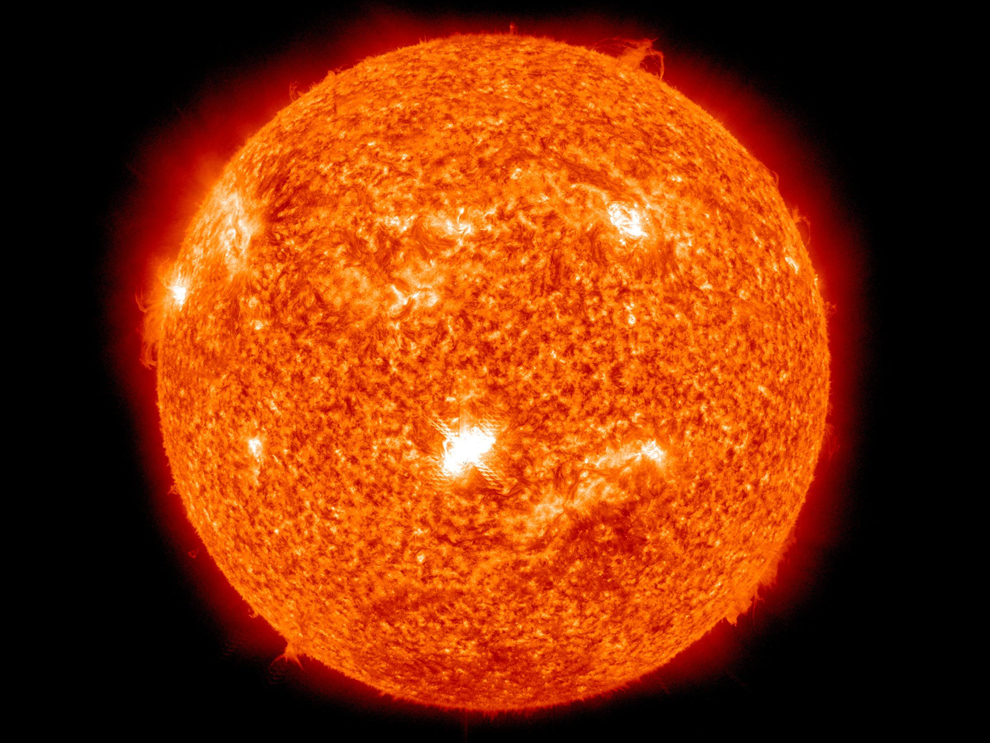
The Sun lies about 150 million kilometers from Earth—close enough that spacecraft can observe it directly, instruments can resolve surface structures, and scientists can measure its magnetic fields, oscillations, and plasma flows in astonishing precision. No other star offers this level of detail.
We can image sunspots, trace coronal loops, detect solar flares as they erupt, and analyze the Sun’s internal structure through helioseismology—the study of sound waves moving inside it. These acoustic oscillations reveal how temperature and density change from core to surface.
For distant stars, we infer properties indirectly through light spectra and brightness variations. For the Sun, we watch granules the size of continents boiling across its surface in real time.
This level of access makes the Sun not only our star but also our laboratory. It is the benchmark against which stellar physics is built.
2. It Is the Only Star Known to Host Life
Among the trillions of stars in the observable universe, only one is confirmed to host life: our Sun.
This is not a small distinction. It is profound.
The Sun’s steady output of energy has allowed liquid water to exist on Earth’s surface for billions of years. Its radiation spectrum, dominated by visible light, aligns with the atmospheric transparency of our planet and the chemistry of photosynthesis. The balance between ultraviolet radiation and atmospheric protection has allowed biological complexity to evolve without being sterilized.
While exoplanets have been discovered in habitable zones around other stars, no confirmed biosignatures have yet been detected. The Sun remains the only star known to support a biosphere.
Life on Earth is not merely orbiting the Sun. It is powered by it. Photosynthesis converts solar photons into chemical energy, forming the base of most ecosystems. Even fossil fuels are ancient sunlight stored in carbon bonds.
Every heartbeat on Earth ultimately traces back to this star.
3. Its Stability Over Billions of Years Has Been Exceptionally Fortunate
Stars are not static objects. They evolve. They fluctuate. Some flare violently. Some dim unpredictably. Some explode.
The Sun, however, has maintained remarkable stability over the past 4.6 billion years.
Its luminosity has increased gradually, as predicted by stellar evolution models, but not abruptly. It has avoided catastrophic variability. Its solar cycles, driven by magnetic activity, follow an approximately 11-year pattern, producing sunspots and flares but not extreme long-term chaos.
Many stars, especially red dwarfs, exhibit powerful flares capable of stripping planetary atmospheres. Some young stars undergo dramatic brightness changes. Others exist in binary systems where gravitational interactions create instability.
The Sun’s relatively calm behavior has provided Earth with environmental continuity long enough for life to arise and evolve from simple microbes to conscious beings.
This level of long-term stability is not guaranteed for every star.
4. It Exists as a Solitary Star
A significant fraction of stars in the Milky Way are part of binary or multiple star systems. In these systems, two or more stars orbit a common center of mass.
Our Sun, by contrast, is solitary.
This isolation matters. In binary systems, gravitational interactions can disrupt planetary orbits or influence planetary formation. Complex orbital dynamics may affect climate stability.
The Sun’s solitary nature has allowed the planets of our solar system to maintain relatively stable orbits over billions of years. Earth’s nearly circular orbit provides moderate seasonal variations rather than extreme temperature swings.
While planets do exist in binary systems, our Sun’s singleness simplifies gravitational architecture in a way that has likely favored long-term planetary stability.
5. Its Metallicity Is Well-Suited for Planet Formation
In astronomy, “metals” refer to all elements heavier than hydrogen and helium. The Sun formed from a molecular cloud enriched by previous generations of stars that produced heavier elements through nuclear fusion and supernova explosions.
The Sun’s metallicity is moderate—higher than the earliest stars but not extraordinarily high. This balance has allowed the formation of rocky planets like Earth.
Stars with very low metallicity may struggle to form terrestrial planets because there are fewer heavy elements available to build solid bodies. Stars with very high metallicity may produce different planetary architectures.
The Sun’s composition includes carbon, oxygen, silicon, iron, and other elements essential for both planetary geology and biological chemistry.
The elements that compose our bodies were forged in ancient stars, incorporated into the cloud that formed the Sun, and assembled into planets. The Sun’s chemical inheritance made Earth possible.
6. Its Mass Places It in a Long-Lived, Stable Category
The Sun has a mass of approximately 1 solar mass—by definition. This mass is crucial.
More massive stars burn their fuel rapidly and live short, violent lives, often ending in supernova explosions within millions of years. Less massive stars, particularly red dwarfs, burn fuel slowly and can last for trillions of years but often exhibit strong flare activity.
The Sun occupies an intermediate regime. Its total lifetime on the main sequence is about 10 billion years. It has already completed nearly half of that.
This timescale has allowed biological evolution to unfold gradually. Complex life on Earth took billions of years to develop. Around a massive star with a short lifespan, there might not be enough time.
The Sun’s mass provides a balance between longevity and stability.
7. It Emits Most of Its Energy in Visible Light
The Sun’s surface temperature of about 5,800 Kelvin causes it to emit radiation that peaks in the visible portion of the electromagnetic spectrum.
This is not trivial.
Human vision evolved to be sensitive to visible light because that is where the Sun emits most strongly and where Earth’s atmosphere is most transparent. Photosynthesis, which powers most life, is optimized for this spectral range.
Cooler stars emit more infrared radiation. Hotter stars emit more ultraviolet radiation. Both environments could, in principle, support life, but the Sun’s spectral output aligns remarkably well with Earth’s atmospheric and biological properties.
This spectral compatibility is one reason life on Earth flourished under this particular star.
8. It Sits in a Relatively Calm Region of the Milky Way
The Sun resides in the Orion Arm, a minor spiral arm of the Milky Way galaxy, about 26,000 light-years from the galactic center.
This location matters.
Closer to the galactic center, stellar densities are higher, and radiation levels increase. Supernovae and energetic events occur more frequently. Gravitational perturbations could disrupt planetary systems.
Farther out in the galactic outskirts, heavy elements are less abundant.
The Sun’s position lies within what astronomers sometimes call the galactic habitable zone—a region where metallicity and radiation exposure are balanced in a way favorable to long-term planetary stability.
This placement is not necessarily unique in the galaxy, but for us, it is critical.
9. Its Magnetic Cycle Is Moderate Compared to Many Stars
The Sun’s magnetic field reverses polarity approximately every 11 years, producing the solar cycle. During solar maximum, sunspots increase, flares become more frequent, and coronal mass ejections erupt into space.
Yet compared to many stars of similar size, the Sun’s activity is relatively moderate.
Observations of Sun-like stars show that some exhibit far stronger magnetic variability. Intense stellar flares can produce radiation bursts capable of stripping planetary atmospheres or severely impacting surface conditions.
The Sun does produce flares, and they can disrupt satellites and power grids, but on geological timescales, its activity has not sterilized Earth.
This balance between activity and calmness has shaped our technological and biological history.
10. It Is Precisely Timed in Its Evolutionary Stage
We observe the Sun during its stable main-sequence phase, when it fuses hydrogen into helium in its core.
This stage is long but finite. Eventually, in about five billion years, the Sun will exhaust core hydrogen, expand into a red giant, and dramatically alter the solar system.
Right now, the Sun is in a middle-aged state—old enough to have supported billions of years of evolution, but not yet advanced into instability.
The timing is significant. Intelligent observers have emerged during a narrow window when the Sun is luminous enough to support life but not yet destructive.
This temporal coincidence makes our observational perspective unique.
11. It Is the Only Star Whose Interior We Can Probe Through Neutrinos
The Sun’s core produces energy through nuclear fusion, primarily via the proton-proton chain reaction. In this process, neutrinos are emitted.
Neutrinos interact very weakly with matter, allowing them to escape directly from the Sun’s core and reach Earth in about eight minutes.
By detecting solar neutrinos with underground detectors, scientists can test models of fusion processes occurring deep within the Sun. This provides direct insight into stellar interiors.
For other stars, neutrino detection is not currently feasible at such precision. The Sun is close enough to allow this extraordinary probe into its nuclear heart.
We do not merely see its surface. We sense its core.
12. It Anchors a Planetary System with Diverse Worlds
The Sun’s gravitational influence binds together a complex system of planets, moons, asteroids, comets, and dwarf planets.
The architecture of our solar system includes inner rocky planets, an asteroid belt, gas giants, icy moons with subsurface oceans, and distant Kuiper Belt objects.
This diversity has created multiple environments where chemistry evolves in different ways. The gravitational influence of Jupiter may have shielded Earth from excessive comet impacts, though it also redirects some inward.
The Sun’s mass and formation history produced a planetary system that is neither tightly packed like some exoplanetary systems nor dynamically chaotic.
While other stars also host planets, the specific arrangement around our Sun has shaped Earth’s impact history, climate evolution, and potential habitability.
13. It Is the Only Star That Defines Our Units of Measurement
Astronomy uses the Sun as a fundamental reference.
Stellar masses are measured in solar masses. Stellar luminosities are compared to solar luminosity. The astronomical unit—the average Earth-Sun distance—defines distances within planetary systems.
The Sun is not just our star; it is our standard candle for stellar physics.
When astronomers describe a distant star as having 0.8 solar masses or 5 times the Sun’s luminosity, they are using our star as the baseline.
No other star plays this definitional role in human science.
The Ordinary Star That Is Extraordinary to Us
From a purely statistical standpoint, the Sun is not rare. G-type stars are common. Planetary systems are common. Stellar fusion is universal.
And yet, from our perspective as living observers shaped by its energy, the Sun is profoundly different from every other star.
It is the only star whose warmth we feel directly on our skin. The only star whose storms can disrupt our satellites. The only star that has illuminated human history from cave paintings to space telescopes.
It is the only star we have touched with spacecraft, the only one whose oscillations we can map in detail, the only one whose neutrinos we routinely detect.
It is the only star known to nurture life.
Across the universe, countless suns burn in silence. Many may host planets. Some may host life. But none share our history.
The Sun is not cosmically unique in its physics. It follows the same laws that govern every star. It was born from collapsing gas, it shines by fusion, and it will die according to well-understood principles.
Yet its particular mass, stability, composition, location, timing, and solitude have converged in a way that allowed oceans to form, cells to evolve, forests to grow, and minds to wonder.
It is an ordinary star in an extraordinary role.
And in its steady light, we found ourselves.