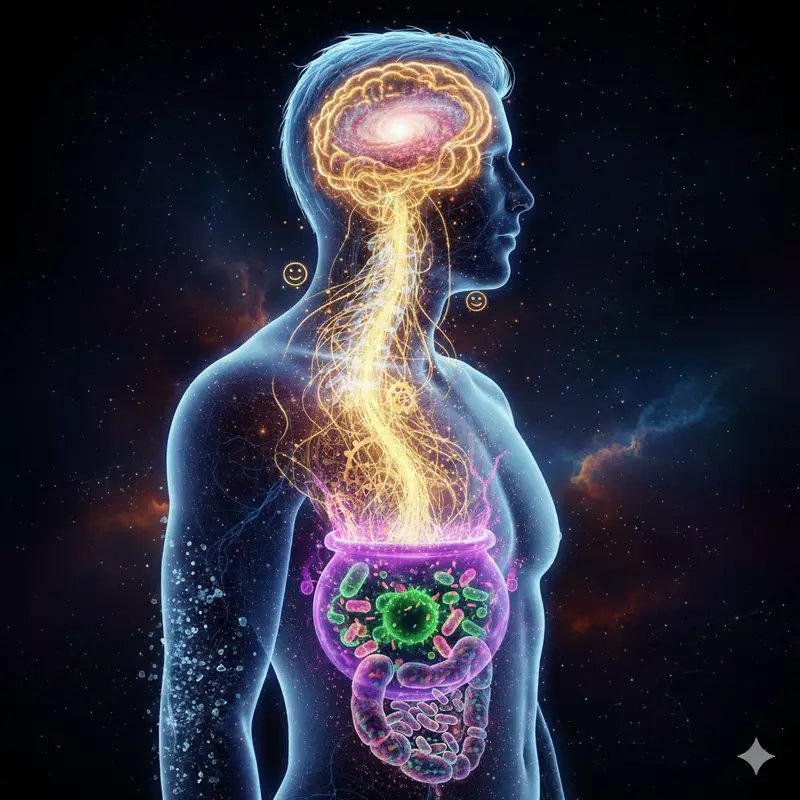
Deep inside your body, far below conscious thought, an invisible conversation is happening every second of your life. It doesn’t involve words, memories, or emotions in the way you recognize them—but it shapes how you feel, how you react, and even how you experience joy, anxiety, calm, or despair. This conversation is happening between your gut and your brain, and the primary speakers are trillions of microscopic organisms living inside you.
These organisms—your gut bacteria—are not passive passengers. They are active participants in your biology, chemistry, and emotional life. Modern science has revealed something both astonishing and deeply unsettling: your mood is not controlled by your brain alone. Your gut microbiome plays a powerful role in shaping your emotional world, often without you realizing it.
This is not mystical thinking or metaphor. It is physiology, neurochemistry, and evolution intertwining. Your gut bacteria produce chemicals, train your immune system, communicate with your nervous system, and influence how your brain responds to stress, pleasure, and fear. They can tilt your emotional balance toward calm or chaos.
Understanding this connection does more than explain why you sometimes feel “off” without knowing why. It changes how we understand mental health itself—not as something that lives only in the brain, but as a whole-body experience shaped by the ecosystems within us.
Here are eight scientifically grounded ways your gut bacteria quietly control your mood every day.
1. Your Gut Bacteria Produce Mood-Altering Neurotransmitters
One of the most surprising discoveries in modern biology is that your gut bacteria manufacture the same chemical messengers your brain uses to regulate emotion. Neurotransmitters—once thought to be the exclusive domain of neurons—are produced in significant quantities by microbes in your intestines.
Serotonin, often called the “feel-good” neurotransmitter, is a prime example. While serotonin is famous for its role in happiness and emotional stability, about 90 percent of the body’s serotonin is produced in the gut, not the brain. Certain gut bacteria stimulate intestinal cells to release serotonin, which then influences gut motility, pain perception, and—indirectly—brain function.
Other bacteria produce gamma-aminobutyric acid (GABA), a neurotransmitter that calms neural activity and reduces anxiety. Some produce dopamine and norepinephrine, chemicals associated with motivation, alertness, and pleasure. These substances don’t all cross directly into the brain, but they influence neural signaling through indirect pathways, including the vagus nerve and immune signaling.
This means your emotional baseline is partly shaped by the chemical output of organisms that are not you—but live inside you. When your gut microbiome is balanced and diverse, these signals tend to support emotional stability. When it is disrupted, neurotransmitter production can shift in ways that promote anxiety, low mood, or emotional volatility.
In a very real sense, your happiness has a microbial component.
2. The Vagus Nerve Acts as a Direct Emotional Hotline
The vagus nerve is one of the longest and most important nerves in your body, running from your brainstem down into your chest and abdomen. It connects your brain to your gut, heart, and lungs, carrying information in both directions. Crucially, most of the signals traveling along the vagus nerve go from the gut to the brain—not the other way around.
Your gut bacteria use this nerve as a communication highway. When certain microbes produce specific metabolites or neurotransmitters, they stimulate receptors in the gut lining that activate the vagus nerve. This sends signals directly to brain regions involved in mood regulation, stress response, and emotional processing.
Experiments have shown that altering gut bacteria can change behavior in animals—but only if the vagus nerve is intact. When the nerve is severed, the mood effects disappear. This provides powerful evidence that gut microbes are not just influencing digestion; they are actively shaping brain activity through direct neural communication.
The vagus nerve is also involved in calming the nervous system. A healthy gut microbiome supports vagal tone, the nerve’s ability to regulate stress and promote relaxation. Poor microbial balance can weaken this calming influence, leaving the brain more reactive, anxious, and emotionally unstable.
Your gut doesn’t whisper to your brain. It calls, constantly.
3. Gut Bacteria Regulate Inflammation That Affects Your Brain
Inflammation is a double-edged sword. In short bursts, it protects you from infection and injury. When it becomes chronic, it quietly damages tissues—including the brain. Increasing evidence shows that low-grade, systemic inflammation is strongly linked to depression, anxiety, and cognitive decline.
Your gut bacteria play a central role in controlling inflammation. A healthy microbiome strengthens the intestinal barrier, preventing harmful substances from leaking into the bloodstream. It also trains immune cells to respond appropriately, avoiding unnecessary inflammatory reactions.
When gut bacteria become imbalanced—a state known as dysbiosis—the intestinal lining can become more permeable. This allows bacterial fragments and toxins to enter circulation, triggering immune responses throughout the body. The resulting inflammation can reach the brain, where it alters neurotransmitter function and neural signaling.
Inflammatory molecules can reduce serotonin availability, disrupt dopamine pathways, and interfere with neuroplasticity—the brain’s ability to adapt and recover. Over time, this inflammatory environment can create a biological foundation for persistent low mood, fatigue, and emotional numbness.
In this way, your gut bacteria don’t just influence how you feel emotionally—they influence whether your brain exists in a state of quiet support or constant biochemical stress.
4. Your Gut Microbiome Shapes How You Respond to Stress
Stress is unavoidable, but your response to it is not fixed. Two people can face the same situation and experience completely different emotional reactions. Part of that difference lies in the gut.
Gut bacteria influence the hypothalamic-pituitary-adrenal (HPA) axis, the system that controls your body’s stress response. When you encounter a stressor, this system releases cortisol and other hormones that prepare you to respond. In healthy regulation, the response rises and falls smoothly. In dysregulation, stress hormones linger, keeping the brain in a heightened state of alert.
Research shows that gut bacteria help calibrate this system, especially early in life. Animals raised without gut microbes show exaggerated stress responses and anxiety-like behavior. Introducing healthy bacteria can normalize these responses, demonstrating a causal relationship.
In humans, disrupted gut microbiomes are associated with heightened stress sensitivity, increased anxiety, and difficulty recovering from emotional challenges. Certain bacterial strains appear to buffer stress, while others may amplify it.
This means your gut bacteria influence not only how much stress you feel, but how long it stays with you. Emotional resilience, it turns out, has a microbial dimension.
5. Gut Bacteria Influence Emotional Learning and Memory
Mood is not just about how you feel in the moment—it’s also shaped by memory, expectation, and emotional learning. Your gut bacteria play a role here too.
The brain regions involved in emotional memory, such as the hippocampus and amygdala, are sensitive to inflammation, neurotransmitter balance, and neurotrophic factors that support neuron growth. Gut bacteria influence all of these through immune signaling and metabolic byproducts.
Short-chain fatty acids, produced when gut bacteria ferment dietary fiber, are particularly important. These molecules support brain health by reducing inflammation, strengthening the blood-brain barrier, and promoting the expression of brain-derived neurotrophic factor (BDNF), a protein essential for learning, memory, and emotional flexibility.
When these supportive signals are strong, the brain is better able to adapt, learn from experience, and regulate emotional responses. When they are weak, emotional memories may become rigid, negative patterns may persist, and recovery from emotional setbacks becomes harder.
Your gut bacteria, in other words, help shape how your emotional past influences your emotional future.
6. Your Microbiome Affects Sleep—and Sleep Shapes Mood
Sleep and mood are inseparable. Poor sleep worsens emotional regulation, increases anxiety, and lowers resilience. Gut bacteria influence sleep in subtle but powerful ways.
Microbes help regulate circadian rhythms by interacting with metabolic and hormonal systems that follow daily cycles. They also influence the production of melatonin and serotonin precursors, which affect sleep onset and quality.
Disruptions in the gut microbiome have been linked to fragmented sleep, altered REM cycles, and increased daytime fatigue. These changes feed directly into mood disturbances, creating a feedback loop where poor sleep worsens emotional health, and emotional stress further disrupts the gut.
Healthy gut bacteria help stabilize this cycle, supporting deeper sleep and more balanced mood regulation. Your nightly rest, it turns out, is partly negotiated by microorganisms that never sleep.
7. Gut Bacteria Shape Food Cravings That Affect Emotional Health
Food and mood are deeply connected, and gut bacteria sit at the center of that relationship. Different bacterial species thrive on different nutrients. Some prefer fiber, others sugar or fat. To survive, they influence your cravings in subtle ways.
Certain bacteria produce metabolites that stimulate appetite for the foods they feed on. Others affect reward pathways in the brain, shaping how satisfying certain foods feel emotionally. This can influence dietary patterns that either support or undermine mental health.
Diets low in fiber and rich in ultra-processed foods tend to reduce microbial diversity, increasing inflammation and destabilizing mood. Diets that support diverse gut bacteria promote emotional steadiness, energy, and cognitive clarity.
Cravings are not just psychological weaknesses. They are biological negotiations between you and the ecosystems inside you, with emotional consequences.
8. Your Gut Microbiome Influences Long-Term Mental Health Risk
Perhaps the most profound way gut bacteria control mood is over the long term. Emerging research suggests that microbiome composition is linked to the risk of developing depression, anxiety disorders, and even neurodevelopmental conditions.
Early-life microbial exposure appears especially important. The bacteria that colonize the gut in infancy help shape immune function, stress response, and neural development. Disruptions during this critical window may have lasting emotional effects.
In adults, chronic dysbiosis is associated with persistent mood disorders and reduced response to traditional treatments. Some studies suggest that targeting the gut—through diet, probiotics, or lifestyle changes—can improve mood where other interventions fall short.
This does not mean mental illness is “all in the gut.” But it does mean the gut is a powerful co-author of emotional experience, influencing vulnerability and resilience in ways we are only beginning to understand.
The Emotional Truth of the Gut-Brain Connection
The idea that your mood is influenced by trillions of invisible organisms can feel unsettling. It challenges the notion of emotional autonomy, the belief that feelings arise solely from thoughts, experiences, or personality. But it also offers something deeply hopeful.
If mood is shaped by biology beyond the brain, then emotional suffering is not a moral failure or a personal flaw. It is a physiological state—one that can be understood, supported, and changed.
Your gut bacteria are not controlling you like puppeteers. They are partners in a complex system that evolved to keep you alive in a changing world. When that partnership is healthy, emotional balance becomes easier to achieve. When it breaks down, distress follows.
Listening to your gut is not just a metaphor. It is an invitation to understand yourself as an ecosystem, where mental health emerges from connection, balance, and care—both visible and unseen.
Inside you, a conversation is always happening. And when it’s harmonious, your mind feels it.