In the beginning, there were no galaxies.
There was space expanding in every direction, a hot and luminous cosmos that gradually cooled as it stretched outward. About 13.8 billion years ago, the universe burst into existence in an event we call the Big Bang. In its earliest fraction of a second, it underwent a dramatic expansion known as cosmic inflation, smoothing and flattening space on large scales but leaving behind tiny quantum fluctuations—minute ripples in density that would shape everything to come.
As the universe cooled over the next few hundred thousand years, protons and electrons combined to form neutral hydrogen atoms. Light, once trapped in a dense plasma, streamed freely across space, creating what we now observe as the cosmic microwave background radiation. Yet the universe was still dark. There were no stars, no galaxies—only a vast sea of hydrogen and helium gas, nearly uniform but not perfectly so.
Those small imperfections in density were crucial. In slightly denser regions, gravity exerted a stronger pull. Over millions of years, gravity amplified those tiny differences, drawing matter inward. These early over-densities were the seeds from which galaxies would grow.
To understand how galaxies form is to follow the growth of structure itself—from microscopic quantum fluctuations to colossal assemblies of hundreds of billions of stars. It is a story of gravity, dark matter, cosmic collisions, and relentless transformation.
The Invisible Framework: Dark Matter Halos
Long before the first stars ignited, an invisible scaffolding was forming.
Observations of galaxies and galaxy clusters reveal that visible matter—stars, gas, dust—accounts for only a small fraction of the universe’s total mass. The majority exists in the form of dark matter, a mysterious substance that does not emit, absorb, or reflect light, but exerts gravitational influence. Although its precise nature remains unknown, dark matter played a central role in galaxy formation.
Unlike ordinary matter, which interacted strongly with radiation in the early universe, dark matter decoupled from radiation very early and began clumping under gravity long before atoms formed. It gathered into dense regions known as dark matter halos. These halos acted as gravitational wells, attracting ordinary baryonic matter—hydrogen and helium gas—into their depths.
Computer simulations of cosmic evolution show that dark matter forms a vast cosmic web: filaments stretching across millions of light-years, intersecting at dense nodes. At these intersections, dark matter halos grew more massive. Gas flowed along filaments into these halos, cooling and condensing within them.
Galaxies were born inside these halos. Without dark matter’s gravitational grip, gas would not have accumulated efficiently enough to form the luminous structures we see today. The visible grandeur of spiral arms and glowing nebulae rests upon an unseen foundation.
The First Galaxies and the Dawn of Light
Within a few hundred million years after the Big Bang, the first stars began to ignite in the densest regions of collapsing gas. These early stars, often called Population III stars, were likely massive and short-lived, composed almost entirely of hydrogen and helium. They burned brightly and died in spectacular supernova explosions, enriching their surroundings with heavier elements for the first time.
As more stars formed within the same dark matter halos, their combined light marked the birth of the first galaxies. These early galaxies were small and irregular, containing perhaps millions rather than billions of stars. Compared to modern galaxies, they were chaotic and turbulent, shaped by rapid star formation and frequent mergers.
The intense ultraviolet radiation from the first generations of stars and galaxies gradually ionized the surrounding hydrogen gas, ending the cosmic dark ages in a period known as reionization. By about one billion years after the Big Bang, much of the universe had been transformed from neutral to ionized gas.
The first galaxies were not the majestic spirals we admire today. They were compact, clumpy systems, forming stars at furious rates. Yet they laid the foundation for all cosmic architecture that followed.
Gas, Cooling, and the Birth of Galactic Disks
The formation of a galaxy is not a single event but a prolonged process of accumulation and transformation.
As gas falls into a dark matter halo, it does not collapse directly to the center in a straight line. Like a collapsing protostar, it possesses angular momentum. As it contracts, it spins faster, flattening into a rotating disk. Over time, this disk becomes the site of ongoing star formation.
In massive halos, infalling gas can be shock-heated to extremely high temperatures, forming a hot, diffuse halo of plasma. For stars to form, gas must cool efficiently. Cooling occurs through radiation emitted by atoms and molecules, particularly hydrogen and helium in the early universe, and later heavier elements that enhance cooling processes.
When cooling is efficient, gas settles into a thin, rotating disk. Within this disk, density fluctuations lead to the formation of giant molecular clouds—the birthplaces of stars. As stars ignite, they illuminate the disk and begin shaping their environment through radiation, stellar winds, and supernova explosions.
The graceful spiral arms of galaxies like the Milky Way arise from density waves moving through the disk. These waves compress gas as they pass, triggering new waves of star formation. The result is a dynamic, evolving structure—never static, always reshaped by gravity and feedback.
Elliptical Galaxies and Violent Origins
Not all galaxies are spirals. Many are elliptical—rounded, smooth systems lacking prominent disks or spiral arms. Their stars move in more random, three-dimensional orbits rather than orderly rotation.
Elliptical galaxies often form through mergers. When two spiral galaxies collide, their gravitational interaction disrupts their disks. Gas clouds collide, triggering bursts of star formation. Over time, the ordered rotation of the original disks is scrambled, and the merged system relaxes into a more spheroidal shape.
These mergers are not rare accidents. In the hierarchical model of cosmic structure formation, small galaxies form first and merge over time to create larger systems. The universe builds complexity through collision and consolidation.
Some elliptical galaxies are enormous, containing trillions of stars and residing at the centers of galaxy clusters. These giants have likely grown through repeated mergers, absorbing smaller galaxies over billions of years. Their smooth appearance belies a tumultuous past.
In this sense, destruction and creation are inseparable. The collision of galaxies destroys old structures but gives birth to new ones.
The Role of Supermassive Black Holes
At the heart of nearly every massive galaxy lies a supermassive black hole, with masses ranging from millions to billions of times that of the Sun. The existence of these central behemoths is one of the most remarkable discoveries in modern astronomy.
These black holes grow alongside their host galaxies. Gas flowing toward the galactic center can feed the black hole, forming an accretion disk that radiates enormous amounts of energy. When actively accreting, the central black hole can outshine the entire galaxy, appearing as a quasar or active galactic nucleus.
The energy released by accretion is not merely a spectacle; it influences galaxy evolution. Powerful jets and winds from active black holes can heat or expel gas from the galaxy, regulating star formation. This process, known as feedback, helps explain why galaxies do not grow indefinitely and why their properties correlate with the mass of their central black holes.
Thus, the growth of galaxies and the growth of black holes are intertwined. The same gravitational processes that assemble stars and gas also nurture the darkest objects in the universe.
Galactic Collisions and the Dance of Gravity
When galaxies collide, they do not behave like solid objects crashing together. The distances between stars are so vast that direct stellar collisions are rare. Instead, gravity reshapes the galaxies over millions of years.
Tidal forces stretch and distort their shapes, creating long tails of stars and gas that stream into intergalactic space. Shockwaves compress gas clouds, igniting bursts of star formation. Eventually, the galaxies may merge into a single, larger system.
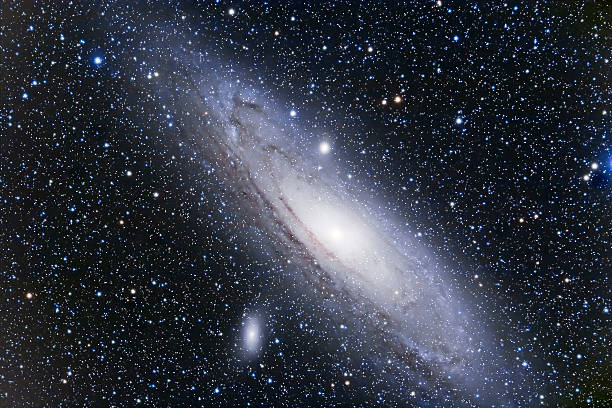
Our own Milky Way is on a collision course with the Andromeda Galaxy. In about four to five billion years, the two will begin a slow gravitational dance, ultimately merging into a new galaxy. Stars will be flung into new orbits. Gas clouds will collide and form new generations of stars. The night sky, if viewed from Earth—if Earth still exists—would transform dramatically.
Such events are not catastrophes in a cosmic sense. They are part of the ongoing evolution of structure. Galaxies grow by cannibalizing smaller companions, a process known as galactic accretion. Even now, the Milky Way is absorbing dwarf galaxies, leaving behind stellar streams as evidence.
Creation and destruction occur simultaneously. Old systems dissolve, and new configurations arise.
Star Formation and Feedback Loops
Within galaxies, star formation is both creative and destructive. When massive stars form, they emit intense ultraviolet radiation, ionizing surrounding gas. Their stellar winds carve cavities in molecular clouds. When they die as supernovae, they release shockwaves that can both trigger new star formation and disperse gas, halting further collapse.
This interplay creates feedback loops. Too much star formation can heat and expel gas, reducing future star formation. Too little may allow gas to accumulate until gravity reignites the process. Galaxies regulate themselves through these competing effects.
In starburst galaxies, often triggered by mergers, star formation rates can soar to hundreds of times that of the Milky Way. But such bursts are temporary. Gas is consumed or expelled, and the galaxy eventually settles into a quieter phase.
Over billions of years, galaxies evolve from gas-rich, actively star-forming systems to more quiescent, gas-poor ones. Some elliptical galaxies are “red and dead,” dominated by old stars with little ongoing star formation. Yet even in these quiet systems, the memory of past activity remains etched in stellar populations and chemical abundances.
Chemical Enrichment and Cosmic Recycling
The earliest galaxies contained only hydrogen and helium. All heavier elements—carbon, oxygen, nitrogen, iron—were forged in stars and distributed by stellar winds and supernova explosions. Each generation of stars enriched the interstellar medium with heavier elements.
This process, known as chemical enrichment, profoundly influences galaxy evolution. Metals enhance gas cooling, making star formation more efficient. They also enable the formation of dust grains and complex molecules.
Planets, including rocky worlds like Earth, require heavy elements. The existence of life depends on carbon, oxygen, nitrogen, and other elements created in stellar interiors. Galaxies are thus not only star factories but chemical factories, gradually increasing the complexity of the universe.
The gas expelled by dying stars may later collapse into new stars and planetary systems. The cycle continues. Matter is neither created nor destroyed in this process; it is rearranged, recycled, and transformed.
In this sense, galaxies are ecosystems, with birth, growth, decay, and renewal occurring across cosmic timescales.
Galaxy Clusters and the Largest Structures
Galaxies rarely exist alone. They gather into groups and clusters bound by gravity. Clusters can contain hundreds or even thousands of galaxies, embedded in vast halos of dark matter and filled with hot, X-ray-emitting gas.
Within clusters, galaxies interact frequently. Ram-pressure stripping can remove gas from galaxies as they move through the dense intracluster medium, quenching star formation. Gravitational interactions can trigger bursts of activity or reshape structures.
On even larger scales, clusters themselves are connected by filaments in the cosmic web. The universe’s structure resembles a sponge or a network of interconnected strands, with vast voids between them.
The formation of galaxies cannot be fully understood without considering this large-scale environment. The density of surrounding matter influences how quickly halos grow and how often mergers occur. The cosmic web is both the stage and the script for galactic evolution.
The Decline of Star Formation in the Universe
Observations indicate that the universe’s star formation rate peaked about 10 billion years ago and has been declining ever since. The reasons are complex. Gas supplies are gradually depleted. Some gas is heated by black hole activity or cluster environments, preventing cooling. The expansion of the universe stretches matter farther apart, reducing interactions that trigger star formation.
While new stars continue to form, especially in spiral galaxies, the era of frenetic galactic youth has passed. The cosmos is aging.
Yet decline does not mean stagnation. Galaxies continue to merge. Black holes continue to accrete. Stars continue to be born and to die. The cycle persists, though at a slower pace.
Far in the future—trillions of years from now—star formation will largely cease. Galaxies will fade as their stars exhaust their fuel. Black holes may dominate the cosmic landscape. The universe will enter a long, dim twilight.
But for now, it is still a place of light.
The Infinite Cycle of Cosmic Life and Destruction
Galaxies are not static monuments. They are dynamic, evolving systems shaped by gravity, gas dynamics, star formation, and feedback. They are born from the collapse of dark matter halos and gas. They grow through mergers and accretion. They transform through internal processes and external interactions. They recycle matter through stellar birth and death.
Destruction is not the opposite of creation in this story; it is part of it. When galaxies collide, old structures are dismantled, and new ones arise. When stars explode, they scatter the elements that will form future stars and planets. When black holes consume gas, they can regulate or suppress star formation, shaping the fate of entire galaxies.
From the smallest fluctuations in the early universe to the sprawling galaxy clusters we observe today, the formation of galaxies is an epic narrative of transformation. It is a testament to gravity’s patient power and to the subtle interplay of forces that govern the cosmos.
Every galaxy in the night sky is a chapter in this grand saga. Each contains billions or trillions of stars, each star a potential cradle of planets, perhaps even life. And all of them emerged from the same primordial simplicity—a nearly uniform sea of hydrogen and helium shaped by gravity and time.
To ask how galaxies form is to ask how the universe became structured, luminous, and complex. It is to trace the journey from darkness to starlight, from chaos to cosmic architecture. It is to recognize that we live within a vast and ongoing cycle—an infinite dance of life and destruction written across billions of years.
And somewhere, in a distant region of the cosmic web, gas is gathering once more. A dark matter halo deepens. Stars begin to ignite. A new galaxy is being born.