For generations, Mars has shimmered in the night sky as a symbol of possibility. It is close enough to feel reachable, yet distant enough to stir awe. Robotic explorers have rolled across its rust-colored plains. Orbiters have mapped its valleys and volcanoes. We know that ancient rivers once carved its surface, that glaciers may still sleep beneath its dust, and that its sunsets glow blue instead of red.
But sending robots is one thing. Living there is another.
Mars is not merely far away. It is cold, dry, irradiated, and nearly airless. It is a world that looks familiar from a distance but becomes alien the moment you stand upon it. If humanity hopes to build a permanent presence there—not just visit, but stay—we must overcome extraordinary challenges.
These are not small technical hurdles. They are fundamental obstacles posed by physics, biology, engineering, and human psychology. Below are twelve of the greatest challenges humans must overcome to live on Mars—and why each one tests the limits of our knowledge and ingenuity.
1. Surviving the Thin, Unbreathable Atmosphere
Mars has an atmosphere, but calling it breathable would be dangerously misleading. The Martian atmosphere is composed of about 95 percent carbon dioxide, with only trace amounts of oxygen. Even more critically, its surface pressure is less than one percent of Earth’s at sea level.
If a human stood unprotected on Mars, they would not suffocate in the dramatic way often portrayed in fiction. Instead, the low pressure would cause bodily fluids to begin boiling at normal body temperature in a process called ebullism. Oxygen in the bloodstream would drop rapidly. Within seconds, unconsciousness would follow.
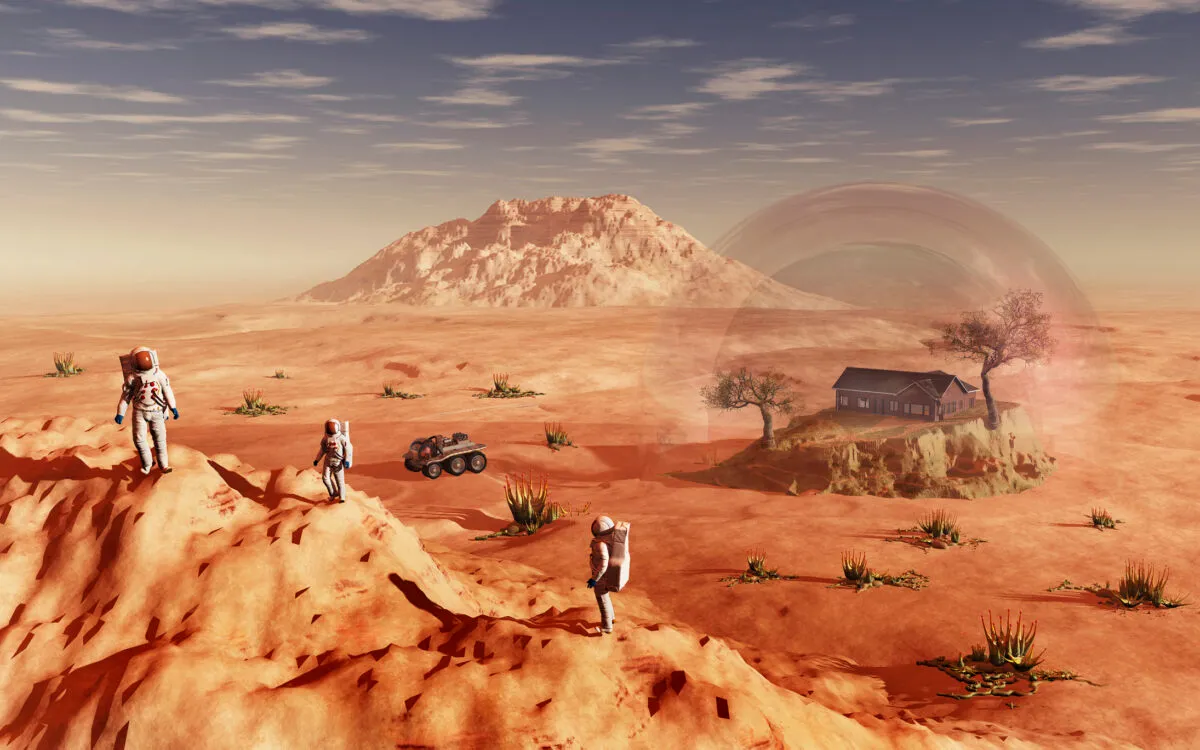
To live on Mars, humans must create and maintain pressurized environments that mimic Earth-like conditions. Habitats must withstand the constant pressure difference between the inside and the outside. Even a small leak could be catastrophic.
Producing oxygen locally is also essential. Transporting enough breathable air from Earth for long-term settlement is impractical. Technologies such as electrolysis of water and splitting carbon dioxide into oxygen and carbon monoxide must operate reliably for years.
Mars does not forgive mistakes. The atmosphere alone ensures that every breath on Mars must be engineered.
2. Shielding Against Deadly Radiation
Earth is protected by a thick atmosphere and a global magnetic field that deflects much of the Sun’s harmful radiation and cosmic rays from deep space. Mars has neither.
Its thin atmosphere provides minimal shielding. Its global magnetic field vanished billions of years ago. As a result, the Martian surface is constantly bombarded by high-energy particles from the Sun and from distant cosmic sources.
Long-term exposure to this radiation increases the risk of cancer, damages the central nervous system, and may impair cognitive function. Solar flares can deliver sudden bursts of radiation that are acutely dangerous.
Habitats on Mars will require substantial shielding. One proposed solution is to build living quarters underground or cover them with thick layers of Martian soil, known as regolith. Water tanks and specialized materials may also help absorb radiation.
Radiation is invisible and relentless. Protecting against it is not optional—it is fundamental to survival.
3. Conquering the Extreme Cold
Mars is cold. The average surface temperature hovers around minus 60 degrees Celsius, and nighttime temperatures near the poles can drop below minus 125 degrees Celsius.
This cold is not merely uncomfortable; it affects every aspect of survival. Equipment can fail. Materials become brittle. Energy demands skyrocket as habitats must maintain stable, livable temperatures.
Unlike Earth, Mars lacks a thick atmosphere to retain heat. Even near the equator, temperatures can fluctuate dramatically between day and night.
Settlers will need highly efficient insulation, reliable heating systems, and abundant energy sources. Nuclear power has been proposed as a stable energy supply, especially during dust storms when sunlight is blocked.
On Mars, warmth is life. Without constant thermal control, survival becomes impossible.
4. Generating Reliable Energy
Energy is the foundation of any settlement. It powers life-support systems, heating, water extraction, communication, and food production.
Solar panels are an obvious choice on Mars, but they come with challenges. Mars receives less sunlight than Earth because it is farther from the Sun. More critically, global dust storms can envelop the planet for weeks or even months, dramatically reducing sunlight.
The Opportunity rover famously lost power during such a storm.
Nuclear reactors offer a promising alternative, providing steady energy regardless of weather. However, transporting, operating, and maintaining nuclear systems on another planet involves immense engineering and safety challenges.
Energy storage systems must also handle the long Martian nights, which last roughly the same length as Earth nights but in harsher conditions.
Without reliable power, a Martian settlement would quickly fail. Energy is not merely a convenience—it is the backbone of life on Mars.
5. Securing Water for Life
Water is essential for drinking, growing food, producing oxygen, and manufacturing fuel. Fortunately, Mars is not entirely dry.
Water ice exists at the poles and beneath the surface in many regions. Some areas contain subsurface ice just a few centimeters below the ground. Extracting this ice will be crucial.
However, mining water in extreme cold, transporting it, purifying it, and recycling it efficiently presents significant logistical challenges.
Closed-loop water recycling systems, similar to those used on the International Space Station, will be essential. On Mars, nearly every drop must be reused.
Water is heavy to transport from Earth. A sustainable settlement must learn to harvest it locally.
6. Growing Food in Alien Soil
Humans cannot survive on packaged food indefinitely. A permanent settlement requires agriculture.
Martian soil contains essential elements like phosphorus and nitrogen, but it also contains perchlorates—chemicals that are toxic to humans. These must be removed or neutralized before soil can be used safely.
Greenhouses must be pressurized and heated. They must protect plants from radiation while providing adequate light. Hydroponic systems, which grow plants without soil, may prove more practical.
Mars’ lower gravity may affect plant growth in ways not yet fully understood. Pollination, nutrient cycling, and microbial interactions must all function reliably.
Food production is not simply about calories. It is about creating a self-sustaining ecosystem in a place that has never hosted life.
7. Coping with Reduced Gravity
Mars has about 38 percent of Earth’s gravity. While this is stronger than the microgravity experienced in orbit, it is significantly weaker than what the human body evolved to handle.
On the International Space Station, astronauts experience muscle loss, bone density reduction, and cardiovascular changes in microgravity. While Mars’ gravity may reduce these effects, we do not yet know how the human body responds to long-term living in partial gravity.
Will children born on Mars develop normally? Will bones and muscles adapt, or weaken over time? Will returning to Earth after years on Mars become physically impossible?
Artificial gravity through rotating habitats is theoretically possible but complex to implement on a planetary surface.
Reduced gravity is not merely a curiosity—it may fundamentally alter human physiology.
8. Managing Psychological Isolation
Mars is far away. At its closest, it is about 56 million kilometers from Earth. At its farthest, over 400 million kilometers.
Communication delays range from about 4 to 24 minutes one way, depending on planetary positions. Real-time conversations with Earth will be impossible.
Astronauts will live in confined spaces, surrounded by barren landscapes. The sky will not be blue. There will be no oceans, forests, or natural wildlife.
Psychological stress, loneliness, and interpersonal conflict could pose serious risks. Long-duration missions in isolated environments on Earth, such as Antarctica, provide valuable data—but Mars will amplify these conditions.
Building a healthy social structure, maintaining mental well-being, and fostering a sense of purpose will be as critical as engineering solutions.
Mars will test not only our technology, but our minds.
9. Protecting Against Martian Dust
Martian dust is fine, pervasive, and electrostatically charged. It clings to surfaces, infiltrates machinery, and may pose health risks if inhaled.
During global dust storms, the entire planet can be enveloped in a reddish haze. Reduced visibility and diminished solar power are immediate concerns.
Dust could degrade equipment, clog filters, and contaminate habitats. Designing systems resistant to dust intrusion is essential.
The Apollo missions revealed how problematic lunar dust could be. Martian dust may present similar or greater challenges.
In the quiet stillness of Mars, dust becomes an invisible adversary.
10. Achieving Sustainable Construction
Transporting building materials from Earth is prohibitively expensive. Martian settlers must learn to build using local resources.
Regolith-based construction, possibly using 3D printing technologies, is a promising approach. Structures may be built from compressed soil or sintered bricks formed by heating regolith.
Habitats must withstand pressure differences, radiation, micrometeoroid impacts, and thermal stress.
Sustainable construction on Mars requires mastering in-situ resource utilization—using what the planet provides.
Building a home on Mars is not about comfort alone. It is about engineering resilience into every wall.
11. Ensuring Medical Care Far from Earth
On Earth, serious medical emergencies can be treated in well-equipped hospitals. On Mars, evacuation to Earth would take months.
Medical facilities must be capable of handling trauma, illness, surgery, and even childbirth. Supplies will be limited. Equipment must function flawlessly.
Radiation exposure, reduced gravity, and isolation may create new medical challenges we do not yet fully understand.
Telemedicine will be hindered by communication delays. Martian settlers must be highly trained and largely self-reliant.
On Mars, healthcare becomes a matter of survival in the most literal sense.
12. Creating a Self-Sustaining Society
Perhaps the greatest challenge is not technical, but systemic. A Martian settlement cannot rely indefinitely on Earth for supplies.
To thrive, it must become self-sustaining—producing its own food, water, air, energy, and eventually manufacturing tools, spare parts, and advanced technologies.
Economic systems must develop. Governance structures must emerge. Ethical and legal questions will arise: Who owns Martian land? What laws apply?
A self-sustaining society requires diversity of skills, education, and long-term planning. It demands redundancy in critical systems.
Living on Mars is not about planting a flag. It is about building a civilization from scratch in one of the harshest environments imaginable.
The Long Road to Becoming Martians
Mars is not an impossible dream. Physics does not forbid human settlement there. The challenges are immense, but none violate known scientific principles.
Yet the gap between visiting and living is vast.
Every breath must be manufactured. Every drop of water must be captured and reused. Every structure must defy radiation and pressure. Every human body must adapt to alien gravity. Every mind must withstand profound isolation.
Mars will demand patience, creativity, and resilience. It will test our ability to cooperate, innovate, and endure.
And perhaps that is why the dream persists.
To live on Mars would be more than a technological achievement. It would be a declaration that life from Earth can extend beyond its birthplace. That humanity can become a multiplanetary species.
The red planet waits—cold, silent, and indifferent.
Whether we rise to meet its challenges will define one of the most extraordinary chapters in human history.