Fifty years ago, humans had just begun walking on the Moon. Computers filled rooms. The internet did not exist. Reusable rockets were science fiction. Private space companies were almost unimaginable. If someone in 1975 had predicted today’s world of orbital space stations, Mars rovers with high-definition cameras, reusable boosters landing upright on drone ships, and thousands of satellites forming global communication networks, many would have called it fantasy.
The next fifty years may be even more transformative.
Space travel is no longer a symbolic contest between superpowers. It is becoming an economic frontier, a scientific laboratory, and potentially a second home for humanity. The laws of physics will not change, but our engineering, materials science, computing, and biological understanding will continue to evolve rapidly.
Below are seven of the wildest—but scientifically plausible—predictions for how space travel could transform over the next half century. None violate known physics. All are rooted in technologies already under development or serious scientific consideration. Yet taken together, they paint a picture of a future that feels astonishing.
1. Permanent Human Cities on the Moon
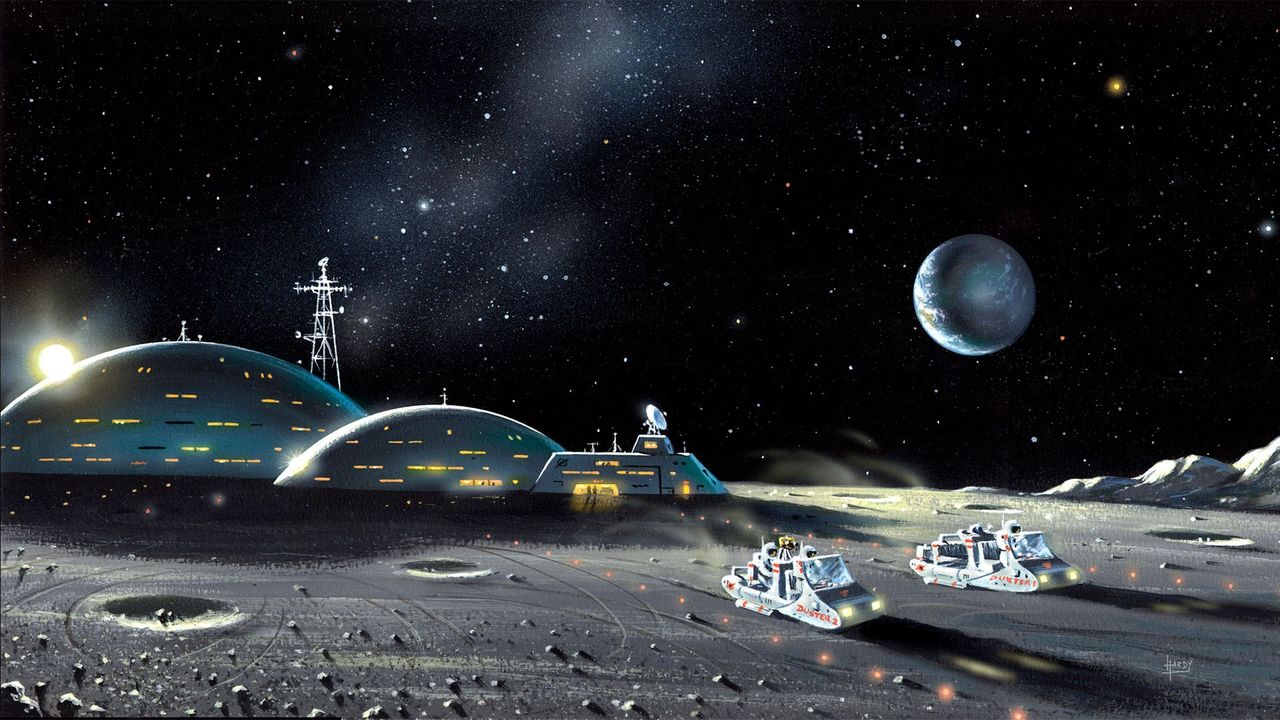
The Moon will likely transform from a destination into a settlement.
Humanity already understands how to reach the Moon. The challenge is not travel itself but sustainability. Over the next fifty years, permanent lunar bases could evolve into small but continuously inhabited settlements.
Water ice has been detected in permanently shadowed craters near the Moon’s poles. This is critical. Water can be used for drinking, growing food, producing oxygen, and splitting into hydrogen and oxygen for rocket fuel. A lunar base positioned near polar regions could access both near-continuous sunlight for power and nearby ice deposits.
The first lunar habitats will likely be modular and partially buried beneath regolith—the Moon’s dusty soil—to protect inhabitants from radiation and micrometeorites. Inflatable modules, rigid habitats, and underground lava tubes may all play a role. Radiation shielding is essential because the Moon lacks a thick atmosphere and global magnetic field.
Over time, in-situ resource utilization will become central. Instead of transporting every material from Earth, lunar regolith could be processed to extract oxygen, metals, and construction materials. 3D printing using lunar materials may enable the gradual expansion of infrastructure.
A permanent lunar presence would serve multiple purposes. Scientifically, it offers access to pristine geological records of early solar system history. Economically, it could support fuel depots for deeper space missions. Strategically, it establishes a stepping stone for Mars.
The most profound transformation, however, would be psychological. The Moon would no longer be a distant symbol in the night sky. It would become a lived-in extension of humanity.
2. Human Missions and Early Settlements on Mars
Within fifty years, humans will likely set foot on Mars. The first missions will be perilous, technologically demanding, and historically unforgettable.
Mars presents challenges far greater than the Moon. Travel time is measured in months, not days. Astronauts must endure prolonged exposure to microgravity and cosmic radiation. Communication delays range from several minutes to over twenty minutes one way.
Yet Mars also offers advantages. It has a day length similar to Earth’s, abundant water ice, carbon dioxide in its atmosphere for fuel production, and gravity stronger than the Moon’s—though still only about 38 percent of Earth’s.
Early missions will focus on survival technologies. Closed-loop life support systems will recycle water and air. Nuclear or advanced solar power systems will provide energy. Fuel production facilities may use the Martian atmosphere to create methane and oxygen for return trips.
Habitats may be constructed using local materials, possibly by robotic precursors before human arrival. Underground shelters or lava tubes could provide radiation protection.
If missions prove sustainable, early semi-permanent outposts may form. Over decades, these could expand into small settlements. Agriculture under pressurized domes, hydroponics, and controlled environment farming will be essential.
Mars colonization will not be easy. It will demand resilience, automation, and international collaboration. But if humanity commits to it, a second planetary home may become reality.
3. Fully Reusable, Rapid-Turnaround Spacecraft
In the next fifty years, space travel may become dramatically cheaper due to full reusability.
Reusable rockets already exist, but turnaround times and refurbishment costs remain significant. Future spacecraft may operate more like commercial aircraft, with rapid inspection, refueling, and relaunch capabilities.
Advances in materials science will play a key role. Heat-resistant composites, advanced thermal protection systems, and durable engines capable of many flights without major overhaul will reduce operational costs.
If launch costs drop by an order of magnitude or more, entirely new industries become viable. Massive space-based infrastructure, orbital construction, and large-scale exploration missions become economically feasible.
Reusability also enables large cargo capacity. Heavy-lift vehicles could deliver habitat modules, mining equipment, and scientific laboratories in bulk. Frequent launches support a steady flow of supplies and personnel.
Lower costs will not eliminate the challenges of space travel, but they will democratize access. Universities, private companies, and smaller nations may participate more actively in orbital and deep-space missions.
Space will shift from a rare expeditionary environment to a regular operational domain.
4. Rotating Space Stations That Simulate Gravity
One of the greatest obstacles to long-term human presence in space is microgravity. Prolonged weightlessness leads to bone density loss, muscle atrophy, fluid redistribution, and other health issues.
Within fifty years, rotating space habitats may provide artificial gravity through centripetal acceleration. The physics is straightforward: when a structure rotates, occupants experience a force pushing them outward, simulating gravity.
Early versions may consist of tethered spacecraft rotating around a common center of mass. Later designs could include large rotating rings or cylinders, similar to concepts proposed decades ago.
Artificial gravity reduces health risks and enables more Earth-like living conditions. It allows for conventional furniture, natural fluid behavior, and more sustainable agriculture.
These habitats may serve as research stations, manufacturing centers, or waypoints for deeper space missions. They could also become the first long-term orbital communities, where generations grow up never having lived on Earth’s surface.
Engineering challenges remain significant. Structural integrity, vibration control, and safe docking procedures must be mastered. But none of these violate known physical principles.
Artificial gravity habitats could redefine what it means to live in space.
5. Space-Based Manufacturing and Industry
Space is not only a destination; it is an environment with unique physical properties.
Microgravity allows for manufacturing processes impossible or difficult on Earth. Certain crystals, pharmaceuticals, fiber optics, and advanced materials may benefit from the absence of sedimentation and convection.
Over the next fifty years, specialized space-based manufacturing facilities may become economically viable. High-value, low-mass products could be produced in orbit and returned to Earth.
Asteroid mining is another possibility. Near-Earth asteroids contain metals such as iron, nickel, and potentially rare elements. Water extracted from asteroids could serve as fuel and life support for spacecraft.
Rather than transporting all resources from Earth, space industries may use local materials. This reduces launch mass and enables larger-scale infrastructure.
Robotic systems, autonomous mining operations, and AI-guided manufacturing will be essential. Human oversight may occur from orbital stations or Earth-based control centers.
If successful, space could become an industrial extension of Earth’s economy—producing materials, fuel, and components that support both terrestrial and extraterrestrial operations.
6. Nuclear and Advanced Propulsion Systems
Chemical rockets are powerful but limited. Their efficiency, measured as specific impulse, constrains mission duration and payload capacity.
Within fifty years, nuclear propulsion may become operational for deep-space missions. Nuclear thermal rockets, which heat propellant using a nuclear reactor, can provide higher efficiency than chemical systems. This reduces travel time to Mars and beyond.
Nuclear electric propulsion systems, generating electricity for ion engines, could operate continuously for long durations, enabling efficient cargo transport across the solar system.
Ion drives already exist and have powered robotic missions. Future versions with higher power output may support crewed missions, though typically for cargo and long-haul transport rather than rapid travel.
More speculative concepts, such as fusion propulsion or antimatter catalysis, remain technologically distant but are not forbidden by physics. Significant breakthroughs would be required.
Faster propulsion systems reduce radiation exposure and mission risk. They expand the reachable volume of the solar system within practical timeframes.
Travel to the outer planets—once the domain of multi-decade robotic missions—may become achievable within human career timescales.
7. The First Steps Toward Interstellar Probes
Human travel to another star within fifty years is extraordinarily unlikely given current physics. The distances are immense. Even the nearest star system is over four light-years away.
However, robotic interstellar probes may begin their journeys within this timeframe.
Concepts involving light sails propelled by powerful ground-based lasers have been proposed. By accelerating ultra-light spacecraft to a significant fraction of the speed of light, travel times to nearby stars could be reduced to decades.
Miniaturization of electronics, advances in materials, and autonomous AI navigation make such missions increasingly plausible. These probes would not carry humans, but they could transmit data back to Earth.
Interstellar probes would mark a historic milestone. For the first time, humanity would extend its physical reach beyond the solar system.
Even if data return takes years, the symbolic significance would be profound. We would no longer be confined to one star.
A Future Both Bold and Fragile
These predictions are ambitious. They depend on sustained funding, international cooperation, technological progress, and political stability. They also depend on humanity’s willingness to accept risk.
Space travel is not easy. It is unforgiving. Radiation, vacuum, extreme temperatures, and mechanical failure remain constant threats.
Yet the trajectory of progress suggests that the next fifty years will bring transformations as dramatic as those of the past half century.
Children born today may grow up seeing live broadcasts from lunar cities. They may view Mars as a reachable destination rather than a distant dream. They may witness the launch of humanity’s first interstellar messenger.
The laws of physics set boundaries. We cannot exceed the speed of light. We cannot ignore radiation or gravity. But within those boundaries lies enormous possibility.
The future of space travel will not be defined by fantasy warp drives or physics-defying shortcuts. It will be defined by persistence, engineering brilliance, and a refusal to remain confined to one world.
Fifty years from now, when people look up at the night sky, they may not just see distant lights. They may see destinations, industries, and homes.
And perhaps, for the first time in history, humanity will truly begin to live among the stars.