When people look up at the sky just after sunset or shortly before sunrise, they often notice an incredibly bright object shining near the horizon. Many assume it is a star. In reality, it is a planet—one of the most fascinating and mysterious worlds in our solar system.
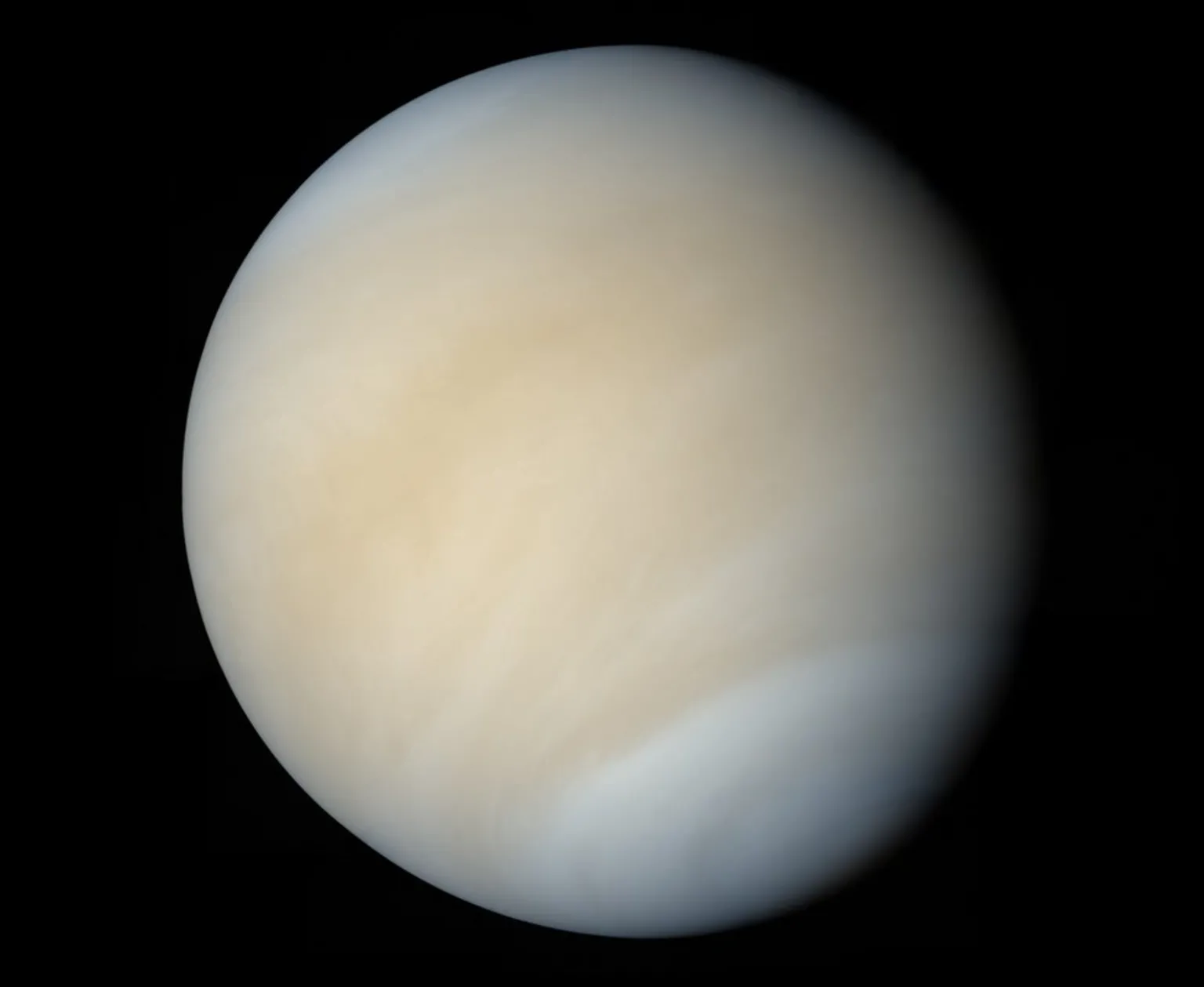
That glowing object is Venus.
For thousands of years, Venus has captured the attention of astronomers, poets, and skywatchers. Because of its dazzling brightness, ancient civilizations often treated it as something magical. Some early cultures even believed the bright object seen in the evening sky and the one seen in the morning sky were two different celestial bodies.
Today we know that both are the same planet. Venus is our closest planetary neighbor and one of the most extreme environments in the solar system. Despite being similar in size to Earth, it is a world of crushing pressure, suffocating atmosphere, and temperatures hot enough to melt metal.
Yet the story of Venus is not just about heat and clouds. It is a planet full of astonishing mysteries that challenge our understanding of planetary evolution.
The following ten facts reveal why Venus is far more extraordinary than its serene appearance in the sky might suggest.
1. Venus Is the Hottest Planet in the Solar System
Many people assume that the hottest planet must be the one closest to the Sun. By that logic, the title should belong to Mercury.
Surprisingly, it does not.
Venus holds the record as the hottest planet in the entire solar system, with average surface temperatures around 465 degrees Celsius. That is hot enough to melt lead.
The reason lies in Venus’s thick atmosphere. The planet is surrounded by an extremely dense blanket of carbon dioxide that traps heat through an intense greenhouse effect. Sunlight enters the atmosphere and warms the surface, but the heat cannot escape back into space efficiently.
Over millions of years this process caused Venus to heat up dramatically, creating a runaway greenhouse effect. The result is a planetary furnace where temperatures remain extremely high day and night.
Even though Mercury is closer to the Sun, it lacks a thick atmosphere, so heat escapes easily. Venus, on the other hand, traps heat like a cosmic oven.
This makes Venus a powerful reminder of how planetary atmospheres can dramatically influence climate.
2. A Day on Venus Is Longer Than a Year
One of the strangest facts about Venus involves the way it rotates.
On Earth, a day lasts 24 hours, while a year takes 365 days. On Venus, the relationship between these two measures is completely different.
Venus rotates incredibly slowly. It takes about 243 Earth days for the planet to complete one full rotation on its axis. However, it takes only about 225 Earth days to complete one orbit around the Sun.
This means a single day on Venus is longer than an entire year there.
If someone could stand on the surface of Venus and watch the sky, the Sun would take longer to rise and set than it takes the planet to circle the Sun once.
This unusual rotation adds another layer of mystery to Venus and continues to puzzle scientists who study planetary dynamics.
3. Venus Rotates Backward
Most planets in the solar system rotate in the same direction. If viewed from above the Sun’s north pole, they spin counterclockwise.
Venus breaks that pattern.
It rotates in the opposite direction, a motion known as retrograde rotation. This means that if you stood on the surface of Venus, the Sun would appear to rise in the west and set in the east.
This backward spin is one of the most unusual characteristics of the planet.
Scientists believe this rotation may have been caused by a massive collision early in the planet’s history or by long-term gravitational interactions with the Sun and its thick atmosphere.
Whatever the cause, Venus remains one of the few planets with this reversed rotation, making its day-night cycle unlike anything on Earth.
4. Venus Has Crushing Surface Pressure
The surface of Venus is not just hot—it is also under enormous pressure.
The atmosphere of Venus is extremely thick and heavy. At the planet’s surface, the atmospheric pressure is about 90 times greater than the pressure at sea level on Earth.
To understand how intense that is, imagine being nearly one kilometer underwater in Earth’s oceans.
Any spacecraft attempting to land on Venus must be specially designed to withstand this crushing pressure along with the extreme heat. Many early missions sent to Venus survived only a short time before being destroyed by the harsh environment.
The combination of temperature and pressure makes Venus one of the most hostile places in the solar system.
5. Venus Is Covered in Thick Clouds of Acid
When people imagine clouds, they usually think of water droplets floating in the atmosphere. On Venus, the situation is dramatically different.
The planet is wrapped in thick clouds composed primarily of sulfuric acid.
These clouds reflect a large portion of sunlight, which is why Venus appears so bright in the night sky. The reflective clouds act like a giant mirror, bouncing sunlight back toward Earth.
However, beneath this bright exterior lies an extremely hostile environment. The acidic clouds form part of the planet’s dense atmosphere and contribute to the greenhouse effect that traps heat near the surface.
From space, Venus looks smooth and beautiful. But hidden beneath those clouds is a volcanic world that is anything but peaceful.
6. Venus Has Vast Volcanic Landscapes
Because Venus is permanently covered by thick clouds, astronomers cannot see its surface with ordinary optical telescopes.
To reveal the planet’s hidden terrain, scientists used radar imaging from spacecraft missions. These radar observations showed that Venus is dominated by volcanic landscapes.
The planet contains enormous lava plains, towering volcanic mountains, and massive shield volcanoes.
One of the largest volcanoes is Maat Mons, which rises several kilometers above the surrounding terrain.
Evidence suggests that volcanic activity may still occur on Venus today. Some measurements indicate changes in atmospheric gases that could be linked to recent eruptions.
If this is true, Venus may be a geologically active world even now.
7. Venus May Once Have Had Oceans
Although Venus is currently a scorching desert world, some scientists believe it may once have been far more Earth-like.
Early in its history, Venus may have had moderate temperatures and possibly even liquid water on its surface. Under those conditions, the planet could have hosted shallow oceans.
However, as the Sun gradually brightened and the greenhouse effect intensified, water vapor accumulated in the atmosphere. Water vapor is itself a powerful greenhouse gas, which accelerated the warming process.
Eventually the oceans may have evaporated entirely, leaving the planet trapped in a runaway greenhouse state.
If this scenario is correct, Venus could represent a cautionary example of how planetary climates can evolve dramatically over time.
8. Venus Has No Moons
Many planets in the solar system have moons orbiting them. Earth has one natural satellite, while Mars has two small moons.
The giant planets have dozens.
Venus, however, has none.
The reason for this remains uncertain. One possibility is that gravitational interactions with the Sun prevent stable moon orbits close to the planet. Another theory suggests that Venus may once have had a moon that eventually collided with the planet or escaped its gravitational pull.
Whatever the explanation, Venus remains one of only two planets in the solar system without natural moons, the other being Mercury.
This absence makes Venus slightly unusual among planetary bodies.
9. Venus Is the Brightest Planet in the Night Sky
Despite its hostile environment, Venus is one of the most beautiful sights visible from Earth.
Because it is relatively close to our planet and covered with highly reflective clouds, Venus shines brighter than any other planet in the night sky.
At times it becomes so bright that it can even cast faint shadows under very dark conditions.
Venus appears either shortly after sunset or before sunrise because its orbit lies inside Earth’s orbit around the Sun. For this reason, it never travels far across the sky like planets such as Jupiter or Saturn.
When seen after sunset, Venus is often called the Evening Star. When visible before sunrise, it is known as the Morning Star.
These appearances have fascinated skywatchers for thousands of years.
10. Venus Could Help Us Understand Earth’s Future
Perhaps the most important reason scientists study Venus is not just to understand that planet itself, but to learn more about Earth.
Venus and Earth are often called sister planets because they are similar in size, mass, and composition. Yet their environments are dramatically different.
Earth supports oceans, weather systems, and life. Venus is a scorching world of toxic clouds and crushing pressure.
Understanding why these two planets evolved so differently could provide critical insight into climate systems and planetary habitability.
By studying Venus, scientists can better understand how greenhouse gases influence planetary temperatures and how delicate the balance of a planet’s climate can be.
In a way, Venus offers a glimpse of what might happen when atmospheric processes spiral out of control.
Venus and the Human Imagination
For most of human history, Venus was simply a mysterious bright light in the sky. Ancient civilizations associated it with gods, love, beauty, and mythology.
Only in the modern era have spacecraft begun to reveal its true nature.
Probes from the former Soviet space program, especially the Venera program, successfully landed on Venus and transmitted images from the surface before being destroyed by the harsh conditions.
These missions provided humanity’s first glimpses of the planet’s rocky terrain.
Today, new missions are being planned to explore Venus again. Scientists hope to study its atmosphere, surface chemistry, and geological activity in greater detail.
Each new discovery brings us closer to understanding this mysterious world.
Seeing Venus with New Eyes
The next time you see a brilliant point of light glowing in the evening or morning sky, it may be Venus.
At first glance it appears calm and beautiful, like a peaceful star shining quietly above the horizon.
But behind that bright glow lies one of the most extreme worlds in the solar system.
It is a planet where temperatures melt metal, clouds rain acid, and atmospheric pressure crushes anything that dares to land there.
Yet Venus is also a world that may hold clues about the past and future of planetary climates—including our own.
Understanding Venus reminds us that planets can change dramatically over time, shaped by delicate balances of atmosphere, sunlight, and geological activity.
So when you look up and see that bright light in the sky, remember that it is not just another star.
It is a powerful reminder that even our closest neighbors in space can hold astonishing secrets waiting to be discovered.