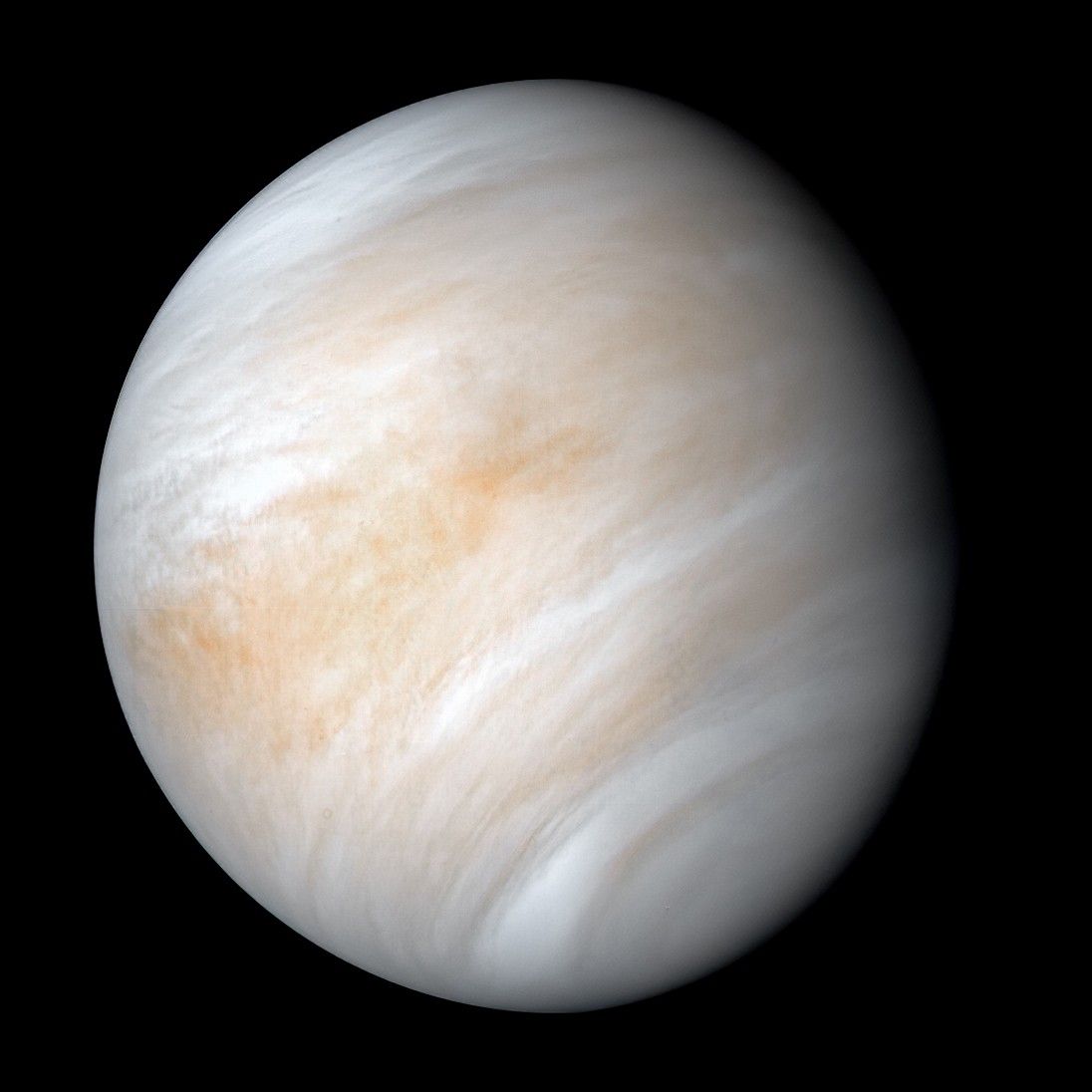
For centuries, the planet Venus has fascinated humanity. Shining brilliantly in the morning or evening sky, it has long been known as one of the most luminous objects visible from Earth. Ancient civilizations across the world watched its appearance and disappearance with wonder, giving it names and weaving it into mythology. Yet beneath its beauty lies one of the most hostile environments in the solar system.
Venus is often called Earth’s “sister planet” because of its similar size, mass, and composition. Early astronomers once imagined that Venus might be covered with oceans, jungles, or perhaps even advanced civilizations hidden beneath thick clouds. Before space exploration, the clouds that permanently cover Venus concealed its surface entirely, leaving scientists to speculate about what might lie below.
The truth turned out to be far more extreme than anyone expected. When spacecraft finally reached Venus during the twentieth century, they revealed a world of crushing pressure, scorching heat, and toxic atmospheric chemistry. The surface temperature is hot enough to melt lead, and the atmospheric pressure is comparable to being nearly a kilometer underwater on Earth.
For decades, Venus seemed to represent the ultimate dead planet.
Yet in recent years, a surprising possibility has emerged. Some scientists now believe that if life exists on Venus, it may not be on the surface at all. Instead, it might be hidden high in the planet’s clouds, floating within layers of atmosphere where conditions are far less extreme.
This idea, once considered unlikely, has grown into one of the most intriguing mysteries in planetary science.
The Harsh Reality of Venus
To understand why scientists are searching for life in the clouds of Venus, it is necessary first to understand how hostile the planet’s surface truly is.
Venus is the second planet from the Sun, orbiting slightly closer to the star than Earth. At first glance, the difference in distance might not seem dramatic. However, the consequences are profound. Venus receives significantly more solar radiation, and its atmosphere traps heat with extraordinary efficiency.
The planet’s atmosphere is composed primarily of carbon dioxide, with thick layers of sulfuric acid clouds covering the sky. These clouds reflect sunlight strongly, which is why Venus appears so bright from Earth. But beneath them, the atmosphere becomes extremely dense.
The greenhouse effect on Venus is far more intense than anything experienced on Earth. Heat absorbed by the atmosphere cannot escape efficiently, causing temperatures to rise to extraordinary levels. Surface temperatures average around 465 degrees Celsius, hotter than Mercury even though Mercury is closer to the Sun.
The pressure at the surface is also extreme. Venus’s atmosphere is roughly ninety times denser than Earth’s at sea level. Any spacecraft landing on Venus must survive conditions similar to those found deep beneath Earth’s oceans.
These conditions make the survival of life as we know it nearly impossible at the surface.
The crushing pressure, extreme heat, and corrosive chemistry would destroy most known biological molecules. For decades, scientists therefore assumed that Venus could not host life in any form.
But the story becomes more complicated when we look higher in the atmosphere.
A Surprisingly Mild Layer in the Atmosphere
Although the surface of Venus is extraordinarily hostile, the conditions change dramatically with altitude. Roughly fifty to sixty kilometers above the surface, the environment becomes much more temperate.
In this region of the atmosphere, temperatures range from approximately 20 to 60 degrees Celsius. The atmospheric pressure is also comparable to that found at Earth’s surface.
In other words, if one could float within this layer of clouds, the temperature and pressure would not be dramatically different from conditions on our own planet.
This discovery immediately sparked scientific curiosity. If life could somehow exist in Venus’s atmosphere, the cloud layer would be the most promising place to look.
The concept of life living in planetary atmospheres is not purely speculative. On Earth, microorganisms can be found floating in the air at high altitudes. Some bacteria have been detected several kilometers above the ground, surviving within airborne particles or droplets of water.
These organisms are capable of enduring intense ultraviolet radiation, cold temperatures, and limited nutrients. Their existence suggests that microbial life can adapt to extreme environments.
If microbes can survive in Earth’s atmosphere, some scientists began to wonder whether similar organisms might survive in the cloud layers of Venus.
Early Scientific Speculation
The idea that Venus’s atmosphere might support life is not entirely new. In the 1960s, scientists including Carl Sagan proposed that microbial organisms might float within Venus’s clouds.
At that time, knowledge of Venus was limited. Scientists knew that the planet had thick clouds but did not yet fully understand the surface conditions. Sagan suggested that microorganisms might exist as airborne life forms, drifting through the atmosphere and possibly absorbing energy from sunlight.
As more spacecraft explored Venus, the extreme nature of the planet became clear. Missions conducted by the NASA and the Soviet space program revealed the intense heat and pressure at the surface, making surface life highly improbable.
However, the idea of atmospheric life never completely disappeared.
Researchers continued to investigate whether Venus’s clouds might contain chemical signatures that could hint at biological processes.
For many years, the evidence remained uncertain.
That changed dramatically in 2020.
The Phosphine Discovery
In 2020, an international team of astronomers announced a discovery that captured global attention. Using powerful telescopes, they reported detecting traces of a chemical called phosphine in the atmosphere of Venus.
Phosphine is a molecule composed of one phosphorus atom and three hydrogen atoms. On Earth, phosphine is associated primarily with biological activity or industrial processes.
The research involved observations made with the James Clerk Maxwell Telescope in Hawaii and the Atacama Large Millimeter/submillimeter Array in Chile. The team reported that they had detected spectral signals consistent with phosphine gas in the Venusian atmosphere.
The study was led by astronomer Jane Greaves, whose team carefully analyzed the spectral data to confirm the presence of the molecule.
The discovery immediately sparked intense debate.
On Earth, phosphine is produced by certain types of anaerobic microorganisms living in environments with little oxygen. These microbes generate phosphine as a metabolic byproduct.
Phosphine can also form through industrial chemistry or extremely high-energy processes. However, known natural mechanisms that produce phosphine typically occur in environments very different from Venus’s atmosphere.
If the detection were correct, scientists needed to explain how phosphine could form there.
One possibility was biological activity.
Why Phosphine Matters
Phosphine is considered a potential biosignature gas. A biosignature is a chemical substance that could indicate the presence of life.
The concept of biosignatures plays an important role in the search for extraterrestrial life. Scientists studying distant planets often analyze atmospheric chemistry to determine whether certain molecules might be produced by living organisms.
On Earth, phosphine appears primarily in oxygen-poor environments where microbes break down organic material.
Producing phosphine through purely chemical processes is difficult under ordinary planetary conditions. This is why its potential detection on Venus generated so much excitement.
The reported concentration of phosphine suggested that something in Venus’s atmosphere might be actively producing the molecule.
Scientists immediately began exploring possible explanations.
Some researchers investigated whether unknown chemical reactions involving sunlight, volcanic activity, or lightning could produce phosphine. Others considered the possibility that the signal might have been misinterpreted or caused by different molecules.
The scientific debate continues today.
Regardless of the outcome, the phosphine discovery reignited global interest in Venus as a possible location for life.
The Chemistry of the Venusian Clouds
The clouds of Venus are composed primarily of sulfuric acid droplets. This presents one of the most significant challenges to the idea of life in the atmosphere.
Sulfuric acid is highly corrosive and destructive to many biological molecules. If life exists in the Venusian clouds, it would need extraordinary adaptations to survive in such an environment.
However, extremophiles on Earth demonstrate that life can adapt to remarkably harsh conditions.
Some microorganisms can survive in extremely acidic environments such as volcanic hot springs and acidic lakes. These organisms possess biochemical mechanisms that protect their internal structures from corrosive surroundings.
Researchers have proposed that hypothetical Venusian microbes might live inside microscopic droplets within the clouds. These droplets could potentially contain small amounts of water mixed with sulfuric acid.
Within these droplets, microbial life might carry out chemical reactions to obtain energy.
Sunlight penetrating the upper atmosphere could provide energy for photosynthesis-like processes. Alternatively, microbes might rely on chemical reactions involving sulfur compounds present in the clouds.
While these ideas remain speculative, they demonstrate that life might find ways to survive even in environments that initially appear hostile.
The Mysterious Dark Patches
Another intriguing observation about Venus involves the appearance of dark patches within its cloud layers.
When Venus is observed in ultraviolet light, certain regions of the atmosphere appear darker than others. These dark streaks and patches absorb ultraviolet radiation strongly.
Scientists have long debated what causes these mysterious features.
One possibility is that the dark material consists of unknown chemical compounds suspended in the clouds. However, some researchers have suggested a more surprising explanation.
If microbial life existed in the clouds, colonies of microorganisms might absorb ultraviolet light, creating darker regions visible from space.
This idea remains controversial and unproven. Yet the unexplained ultraviolet absorption in Venus’s clouds continues to puzzle scientists.
Understanding these dark patches could provide valuable clues about the chemistry of the atmosphere.
Missions That Explored Venus
Throughout the twentieth century, numerous spacecraft explored Venus and revealed its extreme environment.
The Soviet Union launched several missions as part of the Venera program, successfully landing spacecraft on the surface. These missions transmitted the first images of Venus’s rocky landscape before being destroyed by the intense conditions.
Later missions, such as the Magellan spacecraft operated by NASA, used radar mapping to reveal the planet’s surface beneath its thick clouds.
More recently, the Akatsuki spacecraft launched by Japan Aerospace Exploration Agency has been studying Venus’s atmosphere and weather patterns.
These missions have greatly expanded scientific knowledge of the planet, but none were specifically designed to search for life in the clouds.
That may soon change.
New Missions and Future Exploration
The renewed interest in Venus has inspired new plans for exploration.
Several upcoming missions aim to study the planet’s atmosphere in greater detail. These missions will investigate chemical composition, atmospheric dynamics, and cloud structure.
One planned mission from NASA is DAVINCI mission, which will send a probe through Venus’s atmosphere to measure gases and analyze cloud chemistry during descent.
Another mission, called VERITAS mission, will map the surface of Venus with high-resolution radar to understand the planet’s geological history.
The European Space Agency is also planning a mission known as EnVision mission to study Venus’s atmosphere and interior structure.
Some scientists have even proposed specialized missions designed specifically to search for microbial life within the clouds. These missions could involve balloons or floating platforms that remain within the temperate atmospheric layers.
Such platforms could collect cloud particles and analyze them for organic molecules or microscopic life forms.
The possibility of discovering life so close to Earth would represent one of the most profound scientific discoveries in human history.
Rethinking Habitability
The Venus mystery has forced scientists to rethink the concept of planetary habitability.
For many years, the search for life beyond Earth focused primarily on planets with Earth-like surfaces and oceans. Venus was largely dismissed because of its extreme environment.
However, the idea of atmospheric life suggests that habitable environments may exist in unexpected places.
Some gas giant planets in other star systems may possess cloud layers with temperatures and pressures suitable for life. Even planets that appear hostile at the surface might host habitable regions in their atmospheres.
By studying Venus, scientists can learn how life might adapt to unusual environments across the universe.
Venus becomes not just a neighboring planet but a laboratory for understanding the possibilities of life itself.
The Scientific Debate
Despite the excitement surrounding the phosphine detection and the possibility of atmospheric life, many scientists remain cautious.
Some studies have suggested that the phosphine signal may have been overestimated or misinterpreted. Other researchers argue that unknown chemical processes could produce phosphine without involving biology.
Scientific progress often involves disagreement and careful testing of evidence.
Researchers continue to analyze new observations, refine models of Venus’s atmosphere, and search for alternative explanations.
Whether or not phosphine truly exists in Venus’s clouds, the debate has revitalized interest in exploring the planet.
It reminds us that science advances through questioning, skepticism, and investigation.
The Larger Meaning of the Venus Mystery
The mystery of Venus’s clouds represents something larger than a single scientific question.
It reflects humanity’s enduring curiosity about life beyond Earth.
For centuries, people have wondered whether life exists elsewhere in the universe. Discovering even microscopic organisms on another world would profoundly change our understanding of biology and our place in the cosmos.
Venus offers a tantalizing possibility. It is close enough for detailed exploration, yet mysterious enough to surprise us.
The idea that life might float in its clouds challenges our assumptions about where life can exist.
It suggests that the universe may be far more creative than we imagined.
A Planet Waiting for Answers
Today, Venus remains one of the most enigmatic worlds in the solar system.
Its thick clouds continue to hide secrets that scientists are only beginning to explore. The possibility that microbial life might inhabit those clouds remains uncertain, but the question itself has opened a new chapter in planetary science.
Future missions, improved telescopes, and deeper scientific investigation will gradually reveal the truth.
Perhaps the clouds of Venus contain nothing more than unusual chemistry shaped by a harsh planetary environment.
Or perhaps, hidden within those swirling yellow clouds, tiny living organisms drift silently through the atmosphere of Earth’s nearest planetary neighbor.
Until we explore those clouds directly, the mystery of Venus will continue to inspire curiosity, debate, and wonder.