Among all the planets orbiting our Sun, none commands attention quite like Jupiter. It is a world of staggering scale and breathtaking power—a swirling giant composed mostly of gas, crowned with colorful clouds, immense storms, and powerful magnetic forces. Even from the immense distance of hundreds of millions of kilometers, Jupiter dominates the night sky as one of the brightest objects visible to the naked eye.
For centuries, astronomers and sky-watchers have marveled at Jupiter’s brilliance. When early telescopes revealed its striped cloud bands and four large moons, the planet instantly became one of the most fascinating objects in the solar system. The discoveries made by Galileo Galilei in the early 17th century—when he observed four moons orbiting Jupiter—helped reshape humanity’s understanding of the universe.
But despite centuries of study, Jupiter still holds many secrets. Modern spacecraft, telescopes, and scientific models have revealed astonishing details about this colossal planet. The more we learn about Jupiter, the more it challenges our expectations about how planets behave and how planetary systems form.
The following ten facts reveal just how extraordinary Jupiter truly is. Each one expands our understanding of space and reminds us that the universe is far stranger—and far more magnificent—than we once imagined.
1. Jupiter Is So Massive It Almost Became a Star
Jupiter is by far the largest planet in the solar system. Its size and mass are so enormous that it nearly qualifies as a failed star.
The planet contains more than twice the mass of all the other planets in the solar system combined. If you gathered every planet—Mercury, Venus, Earth, Mars, Saturn, Uranus, and Neptune—and added them together, Jupiter would still outweigh them all.
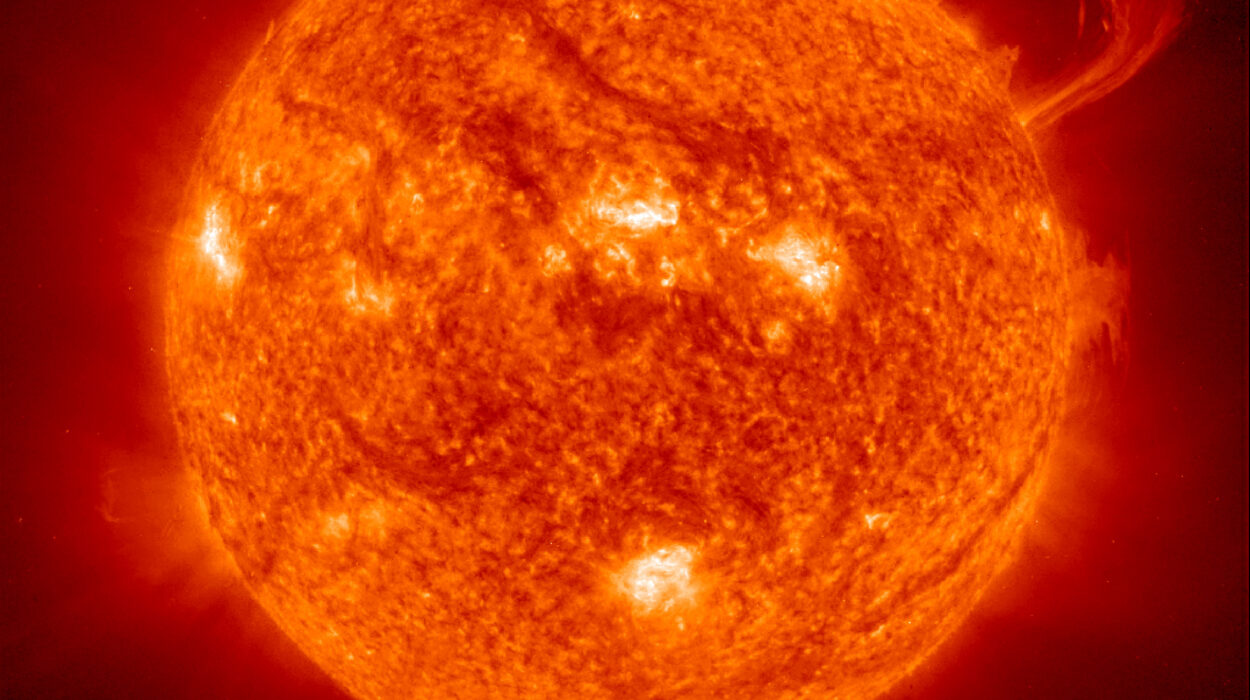
Yet despite its immense size, Jupiter is still far too small to ignite nuclear fusion, the process that powers stars. To become a true star like the Sun, Jupiter would need roughly eighty times its current mass.
Because of this, astronomers sometimes describe Jupiter as a “failed star.” During the early formation of the solar system, enormous clouds of gas and dust collapsed under gravity. While the central region formed the Sun, surrounding material formed planets. Jupiter accumulated a huge amount of gas but not quite enough to trigger stellar fusion.
Even though it never became a star, Jupiter’s enormous gravitational influence shaped the structure of the solar system in profound ways.
2. The Great Red Spot Is a Storm Bigger Than Earth
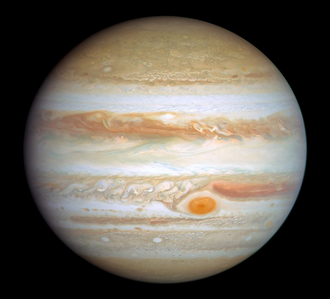
One of Jupiter’s most famous features is the massive storm known as the Great Red Spot.
This storm has been raging for centuries. Astronomers first recorded observations of it in the 1600s, and it has persisted ever since. That means this single storm has lasted far longer than any hurricane or cyclone on Earth.
The scale of the Great Red Spot is astonishing. At times in history, the storm has been large enough to swallow two or three Earth-sized planets. Even though it has slowly been shrinking in recent decades, it still remains larger than our entire world.
Wind speeds within the storm exceed 400 kilometers per hour. These powerful winds swirl around a giant oval-shaped vortex in Jupiter’s atmosphere.
Scientists still debate exactly why the storm has survived for so long. Jupiter’s atmosphere lacks solid surfaces that might weaken storms, allowing them to persist much longer than storms on Earth.
The Great Red Spot is a reminder that Jupiter’s atmosphere operates on a scale far beyond anything we experience on our planet.
3. Jupiter Has the Shortest Day of Any Planet
Despite its enormous size, Jupiter spins incredibly fast.
One full rotation of Jupiter takes only about ten hours. This means a day on Jupiter is less than half the length of a day on Earth.
The rapid rotation creates dramatic effects in the planet’s atmosphere. The spinning motion causes powerful jet streams that separate Jupiter’s atmosphere into colorful bands of clouds. These bands form the striped appearance that is visible even through small telescopes.
The fast rotation also causes Jupiter to bulge outward at its equator. Instead of being perfectly spherical, the planet is slightly flattened at the poles and wider at the middle.
This combination of immense size and rapid rotation produces one of the most dynamic atmospheres in the solar system.
4. Jupiter’s Magnetic Field Is Incredibly Powerful
Jupiter possesses the strongest planetary magnetic field in the solar system.
This magnetic field is generated deep within the planet by the movement of electrically conducting materials in its interior. Unlike Earth, where the magnetic field is created by molten iron in the core, Jupiter’s magnetic field arises from metallic hydrogen—an exotic form of hydrogen that behaves like a liquid metal under immense pressure.
The magnetic field surrounding Jupiter forms a vast region known as a magnetosphere. This magnetosphere extends millions of kilometers into space, making it the largest structure associated with any planet.
If Jupiter’s magnetosphere were visible from Earth, it would appear larger than the Moon in our sky.
Within this region, charged particles become trapped and accelerated, producing intense radiation belts that can damage spacecraft electronics.
The immense strength of Jupiter’s magnetic field shows how unusual and extreme the planet’s internal conditions truly are.
5. Jupiter Acts as a Cosmic Shield for the Inner Solar System
Jupiter’s enormous gravity plays a crucial role in protecting the inner planets.
Because of its massive size, Jupiter acts as a gravitational barrier that influences the paths of comets and asteroids traveling through the solar system.
Many objects that might otherwise cross Earth’s orbit are instead pulled toward Jupiter or deflected into different trajectories. In some cases, Jupiter captures these objects or ejects them entirely from the solar system.
One dramatic example occurred in 1994 when the comet Shoemaker–Levy 9 collided with Jupiter. The comet had been torn apart by Jupiter’s gravity before striking the planet in a series of enormous impacts.
These impacts produced explosions larger than many nuclear weapons, leaving dark scars in Jupiter’s atmosphere visible from Earth.
Events like this demonstrate how Jupiter absorbs cosmic debris that might otherwise threaten smaller planets.
In this way, Jupiter may have played an important role in making Earth a safer environment for life.
6. Jupiter Is Mostly Made of Hydrogen and Helium
Although Jupiter is called a planet, its composition resembles that of a star.
The planet is made primarily of hydrogen and helium—the same elements that dominate the Sun. Unlike rocky planets such as Earth or Mars, Jupiter does not have a solid surface where someone could stand.
Instead, its atmosphere gradually transitions into deeper and deeper layers of gas and fluid under increasing pressure.
As one descends through Jupiter’s atmosphere, the pressure and temperature rise dramatically. Eventually hydrogen gas becomes compressed into liquid form, and at even greater depths it transforms into metallic hydrogen.
This exotic state of matter conducts electricity and is believed to play a key role in generating Jupiter’s magnetic field.
The deeper one goes into Jupiter, the more alien the environment becomes.
7. Jupiter Has Dozens of Moons
Jupiter is surrounded by a vast family of moons.
More than ninety moons are known to orbit the planet, ranging from tiny irregular rocks to large worlds with complex geology.
The four largest moons—known as the Galilean moons—were discovered by Galileo Galilei in 1610. These moons are Io, Europa, Ganymede, and Callisto.
Each of these moons is remarkable in its own way.
Io is the most volcanically active world in the solar system, constantly reshaped by eruptions driven by gravitational forces.
Europa is covered by a thick shell of ice beneath which scientists believe a global ocean may exist. This ocean could potentially harbor conditions suitable for life.
Ganymede is the largest moon in the solar system, even bigger than the planet Mercury.
Callisto, heavily cratered and ancient, preserves a record of early solar system impacts.
These moons transform Jupiter from a single planet into an entire miniature planetary system.
8. Jupiter Emits More Heat Than It Receives from the Sun
One surprising fact about Jupiter is that it produces its own internal heat.
The planet emits roughly twice as much energy as it receives from the Sun. This heat originates from the gradual contraction of the planet under its own gravity.
As Jupiter slowly shrinks—by only a few centimeters each year—gravitational energy is converted into heat.
This process, known as Kelvin–Helmholtz contraction, has been releasing energy since the planet formed billions of years ago.
The internal heat helps power Jupiter’s dynamic atmosphere, driving powerful storms and turbulent cloud systems.
In a sense, Jupiter still carries some of the leftover energy from its birth.
9. Jupiter’s Atmosphere Contains Enormous Lightning Storms
Lightning is not unique to Earth. Jupiter experiences lightning storms far more powerful than those found on our planet.
Observations from spacecraft have detected lightning flashes that release enormous amounts of energy. These flashes occur within towering storm clouds deep in Jupiter’s atmosphere.
The lightning is believed to form through processes similar to those on Earth, involving collisions between water droplets and ice particles inside massive storm systems.
However, Jupiter’s storms can be far larger and more energetic than terrestrial storms.
These lightning flashes illuminate the turbulent layers of Jupiter’s atmosphere, revealing towering cloud structures shaped by powerful convection currents.
10. Jupiter Helped Shape the Entire Solar System
Perhaps the most profound fact about Jupiter is its role in shaping the solar system itself.
During the early stages of planetary formation, Jupiter’s immense gravity influenced the movement of gas, dust, and developing planets.
Some scientists believe Jupiter may have migrated inward and then outward during its early history. This migration could have altered the distribution of material in the solar system, influencing the formation of the inner planets.
Jupiter’s gravitational forces also helped sculpt the asteroid belt between Mars and Jupiter by preventing the debris there from forming another planet.
Without Jupiter’s presence, the architecture of our solar system might be completely different.
In many ways, Jupiter acted as a cosmic architect during the solar system’s formation.
The Giant That Continues to Fascinate Us
Even after centuries of observation, Jupiter remains one of the most mysterious and fascinating worlds in the solar system.
Its massive storms, powerful magnetic fields, and diverse family of moons make it a dynamic and complex planetary system. Each new mission and telescope observation reveals more about the giant planet’s behavior and its influence on surrounding space.
Spacecraft such as Juno continue to explore Jupiter, providing detailed measurements of its atmosphere, magnetic field, and internal structure.
These investigations are helping scientists understand not only Jupiter itself but also the formation of giant planets throughout the universe.
Because gas giants are common around other stars, studying Jupiter offers clues about countless distant planetary systems.
A World That Redefines Our View of Space
Jupiter reminds us that the universe is filled with extremes.
It is a world of immense scale, powerful storms, exotic materials, and gravitational influence stretching across the solar system. The planet challenges our imagination and expands our understanding of what planets can be.
When we look up at the night sky and see Jupiter shining among the stars, we are seeing more than just a distant planet.
We are witnessing one of the most powerful and influential worlds in our cosmic neighborhood—a giant whose presence has shaped the history of our solar system and continues to inspire scientific discovery.
And the more we learn about Jupiter, the more it changes the way we see space itself.