Far beyond the warm glow of the Sun, in a realm where sunlight fades into a pale whisper, drifts a world of deep blue mystery. Neptune, the eighth planet from the Sun, is a place of violent storms, supersonic winds, and icy darkness. It is a giant that few have seen up close, yet it has captured the imagination of scientists and dreamers alike. To understand Neptune is to journey to the very edge of our Solar System, where the familiar gives way to the strange and beautiful unknown.
Neptune is not a world of solid ground or calm skies. It is a vast sphere of swirling gases and icy materials, wrapped in an atmosphere that churns with energy. Its color—an intense, almost hypnotic blue—hints at the secrets hidden within its depths. Though it lies billions of kilometers away, Neptune plays a vital role in the cosmic story of our planetary neighborhood.
To truly understand Neptune, we must explore its discovery, its structure, its weather, its moons, and its place in the grand architecture of the Solar System.
The Discovery of Neptune
Unlike the planets visible to the naked eye, Neptune was not known to ancient civilizations. It is too distant, too faint, hidden in the darkness beyond Saturn and Uranus. Its discovery stands as one of the most remarkable achievements in the history of science—a triumph not of chance observation, but of mathematics and prediction.
In the early nineteenth century, astronomers noticed something unusual about the orbit of Uranus. The planet did not move exactly as expected. Its path seemed to be influenced by an unseen force, as though another massive object were tugging on it from afar.
Two mathematicians, working independently, set out to solve this cosmic puzzle. Urbain Le Verrier in France and John Couch Adams in England used calculations to predict the position of an unknown planet that could explain Uranus’s strange motion.
Their predictions led astronomers to point their telescopes toward a specific region of the sky. In 1846, Johann Gottfried Galle observed Neptune almost exactly where Le Verrier had predicted it would be. It was a stunning confirmation of the power of physics and mathematics.
Neptune became the first planet discovered through calculation rather than direct observation, marking a turning point in the way humanity explored the universe.
Neptune’s Place in the Solar System
Neptune orbits the Sun at an average distance of about 4.5 billion kilometers. At this immense distance, sunlight takes more than four hours to reach the planet. The Sun itself appears as a bright star rather than a dominant presence in the sky.
A single year on Neptune—the time it takes to complete one orbit around the Sun—lasts about 165 Earth years. This means that since its discovery in 1846, Neptune has completed only a single full orbit.
Despite its slow journey around the Sun, Neptune rotates relatively quickly. A day on Neptune lasts roughly 16 hours, leading to rapid cycles of light and darkness.
Neptune belongs to a group of planets known as ice giants, along with Uranus. These planets differ from the larger gas giants, Jupiter and Saturn, in their composition and structure. While all four are massive and lack solid surfaces, Neptune and Uranus contain higher proportions of heavier elements such as water, ammonia, and methane.
At such a remote distance, Neptune exists in a region where the Sun’s influence is weaker and the boundary between our Solar System and interstellar space begins to feel closer.
The Size and Structure of Neptune
Neptune is the fourth-largest planet in the Solar System and slightly smaller than Uranus in diameter. However, it is more massive, making it denser than its icy neighbor.
Its diameter measures about 49,000 kilometers, nearly four times that of Earth. Despite its immense size, Neptune is still dwarfed by Jupiter and Saturn, which dominate the outer Solar System.
Neptune does not have a solid surface in the way Earth does. Instead, it transitions gradually from a gaseous atmosphere to a dense, hot interior. Beneath its visible clouds lies a thick mantle composed of water, ammonia, and methane in exotic forms. These substances exist under extreme pressure and temperature, creating conditions unlike anything found on Earth.
At the center of Neptune lies a rocky core, roughly Earth-sized, surrounded by layers of superheated fluid. Temperatures in the core may reach thousands of degrees Celsius, despite the planet’s cold outer environment.
The internal structure of Neptune is a dynamic system where heat flows outward, driving the powerful weather patterns observed in its atmosphere.
The Deep Blue Color
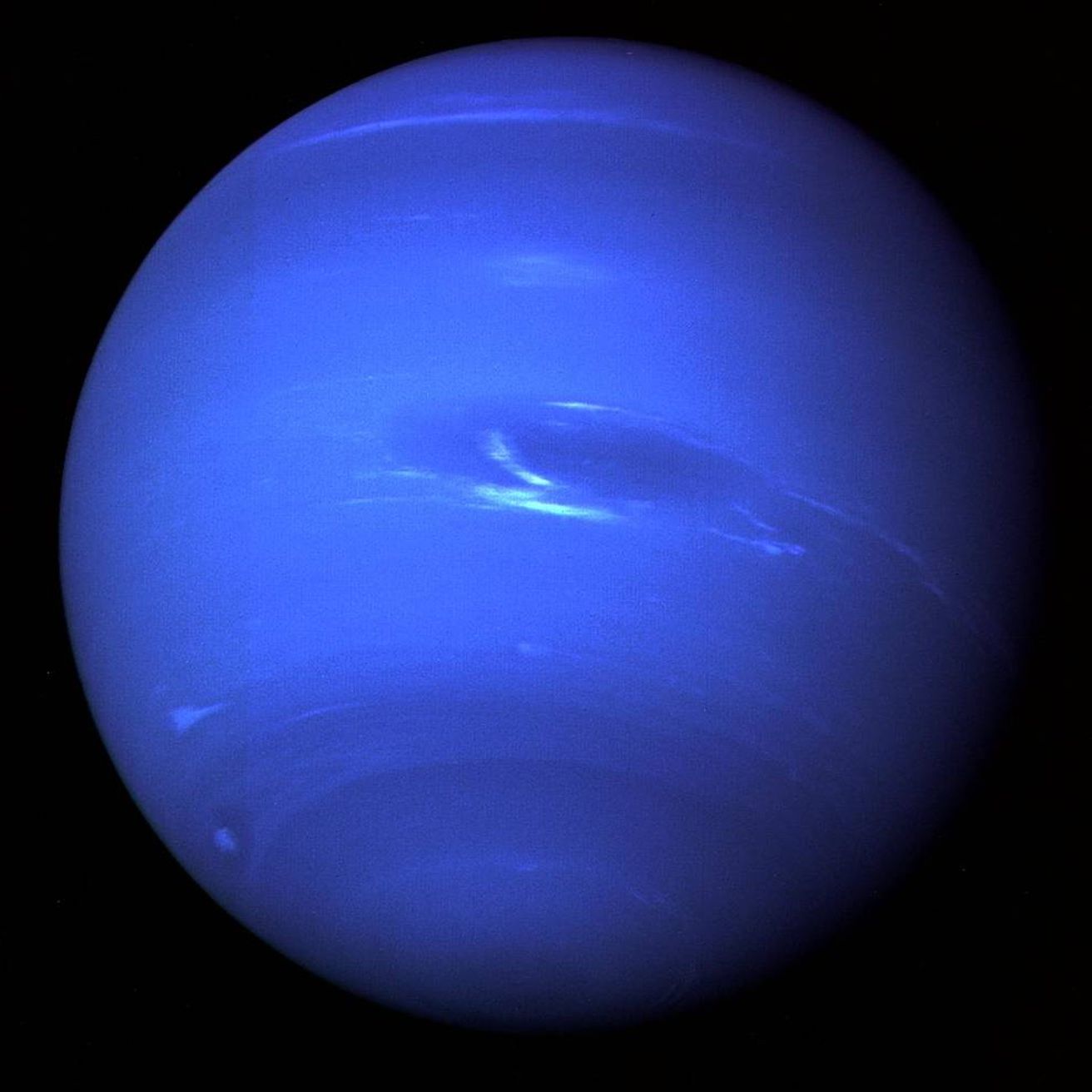
One of Neptune’s most striking features is its vivid blue color. When viewed through telescopes or spacecraft images, the planet appears as a brilliant sapphire sphere floating in darkness.
This color is primarily due to methane gas in Neptune’s atmosphere. Methane absorbs red light from the Sun and reflects blue wavelengths back into space, giving the planet its characteristic hue.
However, Neptune’s blue is deeper and more intense than that of Uranus, which also contains methane. Scientists believe that additional atmospheric components or processes may enhance Neptune’s coloration, though the exact cause is still not fully understood.
The blue of Neptune is not just a visual detail—it is a clue to the complex chemistry and physics occurring within its atmosphere.
Neptune’s Atmosphere and Weather
If one could somehow descend into Neptune’s atmosphere, the experience would be unlike anything imaginable on Earth. The planet’s atmosphere is a place of extreme conditions, where powerful winds and massive storms dominate the landscape.
Neptune holds the record for the fastest winds in the Solar System. Speeds can exceed 2,000 kilometers per hour, faster than the speed of sound on Earth. These winds whip through the atmosphere, driving enormous weather systems across the planet.
Among the most famous features ever observed on Neptune was the Great Dark Spot, a विशाल storm system discovered by the Voyager 2 spacecraft in 1989. Similar in some ways to Jupiter’s Great Red Spot, this storm was a massive swirling vortex, large enough to engulf Earth.
Unlike Jupiter’s long-lasting storm, Neptune’s Great Dark Spot eventually disappeared, highlighting the dynamic and ever-changing nature of the planet’s atmosphere.
Neptune’s atmosphere is composed mainly of hydrogen, helium, and methane, along with trace amounts of other compounds. The upper layers are extremely cold, with temperatures dropping to around minus 200 degrees Celsius.
Yet despite this cold exterior, Neptune emits more heat than it receives from the Sun. This internal heat source fuels its turbulent weather, making it one of the most active planets in the Solar System.
The Mysterious Interior
Beneath Neptune’s clouds lies a world of extremes. As pressure increases with depth, gases transform into dense fluids, and familiar substances behave in unfamiliar ways.
The mantle of Neptune is often described as a mixture of water, ammonia, and methane ices, though under the immense pressures present, these materials exist in a hot, dense, fluid state.
One of the most fascinating possibilities within Neptune’s interior is the formation of diamonds. Under the extreme pressure and temperature conditions, carbon atoms from methane may be compressed into crystalline structures, creating diamond rain that falls through the planet’s interior.
While direct evidence for this phenomenon is still being studied, laboratory experiments and theoretical models suggest that such processes could occur in ice giant planets like Neptune.
The idea of diamonds raining through a distant alien world captures the imagination, reminding us that the universe often behaves in ways far beyond human experience.
Neptune’s Magnetic Field
Neptune possesses a magnetic field that is both powerful and unusual. Unlike Earth’s relatively aligned magnetic field, Neptune’s field is tilted significantly relative to its rotation axis and is offset from the planet’s center.
This creates a complex and dynamic magnetosphere, the region around the planet influenced by its magnetic field. Charged particles from the Sun interact with this field, producing auroras near Neptune’s poles.
The irregular nature of Neptune’s magnetic field suggests that it is generated not in the planet’s core, but in its mantle, where electrically conducting fluids move under the influence of rotation and heat.
Understanding Neptune’s magnetic field provides insight into the internal dynamics of ice giant planets and helps scientists refine models of planetary formation and behavior.
The Rings of Neptune
Like all the giant planets in the Solar System, Neptune has a system of rings. However, its rings are faint, dark, and difficult to observe.
Neptune’s rings are composed of small particles of ice and dust, likely originating from debris left behind by broken moons or captured material. Some of these rings contain bright arcs—clumps of material that appear concentrated in certain regions.
These arcs are a mystery. According to physics, the particles in the rings should spread out evenly over time, yet the arcs persist. Scientists believe that gravitational interactions with nearby moons may help maintain these structures.
Though not as spectacular as the rings of Saturn, Neptune’s rings add another layer of complexity to this distant world.
The Moons of Neptune
Neptune is accompanied by a diverse collection of moons, each with its own unique characteristics. Among them, one stands out as particularly remarkable.
Triton is Neptune’s largest moon and one of the most intriguing objects in the Solar System. Unlike most large moons, Triton orbits Neptune in a retrograde direction, meaning it moves opposite to the planet’s rotation.
This unusual orbit suggests that Triton was not formed alongside Neptune but was captured by its gravity long ago, possibly originating from the Kuiper Belt.
Triton is geologically active, with geysers that erupt nitrogen gas into space. Its surface is a mix of ice, frozen plains, and rugged terrain, making it one of the coldest and most dynamic places known.
Neptune has many other smaller moons, each contributing to the complex gravitational environment surrounding the planet.
Exploration of Neptune
Despite its importance, Neptune remains one of the least explored planets in the Solar System. Only one spacecraft has visited it: Voyager 2.
In 1989, Voyager 2 flew past Neptune, providing humanity with its first close-up images of the planet and its moons. The spacecraft revealed the Great Dark Spot, captured detailed views of Triton, and transformed our understanding of this distant world.
Since then, Neptune has been studied primarily through telescopes, both on Earth and in space. Advances in technology have allowed scientists to observe changes in its atmosphere and track its dynamic weather patterns.
Future missions to Neptune are being considered, as scientists recognize the importance of studying ice giants to better understand planetary systems both within and beyond our Solar System.
Neptune and the Edge of the Solar System
Neptune occupies a unique position at the outer boundary of the classical planets. Beyond its orbit lies the Kuiper Belt, a vast region filled with icy bodies and dwarf planets.
This region represents the remnants of the early Solar System, containing material that never formed into planets. Neptune’s gravity plays a key role in shaping the structure of the Kuiper Belt, influencing the orbits of countless objects.
The boundary beyond Neptune is not a sharp line, but a gradual transition into the outer reaches of the Sun’s influence. Studying Neptune helps scientists understand this transition and the processes that govern the formation of planetary systems.
The Symbolism and Naming of Neptune
Neptune is named after the Roman god of the sea, a fitting choice for a planet that appears as a deep blue ocean in the sky. The name reflects both its color and its dynamic, fluid nature.
The connection between mythology and astronomy highlights humanity’s long-standing fascination with the heavens. Even as science advances, these ancient names remind us of the cultural and historical roots of our exploration.
Neptune’s name evokes images of power, mystery, and depth—qualities that perfectly describe the planet itself.
The Continuing Mystery
Despite everything we have learned, Neptune remains a world of unanswered questions. Its deep interior, its powerful winds, its magnetic field, and its atmospheric chemistry all present challenges to our understanding.
Why are its winds so fast? What drives its internal heat? How do its rings and arcs remain stable? What secrets lie hidden beneath its clouds?
These questions continue to inspire research and exploration. Neptune stands as a reminder that even in our own Solar System, there are worlds that remain largely unknown.
A Distant Blue Frontier
To gaze upon Neptune is to look across billions of kilometers into a realm where sunlight fades and mystery deepens. It is a planet of extremes, where beauty and violence coexist in a delicate balance.
Though distant, Neptune is not isolated from us. It is part of the same cosmic story that gave rise to Earth, life, and human curiosity. By studying Neptune, we learn not only about a distant world, but also about the processes that shaped our own planet and the universe beyond.
In the vast expanse of space, Neptune drifts as a silent sentinel at the edge of the Solar System—a deep blue frontier waiting to be understood.