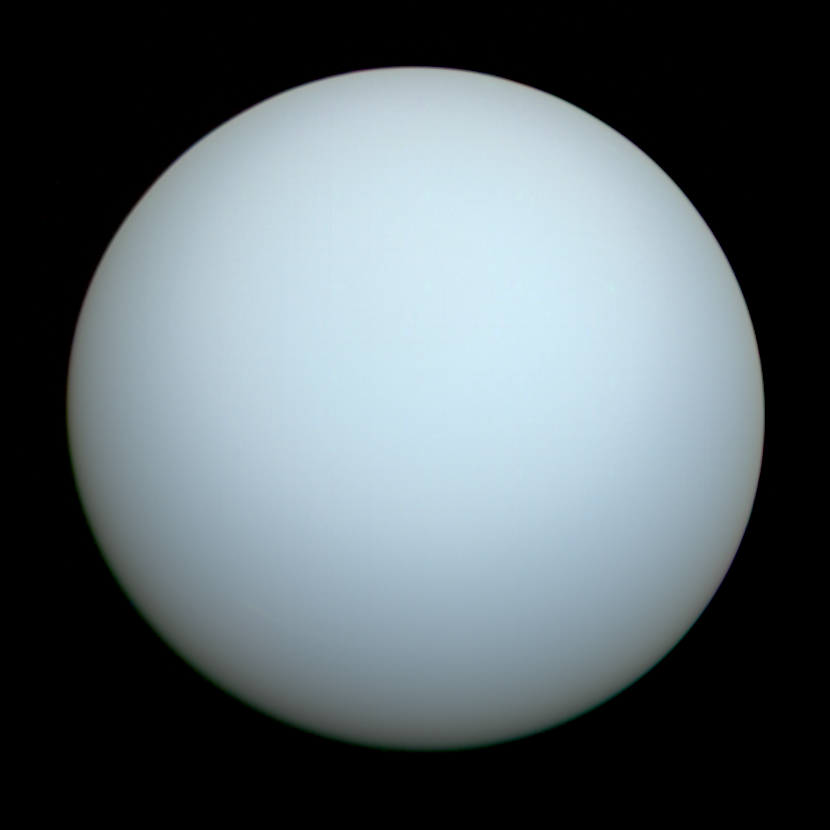
Uranus is one of the most mysterious and fascinating worlds in our solar system, a distant giant that spins in a way no other planet does, wrapped in a cold, pale blue haze that conceals more than it reveals. It is the seventh planet from the Sun, orbiting far beyond the warmth of Earth and even the fiery storms of Jupiter. At that distance, sunlight fades into a dim glow, and Uranus drifts quietly through the darkness, taking more than eight decades to complete a single journey around the Sun.
Yet despite its quiet appearance, Uranus is anything but simple. It is a planet of extremes and paradoxes. It rotates on its side, as though knocked over by some ancient cosmic event. Its seasons last decades, with entire hemispheres plunged into darkness or light for years at a time. Its atmosphere hides powerful winds and subtle storms, while its interior holds secrets about the formation of planets themselves.
To understand Uranus is to explore a world that challenges expectations, a place that forces us to rethink what a planet can be. It is a frozen giant, a relic of the early solar system, and a key to understanding worlds beyond our own.
The Discovery of Uranus
For most of human history, Uranus was invisible as a planet. Though it can be seen with the naked eye under very dark skies, its slow movement made it appear like just another faint star. Ancient astronomers recorded it without realizing its true nature.
Everything changed in 1781, when the astronomer William Herschel carefully observed a faint object moving across the sky. At first, he believed he had discovered a comet. But as he continued to track its motion, it became clear that this object followed a nearly circular orbit, far beyond Saturn.
Herschel had discovered a new planet—the first one ever found with a telescope. This was a revolutionary moment in astronomy. Until then, the solar system was thought to consist only of the planets known since ancient times. Uranus expanded the boundaries of the known universe, proving that there was more to discover beyond what the eye alone could see.
The planet was eventually named Uranus, after the ancient Greek sky god. This choice followed a tradition of naming planets after mythological figures, connecting science with humanity’s long history of storytelling and wonder.
The Place of Uranus in the Solar System
Uranus orbits the Sun at an average distance of about 2.9 billion kilometers. At that immense distance, sunlight is more than 400 times weaker than what we experience on Earth. The Sun appears as a bright star rather than a blazing disk, and the energy reaching Uranus is barely enough to warm its upper atmosphere.
This distant orbit means that Uranus takes approximately 84 Earth years to complete a single revolution around the Sun. In other words, a year on Uranus lasts nearly a human lifetime.
Uranus belongs to a group of planets known as ice giants, along with Neptune. These planets are different from the gas giants Jupiter and Saturn. While gas giants are composed mostly of hydrogen and helium, ice giants contain larger amounts of heavier elements such as water, ammonia, and methane.
The position of Uranus in the outer solar system places it in a region filled with icy remnants from the formation of planets. Beyond Uranus lies Neptune, and beyond that, the Kuiper Belt—a vast region of frozen objects that includes dwarf planets like Pluto.
The Size and Structure of Uranus
Uranus is the third-largest planet in the solar system by diameter, measuring about four times wider than Earth. If Earth were the size of a small apple, Uranus would be closer to a large watermelon. Despite its size, Uranus is not as massive as Jupiter or Saturn, but it still contains more than 14 times the mass of Earth.
The planet does not have a solid surface like Earth. Instead, it is made up of layers that gradually transition from gas to liquid and possibly to a dense, icy core.
The outermost layer is the atmosphere, composed mainly of hydrogen and helium, with a small but significant amount of methane. Beneath this lies a thick mantle of water, ammonia, and methane in a superheated, high-pressure state. This layer is often referred to as a “hot ice” layer, though it behaves more like a fluid than solid ice.
At the center, Uranus likely has a rocky core, though its exact composition remains uncertain. The extreme pressures and temperatures deep inside the planet make direct observation impossible, leaving scientists to rely on models and indirect measurements.
The Blue Color of Uranus
One of the most striking features of Uranus is its pale blue-green color. This gentle hue gives the planet a serene appearance, but the reason behind it lies in the chemistry of its atmosphere.
Methane gas plays a key role in shaping Uranus’s color. It absorbs red wavelengths of sunlight while allowing blue and green wavelengths to be reflected back into space. The result is the soft cyan glow that makes Uranus stand out among the planets.
However, Uranus’s color is not identical to that of Neptune, which appears a deeper blue. Scientists believe this difference may be due to variations in atmospheric composition or the presence of hazes that affect how light is scattered.
The color of Uranus is more than just a visual feature. It provides clues about the planet’s atmospheric chemistry and the processes occurring high above its hidden interior.
The Tilt That Defies Expectation
Perhaps the most extraordinary feature of Uranus is its extreme axial tilt. While most planets spin upright or with only a slight tilt, Uranus is tilted by about 98 degrees. This means it essentially rotates on its side.
Imagine a spinning top lying on the ground instead of standing upright—that is how Uranus behaves. Its poles point almost directly toward and away from the Sun during its orbit.
This unusual orientation leads to extreme seasonal changes. Each pole experiences around 42 years of continuous sunlight, followed by 42 years of darkness. As Uranus slowly moves along its orbit, the sunlight shifts from one hemisphere to the other in a gradual, dramatic cycle.
The cause of this tilt is still debated. Many scientists believe that Uranus was struck by a massive object early in its history, knocking it sideways. This ancient collision would have reshaped the planet’s rotation and possibly influenced the formation of its moons and rings.
The Atmosphere of Uranus
At first glance, Uranus appears calm and featureless, especially when compared to the turbulent clouds of Jupiter or the dynamic storms of Saturn. However, this calm appearance can be misleading.
Uranus has an atmosphere filled with subtle structures and occasional storms. High-altitude clouds made of methane ice drift through the upper layers, while deeper clouds may consist of water and ammonia.
Wind speeds on Uranus can reach hundreds of kilometers per hour, creating powerful atmospheric currents. These winds move in different directions depending on latitude, forming complex patterns that scientists are still trying to understand.
Unlike Jupiter and Saturn, Uranus emits very little internal heat. Most of the energy in its atmosphere comes directly from the Sun. This lack of internal heat may explain why Uranus appears less active than other giant planets.
Despite its subdued appearance, Uranus occasionally surprises scientists with bursts of activity. Observations have revealed bright storms and cloud formations that appear and disappear over time, hinting at dynamic processes beneath the surface.
The Rings of Uranus
Uranus is surrounded by a system of rings, though they are far less prominent than those of Saturn. These rings are dark, narrow, and composed mainly of small particles and debris.
The rings were discovered in 1977 when astronomers observed Uranus passing in front of a distant star. As the planet moved across the star, the light dimmed in a pattern that revealed the presence of rings.
There are at least thirteen known rings around Uranus, each with its own structure and characteristics. Some are dense and well-defined, while others are faint and diffuse.
The origin of these rings is still uncertain. They may have formed from the remnants of moons that were shattered by impacts or torn apart by gravitational forces. Over time, collisions and interactions have shaped the rings into their current form.
Though less spectacular than Saturn’s, the rings of Uranus offer valuable insights into the processes that shape planetary systems.
The Moons of Uranus
Uranus is accompanied by a diverse collection of moons, each with its own unique features. There are 27 known moons orbiting the planet, many of which are named after characters from the works of William Shakespeare and Alexander Pope.
The five largest moons—Miranda, Ariel, Umbriel, Titania, and Oberon—are particularly intriguing. These worlds are composed of ice and rock, and they display a range of geological features.
Miranda is perhaps the most unusual, with a surface that appears shattered and reassembled. It has towering cliffs, deep valleys, and regions that look dramatically different from one another, suggesting a complex history of geological activity.
Ariel shows signs of relatively recent resurfacing, with smooth plains and few impact craters. This indicates that it may have experienced internal activity that reshaped its surface.
Umbriel is darker and more heavily cratered, suggesting it has been less active over time. Titania and Oberon are larger and display a mix of features, including faults and craters.
These moons provide a window into the past, preserving clues about the conditions and events that shaped the Uranian system.
The Magnetic Field of Uranus
Uranus has a magnetic field unlike any other in the solar system. Instead of being aligned with the planet’s rotation axis, its magnetic field is tilted at a significant angle and offset from the center of the planet.
This unusual configuration creates a complex and dynamic magnetic environment. As Uranus rotates, its magnetic field wobbles and shifts, producing unpredictable patterns.
The source of this magnetic field is believed to lie within the planet’s interior, possibly in layers of electrically conducting fluids. However, the exact mechanism remains a subject of ongoing research.
The strange nature of Uranus’s magnetic field highlights how much we still have to learn about this distant world.
Exploration of Uranus
Despite its importance, Uranus has been visited by only one spacecraft: Voyager 2. In 1986, this robotic explorer flew past the planet, providing humanity with its first close-up view.
Voyager 2 revealed the planet’s pale atmosphere, its rings, and its moons in remarkable detail. It also provided crucial data about the planet’s magnetic field and environment.
However, the flyby was brief, lasting only a few hours. Since then, no dedicated mission has returned to Uranus, leaving many questions unanswered.
Scientists have proposed future missions to explore Uranus more thoroughly. These missions could include orbiters and probes designed to study the planet’s atmosphere, interior, and moons in greater detail.
Such exploration would not only deepen our understanding of Uranus but also provide insights into similar planets beyond our solar system.
Uranus and the Search for Other Worlds
The study of Uranus has implications far beyond our own solar system. Many exoplanets discovered around distant stars are similar in size and composition to Uranus and Neptune.
By understanding Uranus, scientists can gain insights into these distant worlds. The processes that shaped Uranus may also operate in planetary systems across the galaxy.
Uranus serves as a natural laboratory for studying ice giants, helping us interpret observations of planets that are too far away to examine directly.
The Mysteries That Remain
Even after centuries of study, Uranus remains a world full of unanswered questions. Why does it emit so little internal heat compared to other giant planets? What caused its extreme tilt? What lies deep within its interior? How active is its atmosphere over long periods?
These mysteries continue to inspire scientific curiosity. Each new observation and theoretical model brings us closer to understanding this enigmatic planet.
A World of Quiet Wonder
Uranus may not have the dramatic storms of Jupiter or the dazzling rings of Saturn, but it possesses a quiet, subtle beauty. Its pale blue glow, its sideways spin, and its distant orbit create a sense of calm and mystery.
It is a reminder that the universe is filled with diversity, that even within our own solar system, there are worlds that defy expectations and challenge our understanding.
To study Uranus is to look into the unknown, to explore a place where familiar rules bend and new questions emerge. It is a journey into the outer reaches of our cosmic neighborhood, where the Sun shines faintly and the secrets of planetary formation wait to be uncovered.
In the end, Uranus is more than just a distant planet. It is a symbol of discovery, a testament to human curiosity, and a reminder that there is always more to learn about the universe we call home.