From the moment early humans first looked up at the stars, a question has followed us like a shadow: Are we alone?
It is not merely a scientific question. It is emotional. It is philosophical. It is deeply human. To ask whether we are alone in the universe is to ask whether life is a rare miracle or a common thread woven into the cosmic fabric.
For centuries, we had no way to investigate this question beyond speculation. But today, armed with powerful telescopes, interplanetary probes, radio arrays, and the tools of astrophysics and biology, we are no longer guessing in the dark. While we have not yet confirmed extraterrestrial life, science has uncovered compelling evidence suggesting that we may not be alone.
Below are ten scientifically grounded signs—clues drawn from astronomy, chemistry, biology, and planetary science—that suggest life beyond Earth is not only possible, but perhaps even likely.
1. The Universe Is Incomprehensibly Vast
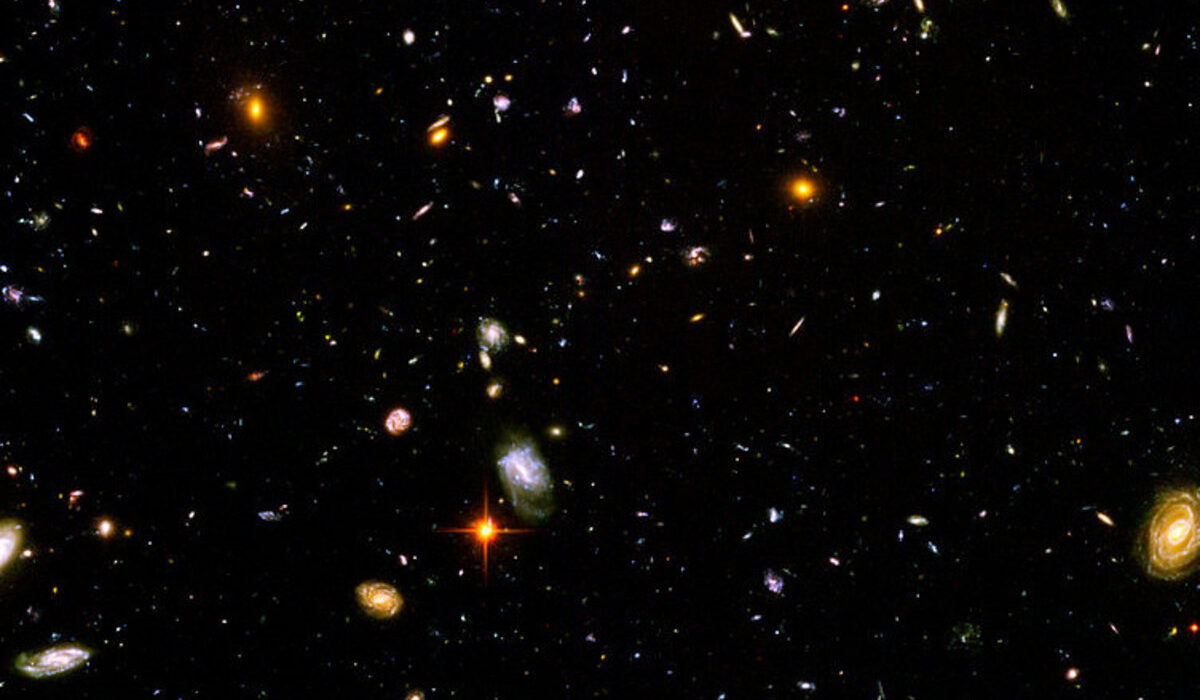
The observable universe contains an estimated two trillion galaxies. Each galaxy contains hundreds of billions of stars. Around many of those stars orbit planets.
The numbers are staggering. Even if life were extraordinarily rare—emerging on only one planet in a billion—the sheer number of worlds would still imply countless living systems scattered across cosmic distances.
Our own galaxy, the Milky Way, contains more than 100 billion stars. Recent studies suggest that, on average, most stars host at least one planet. That means hundreds of billions of planetary systems in just one galaxy.
Statistically, it would be astonishing if Earth were the only cradle of life.
Vastness alone does not guarantee life. But scale matters. When probability is multiplied by unimaginable numbers, even rare events become common. The universe is simply too large for Earth to feel like the only experiment in biology.
2. Exoplanets Are Everywhere
Until the early 1990s, we did not know whether planets orbited other stars. Today, thanks to missions like the Kepler Space Telescope and the Transiting Exoplanet Survey Satellite, thousands of exoplanets have been confirmed.
These discoveries transformed our understanding of planetary systems. We now know that planets are not rare cosmic accidents. They are common outcomes of star formation.
Among these exoplanets are rocky worlds similar in size to Earth. Some orbit within their star’s habitable zone, the region where temperatures could allow liquid water to exist on the surface.
While being in the habitable zone does not guarantee life, it does create conditions that make life possible as we understand it. The discovery of so many potentially habitable planets strongly suggests that Earth is not unique in its physical properties.
The night sky, once thought to hold only distant suns, now reveals itself as a tapestry of planetary systems—each one a possible stage for life.
3. Water Is Abundant in the Universe
Water is essential for life as we know it. For decades, scientists believed Earth’s oceans might be rare. That assumption has collapsed.
Water has been detected in interstellar clouds, in comets, in protoplanetary disks around young stars, and in the atmospheres of exoplanets. Frozen water exists on Mars, beneath the icy crusts of Jupiter’s moon Europa and Saturn’s moon Enceladus.
Enceladus, in particular, astonished scientists when the Cassini spacecraft detected plumes of water vapor erupting from beneath its icy surface. These plumes contain organic molecules and salts, suggesting the presence of a subsurface ocean in contact with a rocky core.
Europa shows strong evidence of a vast ocean beneath its icy shell, potentially containing more water than all of Earth’s oceans combined.
Water is not rare. It is a common cosmic molecule. Where water exists in stable environments with energy sources, life becomes conceivable.
The realization that oceans may exist beyond Earth is both thrilling and profound.
4. Organic Molecules Form Naturally in Space
Life on Earth is built from complex organic molecules—carbon-based compounds that form the backbone of biological chemistry.
For a long time, scientists wondered whether such molecules required life to exist. We now know they do not.
Organic molecules, including amino acids—the building blocks of proteins—have been detected in meteorites and interstellar clouds. Laboratory simulations show that under the right conditions, simple chemicals can spontaneously assemble into more complex organic compounds.
The famous Miller-Urey experiment in the 1950s demonstrated that amino acids could form from simple gases when exposed to electrical energy simulating lightning. Since then, research has shown that organic chemistry is remarkably robust.
Carbon, hydrogen, oxygen, nitrogen—these elements are among the most abundant in the universe. When combined with energy and time, chemistry tends toward complexity.
The ingredients of life appear not to be rare accidents but natural outcomes of cosmic processes.
5. Life on Earth Emerged Quickly
Earth formed about 4.5 billion years ago. The earliest evidence of life dates back at least 3.5 billion years, possibly earlier.
This means that life arose relatively quickly after the planet cooled enough to support liquid water.
If the origin of life were an extraordinarily improbable event requiring highly specific and unlikely conditions, we might expect it to have taken far longer. Instead, life seems to have appeared as soon as the environment allowed it.
This rapid emergence suggests that when conditions are suitable, life may arise naturally.
We do not yet fully understand the process of abiogenesis—the transition from nonliving chemistry to living cells. But the speed with which it occurred on Earth implies that the leap from chemistry to biology may not be as astronomically rare as once feared.
6. Extremophiles Show Life Is Incredibly Resilient
Life on Earth thrives in environments once thought uninhabitable.
Extremophiles—organisms that live in extreme conditions—have been found near hydrothermal vents at the ocean floor, where temperatures exceed 300 degrees Celsius. Others survive in acidic lakes, radioactive waste, deep underground rock, or Antarctic ice.
Some microbes can endure intense radiation, crushing pressures, or near-vacuum conditions. Certain bacteria can survive for years in space-like environments.
These discoveries dramatically expand the range of environments considered potentially habitable.
Planets and moons once dismissed as too harsh may, in fact, host microbial life. If life can adapt to such extremes on Earth, it becomes easier to imagine it adapting elsewhere.
The resilience of life suggests that biology is not fragile. It is tenacious.
7. Mars Shows Signs of a Watery Past
Mars today is cold and dry, its surface exposed to harsh radiation. But geological evidence indicates that billions of years ago, Mars had rivers, lakes, and perhaps even oceans.
Orbital imagery reveals dried river valleys and sedimentary structures consistent with flowing water. Rovers have detected minerals that form in aqueous environments.
If life arose quickly on Earth under similar early conditions, it is plausible that Mars could have hosted microbial life during its warmer, wetter past.
Scientists continue to search for biosignatures—chemical or structural indicators of past life—in Martian rocks. The Perseverance rover is collecting samples for future return to Earth.
Even if Mars does not currently host life, the possibility that it once did suggests that life may arise wherever conditions permit.
8. The Chemistry of Titan and Other Moons
Saturn’s moon Titan possesses lakes and rivers—not of water, but of liquid methane and ethane. Its atmosphere is rich in organic molecules, and complex chemical reactions occur under the influence of sunlight and cosmic radiation.
While Titan’s conditions are extremely cold, its chemistry demonstrates that organic complexity can emerge in diverse environments.
Other moons, such as Europa and Enceladus, combine liquid water with potential energy sources like tidal heating. The plumes from Enceladus contain hydrogen, which on Earth can serve as an energy source for microbial ecosystems.
These worlds broaden our imagination. Life elsewhere may not mirror Earth precisely. It may operate under different chemical regimes, adapted to alien conditions.
The solar system itself presents multiple laboratories for potential biology.
9. Technosignature Searches Continue
Scientists are not only searching for microbial life but also for technological civilizations.
Radio telescopes scan the sky for unusual signals that might indicate artificial origins. Optical searches look for laser pulses. Astronomers examine exoplanet atmospheres for industrial pollutants that could signal advanced societies.
While no confirmed technosignatures have been detected, the search is still in its early stages. The sky is vast, and we have sampled only a tiny fraction of possible frequencies and regions.
The absence of evidence is not evidence of absence.
The fact that we possess the ability to search systematically for extraterrestrial intelligence marks a profound shift. Humanity is no longer silently wondering; it is actively listening.
10. The Principles of Physics and Chemistry Are Universal
Perhaps the most profound sign lies in the universality of physical law.
The same atoms found in our bodies exist in distant stars. The same laws of gravity, electromagnetism, and quantum mechanics apply across billions of light-years. Spectroscopy shows that chemical elements behave identically in remote galaxies as they do on Earth.
If physics and chemistry are universal, then the processes that produced life here could operate elsewhere under similar conditions.
Carbon bonds form predictably. Water behaves consistently. Energy flows according to thermodynamic principles everywhere.
The universe is not a chaotic patchwork of arbitrary rules. It is governed by consistent laws. That consistency makes it plausible that life is not confined to a single planetary accident.
The cosmos appears primed for complexity.
The Silence and the Hope
Despite these compelling signs, we have not yet found definitive evidence of life beyond Earth. The silence remains.
But silence does not equal emptiness. It may reflect distance, technological limitations, or the rarity of detectable civilizations. It may reflect time—civilizations rising and falling across cosmic epochs without overlapping.
Science does not claim certainty. It follows evidence. And the evidence increasingly suggests that the universe is fertile ground for life.
We stand at a turning point in history. Within this century, missions may probe Europa’s ocean, return Martian samples, and analyze exoplanet atmospheres for biosignatures.
The answer to the ancient question may come not through philosophy but through data.
If we discover even microbial life beyond Earth, it will transform our understanding of biology and our place in the cosmos. It will mean that life is not a solitary miracle but a cosmic phenomenon.
And if one day we detect intelligent signals from another star, humanity will cross a threshold as profound as any in history.
Until then, the stars shine above us—silent, distant, and full of possibility.
The signs are there. The chemistry is there. The planets are there. The water is there. The physics is there.
The universe does not feel empty.
It feels alive with potential.