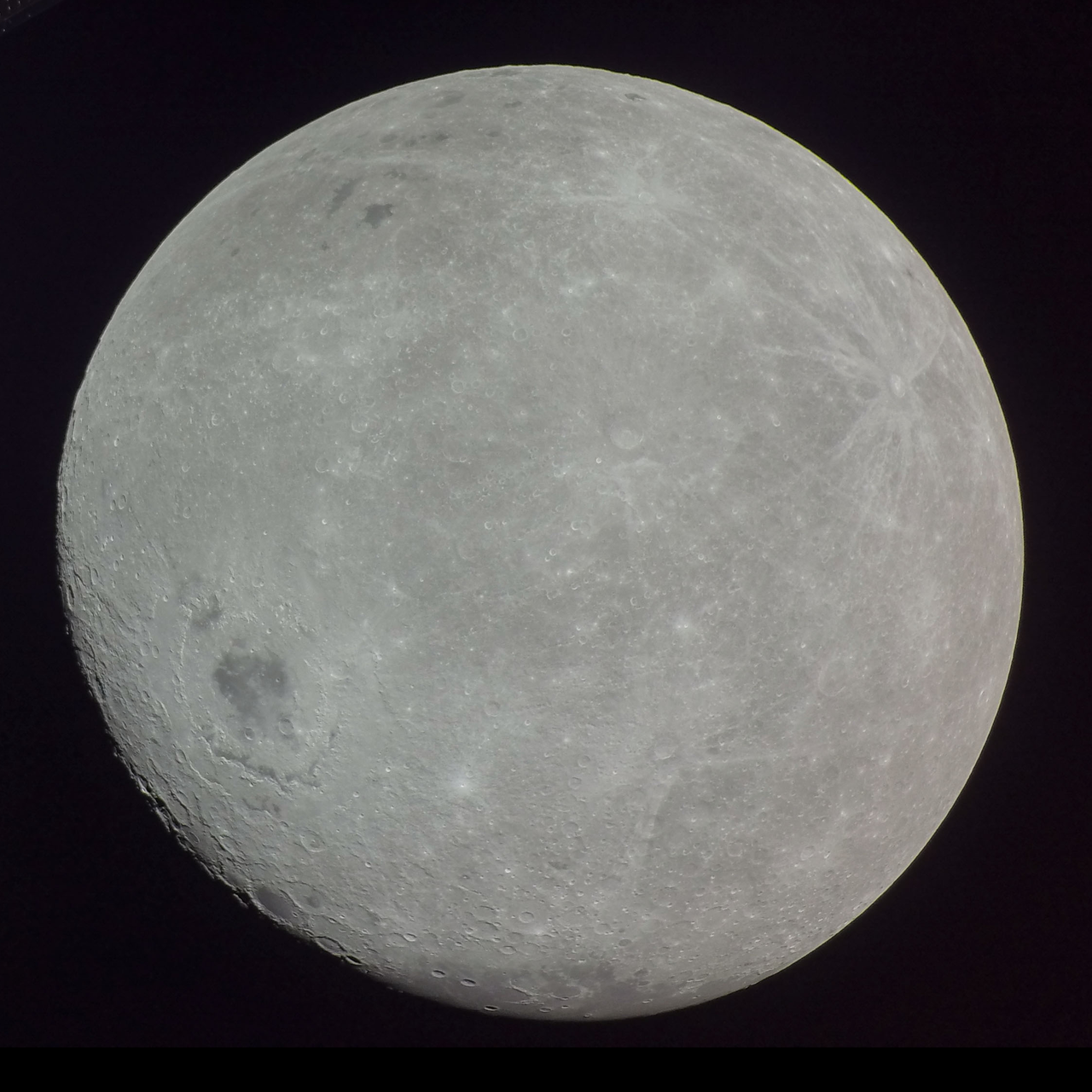
The Moon is our closest celestial neighbor, locked in a gravitational dance with Earth that ensures we see only one of its faces. This phenomenon, known as tidal locking, means the same hemisphere of the Moon always points toward us. For most of human history, the far side of the Moon remained completely unseen—a literal dark side in our imagination, though it receives just as much sunlight as the near side.
When spacecraft finally circled the Moon in the mid-20th century, the far side stunned scientists. It looked dramatically different from the familiar face marked by dark maria—vast basaltic plains visible from Earth. The far side was rougher, more cratered, more ancient. Its terrain felt alien in a way the near side did not.
Over the decades, high-resolution images from missions such as the Lunar Reconnaissance Orbiter and earlier Soviet and American spacecraft have revealed remarkable geological features on this hidden hemisphere. Some of these formations appear so unusual that, at first glance, they seem almost artificial. Social media speculation and conspiracy theories often latch onto them, imagining alien bases or forgotten ruins.
Yet the truth is more subtle—and more fascinating. These “structures” are not buildings, but natural formations shaped by violent impacts, volcanic processes, tectonic stresses, and billions of years of cosmic bombardment.
Here are seven mysterious structures on the Moon’s far side that have captivated scientists and the public alike.
1. The South Pole–Aitken Basin
The largest and oldest recognized impact basin on the Moon lies on the far side. Known as the South Pole–Aitken Basin, it stretches roughly 2,500 kilometers across and plunges more than 8 kilometers deep in places. If placed on Earth, it would span a continent.
At first glance in elevation maps, the basin appears like a colossal scar—an enormous, circular depression with subtle rings and variations in terrain. Its scale is almost incomprehensible. It dominates the southern far side of the Moon.
This basin likely formed over four billion years ago when a massive asteroid or protoplanet slammed into the young Moon. The energy released would have melted vast amounts of crust, possibly exposing material from the lunar mantle.
What makes the South Pole–Aitken Basin mysterious is not only its size but also its composition. Remote sensing data suggest unusual chemical signatures within the basin, including materials that may have originated deep inside the Moon. Scientists are still working to understand the full implications of these findings.
It is not an artificial structure, but it is a monument to cosmic violence on a planetary scale—a natural formation so immense it reshaped the Moon’s evolution.
2. The “Towers” of Von Kármán Crater
Inside the South Pole–Aitken Basin lies Von Kármán Crater, a relatively younger impact feature. When China’s Chang’e 4 mission became the first spacecraft to land on the Moon’s far side in 2019, it touched down within this crater.
Orbital imagery and shadow patterns sometimes create the illusion of vertical spires or towers rising from the crater floor. These shapes have fueled online speculation, with some claiming they resemble artificial constructs.
In reality, such formations are consistent with central peaks and uplifted materials commonly found in complex impact craters. When a large object strikes a planetary surface, the crust compresses and rebounds, forming peaks at the center. Erosion is minimal on the Moon due to the absence of atmosphere, so these peaks can remain sharp and dramatic.
Lighting angles, especially near the lunar terminator where shadows are long, can exaggerate vertical features. What looks like a tall tower may be a modest hill casting an elongated shadow.
The mystery here lies not in alien architecture but in the raw mechanics of impact geology, frozen in time.
3. The Rectangular Features of Mare Moscoviense
Mare Moscoviense is one of the very few maria—dark volcanic plains—located on the Moon’s far side. It is surrounded by heavily cratered highlands, making its dark basaltic surface stand out dramatically.
Within and around Mare Moscoviense, certain ridges and crater edges appear strikingly linear. Some images show what seem to be rectangular or grid-like patterns. To the untrained eye, these can resemble foundations or walls.
However, such geometric appearances arise from tectonic stresses and the way lava flows cooled and fractured. When basalt cools, it can crack in relatively straight lines due to contraction. Impact events can also create fractures that intersect at angles, giving a misleading impression of design.
Human perception is highly sensitive to patterns. We are wired to recognize symmetry and straight lines as signs of intention. But geology often produces shapes that mimic artificial forms.
Mare Moscoviense remains scientifically intriguing because its volcanic origin on the far side raises questions about why the near side has so many more maria. The far side’s thicker crust may have limited lava flows, making this mare a rare exception.
4. The “Cube” Spotted by Yutu-2
In 2021, China’s Yutu-2 rover, part of the Chang’e 4 mission, photographed what appeared to be a cube-shaped object on the horizon. The image spread rapidly across the internet. The object, informally nicknamed the “mystery hut,” seemed to stand alone against the stark lunar landscape.
Speculation ran wild. Was it artificial? A remnant of alien construction? A forgotten relic from a secret mission?
As the rover approached and captured clearer images, the object resolved into a simple rock—a boulder shaped by impact fragmentation and erosion.
Rocks on the Moon can take on angular forms because there is no wind or water to smooth them. Impact events shatter bedrock into blocks with sharp edges. The low Sun angle and pixel resolution made the boulder appear more cubic than it actually was.
The episode serves as a powerful reminder of how easily limited data can mislead interpretation. It also highlights the importance of careful, incremental exploration.
5. The Giant Linear Rilles of the Far Highlands
Across the far side highlands are long, narrow depressions known as rilles. Some are sinuous, resembling dried riverbeds formed by ancient lava flows. Others are remarkably straight, stretching for tens of kilometers.
These linear rilles can look artificial in orbital images, as if carved deliberately into the surface. In reality, they are tectonic features created by crustal stretching and faulting.
As the Moon cooled and contracted over billions of years, stresses built up in its crust. In some regions, the crust fractured, forming grabens—blocks that dropped down between parallel faults.
The far side highlands preserve many such features due to their ancient age and lack of resurfacing by lava. They record a history of internal evolution and thermal contraction.
What appears as mysterious straight lines etched into stone is actually a record of planetary cooling written across billions of years.
6. The Multi-Ringed Orientale Basin (Edge Region)
While the main portion of the Orientale Basin is visible from Earth near the lunar limb, significant portions of its structure extend toward the far side. This basin is one of the best-preserved multi-ring impact basins on the Moon.
In high-resolution images, the concentric rings appear almost architectural—vast circular walls rising from the surface in perfect arcs. The geometry is strikingly precise.
Multi-ring basins form when enormous impacts cause waves of uplift and collapse in the crust. The result is a series of nested rings, like ripples frozen in stone.
The Orientale Basin’s rings provide crucial insights into how planetary crust behaves under extreme stress. Computer simulations attempt to reproduce such structures, but fully understanding their formation remains an active area of research.
Its beauty and symmetry can feel intentional, yet it is entirely the product of physics operating at planetary scale.
7. The Farside Highlands’ “Megablocks”
In certain far side regions, especially near large impact basins, spacecraft have photographed enormous fractured blocks—sometimes kilometers across—jumbled together in chaotic patterns.
These megablocks can resemble collapsed walls or toppled ruins in low-resolution imagery. Their sharp edges and angular forms create an impression of structure.
They are, in fact, ejecta—massive chunks of crust thrown outward during colossal impacts. When asteroids struck the Moon with tremendous force, they excavated material and deposited it in chaotic arrangements.
Without atmospheric erosion, these blocks remain stark and angular for billions of years. The far side, with its heavier cratering and thicker crust, preserves many such ancient impact scars.
They are not ruins of cities. They are ruins of worlds—fragments of crust displaced by impacts that once melted rock and reshaped the lunar surface.
The Psychology of Lunar Mystery
Why do these formations provoke such fascination? Partly because the far side of the Moon was hidden from human eyes for most of history. The unknown invites imagination.
But there is also a deeper reason. Humans are pattern-seeking creatures. Our brains evolved to detect structure and intention. When we see symmetry, straight lines, or geometric forms, we instinctively wonder whether intelligence played a role.
On Earth, many geometric structures are indeed artificial. Cities, roads, monuments—all are built with lines and angles. When similar shapes appear in distant landscapes, it is natural to question their origin.
Yet nature is capable of astonishing geometry. Crystals form perfect lattices. Snowflakes display intricate symmetry. Impact basins produce circular rings. Tectonic stresses create straight fractures.
The Moon’s far side feels mysterious not because it hides alien cities, but because it preserves geological processes in pristine clarity.
A Landscape Frozen in Deep Time
The far side of the Moon is older, on average, than much of the near side. It lacks the extensive volcanic maria that resurfaced large regions visible from Earth. As a result, it retains a more complete record of early solar system history.
Every crater tells a story of impact. Every ridge and basin encodes information about the Moon’s formation and thermal evolution. The far side is like an ancient archive, largely untouched by erosion.
It is also the target of increasing scientific interest. Future missions aim to sample materials from the South Pole–Aitken Basin, potentially revealing insights into the Moon’s interior. Radio telescopes placed on the far side could operate shielded from Earth’s radio noise, opening new windows into the early universe.
Far from being a place of alien architecture, the lunar far side is a place of scientific revelation.
The Real Wonder
The truth about these seven mysterious “structures” is both simpler and more profound than conspiracy theories suggest. They are natural formations shaped by gravity, impact, volcanism, and time.
And yet, their existence is extraordinary.
The South Pole–Aitken Basin is a scar from a collision so powerful it altered a world. The plumes sampled at Von Kármán Crater reveal geological complexity. Linear rilles map the cooling of a planetary body. Megablocks testify to impacts beyond imagination.
The far side of the Moon does not hide cities or alien outposts. It hides history.
It is a reminder that the universe is capable of constructing forms more dramatic than fiction. It sculpts landscapes through forces both violent and subtle. It writes its story in rock and shadow.
When we gaze at images from the Moon’s hidden hemisphere, we are not looking at ruins of lost civilizations. We are looking at the raw record of cosmic evolution.
And perhaps that is even more awe-inspiring.