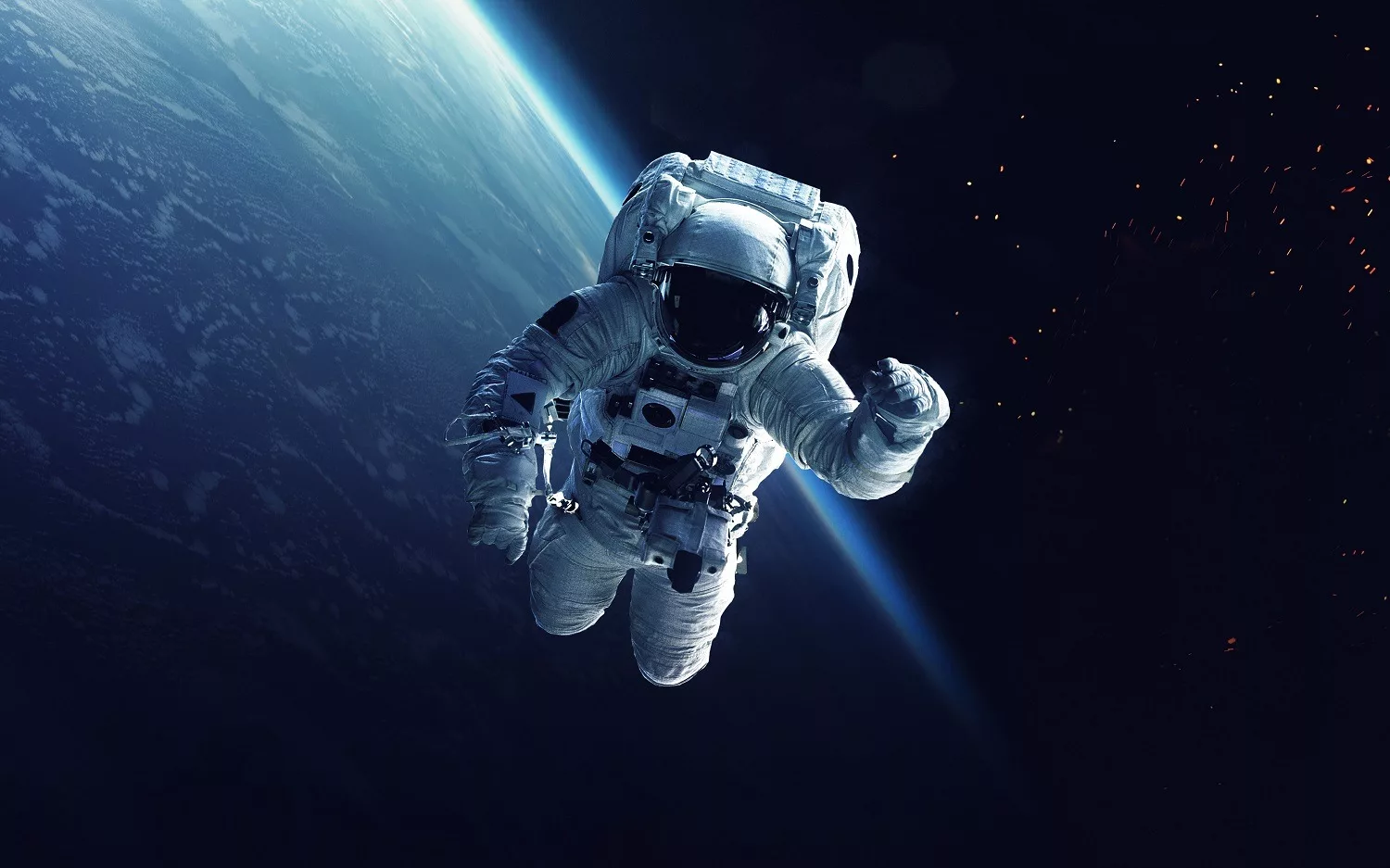
Space is not merely empty. It is vast, silent, radiation-soaked, and psychologically overwhelming. Astronauts who leave Earth do not simply travel farther than anyone before them—they enter an environment the human body and brain were never designed to experience. Microgravity alters fluid distribution in the body. Cosmic radiation interacts with the retina. Isolation reshapes perception. The thin walls of spacecraft separate fragile biology from lethal vacuum.
Over the decades, astronauts from programs such as NASA, Roscosmos, and other space agencies have described experiences that sound eerie, unsettling, even paranormal. Yet none of these accounts require supernatural explanations. In fact, they reveal something far more fascinating: how human perception behaves at the edge of Earth.
The following ten accounts are drawn from documented astronaut reports, declassified transcripts, and well-studied physiological phenomena. They are creepy not because they imply alien visitors or cosmic ghosts—but because they show how strange reality becomes when gravity disappears and the familiar rules of Earth fall away.
1. Flashes of Light With Eyes Closed
Several astronauts who traveled to the Moon during the Apollo missions reported seeing sudden flashes of light—even when their eyes were closed inside a dark spacecraft.
Astronauts aboard missions like Apollo 11 described bright streaks, arcs, or starbursts appearing in their vision while resting. These flashes were not reflections. They were not equipment malfunctions. They appeared inside their own visual field.
The likely explanation is both scientifically established and unsettling. Outside Earth’s protective magnetic field, astronauts are exposed to higher levels of cosmic rays—high-energy charged particles traveling through space. When one of these particles passes through the retina, it can stimulate photoreceptor cells directly, producing a flash of light sensation.
In other words, astronauts were literally seeing radiation.
There is something profoundly eerie about that. In deep space, even with your eyes closed, the universe can still reach inside your nervous system and announce its presence.
2. The “Overview Effect” and Altered Consciousness
Many astronauts have described an overwhelming cognitive shift after seeing Earth from orbit. This phenomenon, often called the Overview Effect, is not hallucination—but it can feel transcendent.
Looking down at Earth from space, seeing continents without borders, clouds swirling over oceans, and the thin blue line of atmosphere protecting all life, some astronauts report intense emotional reactions. Feelings of unity, interconnectedness, even existential awe.
Some have described the experience as spiritually overwhelming. Others have said it altered their perception of humanity permanently.
Scientifically, this is understood as a psychological response to a dramatic shift in perspective. The human brain evolved to process landscapes at ground level. Seeing an entire planet at once creates cognitive dissonance and profound emotional reaction.
It is not paranormal. It is neuropsychology meeting cosmic scale.
But the experience can feel so powerful, so transformative, that astronauts sometimes struggle to fully explain it upon return.
3. Strange Noises in an Airless Void
Space is silent. Sound cannot travel through vacuum. Yet astronauts aboard spacecraft and space stations sometimes report hearing unexplained noises.
Inside a spacecraft, there are constant mechanical sounds: ventilation fans, pumps, structural creaks as materials expand and contract under temperature shifts. In microgravity, small objects can drift and bump into surfaces.
On several occasions, astronauts aboard the International Space Station have reported hearing knocking, tapping, or metallic pinging sounds that seemed to have no immediate source.
In most cases, these sounds were eventually traced to thermal stress on metal components. When spacecraft move between sunlight and shadow, materials expand and contract rapidly, producing sharp noises.
Yet in the moment—floating in darkness, surrounded by vacuum—the sound of unexplained knocking can feel profoundly unsettling.
Your brain is wired to interpret unexplained sounds as threats. In space, that instinct becomes amplified.
4. Moving Objects in Peripheral Vision
Several astronauts have described fleeting shapes or movements in their peripheral vision during missions.
In microgravity, small particles—dust, water droplets, even tiny fibers—can float freely. Light from instrument panels reflects unpredictably off surfaces. The brain, already adjusting to unusual spatial orientation, can misinterpret these stimuli.
The human visual system relies heavily on gravity to maintain spatial stability. Remove gravity, and the brain must recalibrate.
Peripheral vision is particularly sensitive to motion detection. Under stress, fatigue, and altered circadian rhythms, astronauts may briefly perceive shadows or movement that vanish upon direct focus.
These are not hallucinations in a pathological sense. They are predictable perceptual artifacts in extreme environments.
Still, imagine floating alone in orbit, catching movement from the corner of your eye—only to turn and see nothing but the infinite black beyond a window.
5. The “Space Adaptation Syndrome” Dream State
During early days in orbit, many astronauts experience space adaptation syndrome, a form of motion sickness caused by conflicting signals between the inner ear and visual system.
But beyond nausea and dizziness, some astronauts report vivid dreams and unusually intense mental imagery.
Microgravity changes how fluids distribute in the brain. Combined with stress and altered sleep cycles, this can produce highly realistic dreams that feel different from Earth-bound sleep.
Astronauts have described waking unsure whether certain events occurred or were dreamt. The line between memory and imagination can blur temporarily.
This phenomenon is neurologically explainable. Yet it creates a psychological vulnerability—an unsettling sense that perception itself cannot always be trusted.
6. Seeing Lightning From Above
From orbit, astronauts witness thunderstorms from a perspective no human evolved to see. They observe massive lightning storms illuminating entire cloud systems from above.
Occasionally, astronauts have reported witnessing strange upward-moving flashes—gigantic jets and sprites extending from storm tops into the upper atmosphere.
These phenomena are real atmospheric electrical events, documented by satellites and ground-based observers. But before they were widely studied, such upward lightning displays were poorly understood.
To an astronaut unfamiliar with the phenomenon, seeing enormous blue or red tendrils reaching into near-space could appear otherworldly.
They were not alien craft. They were rare forms of high-altitude electrical discharge.
Still, the sight of lightning climbing toward your spacecraft is unforgettable.
7. The Smell of Space
After returning from spacewalks, astronauts have described a peculiar smell clinging to their suits.
The odor has been compared to burnt metal, welding fumes, seared steak, or ozone.
Of course, space itself has no smell—vacuum cannot carry scent. But atomic oxygen in low Earth orbit reacts with materials, and high-energy radiation alters surfaces chemically. When astronauts re-enter the airlock and repressurize it, these altered molecules interact with oxygen, producing distinct odors.
The smell is not supernatural. It is chemistry.
Yet astronauts consistently remark on how strange and metallic it feels—like bringing a piece of the cosmos inside.
There is something deeply eerie about the idea that space has a signature scent.
8. Fire Behaving Unnaturally
Fire in space does not burn the way it does on Earth. Without gravity, hot air does not rise. Flames become spherical, blue, and slower-burning.
During experiments aboard the International Space Station, astronauts have observed flames that float like glowing orbs.
While entirely predictable under fluid dynamics, the visual effect is unsettling. A floating ball of fire drifting in microgravity contradicts every instinct shaped by Earth’s gravity.
Astronauts trained extensively for such experiments, yet seeing fire defy terrestrial behavior can feel alien.
It is a reminder that even familiar phenomena transform in orbit.
9. Optical Illusions During Reentry
Reentry into Earth’s atmosphere is one of the most intense phases of spaceflight. Plasma forms around the spacecraft as air compresses and heats.
Astronauts inside capsules have reported seeing strange glowing patterns outside windows—swirling colors, luminous arcs, and streaks of light.
These are well-understood plasma effects and ionized gases interacting with the vehicle’s heat shield.
But during the high-stress, high-noise chaos of reentry, with communications sometimes temporarily disrupted, the visual spectacle can feel surreal.
It is as if the spacecraft is wrapped in living fire.
The science is clear. The emotional impact is profound.
10. The Silence of Earth From Orbit
Perhaps the creepiest experience astronauts describe is not something they see—but something they do not hear.
From orbit, Earth appears peaceful. Wars, storms, human activity—all invisible from hundreds of kilometers above.
Astronauts have described looking down at cities at night, seeing glowing networks of lights, yet hearing nothing.
No wind. No voices. No life.
The silence is absolute.
Psychologically, this can produce a strange detachment. You are looking at the cradle of humanity, yet you are not part of it in that moment. You are suspended between worlds.
The quiet of space is not merely absence of sound. It is the absence of context. The absence of human noise.
And that silence can feel deeply unsettling.
The Real Mystery Is the Human Brain
None of these experiences require aliens, ghosts, or secret conspiracies. They arise from physics, physiology, chemistry, and psychology.
Cosmic rays stimulate retinas. Microgravity alters perception. Radiation modifies materials. Plasma glows during reentry. The brain adapts imperfectly to new environments.
Yet what makes these accounts compelling is not their supernatural potential—but their humanity.
Astronauts are highly trained professionals. They understand the science. They know the mechanisms. And still, in the moment, the experiences can feel uncanny.
Space strips away familiarity. It removes gravity, alters sensory input, distorts orientation, and exposes the body to cosmic forces.
In that environment, even ordinary phenomena can feel extraordinary.
Awe at the Edge of Understanding
Space exploration is not merely technological achievement. It is a confrontation with environments radically different from Earth.
The creeping feelings astronauts report are not signs of delusion. They are reflections of how the human nervous system responds to the unfamiliar.
Perhaps the most important lesson is this: the universe does not need monsters to feel mysterious.
Radiation passing through your eyes.
Lightning rising upward into space.
Flames forming perfect spheres.
Metal groaning in thermal stress.
Earth glowing silently beneath you.
All scientifically explainable.
All profoundly strange.
When humans leave Earth, we do not just explore space.
We discover how fragile—and how adaptable—our perception of reality truly is.