Black holes are often described as simple objects. According to the equations of general relativity, once a black hole forms, it can be completely described by just three properties: mass, spin, and electric charge. This elegant idea is known as the “no-hair theorem.” It suggests that black holes, despite forming from chaotic stellar deaths or cosmic collisions, settle into remarkably simple states.
And yet, when we observe real black holes across the universe, simplicity dissolves. They flare unexpectedly. They consume matter in violent fits. They launch jets that stretch for thousands of light-years. They warp space and time so intensely that our understanding of physics trembles.
Black holes were once theoretical solutions in Einstein’s equations. Now they are astrophysical realities. We have detected their gravitational waves, imaged their shadows, and tracked stars orbiting invisible monsters at the centers of galaxies. But with each discovery, black holes seem to behave in ways that are relentlessly strange.
Below are seven black holes that challenge expectations, defy models, and remind us that gravity is far more dramatic than we ever imagined.
1. Sagittarius A* — The Restless Giant at the Heart of the Milky Way
At the center of our galaxy lies a supermassive black hole known as Sagittarius A*. With a mass about four million times that of the Sun, it anchors the Milky Way, holding hundreds of billions of stars in orbit.
For decades, Sagittarius A* was considered relatively quiet compared to the blazing active galactic nuclei seen in distant galaxies. It appeared calm, almost dormant. But appearances can be deceiving.
Stars orbiting Sagittarius A* move at astonishing speeds, some completing their orbits in mere decades. These precise stellar motions provided the strongest evidence that a compact, invisible object with enormous mass must reside at the galactic center. The observations were so compelling that they earned the 2020 Nobel Prize in Physics.
Yet Sagittarius A* is far from inactive. It emits powerful X-ray and infrared flares, sometimes brightening dramatically in short bursts. These flares are thought to arise from turbulent magnetic fields in the swirling accretion flow of hot plasma around the black hole. Matter falling inward does not plunge smoothly. It twists, heats, and snaps magnetic lines like cosmic rubber bands, releasing sudden blasts of energy.
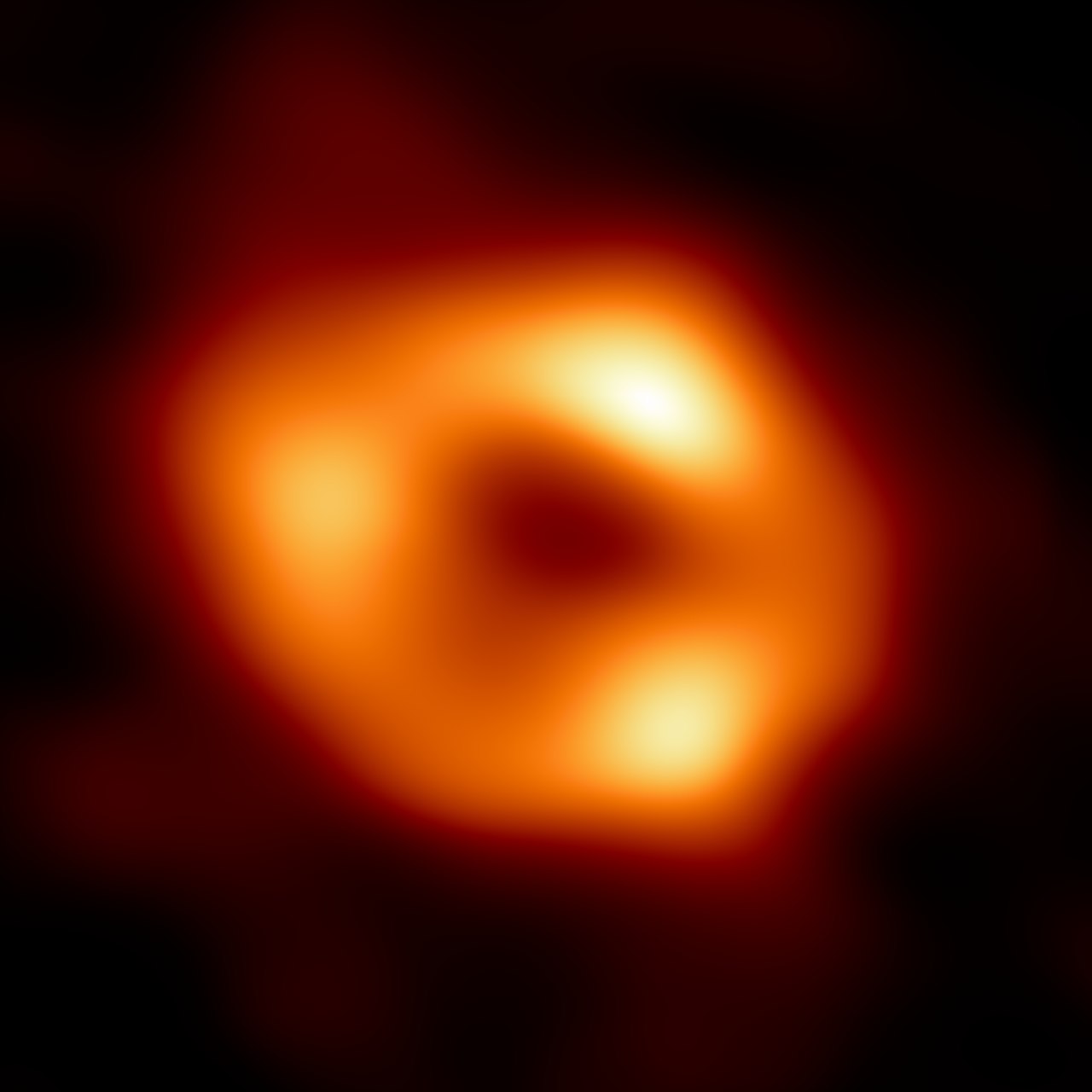
In 2022, astronomers revealed the first image of Sagittarius A*’s shadow, captured by the Event Horizon Telescope. Unlike the relatively steady image of the black hole in galaxy M87, Sagittarius A* proved frustratingly variable. Its brightness changes rapidly because gas orbits close to the event horizon in minutes rather than days.
Sagittarius A* acts strangely not because it is exceptionally violent, but because it fluctuates in unpredictable ways. It sits quietly for long stretches, then erupts in flickering bursts. It is both stable and chaotic, serene and restless.
And we are orbiting it.
2. M87* — The Black Hole That Showed Us Its Face
In 2019, humanity saw something once thought impossible: the silhouette of a black hole. At the center of the galaxy Messier 87 lies M87*, a supermassive black hole with a mass of about 6.5 billion Suns.
The image released by the Event Horizon Telescope revealed a glowing ring of hot gas surrounding a dark central shadow. It was a triumph of global collaboration and observational precision.
But M87* is far stranger than a static photograph suggests.
For over a century, astronomers have observed a massive jet streaming from the core of M87. This jet extends thousands of light-years into space, composed of charged particles accelerated to nearly the speed of light. Its origin lies in the black hole’s accretion disk and powerful magnetic fields, which channel energy outward along the spin axis.
The existence of such a jet is itself extraordinary. Black holes are known for pulling matter inward. Yet here is one blasting energy outward across intergalactic space.
Even more puzzling is how efficiently M87* converts gravitational energy into jet power. The jet shines brightly across the electromagnetic spectrum, indicating extreme particle acceleration. The mechanisms behind this acceleration are still under active study.
M87* is not merely devouring matter. It is sculpting its galaxy, influencing star formation, and injecting colossal energy into its environment. It is both destroyer and architect.
3. Cygnus X-1 — The Black Hole That Spins at the Edge of Physics
In the constellation Cygnus lies one of the first strong black hole candidates ever identified: Cygnus X-1. It resides in a binary system with a massive blue supergiant star, siphoning material from its companion.
Cygnus X-1 emits powerful X-rays as gas from the star spirals into the black hole, heating to millions of degrees in the accretion disk. But what makes this black hole relentlessly strange is its spin.
Measurements suggest that Cygnus X-1 is spinning extremely close to the maximum rate allowed by general relativity. A rapidly spinning black hole drags spacetime around with it in a phenomenon called frame-dragging. Near the event horizon, space itself is twisted into a cosmic whirlpool.
This near-maximal spin affects everything around it. It changes the structure of the accretion disk, influences jet formation, and alters the innermost stable orbit where matter can circle before plunging inward.
The fact that Cygnus X-1 spins so rapidly raises questions about its origin. Did it form from a star that collapsed almost perfectly symmetrically, preserving angular momentum? Did it grow by accreting matter over time?
Its behavior pushes our models to their limits, showing us what happens when gravity and rotation combine at extreme scales.
4. TON 618 — The Monster Beyond Imagination
If stellar black holes are dramatic and supermassive black holes are powerful, then TON 618 is monstrous.
TON 618 is one of the most massive black holes ever observed, with an estimated mass of tens of billions of Suns. It powers an extremely luminous quasar, outshining entire galaxies.
The energy output of TON 618 is staggering. As matter falls into its accretion disk, gravitational energy converts into radiation with extraordinary efficiency. The quasar shines so brightly that it can be seen across billions of light-years.
How does such a black hole grow so massive in the relatively short time after the Big Bang? Observations of distant quasars reveal that supermassive black holes already existed when the universe was less than a billion years old.
The formation and growth mechanisms of these ultramassive black holes remain uncertain. Did they start from massive seed black holes formed by direct gas collapse? Did they grow rapidly through mergers and accretion?
TON 618 challenges our understanding of cosmic evolution. It represents a scale of gravity that seems almost excessive, as though the universe briefly lost restraint.
5. V404 Cygni — The Black Hole That Erupts Without Warning
V404 Cygni is a stellar-mass black hole in a binary system that periodically undergoes dramatic outbursts.
For decades, it remained relatively quiet. Then, in 2015, it erupted in one of the most chaotic black hole outbursts ever recorded. Telescopes around the world observed intense X-ray flares that fluctuated wildly on timescales of minutes.
The brightness changed so rapidly that astronomers struggled to interpret the data. The accretion disk appeared unstable, puffing up and collapsing repeatedly. Powerful winds of hot gas were launched outward, partially obscuring the black hole and then clearing again.
V404 Cygni did not behave like a steady cosmic vacuum cleaner. It acted more like a sputtering engine, surging and choking unpredictably.
These erratic behaviors reveal how complex accretion physics can be. Matter does not always flow smoothly into black holes. It forms turbulent structures, interacts with magnetic fields, and generates violent feedback.
V404 Cygni is a reminder that even small black holes can produce outsized drama.
6. OJ 287 — The Black Hole with a Rhythmic Heartbeat
In the distant universe lies a blazar known as OJ 287. It is believed to host not one but two supermassive black holes locked in a gravitational dance.
OJ 287 exhibits quasi-periodic optical outbursts roughly every 12 years. The leading model suggests that a smaller black hole orbits a much larger one, periodically plunging through its accretion disk. Each plunge generates a burst of radiation.
If confirmed, this system represents one of the best candidates for a supermassive black hole binary. It offers a rare opportunity to study gravitational interactions at enormous scales.
The orbit of the smaller black hole appears to precess due to relativistic effects, providing a test of general relativity in extreme conditions.
OJ 287 acts strangely because it behaves like a cosmic clock, ticking in bursts of light. It reminds us that black holes are not always solitary monsters. Sometimes, they come in pairs—and their interactions can be spectacular.
7. The Black Hole Merger GW150914 — When Spacetime Rang Like a Bell
On September 14, 2015, detectors of the Laser Interferometer Gravitational-Wave Observatory recorded a faint ripple in spacetime. The signal, known as GW150914, came from the merger of two stellar-mass black holes over a billion light-years away.
For a fraction of a second, these two black holes spiraled together and collided, releasing more energy in gravitational waves than all the stars in the observable universe emitted as light during that instant.
The final black hole formed from the merger rang down like a struck bell, emitting gravitational waves that matched predictions from general relativity with remarkable precision.
Yet this event was strange in several ways. The masses of the merging black holes were larger than many previously known stellar black holes, challenging models of stellar evolution. The mere detection of gravitational waves opened an entirely new way of observing the universe.
Black holes are no longer just objects we see indirectly through light. We can now hear them through spacetime vibrations.
The universe itself trembled when these black holes collided.
The Relentless Strangeness of Gravity
Black holes were once theoretical curiosities. Today, they are among the most intensely studied objects in astrophysics. And yet, the more we observe them, the stranger they seem.
They flicker unpredictably. They launch jets across galaxies. They spin space into vortices. They merge and send ripples across the cosmos. They grow to monstrous sizes faster than our models predict.
And deep inside them, beyond the event horizon, lies a region where our two greatest theories—general relativity and quantum mechanics—refuse to cooperate.
Black holes are not merely astronomical objects. They are laboratories for extreme physics. They expose the seams in our understanding of reality.
Gravity, it seems, is not content to behave politely. It bends, twists, accelerates, and sometimes shouts across billions of light-years.
And as we continue to observe these relentlessly strange objects, one truth becomes clear: black holes are not the end of knowledge. They are the beginning of deeper questions.
Somewhere inside their darkness lies the next revolution in physics.