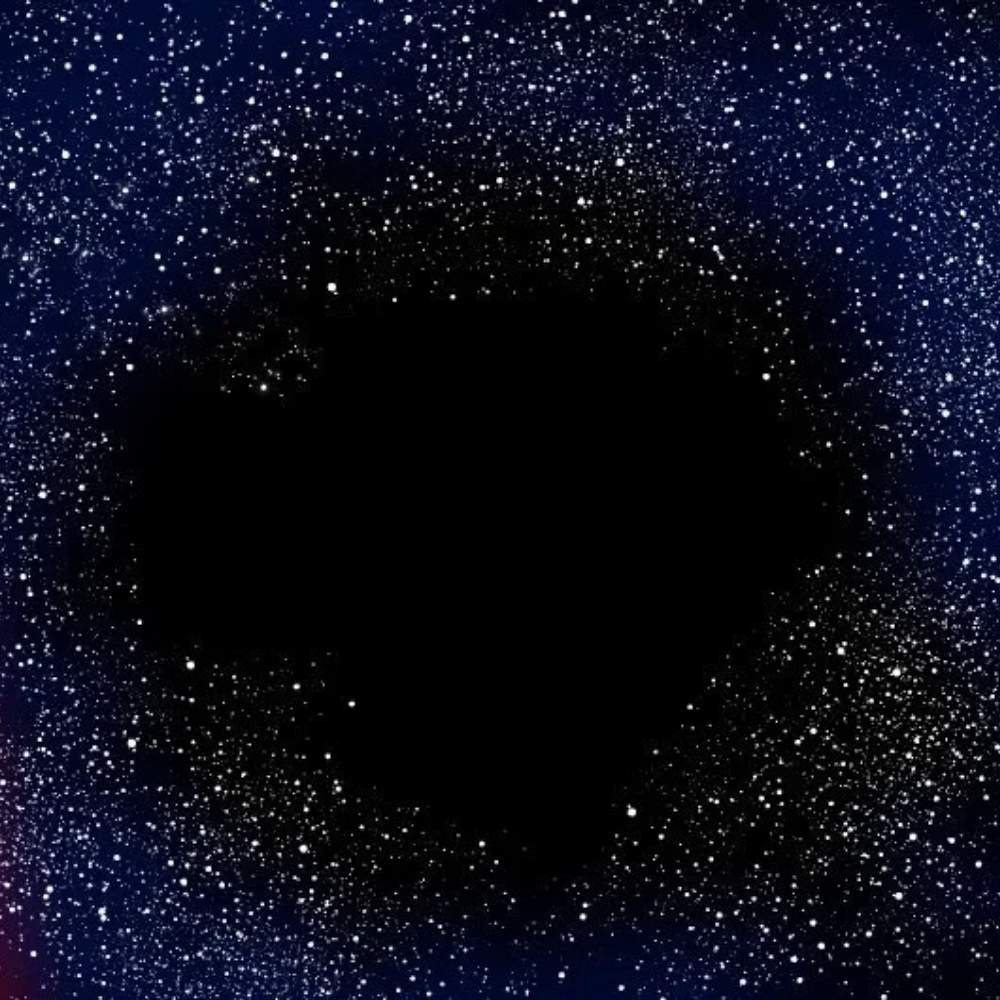
When we imagine the universe, we picture brilliance—spiral galaxies glowing like cosmic whirlpools, supernovae erupting in spectacular bursts of light, nebulae shimmering in radiant clouds of gas and dust. We imagine crowded star systems and the relentless pull of gravity weaving matter into ever more intricate structures.
But the universe is not primarily made of stars.
It is made of emptiness.
On the largest scales, the cosmos resembles a vast cosmic web. Galaxies cluster along immense filaments of dark matter stretching across hundreds of millions of light-years. Where these filaments intersect, galaxy clusters gather in luminous knots. Yet between these glowing strands lie enormous regions where almost nothing exists.
These regions are called cosmic voids. They are not completely empty, but they are so underdense that they can span tens or even hundreds of millions of light-years with only a scattering of galaxies inside them. They are the largest known structures in the universe.
Voids are not simply gaps. They are profound. They shape cosmic evolution. They influence galaxy motion. They hold clues about dark matter, dark energy, and the earliest moments after the Big Bang.
And they are unsettling.
Here are ten of the most mysterious and immense voids known to science—places where the universe fades into astonishing emptiness.
1. The Boötes Void
In 1981, astronomers surveying the distribution of galaxies made a discovery so startling it almost seemed like an error. In the direction of the constellation Boötes lay a region of space roughly 250 million light-years across that contained astonishingly few galaxies.
This region became known as the Boötes Void.
To grasp its scale is to confront the incomprehensible. If the Milky Way were placed at one edge of the Boötes Void, light traveling at 300,000 kilometers per second would take 250 million years to cross to the other side.
Within this enormous expanse, only a small number of galaxies are known to exist, far fewer than expected from average cosmic density. It is not entirely empty, but compared to surrounding regions, it is strikingly barren.
How did such a vast void form?
According to cosmological models, tiny density fluctuations in the early universe were amplified by gravity. Regions slightly denser than average pulled in matter and grew into filaments and clusters. Regions slightly less dense became emptier over time, as matter drained away into surrounding structures.
The Boötes Void may represent one of these primordial underdensities expanded to extreme proportions.
Yet its size and relative isolation still provoke curiosity. It stands as one of the earliest and most dramatic confirmations that the universe on large scales is not uniform but structured like a web—with yawning cavities between its luminous strands.
2. The Eridanus Supervoid
In the southern constellation Eridanus lies a vast underdense region sometimes called the Eridanus Supervoid. This void gained particular attention because it appears to coincide with a mysterious feature in the cosmic microwave background known as the Cold Spot.
The Cold Spot is an unusually cool region in the relic radiation from the Big Bang. One hypothesis proposed that light from the early universe passed through the Eridanus Supervoid, losing energy through gravitational effects in a way that produced the temperature anomaly.
The void itself may span roughly 1.8 billion light-years, though its exact structure remains debated. If confirmed at that scale, it would be among the largest known cosmic underdensities.
Whether the supervoid fully explains the Cold Spot is still uncertain. Some studies suggest the void is not deep enough to account entirely for the temperature difference. Others argue that additional physics may be involved.
Regardless, the Eridanus Supervoid illustrates how vast regions of near-emptiness can leave subtle imprints on the oldest light in the universe.
3. The Local Void
Not all cosmic voids are distant. One lies surprisingly close to our own galaxy.
The Local Void is a nearby underdense region adjacent to the Local Group, the collection of galaxies that includes the Milky Way and Andromeda. Compared to surrounding cosmic structures, this region contains very few galaxies.
The Local Void exerts a measurable gravitational influence. Galaxies near its boundary appear to be moving away from it faster than expected, as if being pushed outward by surrounding denser regions.
This motion is not due to repulsive gravity but to the relative lack of mass inside the void. Matter in denser regions pulls more strongly, creating apparent motion away from emptiness.
The Local Void reminds us that we are not situated in a uniformly populated cosmos. Even our galactic neighborhood is shaped by immense gaps.
4. The KBC Void
The KBC Void, named after astronomers Keenan, Barger, and Cowie, is a proposed large underdensity that may encompass our local cosmic region.
Some studies suggest that within a radius of roughly 1 billion light-years, galaxy density may be lower than average. If true, we might reside within a relatively underdense bubble compared to the broader universe.
Such a local underdensity could have implications for measurements of the Hubble constant, the rate at which the universe expands. If our region is less dense, local expansion rates might differ slightly from global averages.
The idea remains debated, and further surveys are refining our understanding. But the possibility that we live inside a giant cosmic void adds a subtle twist to our cosmic address.
5. The Giant Void in the Cosmic Web
Large-scale galaxy surveys reveal that voids are not rare anomalies but fundamental components of cosmic structure. Some individual voids span hundreds of millions of light-years.
One particularly large void identified in galaxy surveys measures over 300 million light-years across. It lies embedded within the broader cosmic web, defined by the distribution of galaxies mapped across vast distances.
These giant voids form naturally in simulations of cosmic evolution. As dark matter collapses into filaments, matter drains from underdense regions, leaving expanding bubbles of emptiness.
Over billions of years, these voids grow larger and emptier.
They are not static holes but dynamic features shaped by gravity and cosmic expansion.
6. The Northern Local Supervoid
In certain directions of the sky, galaxy surveys reveal extended regions of below-average density sometimes referred to as local supervoids.
The Northern Local Supervoid is one such region, extending across hundreds of millions of light-years with reduced galaxy counts compared to neighboring areas.
Mapping such structures is challenging. Astronomers rely on redshift surveys to determine galaxy distances and construct three-dimensional maps.
These maps show that voids often connect, forming networks of emptiness separated by filaments.
The Northern Local Supervoid contributes to the patchwork pattern of cosmic density, reminding us that emptiness can be structured and coherent on immense scales.
7. The South Pole Wall Void Region
The South Pole Wall is a massive cosmic structure composed of galaxy clusters and filaments. Adjacent to it lie underdense regions that emphasize the contrast between structure and emptiness.
These void regions, though less famous than named supervoids, play an essential role in defining the cosmic web.
The interplay between walls of galaxies and adjacent voids illustrates how gravity sculpts the universe into patterns reminiscent of foam bubbles.
The voids are not merely background. They are half of the structure.
8. The Hercules Void
In the direction of the Hercules constellation lies another notable underdense region known as the Hercules Void.
Like other voids, it spans hundreds of millions of light-years and contains far fewer galaxies than average.
Its existence reinforces the statistical reality that large portions of the universe are dominated not by clusters but by vast, sparsely populated expanses.
The Hercules Void, like its counterparts, formed from initial density fluctuations seeded in the early universe.
Tiny variations in the primordial plasma eventually became enormous voids.
The scale amplification from quantum fluctuations to cosmic cavities is one of the most astonishing transformations in cosmology.
9. The Microscopium Void
The Microscopium Void lies in the southern sky and represents another large-scale underdensity identified in galaxy catalogs.
Although less widely discussed than the Boötes Void, it shares similar properties: enormous size, low galaxy density, and location within the intricate cosmic web.
The naming of voids often reflects constellations in their direction, but their true dimensions transcend human sky patterns.
The Microscopium Void, like others, is part of a network of expanding emptiness shaping galaxy motion and distribution.
10. The Integrated Sachs-Wolfe Void Effects
Some voids are identified not only through galaxy counts but also through their subtle gravitational effects on cosmic microwave background radiation.
When photons from the early universe pass through large-scale structures, including voids, their energies can be slightly altered by the evolving gravitational potential. This phenomenon is known as the Integrated Sachs-Wolfe effect.
Certain large voids leave measurable imprints on background radiation, detectable through statistical analysis.
These effects reveal that voids are not passive gaps but active participants in cosmic evolution, interacting with light across billions of years.
They are emptiness with consequence.
The Physics of Nothing
Cosmic voids are not absolute nothingness. Even in the deepest voids, a thin sprinkling of galaxies may exist. Dark matter permeates them, though at much lower densities. Intergalactic gas, though rarefied, is present.
But compared to galaxy clusters, voids are extraordinarily empty.
Their average density may be less than 10 percent of the cosmic mean.
In these regions, gravity is weaker. Galaxy formation is suppressed. Structures evolve differently.
Voids expand faster than denser regions because matter flows outward into surrounding filaments. Over time, they become emptier still.
They are expanding bubbles in the cosmic foam.
Why Voids Matter
At first glance, emptiness might seem unimportant. But voids are powerful tools for cosmology.
Their size distribution and growth rate provide insight into dark energy. Their shapes and clustering test models of gravity on large scales.
Because voids are relatively simple environments with fewer nonlinear interactions, they can offer cleaner tests of cosmological theories than dense clusters.
Studying voids helps refine our understanding of the universe’s composition and expansion history.
They are laboratories of nothingness.
The Emotional Weight of Emptiness
There is something psychologically unsettling about cosmic voids.
Human minds are drawn to structure, to light, to matter. We understand objects. We struggle to comprehend absence.
To imagine a region 300 million light-years across with almost no galaxies is to confront a scale beyond intuition.
These voids are reminders that the luminous galaxies we admire represent only a small fraction of cosmic volume.
Most of the universe is dark and sparse.
And yet, it is precisely this emptiness that allows structure to exist. Without underdense regions draining matter into filaments, the cosmic web would not form.
The voids are as essential as the galaxies.
The Universe as a Cosmic Foam
When mapped on the largest scales, the universe resembles a three-dimensional foam.
Galaxies trace the thin walls and filaments between enormous bubbles of emptiness.
This structure emerged from tiny fluctuations in the early universe, amplified by gravity over billions of years.
Computer simulations reproduce this pattern with striking accuracy, showing how dark matter collapses into nodes and strands while voids grow between them.
The universe is not chaotic randomness. It is structured absence.
What Lies Within the Void
Inside cosmic voids, galaxies that do exist often evolve differently.
They may experience fewer interactions and mergers. Star formation histories may diverge from galaxies in dense clusters.
Void galaxies offer insights into how environment shapes cosmic evolution.
Even in emptiness, life cycles of stars continue.
Void does not mean static.
The Deepest Silence
The concept of nothingness in physics is complex.
Even a perfect vacuum contains quantum fluctuations. Virtual particles flicker into and out of existence.
Cosmic voids are not perfect vacuums. They contain matter, radiation, and dark energy.
But relative to the crowded brilliance of galaxy clusters, they are silent expanses.
If a civilization existed inside a deep void, their night sky might reveal fewer galaxies, fewer cosmic landmarks.
Their cosmic perspective would be different from ours.
The Final Reflection
The universe is not uniformly filled with stars and galaxies.
It is defined by contrast.
Filaments of light weave through enormous cavities of darkness.
The ten voids described here represent some of the most dramatic expressions of cosmic emptiness ever observed.
They are not errors or anomalies.
They are fundamental.
They remind us that the universe is shaped as much by absence as by presence.
In the end, perhaps the most mysterious thing about these voids is not that they are empty—but that from such emptiness arose everything we see.
Galaxies. Stars. Planets. Life.
In a cosmos dominated by vast regions of almost nothing, matter gathered just enough, just often enough, to create something.
And in that fragile balance between void and structure, we exist.