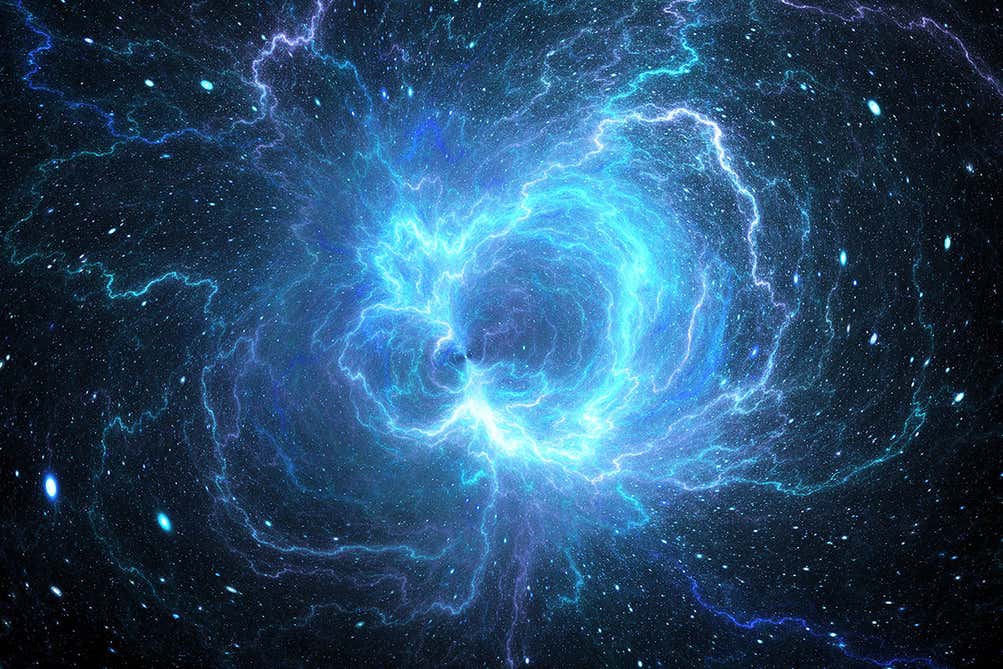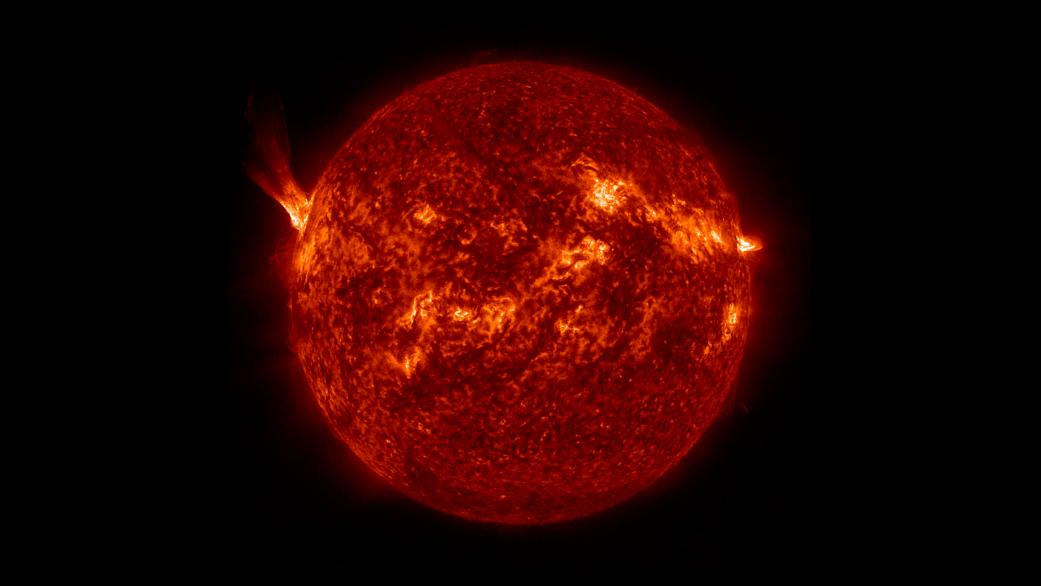
Imagine waking up one ordinary morning. The sky looks the same for a brief moment, blue and familiar. Birds are mid-flight, cities are already humming, oceans continue their slow, patient motion. Then, without warning, without explosion or sound, the Sun—the constant presence at the center of our lives—ceases to be what it has always been. In its place, an object of unimaginable density forms instantly: a black hole with the same mass as the Sun.
This scenario sounds like the opening of a science fiction story, but it is also a profound scientific thought experiment. What would really happen if the Sun turned into a black hole instantly? Would Earth be swallowed? Would gravity tear the solar system apart? Would everything freeze, burn, or vanish into darkness?
The answers are both less dramatic and far more haunting than popular imagination suggests. To understand them, we must carefully separate cinematic myths from the actual laws of physics, and in doing so, confront just how delicately balanced our existence truly is.
What It Means for the Sun to Become a Black Hole
A black hole is not defined by its appetite for destruction but by its density. If you take a certain amount of mass and compress it into a small enough volume, space and time curve so intensely that not even light can escape. That boundary is called the event horizon. Inside it, the known laws of physics break down.
For the Sun to become a black hole, its entire mass would have to collapse into a sphere only about three kilometers in radius. This is unimaginably smaller than the Sun’s current size, which is large enough to hold more than a million Earths inside it. In reality, our Sun cannot become a black hole through natural processes. It is not massive enough. But this thought experiment ignores how and asks only what if.
Crucially, the Sun’s mass would remain exactly the same. That single fact shapes almost everything that follows.
Gravity Would Not Suddenly Change
One of the most common misconceptions about black holes is that they exert some kind of super-gravity, a cosmic vacuum cleaner that sucks everything nearby into oblivion. This idea feels intuitive, but it is wrong.
Gravity depends on mass, not on what form that mass takes. If the Sun instantly became a black hole with the same mass, its gravitational pull on Earth would remain unchanged. The equations governing Earth’s orbit would not notice the difference.
Earth would continue orbiting the new black hole exactly as it orbits the Sun now, tracing the same elliptical path through space. The Moon would stay bound to Earth. Planets would remain in their lanes. The solar system would not collapse or fly apart.
In this sense, gravity would be the least dramatic part of the event.
Eight Minutes of Normalcy
Light takes time to travel. Sunlight reaches Earth about eight minutes after it leaves the Sun’s surface. If the Sun turned into a black hole instantly, Earth would not know right away.
For eight minutes, everything would appear perfectly normal. Daylight would continue to shine. Solar panels would generate power. Plants would continue photosynthesis. People would look up and see the Sun still hanging in the sky.
Then, suddenly, the light would stop.
There would be no gradual dimming, no warning glow, no cosmic sunset. One moment it would be day, the next moment it would be night—an absolute, unnatural darkness falling across half the planet at once.
The Sudden Death of Light
When the sunlight vanishes, it vanishes completely. A black hole of the Sun’s mass would emit essentially no visible light. There would be no warmth, no glow, no gentle twilight.
The stars would appear instantly, even at what had been noon. The sky would turn black, deeper than any night humanity has ever known, because the Moon would not reflect sunlight either. It would disappear from view.
This darkness would be psychologically devastating. For every living creature on Earth, the Sun has always been there. Its sudden absence would feel like the universe itself had blinked and forgotten us.
The Immediate Thermal Shock
Light is not just illumination. It is energy. The Sun continuously bathes Earth in heat, maintaining a delicate thermal balance that makes liquid water, weather, and life possible.
Without incoming solar radiation, Earth would begin to cool immediately. Not freeze instantly, but cool in a way that no organism is prepared for.
Within hours, surface temperatures would begin to drop sharply. Winds would intensify as atmospheric heat gradients destabilize. Weather patterns would collapse into chaos. The familiar rhythms of day and night would be replaced by unending darkness.
Within days, average global temperatures would fall below freezing.
The Collapse of Photosynthesis
Plants, algae, and photosynthetic bacteria form the base of nearly every food chain on Earth. They convert sunlight into chemical energy, feeding themselves and indirectly feeding almost all other life.
When the Sun goes dark, photosynthesis stops instantly.
Plants would not die immediately, but they would stop producing new energy. Within weeks, most plants would be dead. Forests would become silent graveyards. Crops would fail completely. Oceanic phytoplankton, responsible for a significant fraction of Earth’s oxygen production, would collapse.
The extinction cascade would begin quietly but relentlessly.
The Fate of the Atmosphere
Earth’s atmosphere is held in place by gravity, not sunlight, so it would not immediately escape into space. However, the Sun plays a crucial role in keeping the upper atmosphere warm.
As temperatures drop, the atmosphere would contract. The stratosphere and thermosphere would cool and sink. Weather systems would cease functioning as we know them. Without solar heating, the energy driving winds and storms would vanish.
Over longer timescales, Earth would lose atmospheric gases more easily, especially lighter ones, but this would take many thousands to millions of years. The immediate danger would not be suffocation, but freezing and starvation.
Oceans in Darkness
The oceans store vast amounts of heat, far more than the atmosphere. This thermal inertia would slow Earth’s descent into a frozen world, but it would not prevent it.
Within weeks, the surface of the oceans would begin to freeze. Sea ice would spread from the poles toward the equator. Without sunlight, evaporation would drop, precipitation would fail, and the global water cycle would effectively shut down.
Over centuries, the oceans would freeze almost entirely, except perhaps for liquid layers deep below the ice, warmed by geothermal heat from Earth’s interior.
Life Underground and in the Deep Sea
Not all life depends directly on sunlight. Deep-sea ecosystems near hydrothermal vents thrive on chemical energy, not solar energy. Underground microbial life feeds on heat and minerals.
These ecosystems might survive long after the surface becomes uninhabitable. In the absence of sunlight, Earth would resemble an icy, dark world with isolated pockets of warmth deep below the surface.
For humans, survival would require retreating underground or beneath ice, relying on nuclear energy or geothermal heat. Civilization as we know it would collapse within months.
The Long-Term Orbital Stability
Even as Earth freezes, it would continue orbiting the black hole at the center of the solar system. From a purely gravitational perspective, nothing would be wrong.
But without solar radiation pressure and solar wind, subtle changes would occur. Dust and small particles would behave differently. Comet tails would vanish. The heliosphere, the vast magnetic bubble inflated by the Sun’s activity, would collapse.
Cosmic radiation from interstellar space would more easily penetrate the solar system, increasing radiation exposure on Earth’s surface once the atmosphere thins and protective magnetic interactions weaken.
Would Earth Ever Fall Into the Black Hole?
The answer is no, not under normal circumstances.
Earth’s orbit would remain stable indefinitely unless disturbed by an external force. The black hole would not “pull harder” simply because it is a black hole. As long as Earth maintains its orbital velocity, it will continue circling forever.
The event horizon of a solar-mass black hole is tiny compared to Earth’s orbital distance. Falling into it would require losing nearly all orbital energy, which would not happen spontaneously.
The Psychological Impact on Humanity
Beyond the physical devastation, the emotional impact would be profound. The Sun is not just a star; it is a symbol embedded deeply in human culture, language, and psychology.
Its sudden disappearance would feel like cosmic abandonment. Day and night would lose meaning. Time itself, once measured by sunrise and sunset, would become abstract.
Fear, despair, and existential panic would spread faster than cold. Religions, philosophies, and worldviews would be shaken to their core. Humanity would be forced to confront the fragility of its place in the universe more directly than ever before.
The Black Hole as a Silent Sun
Ironically, the black hole replacing the Sun would be invisible and quiet. There would be no dramatic jets, no swirling accretion disk, because there would be very little material falling into it.
From Earth’s distance, it would behave almost exactly like a dark star with the Sun’s mass. It would not actively destroy the solar system. It would simply fail to support life.
This silence makes the scenario more chilling. The universe would not attack us. It would simply stop providing what we need.
Why This Scenario Cannot Happen Naturally
It is important to emphasize that this scenario violates known physics. The Sun cannot turn into a black hole instantly. It lacks the mass required to collapse that far.
Real black holes form from stars many times more massive than the Sun, after violent supernova explosions. Our Sun’s future, billions of years from now, is to become a red giant and then a white dwarf, not a black hole.
This thought experiment exists not to predict reality, but to illuminate how gravity, light, and life are connected.
What This Thought Experiment Teaches Us
The idea of the Sun becoming a black hole reveals how dependent life is on energy flow, not just gravity. It shows that stability in motion does not guarantee habitability. A planet can orbit perfectly and still be utterly dead.
It also exposes how misunderstood black holes are. They are not universal destroyers. They obey the same gravitational laws as any other object of the same mass.
Most importantly, this scenario highlights how finely tuned our existence is. The Sun’s steady light, its gentle warmth, and its long-term stability are not guaranteed features of the universe. They are conditions that happen to exist here and now.
A Universe Indifferent but Understandable
If the Sun turned into a black hole instantly, the universe would not mourn. Physics would continue operating flawlessly. Orbits would remain stable. Laws would be obeyed.
Life, however, would suffer.
This contrast lies at the heart of physics. The universe is not hostile, but it is not kind. It does not care whether life exists, yet it allows life under certain conditions. Understanding those conditions is both a scientific and emotional journey.
Darkness as a Mirror
Imagining a sunless Earth orbiting a silent black hole forces us to confront our dependence on forces we rarely notice. It reminds us that warmth, light, and life are not defaults. They are gifts of circumstance.
In that imagined darkness, physics does not become cruel. It becomes honest.
And perhaps that honesty is the most powerful lesson of all.