The microscopic world is a hidden universe layered beneath our everyday reality. It exists beyond the reach of our naked eyes, yet it shapes everything we touch, breathe, eat, and even think. Within this invisible realm live organisms older than humanity, structures smaller than atoms, and processes so elegant that they blur the line between chemistry and life itself. This world is not silent or simple. It is crowded, dynamic, competitive, cooperative, and endlessly inventive.
For centuries, humans lived unaware of this dimension of existence. Only with the invention of microscopes did we realize that entire civilizations thrive in a drop of water, that our bodies are ecosystems, and that the foundations of life operate on scales almost impossible to imagine. The microscopic world is not just small; it is profound. It reveals how complexity arises from simplicity and how the tiniest entities can shape planets, climates, and civilizations.
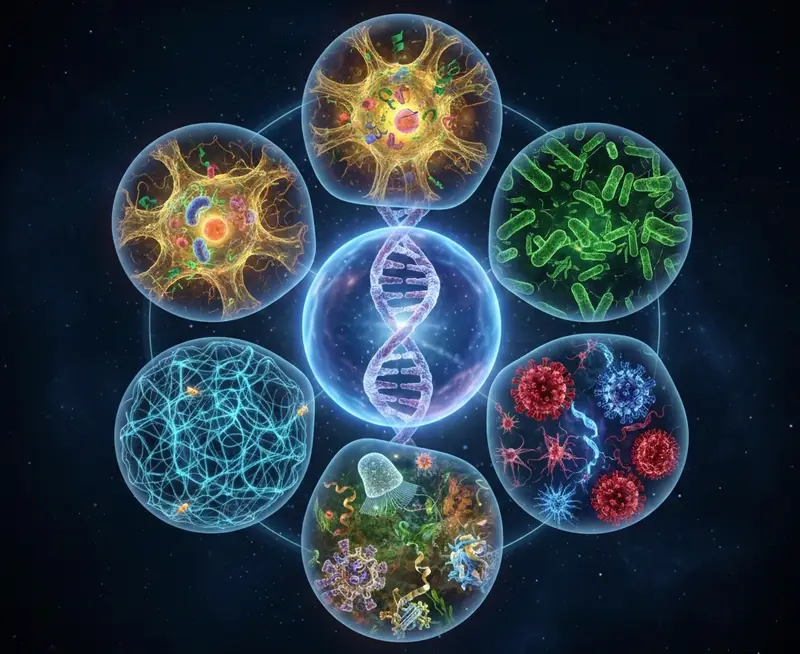
Here are seven wonders of the microscopic world—marvels so small they are invisible to the eye, yet so powerful they define life on Earth.
1. The Cell: The Smallest Unit of Life That Builds Everything
Every living thing on Earth, from towering trees to human beings, is built from cells. A single cell is a self-contained world, capable of maintaining balance, responding to its environment, reproducing, and in some cases, thinking in its own biochemical way. Cells are not just building blocks; they are living factories, libraries, power plants, and cities all at once.
Inside a cell, countless processes happen simultaneously. Proteins are assembled with extraordinary precision. Energy is generated through complex chemical reactions. Genetic instructions encoded in DNA are read, copied, and repaired constantly. All of this happens in a space so small that millions of cells could fit on the head of a pin.
What makes the cell truly wondrous is its efficiency. There is no wasted space, no unnecessary movement. Molecules find their targets through diffusion, collisions, and finely tuned chemical attractions. Errors are corrected. Damage is repaired. When conditions are right, cells divide, giving rise to growth, healing, and reproduction.
Emotionally, the idea of the cell reshapes how we see ourselves. You are not a single being, but a vast community of trillions of cells working together in remarkable harmony. Each heartbeat, breath, and thought is the result of microscopic cooperation happening every second of your life.
2. DNA: The Invisible Code That Writes Life
If cells are the actors of life, DNA is the script. Deoxyribonucleic acid is a molecule so small it can only be seen with powerful instruments, yet it contains the instructions to build and maintain an entire organism. Coiled tightly within the nucleus of nearly every cell, DNA carries information passed down through generations, linking every living thing to its ancestors.
The structure of DNA is elegantly simple: a double helix resembling a twisted ladder. But within that structure lies astonishing complexity. Sequences of just four chemical bases encode everything from eye color to immune responses, from the shape of leaves to the instincts of animals.
DNA is not static. It replicates with incredible accuracy, yet it also mutates. These small changes are the engine of evolution, allowing life to adapt, diversify, and survive changing environments. Errors in DNA replication can lead to disease, but they can also lead to innovation at the scale of species.
The wonder of DNA lies not only in its function but in its implications. Every human shares the vast majority of their DNA with every other human, and even with distant life forms. At the microscopic level, all life on Earth speaks the same biochemical language, written in the same molecular alphabet.
3. Bacteria: The Ancient Rulers of Earth
Bacteria are among the smallest and oldest living organisms on the planet, yet they are also among the most influential. Long before plants, animals, or humans existed, bacteria shaped Earth’s atmosphere, oceans, and soil. They are found everywhere—deep underground, in boiling hot springs, frozen in ice, and inside your body.
A single bacterium is astonishingly simple compared to a human cell, yet its survival skills are extraordinary. Bacteria can sense their environment, move toward nutrients, communicate with one another, and adapt rapidly to threats. Some species can survive extreme radiation, crushing pressure, or total lack of oxygen.
Inside the human body, bacteria are not just passengers; they are partners. Trillions of bacteria live in the gut, helping digest food, synthesize vitamins, and train the immune system. Without them, human life as we know it would not be possible.
Bacteria also remind us that power does not require size. Microscopic organisms can cause global pandemics, transform ecosystems, and drive evolution. They are a humbling force, teaching us that dominance in nature is not measured in mass or visibility, but in adaptability.
4. Viruses: The Borderline Between Life and Non-Life
Viruses occupy one of the strangest positions in the microscopic world. They are not fully alive, yet they are not truly inanimate. A virus is essentially genetic material wrapped in a protein shell, unable to reproduce on its own. To exist, it must invade a living cell and hijack its machinery.
Once inside a host cell, a virus becomes frighteningly efficient. It redirects the cell’s resources to produce copies of itself, often destroying the cell in the process. This parasitic simplicity makes viruses both elegant and dangerous.
Despite their reputation as enemies, viruses play a complex role in life. They influence evolution by transferring genes between organisms. Some viruses regulate populations of bacteria in oceans, shaping global nutrient cycles. Others have become integrated into the genomes of animals, including humans, where they now serve essential functions.
The wonder of viruses lies in their ambiguity. They challenge our definitions of life, agency, and survival. They show that even at the smallest scales, existence does not fit neatly into human categories.
5. The Cytoskeleton: The Microscopic Architecture of Life
Inside every cell is a structure that gives it shape, strength, and the ability to move: the cytoskeleton. This network of protein filaments acts like an internal scaffolding, supporting the cell and organizing its contents. But it does far more than hold things in place.
The cytoskeleton is dynamic, constantly assembling and disassembling itself. It allows cells to change shape, divide, and transport materials internally. Motor proteins walk along cytoskeletal tracks, carrying cargo with astonishing precision, much like trains running on microscopic railways.
This internal architecture is essential for life. Without it, cells would collapse into chaos. Nerve cells could not transmit signals properly. Immune cells could not chase down pathogens. Development itself would be impossible.
The cytoskeleton reveals that even at microscopic scales, life depends on structure, organization, and movement. It is a reminder that biology is not random chemistry, but a carefully choreographed performance unfolding at unimaginable speed.
6. Microscopic Ecosystems in a Drop of Water
A single drop of pond water can contain an entire ecosystem. Under a microscope, this droplet transforms into a bustling world filled with algae, protozoa, bacteria, and tiny multicellular organisms. Predators hunt prey. Photosynthetic organisms harvest light. Waste is produced, recycled, and reused.
These microscopic ecosystems mirror the complexity of forests or coral reefs, compressed into a space smaller than a grain of rice. They contain food webs, competition, cooperation, and balance. Disturb the environment slightly, and the entire system shifts.
What makes these ecosystems truly wondrous is their resilience. They respond quickly to change, adapting faster than large-scale ecosystems. They demonstrate how life organizes itself wherever conditions allow, regardless of scale.
Emotionally, these hidden worlds invite humility. Entire dramas of survival and interaction unfold unnoticed beneath our feet, reminding us that significance is not determined by size or visibility.
7. Molecular Machines: The Tiny Engines That Power Life
At the smallest scale of biology exist molecular machines—proteins and complexes that perform specific tasks with mechanical precision. These structures rotate, pull, push, and assemble components, all driven by chemical energy.
One of the most astonishing examples is ATP synthase, a molecular motor embedded in cell membranes. It spins like a turbine, producing ATP, the molecule that powers nearly all cellular activity. This rotation happens billions of times every second across your body, fueling movement, thought, and growth.
Other molecular machines copy DNA, repair damage, transport materials, and trigger responses. They are not conscious, yet their efficiency rivals human-engineered machines. They operate in crowded, noisy environments, yet achieve extraordinary reliability.
These machines reveal a deeper truth about life: complexity does not require intention. Order can emerge from physical laws, shaped by evolution into systems of breathtaking sophistication.
The Emotional Power of the Invisible World
The microscopic world changes how we understand existence. It teaches us that life is layered, that reality extends far beyond what we can see, and that the foundations of our world are built from entities smaller than imagination. It humbles us by showing that humans are not separate from nature, but deeply embedded within it.
Every breath you take involves oxygen molecules interacting with hemoglobin. Every thought depends on microscopic ion flows across neuron membranes. Every meal feeds not just you, but trillions of unseen partners living inside your body.
The wonders of the microscopic world are not distant or abstract. They are happening within you right now. They are the quiet miracles that make life possible, unfolding endlessly in silence.
To truly appreciate them is to see the universe not just as vast and star-filled, but as intimate, intricate, and alive at every scale.