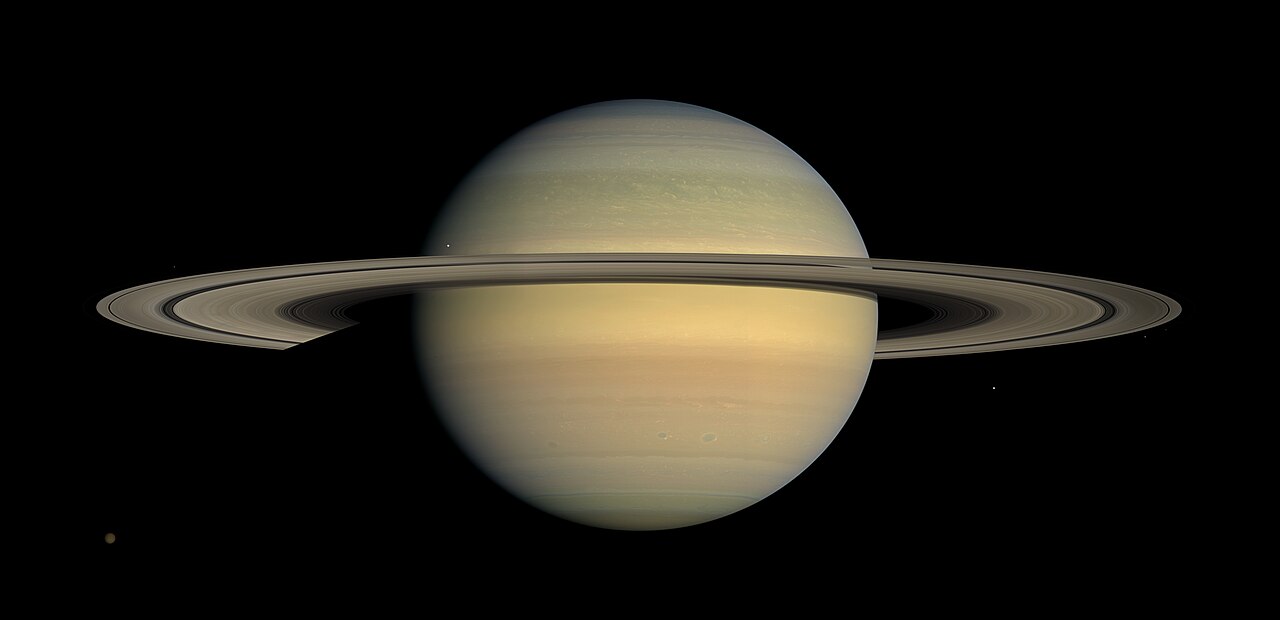
There is something almost dreamlike about Saturn. Among all the worlds that circle our Sun, it is the one that seems least like a distant sphere of rock or gas and most like a work of cosmic art. Suspended in the blackness of space, adorned with shimmering rings that stretch out like delicate threads of light, Saturn captures the imagination in a way few celestial objects can. It feels less like a planet and more like a symbol—of mystery, of beauty, of the vast and silent complexity of the universe.
Yet behind that beauty lies a world of staggering scale and complexity. Saturn is not just a pretty face in the sky. It is a colossal gas giant, a storm-filled realm where winds scream across its atmosphere at incredible speeds, where pressures crush and temperatures rise deep below the clouds, and where dozens of moons dance in intricate gravitational harmony.
To understand Saturn is to journey far beyond its rings and into the deeper truths of planetary science, cosmic history, and the processes that shaped our solar system.
The Discovery and Early Observations of Saturn
Saturn has been known to humanity for thousands of years. Unlike the faint planets that require telescopes to detect, Saturn is visible to the naked eye. Ancient civilizations across the world observed it wandering slowly through the night sky, distinguishing it from the fixed stars.
Because of its slow movement, Saturn was often associated with time, patience, and cycles. In ancient Roman culture, it was named after the god Saturnus, a deity linked to agriculture and time. In other cultures, it carried different meanings, yet always retained an aura of significance.
The true nature of Saturn began to emerge in the early seventeenth century when the Italian astronomer Galileo Galilei turned his telescope toward it. What he saw puzzled him. Saturn did not appear as a simple sphere. Instead, it seemed to have strange extensions on either side, like ears or handles. Galileo could not resolve the structure clearly and described it as a triple-bodied object.
It was only decades later that the Dutch astronomer Christiaan Huygens correctly interpreted these features as a ring system surrounding the planet. This discovery transformed Saturn from a curiosity into one of the most fascinating objects in the solar system.
As telescopes improved, astronomers continued to refine their understanding. They discovered that the rings were not solid structures but composed of countless smaller particles. Over time, Saturn became a central subject in the study of planetary formation and dynamics.
Saturn’s Place in the Solar System
Saturn is the sixth planet from the Sun, orbiting at a vast distance of about 1.4 billion kilometers. It resides in the outer region of the solar system, beyond the asteroid belt and the orbit of Jupiter. As one of the gas giants, Saturn belongs to a group of massive planets that differ fundamentally from the rocky worlds closer to the Sun.
With a diameter of approximately 120,000 kilometers, Saturn is the second-largest planet in the solar system, surpassed only by Jupiter. Its size is so immense that more than 760 Earths could fit inside it. Despite this enormous volume, Saturn is surprisingly light for its size. Its average density is so low that, in theory, it could float in water if such a vast ocean existed.
This low density reflects its composition. Saturn is made primarily of hydrogen and helium, the same elements that dominate the Sun. These gases exist in different states within the planet, transitioning from gaseous layers in the upper atmosphere to liquid and possibly metallic forms deeper inside.
Saturn’s orbit around the Sun takes about 29.5 Earth years. This long journey means that each season on Saturn lasts for more than seven Earth years. As the planet moves along its orbit, the tilt of its axis causes changes in how sunlight illuminates its rings, creating spectacular variations in their appearance when viewed from Earth.
The Structure and Composition of Saturn
At first glance, Saturn appears as a smooth, pale yellow sphere, but this simplicity hides a complex and dynamic internal structure. Like other gas giants, Saturn does not have a solid surface in the way Earth does. Instead, it transitions gradually from its outer atmosphere into deeper, denser layers.
The outermost region is composed of clouds made primarily of ammonia crystals. These clouds form bands that wrap around the planet, driven by powerful winds and atmospheric currents. Beneath these clouds lies a deeper layer where pressures increase and temperatures rise dramatically.
As one descends further into Saturn, hydrogen gas is compressed into a liquid state. Deeper still, it may transform into metallic hydrogen, a phase in which hydrogen behaves like an electrical conductor. This layer plays a crucial role in generating Saturn’s magnetic field.
At the center of the planet is believed to be a dense core composed of rock and ice. This core is much smaller relative to the planet’s size but contains a significant portion of its mass.
The transition from one layer to another is not sharply defined. Instead, Saturn’s interior is a continuous gradient of increasing density and pressure, creating a world that is both fluid and dynamic.
The Magnificent Rings of Saturn
No discussion of Saturn would be complete without its rings, the feature that makes it instantly recognizable and uniquely captivating.
Saturn’s rings are vast, extending hundreds of thousands of kilometers from the planet, yet they are astonishingly thin—often only tens of meters thick. This contrast between width and thickness gives them a delicate, almost fragile appearance.
The rings are composed primarily of ice particles, mixed with smaller amounts of rock and dust. These particles range in size from tiny grains to chunks as large as houses. Each particle orbits Saturn independently, following the laws of gravity and motion.
The ring system is divided into several main sections, labeled alphabetically in the order of their discovery. These include the A, B, and C rings, which are the most prominent, as well as fainter rings such as the D, E, F, and G rings.
Within the rings, countless structures can be observed—gaps, waves, and intricate patterns created by gravitational interactions. Some gaps are caused by moons that orbit within or near the rings, clearing paths as they move. These “shepherd moons” help maintain the structure of the rings, preventing them from spreading out into space.
The origin of Saturn’s rings remains an area of active research. One leading theory suggests that they formed from the remnants of a moon or comet that was torn apart by Saturn’s gravity. Another possibility is that they are leftover material from the formation of the planet itself.
Whatever their origin, the rings are not permanent. Over time, they are gradually losing material, and scientists believe that they may eventually disappear, making Saturn’s current appearance a temporary phase in its long history.
Saturn’s Atmosphere and Weather
Saturn’s atmosphere is a realm of motion and turbulence. Although it appears calm from a distance, closer observation reveals a dynamic environment shaped by powerful winds and complex weather systems.
The planet’s atmosphere is divided into bands, similar to those seen on Jupiter, but with less contrast. These bands are regions of rising and sinking gases, creating subtle variations in color and brightness.
Wind speeds on Saturn can reach up to 1,800 kilometers per hour, making them among the fastest in the solar system. These winds drive massive storms that can last for months or even years.
One of the most remarkable features in Saturn’s atmosphere is the hexagon at its north pole. This enormous, six-sided jet stream has puzzled scientists since its discovery. Unlike typical storms, the hexagon is remarkably stable, maintaining its shape over long periods.
Lightning storms also occur within Saturn’s atmosphere, producing powerful bursts of energy. These storms can be so intense that they are detectable from space as radio emissions.
Despite its beauty, Saturn’s atmosphere is an extreme environment. Temperatures are incredibly low in the upper layers, while pressures increase dramatically with depth. It is a world far removed from anything we experience on Earth.
The Moons of Saturn
Saturn is surrounded by an extraordinary system of moons, each with its own unique characteristics. More than 140 moons have been identified, making Saturn the planet with the largest number of known satellites in the solar system.
Among these moons, Titan stands out as one of the most fascinating. It is larger than the planet Mercury and possesses a thick atmosphere rich in nitrogen. Titan is the only moon in the solar system known to have stable liquid on its surface, though instead of water, it hosts lakes and rivers of methane and ethane.
Another intriguing moon is Enceladus, a small icy world that hides a subsurface ocean beneath its frozen crust. Geysers of water vapor and ice particles erupt from its surface, suggesting the presence of hydrothermal activity. This makes Enceladus one of the most promising places to search for extraterrestrial life.
Other moons, such as Rhea, Dione, and Iapetus, display a wide range of geological features, from heavily cratered surfaces to strange color contrasts. Each moon tells a different story about the history and evolution of Saturn’s system.
The gravitational interactions between Saturn and its moons play a crucial role in shaping the rings and maintaining the stability of the system. Together, they form a complex and dynamic network of celestial bodies.
Exploration of Saturn
Human understanding of Saturn has been greatly enhanced by space missions. While telescopes have provided valuable insights, spacecraft have allowed scientists to study the planet up close.
One of the most significant missions was the Cassini spacecraft, which orbited Saturn for more than a decade. Launched in 1997, Cassini arrived at Saturn in 2004 and began a detailed exploration of the planet, its rings, and its moons.
Cassini revealed new details about Saturn’s atmosphere, including the structure of its storms and the behavior of its winds. It studied the rings in unprecedented detail, uncovering complex patterns and interactions.
The mission also made groundbreaking discoveries about Saturn’s moons. It confirmed the presence of liquid hydrocarbon lakes on Titan and detected water plumes erupting from Enceladus.
In 2017, Cassini ended its mission with a dramatic plunge into Saturn’s atmosphere, sending back valuable data until the very end. This final act ensured that the spacecraft would not contaminate any of Saturn’s potentially habitable moons.
The Role of Saturn in Understanding the Universe
Saturn is more than just a beautiful planet. It is a natural laboratory for studying the processes that shape planetary systems.
By examining Saturn’s structure and composition, scientists gain insights into how gas giants form and evolve. The study of its rings provides clues about disk dynamics, which are also relevant to the formation of planets around stars.
Saturn’s moons offer opportunities to explore conditions that may support life beyond Earth. The subsurface ocean of Enceladus and the complex chemistry of Titan are of particular interest in the search for extraterrestrial life.
In many ways, Saturn serves as a bridge between different areas of science, connecting planetary physics, astronomy, chemistry, and even biology.
The Emotional Pull of Saturn
Beyond its scientific importance, Saturn holds a special place in the human imagination. Its rings give it an elegance that sets it apart from all other planets. When viewed through a telescope, even a small one, Saturn often leaves observers speechless.
There is something profoundly moving about seeing a world so distant yet so vividly real. It reminds us of the vastness of the universe and our small place within it.
Saturn invites us to look outward, to wonder, and to explore. It stands as a symbol of curiosity and discovery, a reminder that the universe is filled with beauty and mystery waiting to be understood.
The Future of Saturn Exploration
The exploration of Saturn is far from complete. Future missions may return to this distant world, equipped with advanced instruments capable of probing deeper into its atmosphere and studying its moons in greater detail.
Scientists are particularly interested in sending missions to Titan and Enceladus to investigate their potential for life. These missions could revolutionize our understanding of habitability and the conditions necessary for life to emerge.
Advances in technology may also allow for new ways of studying Saturn’s rings, perhaps even sending probes to sample their material directly.
As we continue to explore, Saturn will undoubtedly reveal more secrets, challenging our understanding and inspiring new questions.
Conclusion: A World of Wonder
Saturn is a planet that captures both the mind and the heart. It is a world of extremes, where delicate rings coexist with powerful storms, and where icy moons may harbor hidden oceans.
To study Saturn is to engage with one of the most beautiful and complex systems in the solar system. It is a journey into the depths of science and the heights of imagination.
In the quiet glow of its rings, Saturn tells a story of creation, change, and cosmic elegance. It reminds us that the universe is not only vast and mysterious but also profoundly beautiful.