Every morning, the Sun rises without effort, without sound, without ceremony. It pours light across oceans and cities, fields and forests, waking life with the same quiet certainty it has shown for billions of years. Because it has always been there for us, it is easy to believe it always will be. Yet the Sun is not eternal. It was born, it lives, and one day it will die. To ask how long the Sun will actually live is to ask a question not only about astronomy, but about time itself, about origins and endings, and about humanity’s place inside a vast cosmic story.
The Sun’s lifespan is not a guess or a myth. It is written into the laws of physics, encoded in the behavior of matter and energy. By understanding how stars work, how fuel is burned in their cores, and how gravity shapes their fate, we can tell a remarkably precise story about the Sun’s past, present, and future. That story stretches across billions of years, far beyond human history, yet it is intimately connected to every breath we take and every life that has ever existed on Earth.
The Sun as a Living Star, Not a Static Object
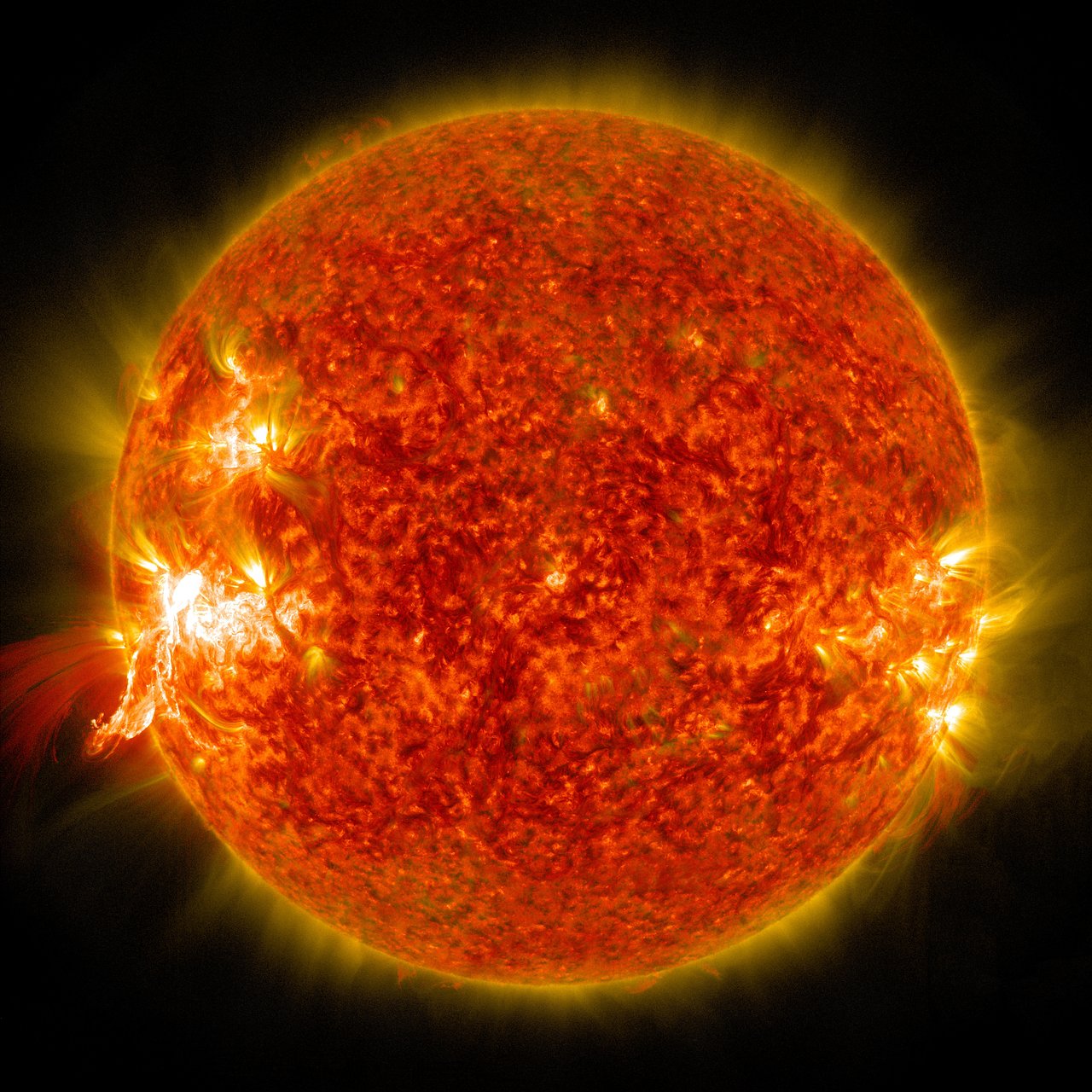
Although the Sun appears constant to human eyes, it is anything but static. It is a dynamic, evolving star, changing slowly but relentlessly over time. Its light, heat, and structure are the result of an ongoing battle between two powerful forces. Gravity is constantly trying to crush the Sun inward, while nuclear energy produced in its core pushes outward. The balance between these forces defines the Sun’s life.
This balance is not permanent. It depends on fuel, just as a fire does. The Sun shines because it is burning hydrogen in its core, converting it into helium through nuclear fusion. This process releases enormous amounts of energy, which slowly make their way to the surface and then travel across space as sunlight. As long as hydrogen remains available in the core, the Sun can continue to shine steadily.
Understanding how long the Sun will live means understanding how much fuel it has, how fast it burns that fuel, and what happens when that fuel begins to run out. Physics provides clear answers to these questions, even though the timescales involved are almost unimaginable.
The Birth of the Sun and the Clock That Started Ticking
The Sun was not always there. It formed about 4.6 billion years ago from a collapsing cloud of gas and dust in the Milky Way. Gravity pulled this material together, compressing it until temperatures and pressures in the center became high enough to ignite nuclear fusion. At that moment, the Sun was born as a true star, and its lifetime clock began.
This moment matters because it allows scientists to estimate not only how old the Sun is, but how long it is expected to last. Stars like the Sun follow well-understood evolutionary paths. By studying countless other stars at different stages of life, physicists and astronomers have learned how long stars of various sizes and compositions tend to live.
The Sun is a medium-sized star, neither small nor massive. This is crucial. Smaller stars burn their fuel slowly and can live for hundreds of billions or even trillions of years. Massive stars burn furiously and die young, sometimes in just a few million years. The Sun occupies a stable middle ground, with a lifespan measured in billions of years.
The Main Sequence: The Sun’s Long, Stable Adulthood
Right now, the Sun is in the most stable and longest phase of its life, known as the main sequence. During this stage, it steadily converts hydrogen into helium in its core. This process is incredibly efficient and remarkably consistent. The Sun has been doing this for billions of years, and it will continue to do so for billions more.
Based on its mass and energy output, scientists estimate that the Sun’s total main-sequence lifetime is about ten billion years. Since it is already approximately 4.6 billion years old, that means it is not even halfway through this phase. Roughly five billion years remain before the Sun exhausts the hydrogen in its core and begins to change in dramatic ways.
This realization can be both comforting and unsettling. Comforting because the Sun is not about to die anytime soon. Unsettling because it reminds us that even the most familiar and dependable features of our world are temporary on cosmic timescales.
The Slow Brightening of the Sun
Although the Sun appears constant, it is slowly changing even now. As hydrogen is converted into helium in the core, the core’s composition changes. Helium atoms are heavier than hydrogen atoms, and their accumulation increases the core’s density and temperature. This causes nuclear fusion to proceed slightly faster over time.
As a result, the Sun is gradually becoming brighter. This increase is extremely slow by human standards, but over hundreds of millions of years, it becomes significant. Billions of years ago, the Sun was noticeably dimmer than it is today. Billions of years from now, it will be brighter still.
This gradual brightening has profound consequences for Earth. Long before the Sun runs out of fuel, increasing solar brightness will alter Earth’s climate in ways that challenge the survival of life as we know it. In this sense, the Sun’s life expectancy as a life-supporting star is shorter than its total physical lifespan.
The Future That Awaits the Sun
When the Sun finally exhausts the hydrogen in its core, it will not simply switch off. Instead, it will enter a new and more dramatic phase of evolution. Without hydrogen fusion in the core, gravity will begin to compress it. As the core contracts, temperatures will rise, igniting hydrogen fusion in a shell surrounding the core rather than in the core itself.
This change will cause the outer layers of the Sun to expand enormously. The Sun will swell into a red giant, growing so large that it will engulf the inner planets of the solar system. Mercury and Venus will almost certainly be consumed. Earth’s fate is uncertain, but even if it escapes being swallowed, it will become an uninhabitable, scorched world.
This red giant phase marks the beginning of the end of the Sun’s life as we recognize it. Yet even here, the Sun’s death is not violent. It does not explode. Instead, it sheds its outer layers gently, creating a glowing shell of gas while its core collapses into a dense remnant known as a white dwarf.
The Final Remnant: A White Dwarf in the Dark
After the red giant phase, the Sun will leave behind its core, a white dwarf roughly the size of Earth but containing about half the Sun’s original mass. This white dwarf will no longer produce energy through fusion. It will shine only by releasing stored heat, slowly cooling over immense stretches of time.
In this final state, the Sun will be a ghost of its former self. It will no longer support life, no longer illuminate planets, no longer dominate the solar system with warmth. Yet it will persist for trillions of years, gradually fading into darkness.
In this sense, the Sun never truly disappears. It transitions from a life-giving star to a silent cosmic ember, carrying the memory of its nuclear past in its dense, cooling core.
Measuring the Sun’s Life with Physics, Not Guesswork
The remarkable thing about this entire story is how confidently scientists can tell it. This confidence does not come from speculation, but from well-tested physical principles. Nuclear fusion, gravity, energy conservation, and quantum mechanics all play roles in determining how stars behave.
By observing other stars in different stages of life and comparing them to theoretical models, physicists have confirmed that stars like the Sun follow predictable paths. The Sun’s mass determines its internal pressure and temperature, which determine how fast it burns fuel, which in turn determines how long it can shine.
The Sun’s expected lifespan is not a mystery waiting to be solved. It is a calculation grounded in physics that has been tested across the universe.
The Emotional Weight of the Sun’s Mortality
Learning that the Sun will one day die can provoke unexpected emotions. The Sun feels permanent because it anchors our sense of time. Days, seasons, and years all depend on its steady presence. To imagine a future without the Sun is to imagine a universe in which Earth is no longer a living world.
Yet there is also beauty in this knowledge. The Sun’s life is long enough to nurture complexity, consciousness, and culture. It has provided a stable environment for billions of years, allowing life to evolve from simple molecules to thinking beings capable of asking about the Sun’s future.
In that sense, the Sun’s lifespan is not merely long; it is generous.
The Sun in the Context of Cosmic Time
When we place the Sun’s life into the broader timeline of the universe, its story becomes even more striking. The universe itself is about 13.8 billion years old. The Sun formed relatively late in cosmic history, from material enriched by earlier generations of stars.
Those earlier stars lived and died, creating heavier elements through nuclear processes and scattering them across space. The Sun and Earth are products of those ancient stellar deaths. In turn, the Sun’s eventual shedding of material will contribute to future generations of stars and planets.
The Sun’s life is one chapter in an ongoing cosmic cycle, where stars are born from the ashes of their predecessors and eventually become the raw material for what comes next.
How Long Is “Long” When Talking About the Sun?
From a human perspective, five billion years is almost meaningless. It dwarfs all of recorded history. Entire civilizations rise and fall in the blink of an eye compared to the Sun’s remaining lifespan. Even the existence of humanity as a species occupies only a tiny fraction of the Sun’s life.
Yet from the universe’s perspective, the Sun’s life is finite and unremarkable. Many stars have already lived and died in the time since the universe began. Many more will be born and die long after the Sun fades.
This dual perspective is one of physics’ great gifts. It teaches us to hold multiple scales of time in mind at once, to see ourselves as both fleeting and significant.
What the Sun’s Life Means for Humanity
Knowing how long the Sun will live shapes how we think about the future of life and civilization. On shorter timescales, humanity faces challenges that have nothing to do with stellar evolution. On longer timescales, however, the Sun’s gradual changes set ultimate limits on Earth’s habitability.
Long before the Sun becomes a red giant, Earth will likely become too hot for complex life. Oceans may evaporate, and the atmosphere may change beyond recognition. If life continues beyond that point, it will need to find new homes elsewhere.
In this way, the Sun’s life expectancy frames the deepest questions about humanity’s long-term future. It reminds us that survival is not just a biological or social challenge, but a cosmic one.
The Quiet Certainty of the Sun’s End
Unlike many things in life, the Sun’s fate is not uncertain. There is no sudden catastrophe waiting to extinguish it. There is no dramatic explosion in its future. Its end will come slowly, following rules that have governed stars since the universe began.
This quiet certainty is both sobering and reassuring. It tells us that the universe is not random chaos, but a place where patterns endure across unimaginable scales of time and space.
A Star with Time Still to Give
So how long will the Sun actually live? In physical terms, it has about five billion years left as a stable, hydrogen-burning star, followed by additional phases that extend its existence far beyond that. In practical terms, it has already given Earth nearly everything it will ever give.
The Sun’s story is not one of imminent loss, but of deep time. It invites us to appreciate the present moment, to recognize how rare and precious stable, life-supporting stars are, and to understand that our existence is tied to processes far larger than ourselves.
The Sun will one day fade, but not before it has illuminated the universe with the light of life, curiosity, and understanding. In learning how long the Sun will live, we learn something equally important about ourselves: that we are temporary, yes, but also profoundly connected to the enduring rhythms of the cosmos.