Spacetime feels simple when you live inside it. You wake up in the morning, move through space, and watch time carry you forward like a river. A step takes you from one place to another. A second ticks by with quiet certainty. To the human mind, space feels like a vast stage and time feels like an invisible clock ticking in the background. For most of history, that is exactly how people imagined them: space as a rigid container and time as a universal rhythm that beat the same everywhere.
Modern physics has shattered that comforting picture. Space and time are not passive backdrops. They stretch, twist, slow, and even break into uncertainty at the smallest scales. They can be warped by gravity, distorted by motion, and entangled with matter and energy in ways that feel almost mystical. What we call spacetime is not what common sense suggests. It is deeper, stranger, and more flexible than intuition allows.
This is the story of why spacetime is not what it seems. Each reason is a window into a universe where the rules of everyday experience quietly fail, and where reality reveals a structure far more dramatic than our senses suggest.
1. Space and Time Are Not Separate Things
For most of human history, space and time were treated as independent realities. Space was where events happened. Time was when they happened. One could imagine freezing time while leaving space untouched, or erasing space while keeping time flowing. This separation felt natural because it matched experience.
That separation collapsed with the insights of Albert Einstein. His theory of special relativity revealed that space and time are woven together into a single fabric: spacetime. An event is no longer defined only by where it happens or when it happens, but by both together. Distance and duration become aspects of the same structure.
What this means emotionally is unsettling. It means that the universe does not keep a single master clock. Two observers moving relative to each other can disagree about how much time has passed between events. Two observers can disagree about the length of an object. These disagreements are not illusions; they are built into the structure of spacetime itself.
Spacetime replaces the idea of a fixed arena with something more like a flexible stage. It unifies what once seemed distinct. The world does not consist of three dimensions of space plus a separate stream of time. It consists of four dimensions blended into one geometry. That geometry defines what motion means, what simultaneity means, and even what causality means.
So the first reason spacetime is not what it seems is simple and profound: space and time are not separate realities. They are two faces of the same deeper thing.
2. Time Does Not Flow the Same for Everyone
In everyday life, time feels universal. A minute is a minute whether you are walking or sitting. A year is a year whether you are young or old. It feels as though time is the same for all observers.
Physics says otherwise. Motion changes the rate at which time passes. A clock moving rapidly relative to you ticks more slowly than one at rest beside you. This effect, called time dilation, has been confirmed by experiments using atomic clocks on airplanes and satellites. Astronauts age slightly more slowly than people on Earth. Particles traveling near the speed of light live longer than they would if they were still.
This is not because clocks malfunction when they move fast. It is because time itself is stretched by motion. Spacetime demands it. If the speed of light is to be the same for all observers, then measurements of time and space must adjust.
Emotionally, this undermines the idea of a universal present. There is no single “now” shared by all observers. What one person calls the present, another moving fast may call the past or future. Reality does not slice neatly into moments that everyone agrees upon.
Time is personal in a physical sense. Each path through spacetime has its own rhythm. The second reason spacetime is not what it seems is that time is not absolute. It bends with motion, reshaping the very meaning of duration.
3. Gravity Is Not a Force in the Ordinary Sense
In everyday thought, gravity feels like a pull. The Earth pulls apples downward. The Sun pulls planets inward. This matches the old image of gravity as a force acting across space.
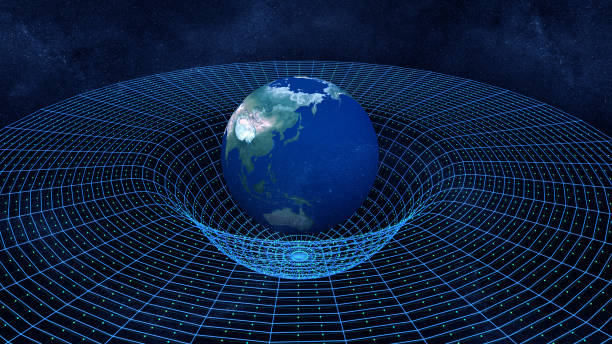
General relativity rewrote that idea. Gravity is not a force in the traditional sense. It is the curvature of spacetime caused by mass and energy. Objects move as they do because they follow the straightest possible paths through curved spacetime. What looks like a pull is actually motion along a warped geometry.
Imagine spacetime as a stretched fabric. Place a heavy ball in the center, and the fabric sags. Roll a marble nearby, and it curves toward the ball, not because of a direct pull, but because the surface itself is bent. In the same way, Earth bends spacetime around it, and objects fall because they move along those curved paths.
This means gravity is not something acting inside spacetime. It is a property of spacetime itself. Space and time are not passive stages; they participate in the drama. They respond to matter and energy, reshaping themselves.
The third reason spacetime is not what it seems is that gravity is geometry. The universe does not simply contain gravity; it is gravity, written into the shape of spacetime.
4. Space Can Stretch and Carry Galaxies with It
We imagine space as something solid and unchanging, a fixed grid on which objects sit. But space itself can expand. The universe is not merely filled with galaxies moving through space. Space itself is growing, carrying galaxies along like dots on an inflating balloon.
When astronomers observe distant galaxies, they see that they are receding from us. The farther away a galaxy is, the faster it appears to be moving. This pattern is not because we are at the center, but because space is expanding everywhere. Every point sees other points moving away.
This expansion is not motion through space in the ordinary sense. It is the stretching of space itself. Galaxies remain roughly fixed relative to their local spacetime, but the distance between them increases because the fabric between them grows.
Emotionally, this changes how we think about distance. The gap between galaxies is not just empty nothingness. It is an active, dynamic entity that can grow and evolve. The universe is not static; it is unfolding.
The fourth reason spacetime is not what it seems is that space is not rigid. It stretches, expands, and reshapes itself on cosmic scales.
5. Spacetime Can Ripple Like a Wave
For a long time, gravity was thought to act instantaneously. If the Sun moved, Earth would immediately feel the change. General relativity predicted something very different: changes in the gravitational field propagate as waves through spacetime itself.
These gravitational waves are ripples in the fabric of spacetime caused by violent events such as colliding black holes or exploding stars. They travel at the speed of light, carrying information about their source.
When such a wave passes through Earth, it slightly stretches and compresses space. Distances between objects change by tiny amounts, far smaller than the width of an атом, yet measurable with sensitive instruments.
The existence of gravitational waves means spacetime is not a static background. It is a medium capable of vibration. It can tremble, oscillate, and carry energy.
The fifth reason spacetime is not what it seems is that it is not silent. It can sing in waves that echo across the cosmos, revealing hidden cataclysms and showing that geometry itself can move.
6. The Geometry of Spacetime Is Not Always Flat
In school, we learn geometry as a study of flat surfaces and straight lines. A triangle’s angles add to 180 degrees. Parallel lines never meet. This is Euclidean geometry, and it matches everyday experience on small scales.
But spacetime does not always obey this geometry. In the presence of mass and energy, spacetime becomes curved. Triangles can have angle sums greater or less than 180 degrees. Parallel paths can converge or diverge. Straight lines become arcs.
This curvature explains planetary orbits, the bending of light near stars, and the formation of black holes. Light passing near a massive object follows curved spacetime, appearing to bend as though deflected by a force.
This means geometry is not merely a human invention for describing space. It is a physical property of reality. Space and time have shape, and that shape influences motion.
The sixth reason spacetime is not what it seems is that it is not guaranteed to be flat. Its geometry changes with mass and energy, making space and time flexible rather than rigid.
7. Near Black Holes, Spacetime Breaks Common Sense
Black holes represent the most extreme warping of spacetime known. They are regions where gravity becomes so strong that not even light can escape. The curvature of spacetime near them is so intense that familiar ideas of distance and time collapse.
As one approaches a black hole, time slows relative to distant observers. From far away, an infalling object appears to freeze at the edge, never quite crossing. For the falling object itself, time continues normally, and it crosses the boundary without noticing anything special at that exact moment.
Inside a black hole, spacetime becomes so distorted that the future may lie in the direction of the center rather than ahead in time. Paths that once allowed escape now point inevitably inward.
Black holes reveal that spacetime can be twisted into forms that destroy intuitive distinctions between past and future, inside and outside, near and far.
The seventh reason spacetime is not what it seems is that in extreme conditions, its structure overturns the logic of everyday experience.
8. On the Smallest Scales, Spacetime May Be Uncertain
Quantum physics teaches that at tiny scales, certainty dissolves. Particles do not have definite positions until measured. Energies fluctuate. Events become probabilistic.
When quantum ideas are applied to spacetime itself, the picture becomes even stranger. At extremely small scales, spacetime may not be smooth at all. It may be foamy, jittery, and uncertain. Distances may not be precisely defined. Time may not flow continuously.
Some theories suggest that spacetime emerges from more fundamental quantum processes, like a pattern arising from deeper rules. In this view, space and time are not basic ingredients of reality but collective behaviors, similar to how temperature emerges from the motion of molecules.
If this is true, then what we perceive as continuous spacetime is an approximation, like a smooth ocean surface hiding turbulent currents below.
The eighth reason spacetime is not what it seems is that at the deepest level, it may not exist in the familiar form at all. It may be a quantum phenomenon rather than a fundamental stage.
9. The Past and Future May Both Exist in Spacetime
We experience time as a flowing present, with the past gone and the future not yet real. But relativity challenges this view. If different observers disagree about what events are simultaneous, then there is no single slice of time that defines the present for everyone.
One way to interpret this is to imagine spacetime as a four-dimensional block, containing all events past, present, and future. In this picture, time does not flow. Instead, we move along a path through a landscape that already includes every moment.
This idea is deeply unsettling. It suggests that the future may be as real as the past, and that the sensation of flow is a feature of consciousness, not of spacetime itself.
Physics does not demand this interpretation, but it makes it difficult to defend the idea of an absolute, universal present. The structure of spacetime seems to accommodate all moments equally.
The ninth reason spacetime is not what it seems is that time may not be a river flowing forward. It may be a dimension like space, with all points equally real.
10. Spacetime Shapes Causality Itself
We think of cause and effect as simple: one event happens, then another follows. But in spacetime, causality depends on geometry. The structure of spacetime determines which events can influence which others.
Light cones define regions of possible influence. Events outside one another’s light cones cannot affect each other, because no signal can travel faster than light. This means spacetime sets limits on what can be caused by what.
Near black holes or in rapidly expanding regions of the universe, these limits can behave in unexpected ways. Horizons can form that permanently separate regions of spacetime, preventing any exchange of information.
Causality is not an abstract principle imposed on the universe. It is a consequence of spacetime’s shape. Change the geometry, and you change the structure of cause and effect.
The tenth reason spacetime is not what it seems is that it is not just a setting for events. It governs the very possibility of influence and connection.
The Emotional Meaning of a Flexible Reality
Taken together, these ten reasons paint a picture of a universe far stranger than everyday experience suggests. Space is not a rigid box. Time is not a universal clock. Gravity is not a simple pull. Distance, duration, and causality are shaped by geometry and motion.
This can feel unsettling, even frightening. It suggests that the familiar world is only a surface appearance. Beneath it lies a structure that does not care about human intuition. Yet there is also wonder in this realization. Spacetime is not dull. It is alive with motion, curvature, and possibility.
To understand spacetime is to understand that reality is not built for comfort. It is built for consistency with deep laws. Those laws allow stars to burn, planets to orbit, and minds to arise that can question the nature of existence itself.
Spacetime is not what it seems because it is more than it seems. It is not just where things happen and when they happen. It is an active participant in the universe’s story. It stretches, curves, ripples, and perhaps even emerges from something deeper.
When we look at the sky or watch a clock, we see only shadows of a deeper order. Physics invites us to see beyond those shadows and glimpse the strange architecture that holds everything together. In that architecture, space and time are not fixed and familiar. They are dynamic, flexible, and mysterious.
And that is the final truth behind these ten reasons: spacetime is not what it seems because reality itself is more imaginative than we are.