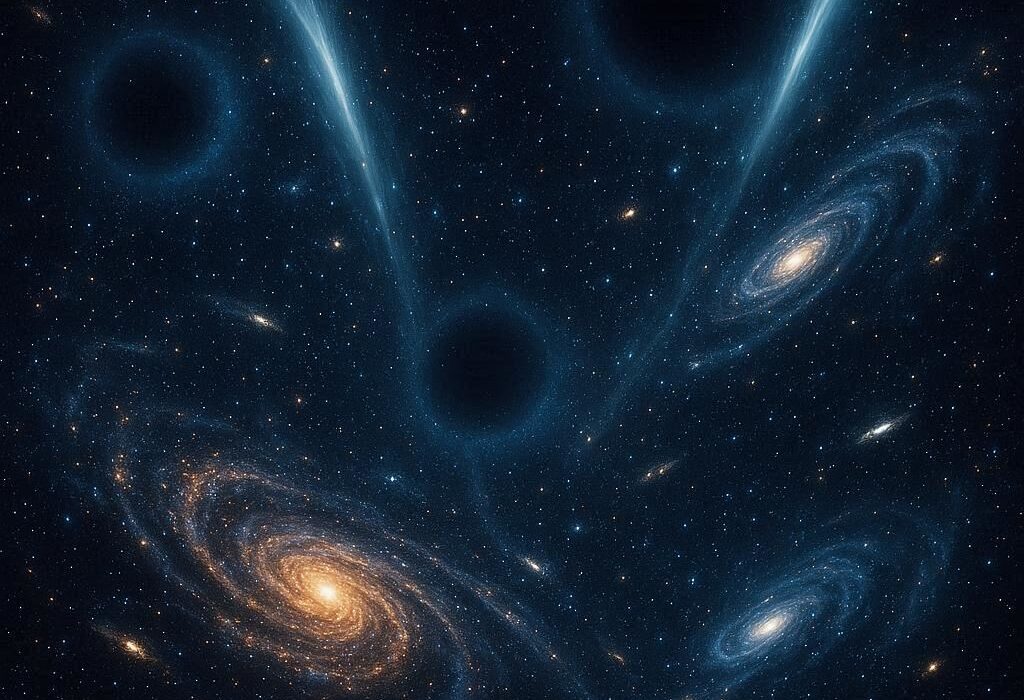
Look up at the night sky from a dark place—far from city lights, far from the glow of human civilization—and you will see what appears to be a scattering of stars. Tiny points of light, calm and silent, hanging in the darkness like scattered diamonds. But that view is an illusion of scale. What you are really seeing is only a small fraction of one galaxy: the Milky Way, a cosmic city containing hundreds of billions of stars, swirling in a gravitational dance that has lasted for more than thirteen billion years.
Galaxies are not just collections of stars. They are living structures on cosmic timescales, shaped by gravity, collisions, dark matter, and time itself. They are the architecture of the universe. They are where stars are born, where planets form, where elements are forged, and where black holes lurk like invisible engines at the hearts of giant stellar systems.
What makes galaxies so mind-blowing is that they operate on scales that stretch human imagination to its breaking point. They are so vast that even light, the fastest thing we know, takes tens of thousands—or even millions—of years to travel across them. Yet they are also shaped by invisible forces, mysterious matter, and ancient histories written into their spiraling arms and glowing halos.
The more astronomers study galaxies, the more they discover facts that sound almost impossible. Facts that challenge our intuition. Facts that make the universe feel less like a quiet void and more like a dramatic, evolving story.
Here are ten scientifically accurate, mind-blowing facts about galaxies that will change the way you look at the night sky forever.
1. Galaxies Are Held Together by Something We Cannot See
One of the most astonishing truths about galaxies is that the stars and gas we can see are not enough to hold them together.
If galaxies were made only of visible matter—stars, planets, nebulae, dust, and gas—they would not behave the way they do. Astronomers discovered this by studying how galaxies rotate. According to Newtonian physics, stars farther from the galactic center should orbit more slowly, because the gravitational pull weakens with distance. This is exactly how planets behave in the solar system. Mercury moves faster than Earth, and Earth moves faster than Neptune.
But galaxies do not follow that pattern.
In spiral galaxies like the Milky Way, stars in the outer regions orbit almost as fast as stars near the center. The galaxy rotates more like a solid disk than a system governed by visible matter. If only visible mass existed, the outer stars should be moving so fast that they would escape into space. The galaxy should tear itself apart.
Yet it doesn’t.
This is one of the strongest pieces of evidence for dark matter—an invisible substance that does not emit, absorb, or reflect light. Dark matter forms a massive halo around galaxies, providing the extra gravitational pull needed to keep them intact.
This means something unsettling: most of the mass of a galaxy is invisible. The bright spiral arms and glittering stars are only the glowing skin of something far larger and stranger.
When you look at a galaxy, you are not seeing the whole object. You are seeing only the part that happens to shine.
2. The Milky Way Is Racing Through Space at a Terrifying Speed
It’s easy to imagine the galaxy as something fixed and stable, like a cosmic background that stays still while stars quietly orbit within it. But the Milky Way is anything but stationary.
Our entire galaxy is moving.
The Milky Way is part of a group of galaxies known as the Local Group, which includes the Andromeda Galaxy, the Triangulum Galaxy, and dozens of smaller dwarf galaxies. Together, this group is moving through the universe under the influence of gravity from larger structures.
Even within the Milky Way itself, the solar system is orbiting the galactic center at a speed of roughly 220 kilometers per second. That’s about 792,000 kilometers per hour. At that speed, you could travel around Earth in less than a minute.
Yet we do not feel this motion because we are moving with the system, much like passengers on a smooth airplane flight.
The truly mind-bending part is that the Milky Way is not only rotating internally. It is also moving through intergalactic space, influenced by gravitational pulls from massive galaxy clusters and large-scale cosmic structures.
We are not standing still in the universe. We are racing through it—carried by a galaxy that itself is part of a vast gravitational migration across cosmic time.
Every moment of your life is spent traveling at incredible speeds through a universe that never stops moving.
3. Most Galaxies Have a Supermassive Black Hole at Their Center
The idea of a black hole at the center of a galaxy sounds like something from science fiction, like an ancient cosmic monster waiting in the darkness. But it is real.
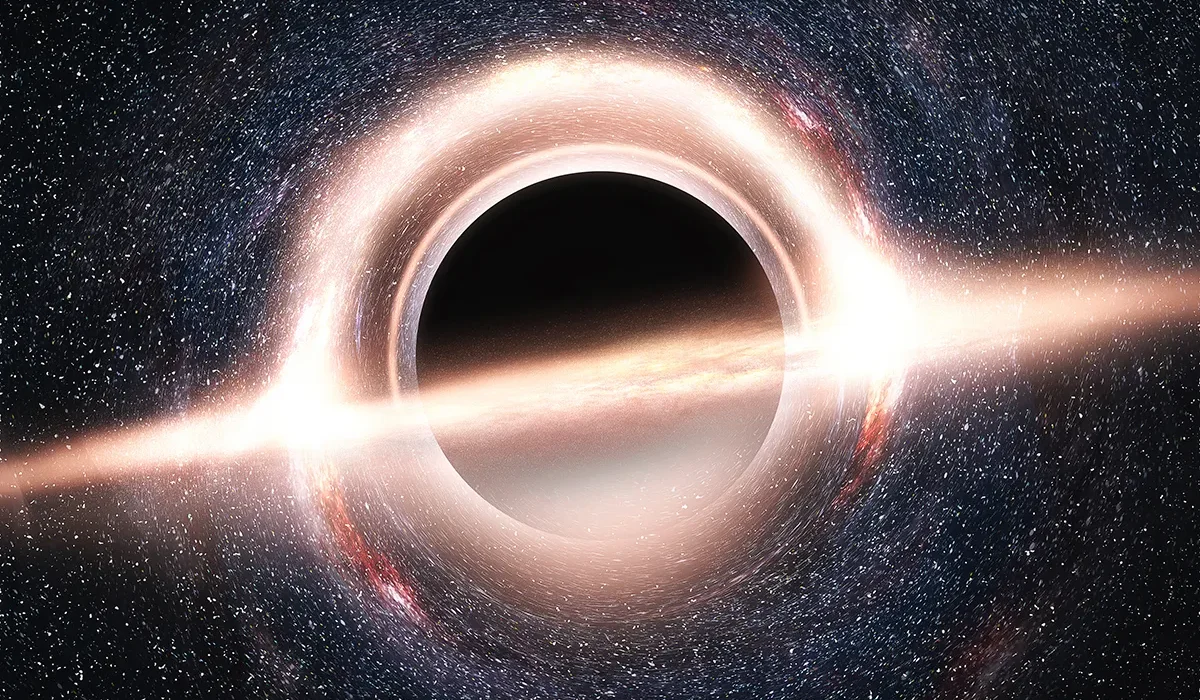
Astronomers have found evidence that nearly every large galaxy contains a supermassive black hole at its core. These black holes can have masses millions or even billions of times greater than the Sun.
Our own Milky Way contains a supermassive black hole called Sagittarius A*. It has a mass about four million times that of the Sun, packed into a region smaller than our solar system. It is currently relatively quiet, not consuming large amounts of matter, which is why our galaxy’s center does not blaze like a quasar.
But in other galaxies, supermassive black holes actively feed on surrounding gas and dust. As matter spirals into the black hole, it forms an accretion disk, heating up to extreme temperatures and releasing enormous energy. These active galactic nuclei can outshine entire galaxies, producing jets of particles that shoot into space at nearly the speed of light.
It is difficult to grasp how something so small compared to the size of a galaxy can have such enormous influence. Yet supermassive black holes appear to shape galaxy evolution, regulating star formation and controlling how gas behaves over billions of years.
Galaxies are not simply star collections. Many of them are built around a gravitational abyss.
4. Galaxies Collide—and It’s More Beautiful Than Violent
When people imagine a galaxy collision, they often picture stars smashing into each other like cars in a cosmic wreck. But galaxy collisions are not like that at all.
Galaxies are mostly empty space.
Even though a galaxy contains hundreds of billions of stars, the distance between stars is so immense that direct collisions between stars are extremely rare when galaxies merge. Instead, what happens is a gravitational interaction on a massive scale.
As galaxies pass through each other, their shapes distort. Spiral arms stretch and twist. Streams of stars are pulled outward into long tidal tails. Gas clouds compress, triggering bursts of star formation. Entire regions ignite with newborn stars, lighting up the merging galaxies like fireworks.
Over time, the galaxies may merge into one larger galaxy, often becoming an elliptical galaxy—a smooth, rounded structure with less distinct shape.
The Milky Way itself is destined for such an event. The Andromeda Galaxy is moving toward us, and in about four billion years, the two galaxies are expected to collide and merge.
It will not be an explosion of stars crashing. It will be a slow gravitational ballet lasting hundreds of millions of years. The night sky from Earth—if Earth still exists—would be filled with the sprawling glow of Andromeda stretching across the heavens.
The universe builds its grandest structures not through calm isolation, but through collision and transformation.
5. Some Galaxies Are So Old That They Formed When the Universe Was Young
When we look at galaxies far away, we are not seeing them as they are today. We are seeing them as they were long ago.
Light takes time to travel.
The Sun is about eight light-minutes away, so we see it as it was eight minutes ago. The nearest star system is more than four light-years away, so we see it as it was four years ago. And galaxies millions or billions of light-years away appear to us as they existed millions or billions of years in the past.
This means telescopes are time machines.
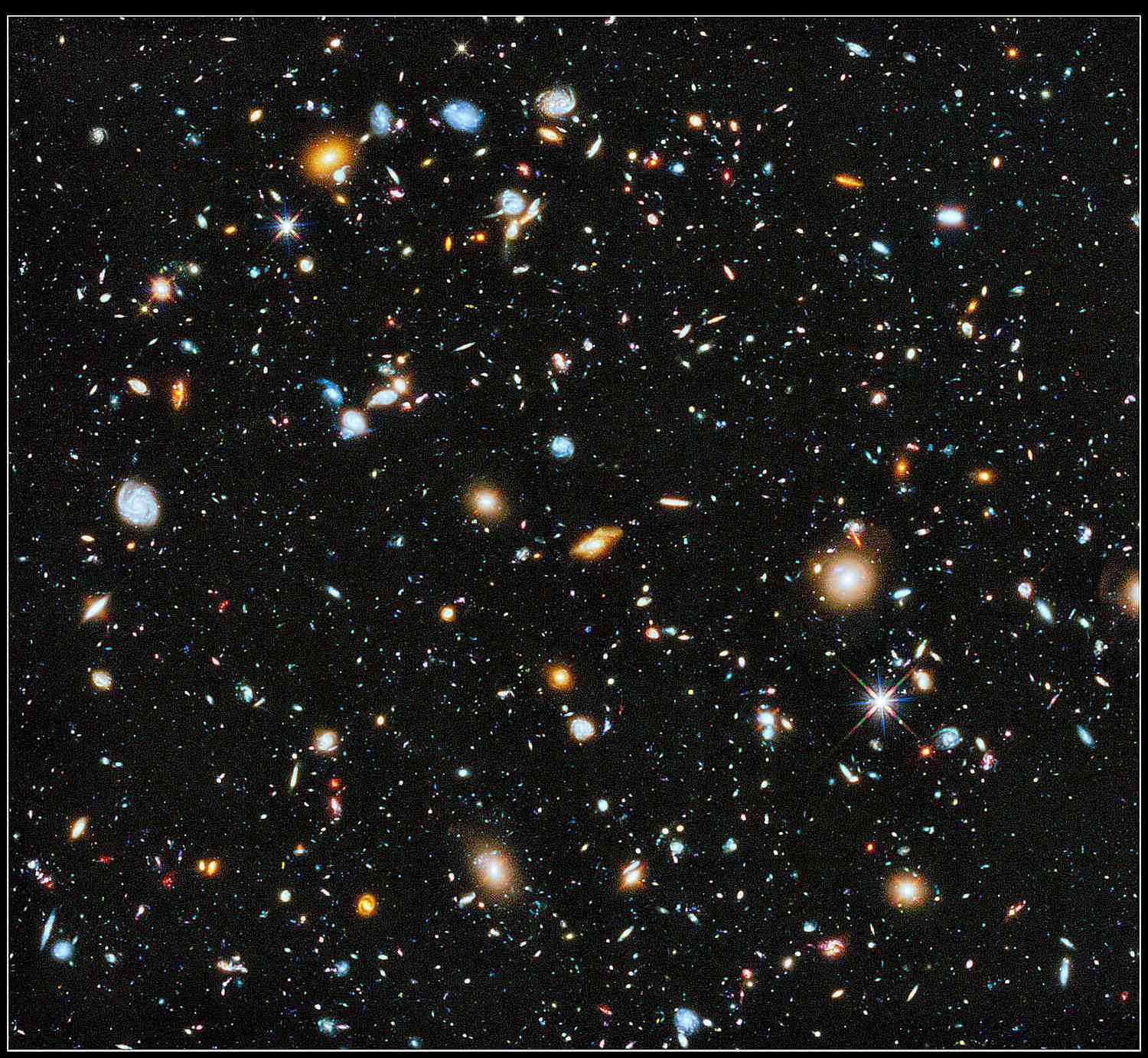
Astronomers have observed galaxies so distant that their light began traveling toward us when the universe was only a few hundred million years old. These ancient galaxies appear small, chaotic, and intensely bright, often undergoing rapid star formation.
In the early universe, galaxies were forming quickly from clouds of hydrogen and helium, pulled together by dark matter. They were not the neat spirals we often picture today. They were turbulent, irregular, and violent, shaped by rapid mergers and constant inflows of gas.
When you see a deep-space image filled with galaxies, you are looking at a cosmic history book. Some of those galaxies may no longer exist in their original form. Some may have merged into larger structures. Some may have changed completely.
The universe does not hide its past. It reveals it in light.
6. A Galaxy’s Shape Is Like a Biography Written in Gravity
Galaxies come in different forms: spirals, ellipticals, irregular shapes, barred spirals, and peculiar distorted structures. These shapes are not random. They are the result of history.
A galaxy’s appearance is a record of its life story.
Spiral galaxies, with their graceful arms, often contain plenty of gas and dust, which means they are still actively forming stars. Their arms are not fixed structures like solid arms of a pinwheel. They are density waves—regions where stars and gas bunch up, triggering star formation as material passes through.
Elliptical galaxies, on the other hand, tend to contain older stars and little gas. They often form after multiple mergers, which scramble stellar orbits and remove the organized rotation needed to maintain spiral arms.
Irregular galaxies may have been shaped by gravitational interactions or may still be in early stages of formation. Some have been distorted by nearby massive galaxies, stretched and pulled like cosmic clay.
Even the Milky Way has a bar-shaped structure at its center, making it a barred spiral galaxy. That bar influences how stars and gas move through the galactic core.
To study a galaxy’s shape is to read the scars and signatures of cosmic time. Gravity is not only a force. It is an author.
7. There Are Galaxies That Barely Have Any Stars
When most people imagine a galaxy, they picture a bright, star-filled spiral. But not all galaxies are like that.
Some galaxies are extremely faint, with very few stars compared to their size. These are known as ultra-diffuse galaxies. They can be as large as the Milky Way in diameter but contain only a tiny fraction of the stars.
Such galaxies are ghostly. They are difficult to detect because they emit very little light. Yet they still have gravitational presence, often suggesting large amounts of dark matter.
Their existence challenges traditional ideas of galaxy formation. How can something so large fail to produce many stars? Did they lose their gas early? Were they stripped by interactions with other galaxies? Are they “failed” galaxies that never completed their growth?
These ghost galaxies remind us that galaxies are not defined only by light. They are defined by mass, structure, and history.
The universe contains enormous objects that are almost invisible—not because they are small, but because they barely shine.
8. Some Galaxies Are Literally Eating Other Galaxies Right Now
Galaxies are not isolated islands. They are predators and prey in a cosmic ecosystem.
Large galaxies often grow by consuming smaller ones. Dwarf galaxies orbit larger galaxies, slowly being pulled apart by tidal forces. Their stars stretch into streams that wrap around the host galaxy like pale ribbons.
The Milky Way is currently devouring smaller galaxies.
One example is the Sagittarius Dwarf Spheroidal Galaxy, which is being torn apart as it orbits the Milky Way. Its stars are being absorbed into our galaxy’s halo. Over time, the dwarf galaxy will be completely dismantled, its identity erased as its stars become part of the Milky Way.
This is not unusual. Galaxy growth often happens through mergers and accretion. The Milky Way likely formed much of its mass by absorbing smaller galaxies over billions of years.
This means that some of the stars you see in the night sky may not have been born in the Milky Way. They may be immigrants—ancient travelers from galaxies that no longer exist.
The universe is not peaceful. It is constantly reshaping itself through cosmic cannibalism.
9. Galaxies Are Part of a Vast Cosmic Web
When we imagine the universe, we often picture galaxies scattered randomly like dust. But the large-scale structure of the universe is not random. It has shape.
Galaxies are arranged in a cosmic web.
This web consists of filaments of galaxies stretching across space, separated by enormous voids that contain very little matter. At the intersections of filaments are galaxy clusters, massive structures containing hundreds or thousands of galaxies bound together by gravity.
The cosmic web formed because dark matter clumped together under gravity in the early universe. Ordinary matter fell into these dark matter wells, forming stars and galaxies along the filaments.
The scale is almost unimaginable. Filaments can stretch hundreds of millions of light-years. Voids can be tens of millions of light-years across.
The universe, when viewed on its largest scale, resembles a neural network or a spider’s web. It is as if the cosmos has its own skeleton, invisible but real.
Every galaxy is not just floating alone. It is part of an immense architecture shaped by gravity and time.
10. We May Not Even Understand How Galaxies Truly Formed
Perhaps the most mind-blowing fact of all is this: despite all our knowledge, galaxy formation remains one of the hardest unsolved problems in astrophysics.
Scientists have powerful theories and computer simulations that model how galaxies form. They know that dark matter plays a central role, forming gravitational scaffolding. They know that gas falls into dark matter halos, cooling and condensing to form stars. They know that supernova explosions and black hole activity can blow gas outward, regulating star formation.
Yet the details remain complicated and often uncertain.
Why do galaxies form with such varied shapes and sizes? Why do some galaxies stop forming stars while others continue? Why do some develop elegant spiral structures while others become massive elliptical giants?
The universe is governed by physical laws, but galaxy formation involves an astonishing complexity of interacting processes: gravity, gas dynamics, radiation, magnetic fields, cosmic rays, turbulence, feedback from star formation, and black hole jets.
Even the Milky Way, our home galaxy, still contains mysteries. Scientists are still mapping its spiral arms accurately. They are still learning how its central bar influences its evolution. They are still discovering hidden dwarf galaxies orbiting in its halo.
Galaxies are not simple objects. They are ecosystems of physics, shaped by both order and chaos.
And that means that even today, we do not fully understand the origins of the grand cosmic cities that fill the universe.
The Sky Is Not What It Seems
Galaxies are among the most breathtaking creations in nature. They are enormous structures built from gravity, sculpted by dark matter, and lit by billions of stars. They are ancient, evolving, colliding, and transforming.
When you stare into the night sky, you may feel small. But the truth is even stranger: you are not separate from the galaxies. Every atom in your body was forged in stars that lived and died inside ancient galaxies long before the Sun existed. You are made of the same cosmic material that forms nebulae and planets and glowing spiral arms.
The Milky Way is not just where you live. It is what you are.
And somewhere out there, beyond the reach of the naked eye, trillions of galaxies drift through the expanding universe—each one a story of birth, destruction, mystery, and time.
Science has revealed extraordinary facts about galaxies, yet it has also uncovered deeper questions. The universe is vast enough to humble every mind that dares to study it.
The most mind-blowing fact about galaxies may not be any single discovery. It may be this: the universe is so complex and so immense that even after centuries of astronomy, we are still only beginning to understand what we are looking at.
The night sky is not a ceiling. It is a doorway.
And galaxies are the glowing cities beyond it.