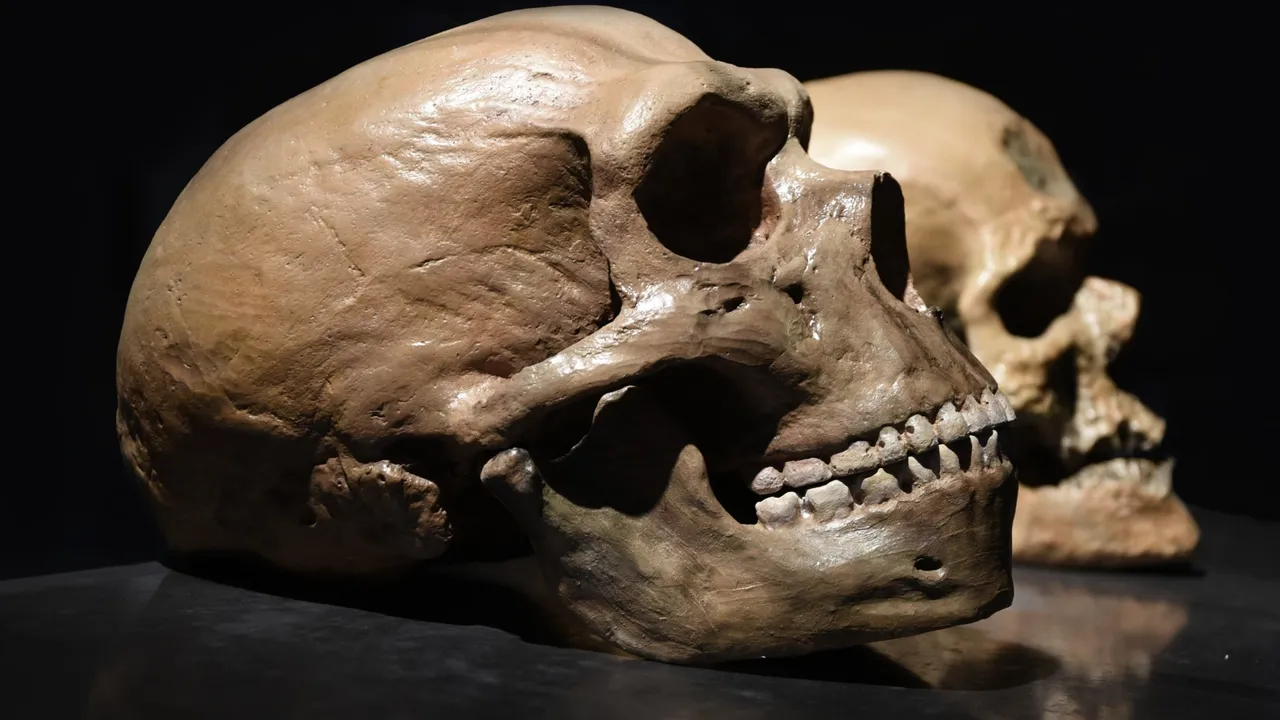
If you could travel back in time and stand in Ice Age Europe, you might see a figure in the distance moving through the snow. At first glance, you would think it was human. The body would be upright. The hands would carry tools. The eyes would scan the landscape with intelligence. But as the figure approached, the differences would become impossible to ignore. The face would be broader, the brow heavier, the nose larger, the body more compact and powerful. You would be looking at a Neanderthal—our closest extinct human relative, and one of the most fascinating mysteries in human history.
Neanderthals were not monsters, not half-apes, and not dull brutes. They were humans in the deeper sense: members of the human family tree. They made tools, controlled fire, hunted large animals, cared for the injured, and likely buried their dead. They survived harsh climates that would challenge even modern technology. For hundreds of thousands of years, they were masters of their environment.
And yet, they are gone.
Modern humans—Homo sapiens—remain. We dominate the planet. We build cities, write books, explore space, and reshape ecosystems on a global scale. We are capable of cooperation on massive scales and destruction on even larger ones. Our minds have become engines of invention and imagination.
So why are we so different from Neanderthals? Why did Homo sapiens thrive while Neanderthals disappeared? And what truly separated us from them?
The answer is not simple. It is a story of biology, climate, culture, intelligence, chance, and survival. It is also a story that reveals something unsettling: the differences between us and Neanderthals may not be as large as we once believed.
Who Were the Neanderthals?
Neanderthals, scientifically known as Homo neanderthalensis, were a distinct human species or subspecies that lived in Europe and parts of western Asia. They evolved from earlier human ancestors, likely descending from Homo heidelbergensis or closely related populations that left Africa hundreds of thousands of years ago.
Neanderthals lived roughly between 400,000 and 40,000 years ago. For most of that time, they were the dominant human population in their regions. They adapted to Ice Age conditions, surviving in environments that included glacial landscapes, cold forests, and open steppes filled with dangerous predators.
Unlike modern humans, Neanderthals did not spread across the entire globe. They remained largely limited to Eurasia, especially Europe and the Middle East. They were shaped by the cold, by scarcity, and by a world where survival required physical toughness and deep ecological knowledge.
Neanderthals were not an evolutionary “dead end” in the sense of being inferior. They were highly specialized humans adapted to an extreme environment. But specialization comes with risks, and when the environment changes, specialization can become vulnerability.
The Physical Differences: Built for the Ice Age
One of the most obvious differences between humans and Neanderthals is their body structure. Neanderthals were shorter than many modern humans but far more muscular. Their bodies were thick, compact, and powerful, with wide hips, short limbs, and dense bones. These traits were not random—they were likely adaptations to cold climates.
A compact body reduces surface area relative to volume, helping conserve heat. Shorter arms and legs also reduce heat loss. In many ways, Neanderthals resembled modern Arctic-adapted humans, but taken to an extreme.
Neanderthals also had distinctive skull shapes. Their brow ridges were pronounced, their faces projected forward, and their noses were wide. Their brains were large—sometimes even larger in raw volume than the brains of modern humans.
But brain size alone does not determine intelligence. Brain organization matters far more. Neanderthal brains may have been structured differently, possibly emphasizing vision and body control more than social cognition and language processing. This remains an active area of research, but it highlights a key point: Neanderthals were not less intelligent simply because they looked different.
They were a different kind of human, shaped by a different world.
Modern humans, in contrast, evolved primarily in Africa, where the climate was often warmer and more varied. Our bodies became leaner and longer-limbed, better suited for endurance travel and heat regulation. Our skeletons became lighter, less dense, and more energy-efficient. We were built not only for survival, but for movement across diverse environments.
This difference in body type reflects a deeper evolutionary divergence: Neanderthals were adapted for strength and cold resistance, while Homo sapiens were adapted for flexibility and range.
Brain Differences: Not Bigger, But Different
Neanderthals had large brains, but the story of human uniqueness lies in how the brain is wired. The human brain is not just a biological organ; it is a social machine. Modern human intelligence depends heavily on language, symbolic thinking, memory, creativity, and complex social interaction.
The human brain has an expanded parietal region and a more rounded skull shape, sometimes described as “globular.” This shape reflects changes in brain organization, particularly in regions associated with integrating sensory information, abstract reasoning, and social cognition.
Neanderthal skulls were longer and lower, with a shape that suggests different neural emphasis. Some researchers propose that Neanderthals devoted more brain tissue to visual processing and body coordination. This would make sense in a world where survival depended on hunting dangerous prey at close range and navigating harsh landscapes.
Modern humans, however, may have developed greater neural resources for communication, social networking, planning, and imagination. These abilities do not necessarily show up in bone structure, but they show up in behavior.
The most significant difference between Homo sapiens and Neanderthals may not have been raw intelligence, but the style of intelligence. Neanderthals may have been brilliant at survival within a narrow world, while humans became brilliant at adapting to any world.
Language: The Invisible Revolution
Language is one of the strongest candidates for what made Homo sapiens so different. Human language is not merely communication. It is a cognitive tool that allows us to share knowledge, plan for the future, teach complex skills, negotiate alliances, and create shared myths.
Neanderthals almost certainly had some form of language. Evidence suggests they had the FOXP2 gene variant associated with speech ability in modern humans, and their anatomy may have supported vocal communication. They also lived in cooperative groups, which would require some structured communication.
But the key question is not whether they could speak—it is whether they had language as flexible, symbolic, and complex as ours.
Modern human language allows abstract concepts, storytelling, metaphor, and the transmission of detailed information across generations. It allows us to build cultures that accumulate knowledge over time. This is called cumulative culture, and it may be one of the most powerful evolutionary advantages humans possess.
If Neanderthal language was less complex or less capable of supporting large-scale information sharing, they would have been limited in how quickly they could innovate and adapt.
Even a small difference in language ability could have massive long-term consequences. In evolution, tiny advantages compound over thousands of years until they reshape destiny.
Tools and Technology: Similar Beginnings, Different Momentum
Neanderthals were skilled toolmakers. Their primary tool tradition is often called the Mousterian industry, involving stone tools made through sophisticated flaking techniques. They created scrapers, points, knives, and tools for working hides and wood. They were not primitive. Their technology was highly functional.
However, modern humans showed a faster pace of technological change. When Homo sapiens spread into Eurasia, new tool traditions appeared that were more diverse and sometimes more specialized. Humans developed bone tools, needles, fishhooks, and projectile weapons such as spear-throwers and eventually bows.
This technological flexibility mattered. Projectile weapons allow hunting from a distance, reducing risk. Better clothing and sewing tools allow survival in colder climates. More efficient hunting strategies allow groups to feed more people with less effort.
Neanderthals were strong and capable hunters, but they often hunted large animals at close range. This was dangerous and required enormous physical power. It may also have led to frequent injuries, which fossil evidence supports. Neanderthal skeletons show many signs of trauma, suggesting a life of constant physical risk.
Humans, by contrast, increasingly relied on tools rather than raw strength. This shift is one of the defining features of our species. We evolved to reshape the environment through technology rather than to physically overpower it.
In the long run, the species that depends less on brute force and more on innovation tends to win.
Social Networks: The Power of Large-Scale Cooperation
Neanderthals lived in relatively small groups, likely consisting of close family units. Their populations were never very large, and genetic evidence suggests that Neanderthals often experienced inbreeding due to limited numbers.
Modern humans also lived in small groups, but we had a unique ability: we could connect groups together through trade, alliances, and shared cultural identity. Humans formed larger social networks that extended beyond immediate family.
This matters because social networks are survival systems. When one group struggles, another group can share resources. When one group invents a better tool, others can learn it. When climates shift, people can migrate and integrate into new communities rather than facing isolation.
Neanderthals may have been more isolated, with fewer long-distance connections. If their hunting failed or the climate worsened, they may have had fewer options.
Modern humans built webs of cooperation. That cooperation created resilience.
In a world of unpredictable Ice Age climates, resilience was everything.
Symbolic Thought: Art, Meaning, and the Human Mind
Perhaps the most haunting difference between Homo sapiens and Neanderthals lies in symbolism. Modern humans created cave paintings, carved figurines, musical instruments, and personal ornaments like beads. These artifacts suggest not just intelligence, but imagination and meaning-making.
Symbolic thought is the ability to let one thing represent another. A drawing of an animal is not the animal, yet it carries meaning. A necklace may signal identity, status, or belonging. A ritual burial may reflect beliefs about death.
Neanderthals may have had symbolic behavior too. Some evidence suggests they used pigments, possibly decorated objects, and may have buried their dead. There are archaeological sites where Neanderthal activity hints at ritual or symbolic practices.
But modern humans appear to have expanded symbolic culture dramatically. Our species became obsessed with meaning, storytelling, and identity. This obsession might sound abstract, but it has survival value. Shared symbols create group unity. Shared myths motivate cooperation. Shared rituals reduce conflict.
Symbolism binds humans together in ways that go beyond biology.
If Neanderthals lacked this intense symbolic culture, they may have lacked the social cohesion and cultural momentum that allowed Homo sapiens to thrive.
Humans did not just survive. We built worlds inside our minds and then made those worlds real.
Diet and Flexibility: Eating the Planet
Neanderthals were expert hunters, and their diet heavily depended on meat, especially large animals such as mammoths, bison, deer, and wild horses. Isotope analysis of Neanderthal bones suggests that many Neanderthals consumed diets comparable to top predators.
They also ate plants, nuts, and possibly cooked grains, but their survival strategy leaned strongly toward big-game hunting.
Modern humans, however, were more flexible. Homo sapiens hunted large animals too, but we also relied heavily on smaller prey, fish, shellfish, birds, and a wide variety of plant foods. We adapted to coastlines, rivers, forests, deserts, and mountains with remarkable speed.
This dietary flexibility gave humans an advantage when large animals became scarce due to climate shifts or overhunting. If mammoth populations declined, humans could switch strategies. Neanderthals may have struggled more.
The ability to survive on many food sources is not just a biological advantage. It is a cultural advantage, because it requires knowledge-sharing, experimentation, and tool innovation.
Humans became ecological opportunists. Neanderthals were ecological specialists.
When the environment changes, opportunists usually outlast specialists.
Climate Change: A Harsh World That Became Harsher
Neanderthals lived through repeated climate swings. Europe during the Ice Age was not stable. Temperatures fluctuated dramatically, glaciers advanced and retreated, forests disappeared and returned, and ecosystems shifted.
Neanderthals adapted to these conditions for a long time. But near the end of their existence, climate instability increased. Rapid changes may have fragmented their habitats and reduced their prey.
At the same time, Homo sapiens arrived in Europe and western Asia. This was not just another climate challenge—it was competition with another intelligent human species.
Neanderthals were suddenly facing both environmental stress and a rival population that may have had better tools, broader social networks, and higher reproductive rates.
It is possible that Neanderthals could have survived climate change alone. They had already done so many times. But combined with competition, disease exposure, and demographic fragility, climate change may have pushed them past a tipping point.
Extinction is rarely caused by one factor. It is usually caused by multiple pressures converging at once.
Competition: Two Human Species Sharing the Same World
When Homo sapiens entered Eurasia, Neanderthals were no longer alone. For thousands of years, the two species coexisted in overlapping territories. They likely encountered each other many times. They may have traded. They may have fought. They may have avoided each other. They almost certainly influenced each other.
Competition does not necessarily mean direct warfare. It can mean competing for the same prey, the same shelter, the same territory, and the same resources.
If humans had slightly better hunting strategies, they could gradually outcompete Neanderthals. If humans had larger social networks, they could recover faster from setbacks. If humans reproduced faster or had higher survival rates for children, their populations would expand while Neanderthal populations declined.
Even small differences can produce massive outcomes over thousands of years.
In evolutionary history, dominance often belongs not to the strongest individual, but to the species that can grow, spread, and adapt more efficiently.
Interbreeding: Neanderthals Are Not Completely Gone
One of the most astonishing discoveries of modern genetics is that Neanderthals did not vanish without leaving traces. Many humans alive today carry Neanderthal DNA.
When Homo sapiens migrated out of Africa, they interbred with Neanderthals. As a result, people of European and Asian ancestry typically carry about 1 to 2 percent Neanderthal genetic material. Some populations carry slightly more.
This means Neanderthals are not entirely extinct. Part of their genetic legacy lives inside us.
Neanderthal DNA may have influenced immune system function, skin adaptation to cold climates, and even certain health traits. Some Neanderthal gene variants may have been beneficial, helping early humans survive unfamiliar environments. Others may have increased risks for certain diseases.
This genetic blending reveals that Neanderthals were not a separate “other” species in the way we often imagine. They were close enough to us biologically to produce fertile offspring. The boundary between “human” and “Neanderthal” is blurrier than textbooks once suggested.
In a way, the story is not simply Homo sapiens replacing Neanderthals. It is Homo sapiens absorbing some of them.
Yet absorption is not the same as survival. Neanderthals as a distinct population disappeared.
The question remains: why did their identity fade while ours expanded?
Population Size: The Quiet Power of Numbers
One of the most underestimated reasons humans became so different from Neanderthals is demographics. Modern humans likely had larger populations than Neanderthals, and this difference matters more than it seems.
Larger populations mean more genetic diversity, reducing vulnerability to disease and environmental stress. Larger populations also mean more innovation. If more people exist, there are more chances for someone to invent a better tool, a better hunting strategy, or a better social system.
Cultural evolution works faster in larger populations because ideas spread and improve. A small population can lose knowledge when elders die. A larger population preserves and accumulates knowledge.
Neanderthal groups may have been too small and too scattered to maintain long-term cultural complexity. Even if a Neanderthal invented something revolutionary, it might not spread widely enough to transform the species.
Humans, with bigger interconnected populations, could keep building upon previous innovations. Over time, this creates an accelerating curve of advancement.
It is possible that the greatest weapon Homo sapiens had was not intelligence alone, but the ability to sustain large communities and pass knowledge forward without losing it.
Childhood and Learning: The Advantage of a Long Youth
Modern humans have unusually long childhoods compared to most animals. Human children remain dependent for many years, and during that time they absorb language, culture, skills, and social rules. This extended learning period is costly, but it creates adults with immense cognitive and social capabilities.
Neanderthals may have matured faster. Some evidence from tooth development suggests Neanderthal childhoods were shorter. If true, this could mean they had less time for cultural learning, skill refinement, and complex social training.
A shorter childhood might be advantageous in harsh environments because individuals become productive sooner. But it may limit the development of complex cultural systems.
Humans evolved into a species that invests heavily in learning. This created minds shaped not only by biology but by culture. It allowed humans to become flexible thinkers capable of adapting to almost any environment.
Culture became our second form of evolution, faster than genes.
Neanderthals may have had culture too, but perhaps not at the same accelerating pace.
The Mystery of Creativity: Why Humans Dream Bigger
When we look at the archaeological record, one of the clearest signs of human uniqueness is creative explosion. Around 50,000 years ago, modern humans began producing more art, more tools, more symbolic objects, and more evidence of complex behavior.
This period is sometimes called the Upper Paleolithic Revolution, though the idea of a sudden “revolution” is debated. Still, there is no doubt that Homo sapiens became increasingly inventive and imaginative.
Creativity is not just entertainment. It is problem-solving. It is the ability to imagine what does not yet exist and then bring it into existence. It is the ability to invent new hunting traps, new social rules, new shelters, and new strategies for survival.
Creativity is also tied to storytelling. Humans create narratives that connect the past, present, and future. Stories allow us to coordinate actions, motivate group loyalty, and share knowledge in memorable form.
Neanderthals may have had creativity, but modern humans appear to have developed an unstoppable momentum of invention.
Once that momentum began, it likely became self-reinforcing. Better tools led to more food. More food led to larger populations. Larger populations led to more innovation. More innovation led to even greater expansion.
This feedback loop may have been the true engine of Homo sapiens dominance.
Were Neanderthals Less Intelligent?
The old stereotype painted Neanderthals as dim-witted cavemen. That stereotype is now scientifically outdated.
Neanderthals were intelligent. Their brains were large. Their toolmaking required planning and skill. They cared for injured group members, which suggests empathy and social responsibility. They survived for hundreds of thousands of years in extreme environments, something no unintelligent species could do.
The difference is not that Neanderthals were stupid and humans were smart. The difference is that Homo sapiens may have been better at certain forms of intelligence: social networking, long-term planning, symbolic communication, and rapid cultural innovation.
Neanderthals were not inferior. They were different.
And evolution is not about being “better” in an absolute sense. It is about being better suited to the challenges of a particular moment in time. When conditions changed, Homo sapiens may have had a combination of traits that allowed us to expand faster and survive more efficiently.
Neanderthals may have been incredibly capable in their world, but their world was vanishing.
Why Did Neanderthals Disappear?
The disappearance of Neanderthals was likely caused by a combination of factors rather than a single event. Climate instability may have reduced their habitats. Competition with Homo sapiens may have pushed them out of key regions. Disease transmission may have harmed small populations. Interbreeding may have absorbed some groups into the growing human population.
But perhaps the most powerful factor was simple mathematics.
Neanderthal populations were small. When populations are small, they are vulnerable to random disasters. A harsh winter, a hunting failure, a disease outbreak, or a loss of fertility can wipe out entire communities. Over time, small losses accumulate.
Meanwhile, Homo sapiens populations grew larger and spread wider. Humans could recover from disasters more easily. They could migrate, adapt, and reorganize. They could carry cultural knowledge across generations and across continents.
Neanderthals were squeezed from multiple directions until their numbers dwindled and their distinct identity faded.
Their disappearance was not necessarily dramatic. It may have been quiet, slow, and heartbreaking—a gradual fading of a people who had once ruled Ice Age Europe.
The Most Important Difference: Adaptability
When we search for the single trait that best explains why humans became so different from Neanderthals, adaptability rises above all others.
Homo sapiens became the ultimate generalist species. We adapted to deserts, jungles, tundra, mountains, and coastlines. We learned to hunt almost every animal, eat almost every plant, and build shelter almost anywhere.
We adapted not through muscle, but through culture. We invented clothing. We developed tools. We created shared knowledge systems. We formed alliances. We cooperated in large groups.
Neanderthals were adaptable too, but they were adapted to a narrower range of environments. Their strength was specialization, and specialization works brilliantly until the world changes faster than a species can adjust.
Homo sapiens did not just survive change.
We became change.
What Neanderthals Reveal About Us
The story of Neanderthals is not only about them. It is about us. They were the closest mirror humanity ever had—another species so similar that we could recognize ourselves in their eyes, yet different enough that history chose one branch of the family tree over the other.
Their existence reminds us that Homo sapiens were not destined to rule the Earth. We were not guaranteed survival. We were one human species among several. At different points in history, the world contained Neanderthals, Denisovans, Homo floresiensis, and possibly others still unknown.
Our dominance is not simply a triumph of intelligence. It is the result of a delicate combination of biology, culture, and chance. If the climate had shifted differently, if migration patterns had changed, if diseases had struck different populations, the story could have ended another way.
Neanderthals could have survived. Perhaps they could have evolved further. Perhaps the world could have contained two human species today.
Instead, we are alone.
And that loneliness is part of what makes their story so haunting.
The Legacy of Neanderthals in Modern Humans
Neanderthals may be gone, but their shadow remains. They remain in our DNA, in our immune systems, and in our evolutionary history. They also remain in our imagination.
Every time we ask why humans are so different from Neanderthals, we are asking a question about identity. What does it mean to be human? What is the difference between intelligence and wisdom? Between survival and civilization?
Neanderthals remind us that humanity is not a single fixed thing. Humanity is a spectrum of possibilities shaped by evolution. Homo sapiens are one outcome, not the only possible outcome.
And in some ways, we carry Neanderthals with us—not just genetically, but emotionally. Their story stirs something deep in us because it feels like the loss of a sibling species, a different kind of humanity that walked the Earth, looked at the same stars, felt the same cold wind, and tried to survive.
They lived, struggled, loved, and died under the same sky we see today.
Conclusion: Why Humans Became So Different
Humans are so different from Neanderthals not because Neanderthals were simple, but because Homo sapiens developed a rare combination of traits that reshaped our destiny. We became leaner, more mobile, and more flexible. We built wider social networks and learned to cooperate beyond immediate family. We developed more complex language and symbolic culture. We accelerated technological innovation. We adapted our diets, our tools, and our strategies to almost every environment.
Neanderthals were powerful, intelligent, and deeply human. But their populations were small, their world was unstable, and their way of life may have been too specialized to survive the combined pressures of climate change and competition.
In the end, the difference may not have been one dramatic breakthrough. It may have been a thousand small advantages accumulating over time, until Homo sapiens became unstoppable.
And yet, perhaps the greatest lesson is this: the gap between us and Neanderthals is not as wide as we once believed.
They were not a failed experiment.
They were another version of humanity.
Their extinction was not proof of their inferiority. It was proof of how fragile survival can be, even for intelligent beings. It was proof that history does not always reward strength or brilliance.
Sometimes, history rewards adaptability.
And sometimes, it rewards luck.
The Neanderthals disappeared, but their story remains etched into the bones of the Earth and the genes of modern humans. They are a reminder that we are not separate from nature, not above evolution, and not immune to the forces that shaped every species before us.
We are different from Neanderthals, yes.
But we are also their relatives.
And their story is part of our own.