At the far edge of our solar system, where sunlight fades into a dim blue whisper and the warmth of the Sun becomes almost irrelevant, there drifts a world of astonishing beauty and terrifying extremes. Neptune is not merely a distant gas giant—it is a realm of supersonic winds, invisible storms, and deep mysteries that challenge everything we think we know about planets.
Discovered not by accident but by mathematics, Neptune stands as a triumph of human reasoning. It is a place where physics becomes poetry, where the laws of nature express themselves in ways both elegant and violent. Though we have visited it only once—briefly, through the lens of a passing spacecraft—Neptune continues to reshape our understanding of planetary science.
Here are ten mind-blowing facts about Neptune that will transform how you see not just this distant world, but the entire solar system.
1. Neptune Was Discovered Before It Was Seen
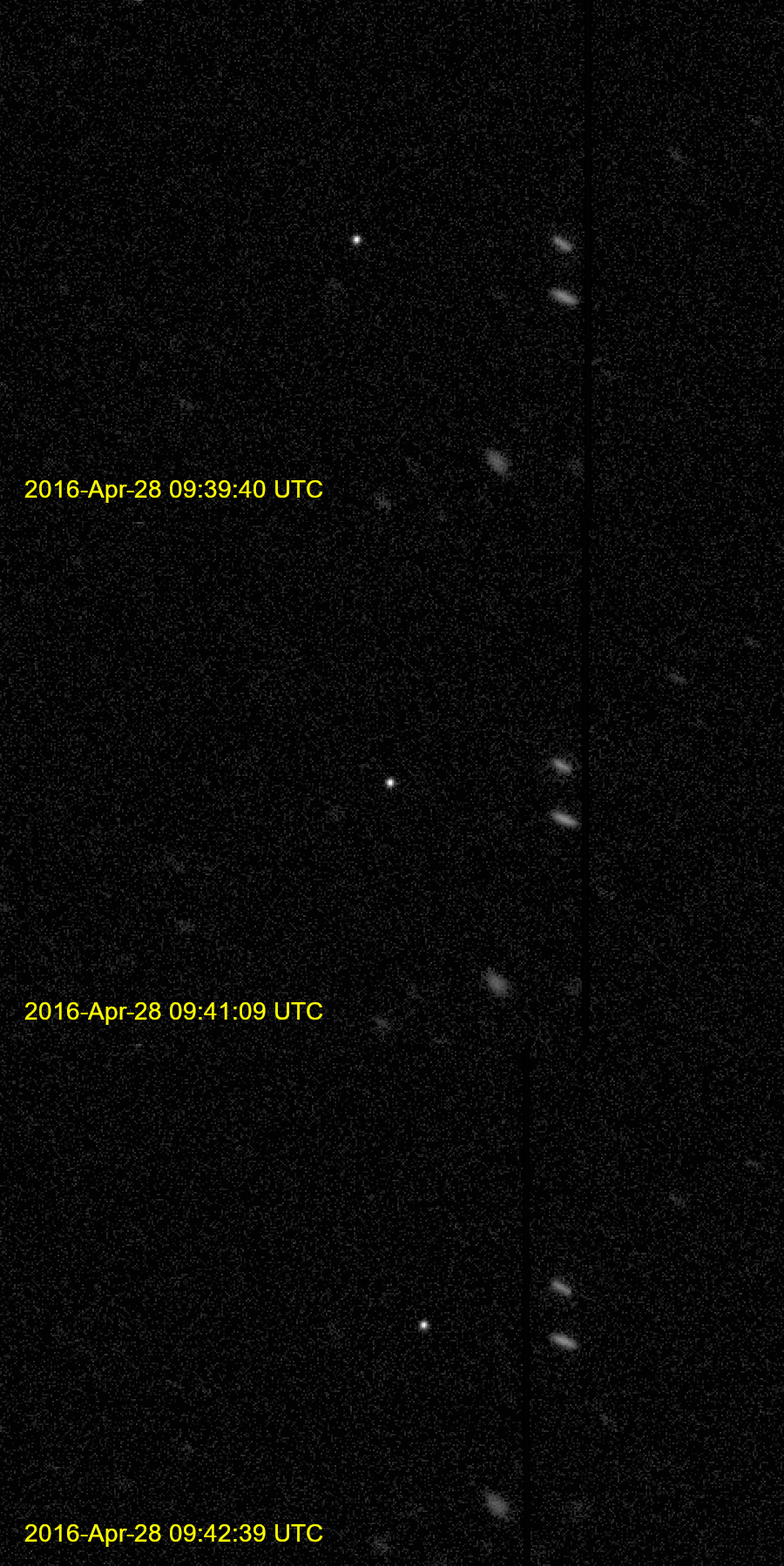
Neptune is the only planet in the solar system discovered through mathematics before it was directly observed.
In the early 19th century, astronomers noticed that the orbit of Uranus did not behave exactly as predicted by Newton’s laws. Something unseen was tugging at it gravitationally. Two mathematicians, Urbain Le Verrier and John Couch Adams, independently calculated the position of an unknown planet that could explain the anomaly.
Using these predictions, astronomers pointed their telescopes to the sky—and there it was.
Neptune’s discovery marked a profound moment in science. It proved that the universe could be understood not just through observation, but through the power of theory and mathematics. It showed that invisible forces could reveal hidden worlds.
In a sense, Neptune was found by thought before it was found by sight.
2. It Is the Windiest Planet in the Solar System
If you could stand on Neptune—though you cannot—you would be swept away instantly.
Neptune hosts the fastest winds in the solar system, reaching speeds of over 2,000 kilometers per hour. These supersonic winds are faster than the speed of sound on Earth.
What makes this even more astonishing is that Neptune receives far less energy from the Sun than Earth does. At such a great distance, solar heating is weak. Yet the planet’s atmosphere is incredibly dynamic.
Scientists believe that internal heat plays a major role. Neptune emits more energy than it receives from the Sun, driving convection and turbulence in its atmosphere.
Massive storms churn through its upper layers. Dark spots—similar to Jupiter’s Great Red Spot—appear and disappear over time, driven by powerful atmospheric currents.
Neptune is a world where wind becomes a force of unimaginable intensity, sculpting clouds and storms in a perpetual, violent dance.
3. Neptune Is Colder Than You Can Imagine—Yet It Burns with Internal Heat
Temperatures on Neptune’s cloud tops can drop to around −214°C. This makes it one of the coldest places in the solar system.
At such temperatures, familiar substances behave in unfamiliar ways. Methane gas, which gives Neptune its vivid blue color, exists in a frigid, exotic state.
And yet, despite this extreme cold, Neptune radiates more than twice the energy it receives from the Sun.
This internal heat likely originates from residual energy left over from the planet’s formation, as well as slow gravitational contraction. Deep within Neptune, pressure and temperature rise dramatically, creating conditions vastly different from those at the surface.
This combination of freezing cold and internal warmth creates a dynamic, layered world—one that is both icy and energetic at the same time.
Neptune defies simple classification. It is not just cold. It is active.
4. A Single Year on Neptune Lasts 165 Earth Years
Time flows differently in the outer solar system.
Neptune orbits the Sun at an average distance of about 4.5 billion kilometers. At that distance, its journey around the Sun takes approximately 165 Earth years.
This means that since its discovery in 1846, Neptune has completed just one full orbit. It returned to the same position in its orbit for the first time in 2011.
Imagine a year lasting longer than a human lifetime.
Seasons on Neptune are equally extreme. Each season lasts over 40 Earth years. Changes in sunlight, though faint, still influence atmospheric behavior over these long timescales.
Neptune exists in a realm where time stretches, where cycles unfold slowly and patiently across generations.
5. Neptune Has Storms That Appear and Disappear
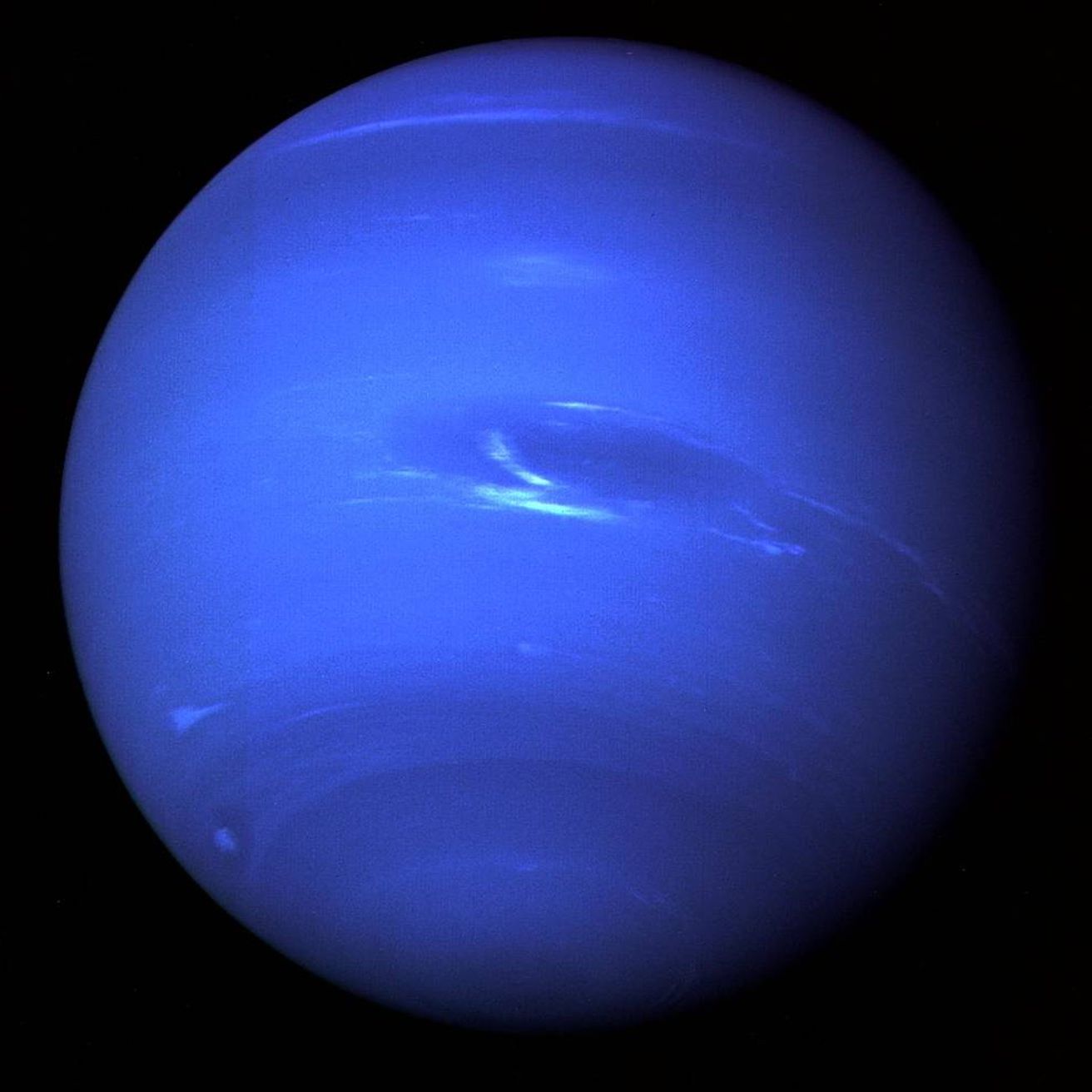
One of Neptune’s most famous features is the Great Dark Spot, discovered by the spacecraft Voyager 2 during its flyby in 1989.
This massive storm was comparable in size to Earth and resembled Jupiter’s Great Red Spot. But unlike Jupiter’s long-lived storm, Neptune’s dark spots are temporary.
When the Hubble Space Telescope later observed Neptune, the Great Dark Spot had vanished. New storms appeared elsewhere.
These storms are high-pressure systems, surrounded by fast-moving winds. Their formation and disappearance suggest a highly dynamic atmosphere, constantly evolving.
Neptune teaches us that not all planetary features are permanent. Some are fleeting, shaped by forces we are only beginning to understand.
6. Neptune’s Blue Color Comes from Methane—and Something More
Neptune’s striking blue color is one of its most recognizable features.
Methane in the planet’s atmosphere absorbs red light from the Sun and reflects blue light back into space. This gives Neptune its deep azure hue.
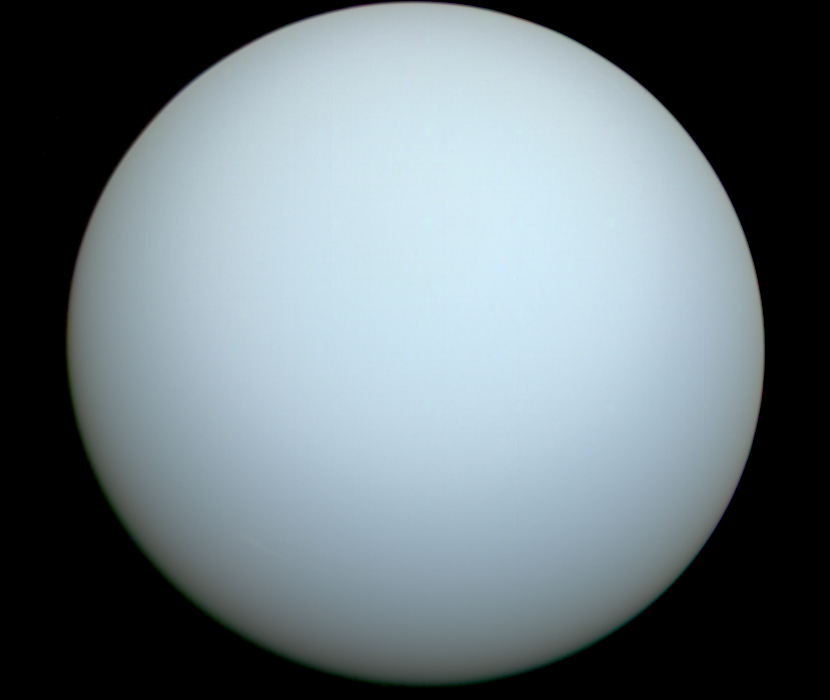
However, Neptune appears a richer, darker blue than its neighbor Uranus, which also contains methane.
This suggests that another, still not fully understood component influences its color. It may involve complex atmospheric chemistry or unknown particles suspended in the upper layers.
The color of Neptune is not just aesthetic—it is a clue. It hints at processes and compositions that scientists are still working to unravel.
Even something as simple as color can hold deep scientific mystery.
7. Neptune Has a Faint but Fascinating Ring System
While Saturn’s rings are bright and spectacular, Neptune’s rings are dark, thin, and mysterious.
Neptune possesses several rings composed of dust and small particles. What makes them particularly unusual is their uneven structure. Some rings contain dense clumps known as arcs—regions where material is concentrated rather than evenly distributed.
These arcs are thought to be maintained by gravitational interactions with nearby moons, preventing the particles from spreading out.
The rings are faint and difficult to observe, yet they reveal the complex gravitational choreography taking place around the planet.
Neptune’s rings remind us that even subtle features can hold profound insights into planetary dynamics.
8. Its Largest Moon, Triton, Orbits Backward
Neptune’s largest moon, Triton, is one of the most unusual objects in the solar system.
Triton orbits Neptune in the opposite direction of the planet’s rotation—a retrograde orbit. This strongly suggests that Triton did not form alongside Neptune. Instead, it was likely captured by Neptune’s gravity, possibly from the Kuiper Belt.
Triton is geologically active. It has geysers that erupt nitrogen gas and dark material into space, driven by seasonal heating. Its surface is relatively young, indicating ongoing processes.
Over time, tidal interactions are causing Triton to spiral inward toward Neptune. Eventually, it may be torn apart, potentially forming a new ring system.
Triton is a captured wanderer, a frozen world with a violent future.
9. Neptune Is Made of Exotic “Ices”
Neptune is often called an ice giant, but this term can be misleading.
In planetary science, “ices” refer not just to frozen water, but to volatile substances like water, ammonia, and methane under high pressure. Inside Neptune, these materials exist in exotic states—neither solid, liquid, nor gas as we experience them on Earth.
Deep within the planet, pressures are so immense that carbon atoms from methane may be compressed into diamond. Some scientists speculate that “diamond rain” could occur in Neptune’s interior.
Above this deep layer lies a thick atmosphere of hydrogen, helium, and methane, with clouds and storms driven by internal heat.
Neptune is not a simple gas ball. It is a layered, complex world where familiar substances behave in extraordinary ways.
10. We Have Only Visited Neptune Once
Despite its importance, Neptune has been visited by only one spacecraft: Voyager 2.
In 1989, Voyager 2 flew past Neptune, providing our first—and so far only—close-up observations. It revealed the planet’s rings, storms, and moons, transforming our understanding overnight.
But a flyby offers only a snapshot.
Since then, all observations of Neptune have come from telescopes, both on Earth and in space. While technology has improved, many questions remain unanswered.
Future missions to Neptune have been proposed, including orbiters and atmospheric probes. These missions could uncover details about its interior, weather systems, and magnetic field.
For now, Neptune remains distant and mysterious—a frontier waiting to be explored.
The Distant Giant That Redefines Perspective
Neptune is more than a planet at the edge of the solar system. It is a reminder of how much we do not yet know.
It challenges assumptions about temperature, motion, time, and structure. It shows that even in the coldest, darkest reaches of our cosmic neighborhood, there can be energy, complexity, and change.
It is a world where winds scream faster than sound, where storms appear and vanish, where moons defy expectations, and where unseen processes shape visible beauty.
And perhaps most astonishing of all, it is a place we have barely begun to understand.
As we look outward into the universe, searching for other worlds and other possibilities, Neptune stands as both a guide and a mystery—a distant blue beacon urging us to keep exploring, questioning, and wondering.
Because if such a strange and beautiful world exists in our own solar system, what else might be waiting beyond?