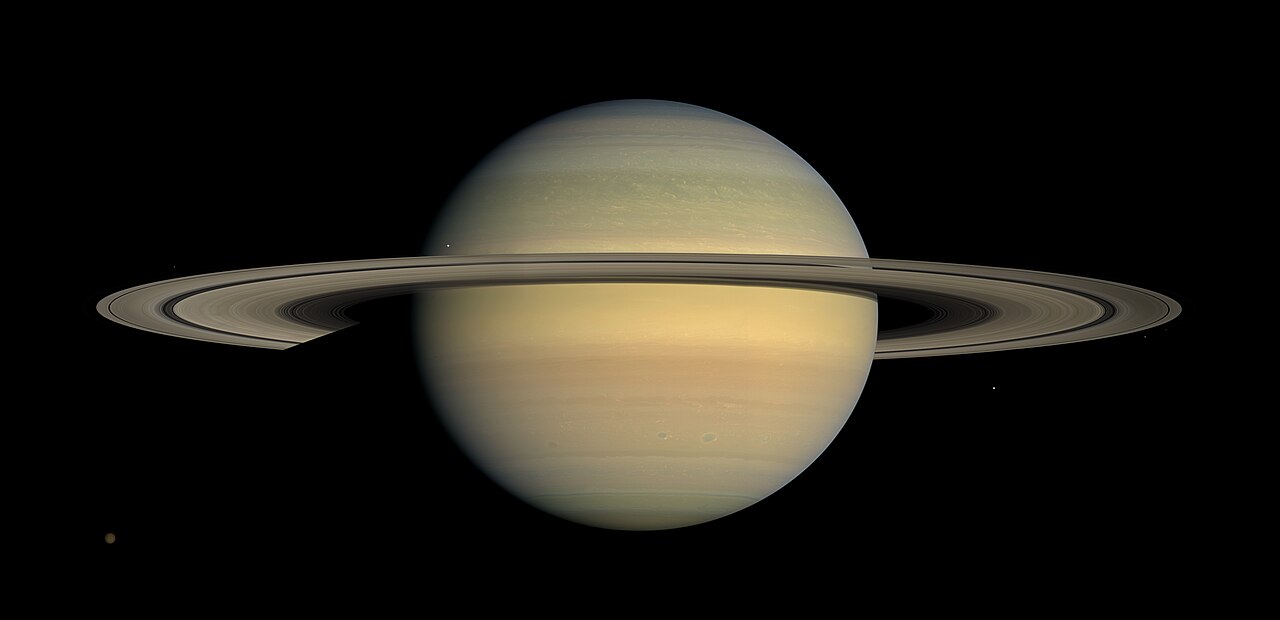
Few sights in astronomy are as breathtaking as the rings of Saturn. Suspended in the darkness of space, they appear like delicate halos surrounding the giant planet, shimmering with icy brilliance. For centuries, these rings have captured the imagination of scientists, philosophers, and dreamers alike. Through telescopes, they seem almost unreal—thin, luminous bands encircling a world made mostly of gas.
For many people, Saturn’s rings are the very symbol of the beauty of the solar system. When someone imagines a planet that looks distinctly “cosmic,” it is almost always Saturn they picture.
Yet behind this iconic image lies a surprising and somewhat bittersweet truth. Saturn’s rings are not permanent structures. In fact, scientific evidence suggests they may be slowly disappearing. Over astronomical timescales, they are gradually fading, particle by particle, as gravity and electromagnetic forces pull ring material toward the planet.
This raises a remarkable possibility: the Saturn we see today may look dramatically different in the distant future. Even more astonishing, the process of ring loss may already be occurring during our own era of observation.
Understanding whether Saturn is losing its rings—and why—requires exploring how the rings formed, what they are made of, and the subtle cosmic forces that shape their fate.
The First Discovery of Saturn’s Rings
The story of Saturn’s rings begins with one of the most transformative inventions in human history: the telescope.
In 1610, the Italian astronomer Galileo Galilei turned his early telescope toward Saturn. What he saw puzzled him deeply. Instead of appearing as a simple sphere like other planets, Saturn seemed to have strange extensions on either side. Galileo described them as “ears” or handles.
His telescope was not powerful enough to reveal the true structure of the rings, so the mystery remained unresolved.
Decades later, in 1655, the Dutch astronomer Christiaan Huygens finally solved the puzzle. Using a better telescope, he proposed that Saturn was surrounded by a thin, flat ring that did not touch the planet.
Later observations confirmed this insight and revealed that the ring was not a solid structure but rather a vast collection of countless small particles orbiting the planet.
This discovery transformed Saturn from an ordinary planet into one of the most extraordinary objects in the solar system.
What Saturn’s Rings Are Made Of
Although they appear smooth and continuous from a distance, Saturn’s rings are actually composed of an enormous number of individual pieces.
Most of these particles are made primarily of water ice, mixed with smaller amounts of rocky material and dust. Their sizes vary dramatically. Some are tiny grains barely larger than sand particles, while others are chunks the size of houses.
Despite their enormous width, the rings are surprisingly thin. In many places they are only tens of meters thick. Compared with their diameter—which stretches hundreds of thousands of kilometers—this thinness makes them resemble an enormous cosmic sheet.
The rings are divided into several major sections known as the A ring, B ring, and C ring, along with fainter outer rings. Each region contains particles moving at different speeds as they orbit Saturn.
These particles follow the laws of gravity and orbital mechanics. The inner particles move faster than those farther away, creating a dynamic system in which collisions and interactions constantly reshape the ring structure.
From a distance, the rings look calm and serene. In reality, they are an ever-changing environment of swirling ice and rock.
The Age of Saturn’s Rings
For many years, astronomers assumed that Saturn’s rings formed at the same time as the planet itself, around 4.5 billion years ago when the solar system first emerged from a rotating cloud of gas and dust.
However, more recent research has challenged that assumption.
Measurements of the brightness and composition of the rings suggest that they may be much younger—possibly only about 100 million years old. In cosmic terms, this is remarkably recent. Dinosaurs still roamed Earth when Saturn’s rings might have formed.
The rings are extremely reflective because they contain large amounts of clean water ice. If they had existed for billions of years, scientists would expect them to be much darker due to contamination from micrometeorite impacts and cosmic dust.
The relative brightness of the rings therefore suggests that they have not been exposed to space debris for extremely long periods.
If this interpretation is correct, Saturn’s rings may represent a temporary stage in the planet’s history rather than a permanent feature.
How the Rings May Have Formed
Scientists have proposed several theories to explain how Saturn’s rings originated.
One possibility is that a moon once orbited too close to Saturn and was torn apart by tidal forces. When a celestial body ventures within a certain distance of a massive planet, gravitational forces can exceed the strength holding the object together. This boundary is known as the Roche limit.
Inside this region, tidal forces stretch and eventually destroy the object, scattering its material into orbit around the planet.
If a moon crossed this boundary, its fragments could have spread into a ring system.
Another possibility involves collisions between icy moons. A violent impact could have shattered one or more moons, releasing debris that gradually formed the rings.
Both scenarios suggest that Saturn’s rings are the result of catastrophic events rather than gentle accumulation.
In either case, the rings may represent the remnants of destroyed worlds.
The Subtle Process of Ring Rain
One of the most intriguing discoveries about Saturn’s rings emerged from observations made by spacecraft and telescopes studying the planet’s magnetic field and atmosphere.
Scientists found evidence that ring particles are slowly being pulled into Saturn’s upper atmosphere in a process sometimes called “ring rain.”
Charged particles within the rings interact with Saturn’s magnetic field. These interactions cause some particles to spiral along magnetic field lines and fall toward the planet.
When they enter the upper atmosphere, they vaporize and become part of Saturn’s atmospheric chemistry.
This process gradually removes material from the rings.
Although the loss rate is relatively slow on human timescales, over millions of years it becomes significant. The cumulative effect could eventually drain much of the ring material back into the planet.
In essence, Saturn is slowly reclaiming the icy debris that orbits it.
The Role of Solar Radiation
The Sun also plays a role in the fate of Saturn’s rings.
Ultraviolet radiation from the Sun can interact with ice particles in the rings, causing them to become electrically charged. Once charged, the particles respond to Saturn’s magnetic field and can be pushed out of stable orbits.
Micrometeorite impacts contribute to the same process. When tiny meteoroids strike ring particles, they eject dust and fragments that may drift away or spiral toward the planet.
Over long periods, these processes gradually erode the rings.
The combined influence of solar radiation, magnetic forces, and collisions means that Saturn’s rings are not stable forever.
They are slowly evolving—and eventually fading.
Observations from the Cassini Mission
One of the most important sources of information about Saturn’s rings came from the spacecraft Cassini–Huygens.
Launched in 1997 and arriving at Saturn in 2004, the mission spent more than a decade studying the planet, its moons, and its rings. The spacecraft performed detailed measurements of ring composition, particle distribution, and gravitational effects.
In the final phase of the mission, Cassini flew repeatedly between Saturn and its innermost rings. These daring maneuvers allowed scientists to measure the mass of the rings more precisely than ever before.
The results suggested that the rings contain less material than previously believed. This supports the idea that they may not last for billions of years.
Cassini also provided evidence for ring rain, detecting charged particles moving from the rings into the planet’s atmosphere.
These observations strengthened the hypothesis that Saturn’s rings are gradually disappearing.
The Timescale of Ring Loss
Despite dramatic headlines suggesting that Saturn’s rings are vanishing, the process occurs over extremely long periods.
Current estimates suggest that the rings could largely disappear within about 100 million to 300 million years.
From a human perspective, this is unimaginably distant. No living observer will witness the complete disappearance of the rings.
However, in astronomical terms, this timescale is relatively short. Planetary features often persist for billions of years.
If Saturn’s rings truly formed around 100 million years ago and may vanish within a few hundred million more, then we happen to live during a rare period in the planet’s history when its rings are visible.
In that sense, humanity exists during a fortunate moment in cosmic time.
Saturn Without Rings
Imagining Saturn without its rings can feel strange because the rings have become inseparable from the planet’s identity.
Yet if the rings disappear, Saturn will not vanish. The massive gas giant itself will remain, along with its dozens of moons and powerful magnetic field.
Without rings, Saturn would resemble other gas giants such as Jupiter, Uranus, and Neptune, though each of those planets also possesses faint ring systems of its own.
In fact, scientists believe that ring systems around giant planets may form and disappear multiple times during their lifetimes. Moons may occasionally break apart and create new rings, while existing rings gradually dissipate.
If that is true, Saturn’s rings may not represent the beginning or the end of the story—only one chapter in an ongoing cycle.
The Dynamic Nature of the Rings
Even today, Saturn’s rings are far from static.
Gravitational interactions with Saturn’s moons create intricate patterns within the rings. Some moons act as “shepherd moons,” maintaining narrow ring structures by gravitationally guiding particles along specific paths.
These interactions produce waves, gaps, and spirals within the ring system.
One famous gap known as the Cassini Division separates two major rings and is maintained by gravitational resonances with Saturn’s moons.
These complex patterns reveal that the rings behave almost like a fluid system, responding dynamically to gravitational forces.
Observing these processes allows scientists to study orbital mechanics and gravitational interactions in extraordinary detail.
Why Saturn’s Rings Matter to Science
Beyond their visual beauty, Saturn’s rings provide a natural laboratory for studying physics.
They offer a large-scale example of disk dynamics—processes that also occur in many other parts of the universe. For example, disks of gas and dust surround young stars during planet formation, and spiral galaxies contain rotating disks of stars.
By studying the interactions between ring particles, scientists can gain insight into how similar structures behave elsewhere in the cosmos.
Saturn’s rings also help researchers understand the gravitational influence of moons and the behavior of particles under competing forces.
In this way, the rings provide valuable clues about cosmic processes occurring on much larger scales.
A Moment in Cosmic History
If Saturn’s rings truly formed relatively recently and may disappear within a few hundred million years, then the era in which we live becomes uniquely significant.
For most of the solar system’s history, Saturn may not have had the magnificent rings we see today.
Long after humanity is gone, those rings may once again fade away.
Our generation happens to exist during the window in which they shine brightly across the sky.
From that perspective, Saturn’s rings become more than an astronomical feature. They represent a fleeting moment in the life of a planet.
The Emotional Power of Cosmic Change
The possibility that Saturn’s rings may one day vanish reminds us that the universe is not static.
Planets evolve. Stars are born and die. Galaxies collide and transform. Even structures that appear timeless are subject to change.
There is something both humbling and beautiful about this reality.
Saturn’s rings have dazzled human observers for centuries, and they will continue to do so for countless generations. Yet their eventual disappearance reveals that the cosmos is always in motion.
Nothing in the universe remains exactly the same forever.
A Future Without the Rings
Far in the future, astronomers—perhaps from civilizations not yet imagined—may look at Saturn and see a different world.
They may read ancient records describing a time when Saturn was surrounded by brilliant rings of ice.
To them, those rings may seem almost mythical, like a vanished wonder from a distant past.
But for us, living in the present era, Saturn still carries its luminous crown.
When we gaze through telescopes and see that glowing halo encircling the planet, we are witnessing something rare in the lifetime of a world.
We are seeing Saturn during one of its most magnificent chapters.