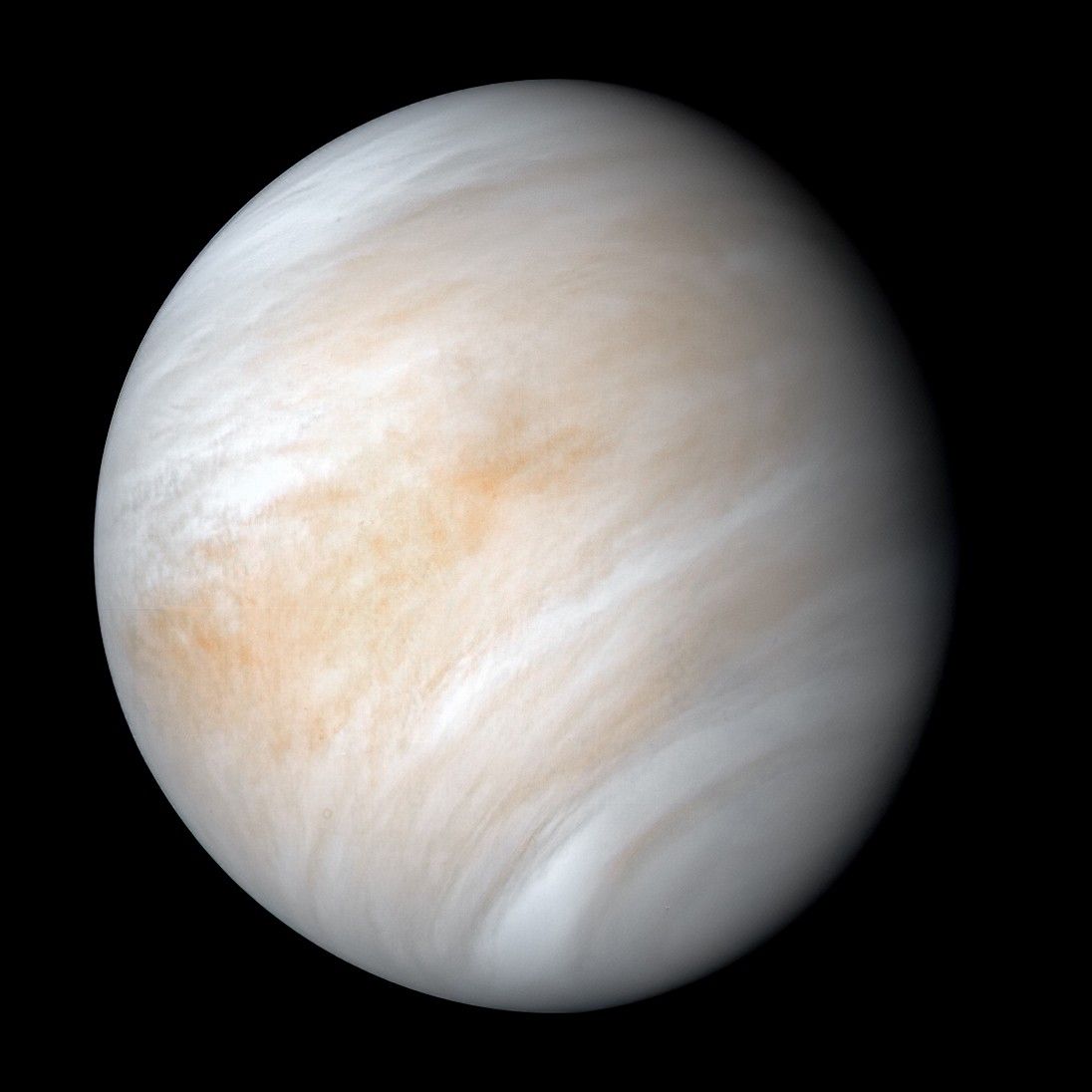
Venus is a world of paradoxes, a planet that glows with breathtaking beauty in our sky while hiding one of the most hostile environments in the solar system. It is often called Earth’s twin, not because it shares our gentle oceans or life-filled landscapes, but because it is almost the same size, made of similar materials, and formed in the same region of space billions of years ago. Yet the similarities end there. Beneath its dazzling brilliance lies a world of crushing pressure, scorching heat, and thick, toxic clouds that never part.
To understand Venus is to confront a mystery that has fascinated scientists, philosophers, and skywatchers for centuries. It is a planet that challenges our expectations and forces us to rethink what it means for a world to be “Earth-like.” In many ways, Venus is a warning, a mirror, and a cosmic puzzle all at once.
The Brightest Planet in the Sky
Venus is the brightest natural object in the night sky after the Moon. It shines so intensely that it can sometimes be seen even in daylight if you know exactly where to look. This brilliance has made Venus a central figure in human culture throughout history.
Ancient civilizations noticed its striking presence long before they understood what it was. They gave it names associated with beauty, love, and divinity. The Romans named it after their goddess of love, while the Greeks associated it with Aphrodite. In many cultures, Venus appeared as both the “Morning Star” and the “Evening Star,” depending on when it rose or set relative to the Sun.
For a long time, people believed these were two separate celestial objects. Only later did astronomers realize they were observing the same planet from different positions in its orbit.
The brightness of Venus comes from its thick cloud cover, which reflects a large portion of the sunlight that reaches it. This high reflectivity, known as albedo, makes Venus appear like a brilliant jewel in the sky, even though the surface below those clouds is hidden from direct view.
Position and Orbit in the Solar System
Venus is the second planet from the Sun, orbiting just inside Earth’s path. It lies at an average distance of about 108 million kilometers from the Sun, closer than Earth but farther than Mercury. This position plays a crucial role in shaping its extreme environment.
Because Venus orbits closer to the Sun, it receives significantly more solar energy than Earth. However, distance alone does not explain its intense heat. Other factors, especially its atmosphere, contribute far more dramatically to its extreme conditions.
One of the most interesting aspects of Venus is how it moves through space. Its orbit around the Sun takes about 225 Earth days to complete. But its rotation—the time it takes to spin once on its axis—is astonishingly slow. A single day on Venus lasts about 243 Earth days, meaning that a Venusian day is actually longer than its year.
Even more unusual is the direction of its rotation. Venus spins in the opposite direction of most planets in the solar system, including Earth. This phenomenon is known as retrograde rotation. As a result, on Venus, the Sun rises in the west and sets in the east, the reverse of what we experience on Earth.
Size, Structure, and Composition
Venus is often described as Earth’s twin because of its similar size and mass. It has a diameter of about 12,100 kilometers, only slightly smaller than Earth’s. Its mass is roughly 81.5 percent that of Earth, and its density suggests a similar internal structure.
Like Earth, Venus is believed to have a layered interior consisting of a core, mantle, and crust. The core is likely composed of iron and nickel, surrounded by a thick mantle of rocky material. The outer crust forms the planet’s surface.
However, despite these similarities, Venus behaves very differently from Earth. One key difference is the apparent lack of plate tectonics. On Earth, the crust is divided into moving plates that interact with one another, creating mountains, earthquakes, and volcanic activity. On Venus, the crust appears to be more rigid and does not show clear evidence of plate boundaries.
Instead, Venus may undergo periodic resurfacing events in which large portions of its surface are reshaped by volcanic activity. This process could explain why much of the planet’s surface appears relatively young in geological terms.
The Surface of Venus
The surface of Venus is a place of extremes. It is dominated by vast plains of volcanic rock, punctuated by mountains, valleys, and enormous volcanic structures. More than 80 percent of the surface is covered by smooth volcanic plains formed by ancient lava flows.
Venus has thousands of volcanoes, many of which are much larger than those found on Earth. Some of these volcanoes are shield volcanoes, formed by the slow accumulation of lava over time. Others are more complex structures with unusual shapes not commonly seen elsewhere in the solar system.
One of the most remarkable features on Venus is Maxwell Montes, the highest mountain on the planet. It rises about 11 kilometers above the surrounding terrain, comparable in height to Earth’s tallest peaks.
The surface also contains large, circular structures called coronae. These features are thought to form when hot material rises from the mantle and pushes against the crust, causing it to bulge and crack.
Impact craters are present on Venus, but they are relatively scarce compared to other rocky planets like Mercury or Mars. This suggests that the surface has been reshaped relatively recently, erasing older craters.
Despite its fascinating geology, the surface of Venus remains hidden beneath thick clouds. Only radar mapping, conducted by spacecraft, has allowed scientists to reveal its features.
The Crushing Atmosphere
If there is one feature that defines Venus more than any other, it is its atmosphere. The atmosphere of Venus is incredibly dense and composed primarily of carbon dioxide, with small amounts of nitrogen and trace gases.
At the surface, the atmospheric pressure is about 92 times greater than that of Earth. This is equivalent to the pressure experienced nearly one kilometer underwater on Earth. Any spacecraft or human attempting to stand on the surface would be crushed under this immense weight.
The atmosphere is also filled with thick clouds of sulfuric acid droplets. These clouds form a global blanket that completely obscures the surface from visible light.
These clouds are not just passive features; they are dynamic and constantly in motion. High-speed winds in the upper atmosphere can circle the planet in just a few days, even though the planet itself rotates very slowly.
This phenomenon, known as super-rotation, is one of the many mysteries that scientists continue to study.
The Runaway Greenhouse Effect
Venus is the hottest planet in the solar system, even hotter than Mercury, which is closer to the Sun. Surface temperatures on Venus average around 465 degrees Celsius, hot enough to melt lead.
The primary reason for this extreme heat is the runaway greenhouse effect. On Earth, greenhouse gases such as carbon dioxide trap some heat in the atmosphere, keeping the planet warm enough to support life. On Venus, this process has gone out of control.
The thick carbon dioxide atmosphere traps heat so effectively that it prevents the planet from cooling down. Sunlight passes through the clouds and heats the surface, but the heat cannot escape back into space. Instead, it is absorbed and re-emitted by the atmosphere, creating a continuous cycle of heating.
Over time, this process led to the extreme conditions we see today. It is possible that Venus once had oceans and a more moderate climate, but as the greenhouse effect intensified, any water would have evaporated and been lost to space.
The story of Venus serves as a powerful example of how climate systems can evolve dramatically under certain conditions.
Weather on Venus
The weather on Venus is unlike anything on Earth. While the surface remains relatively calm with slow-moving winds, the upper atmosphere is a place of intense activity.
Winds in the cloud layers can reach speeds of up to 360 kilometers per hour. These powerful winds drive the super-rotation of the atmosphere, causing it to circle the planet much faster than the surface rotates.
The clouds themselves are composed of sulfuric acid droplets, making them highly corrosive. If you could somehow stand in the upper atmosphere, you would encounter thick, yellowish clouds and a sky that glows with diffused sunlight.
Lightning may also occur within these clouds, although its presence is still a subject of scientific investigation.
Despite the violent conditions above, the lower atmosphere near the surface is relatively still. However, the extreme heat and pressure make it one of the most inhospitable environments in the solar system.
Exploration of Venus
Human curiosity has driven numerous missions to explore Venus, despite its harsh conditions. Early attempts to study the planet relied on telescopes, which could only reveal the cloud-covered exterior.
The true exploration of Venus began in the twentieth century with the arrival of spacecraft. The Soviet Union’s Venera program achieved some of the most remarkable successes. Several Venera landers managed to reach the surface and transmit data before being destroyed by the extreme conditions.
These missions provided the first images of the Venusian surface, revealing a barren landscape of rocks and volcanic formations under a dim, orange sky.
Later missions, including NASA’s Magellan spacecraft, used radar to map the surface in detail. These maps transformed our understanding of Venusian geology and revealed the complexity of its terrain.
More recent missions have focused on studying the atmosphere and searching for clues about the planet’s past. Scientists continue to investigate whether Venus once had conditions that might have been suitable for life.
The Possibility of Life
At first glance, Venus seems completely inhospitable to life as we know it. The extreme heat, crushing pressure, and toxic atmosphere make the surface an unlikely place for any organism to survive.
However, some scientists have proposed that life might exist in the upper layers of the atmosphere, where temperatures and pressures are more moderate. In these regions, conditions are somewhat closer to those found on Earth’s surface.
The idea of airborne microbial life remains speculative, but it has sparked significant interest and debate within the scientific community. Observations of certain chemical compounds in the atmosphere have raised questions that are still being explored.
Whether or not life ever existed on Venus—or still exists in some form—remains one of the most intriguing mysteries in planetary science.
Venus and Earth: A Tale of Two Worlds
The comparison between Venus and Earth is both fascinating and sobering. These two planets share many similarities in size, composition, and origin, yet their paths diverged dramatically.
Earth became a world filled with oceans, life, and a relatively stable climate. Venus, on the other hand, transformed into a scorching, hostile environment.
Understanding why this happened is one of the key goals of planetary science. By studying Venus, scientists hope to learn more about the factors that influence planetary climates and the potential for habitability.
This knowledge is not only important for understanding our solar system but also for studying planets around other stars. Venus serves as a reminder that small differences in conditions can lead to vastly different outcomes.
The Cultural and Historical Significance of Venus
Venus has held a special place in human culture for thousands of years. Its brilliance and predictable motion made it one of the most important objects in ancient astronomy.
Civilizations used Venus to track time, develop calendars, and guide agricultural activities. Its appearances as the Morning Star and Evening Star were often associated with myths, rituals, and symbolism.
In literature and art, Venus has been linked with beauty, love, and mystery. Its name continues to evoke images of elegance and allure, even though the reality of the planet is far from gentle.
This contrast between appearance and reality adds to the enduring fascination with Venus.
The Future of Venus Exploration
The exploration of Venus is entering a new era. Scientists are planning future missions to study the planet in greater detail, focusing on its atmosphere, geology, and potential history of water.
Advanced spacecraft equipped with modern instruments will help answer long-standing questions about the planet’s evolution. Some missions aim to send probes into the atmosphere, while others plan to map the surface with higher resolution than ever before.
There is also growing interest in the possibility of floating habitats in the upper atmosphere, where conditions are less extreme. While such ideas remain in the realm of speculation, they highlight the enduring curiosity that Venus inspires.
Why Venus Matters
Venus is more than just another planet in the solar system. It is a key to understanding planetary evolution, climate dynamics, and the delicate balance that allows a world to support life.
Its extreme conditions provide a natural laboratory for studying the effects of greenhouse gases and atmospheric processes. By learning from Venus, scientists can gain insights that may help us better understand and protect our own planet.
Venus also reminds us of the diversity of worlds that exist in the universe. It challenges our assumptions and encourages us to explore beyond the familiar.
A World of Beauty and Danger
In the end, Venus stands as one of the most captivating objects in the sky. It shines with unmatched brilliance, drawing our eyes and inspiring our imagination. Yet beneath its radiant appearance lies a world of fire, pressure, and relentless heat.
It is a planet that tells a story—a story of transformation, extremes, and the powerful forces that shape worlds. It invites us to ask questions, to seek answers, and to marvel at the complexity of the universe.
To look at Venus is to witness both beauty and danger intertwined. It is a reminder that the universe is filled with wonders that are not always as they seem, and that even the brightest light can conceal the most extraordinary secrets.