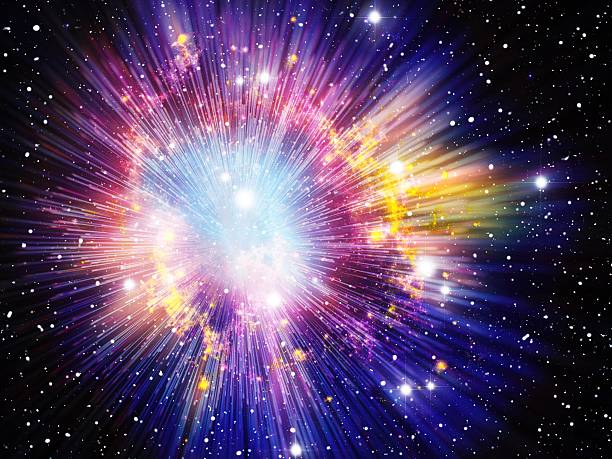
There are moments in science when the universe stops being a distant backdrop and becomes something intimate, something almost personal. The Big Bang is one of those moments. It is not just a theory about the cosmos; it is the story of how every atom in your body began its journey. It is the origin of time, space, matter, and energy as we understand them.
Yet the more we learn about the Big Bang, the stranger it becomes. It is not the neat, fiery explosion often imagined in popular culture. It is deeper, more subtle, more mathematically beautiful—and far more mind-bending.
Here are ten scientifically grounded facts about the Big Bang that may fundamentally alter the way you see reality.
1. The Big Bang Was Not an Explosion in Space
When most people hear “Big Bang,” they imagine a bomb detonating in a vast, dark emptiness. But that image is profoundly misleading.
The Big Bang was not an explosion in space. It was an expansion of space itself.
There was no center from which matter flew outward. There was no preexisting void into which debris scattered. Instead, every region of space expanded simultaneously. Galaxies are not racing away from a central point; rather, the fabric of space between galaxies is stretching.
This insight comes from solutions to the equations of general relativity developed by Albert Einstein. When astronomers like Edwin Hubble observed that distant galaxies are receding from us, they discovered that the universe is expanding uniformly in all directions. The farther away a galaxy is, the faster it appears to move away—a relationship now known as Hubble’s Law.
Imagine dots on the surface of an inflating balloon. As the balloon expands, every dot moves away from every other dot. No dot is the center. The expansion is happening everywhere.
The Big Bang was not something that happened at a place. It happened to space itself.
2. The Universe Has No Center and No Edge
If the Big Bang was not an explosion from a central point, then where is the center of the universe?
There isn’t one.
Every observer, in every galaxy, sees the same large-scale expansion. From any vantage point, distant galaxies appear to recede in all directions. This is not because we occupy a privileged position, but because expansion is built into the geometry of space.
The observable universe—the region from which light has had time to reach us since the beginning—is finite. But that does not necessarily mean the entire universe is finite. It may extend infinitely beyond what we can see.
Even more unsettling is the idea that the universe may not have an “edge” in the traditional sense. Just as the surface of Earth has no boundary yet is finite, space itself could be curved in a way that has no edge.
The implication is dizzying. There is no cosmic stage beyond which nothing exists. Space is either boundless or curved back on itself. Either way, the intuitive notion of an outer boundary collapses.
3. The Big Bang Was Incredibly Hot—Hotter Than Anything We Can Truly Imagine
In its earliest moments, the universe was unimaginably hot and dense. Temperatures exceeded trillions upon trillions of degrees. At such extremes, atoms could not exist. Even protons and neutrons had not yet formed.
Within the first fraction of a second, the universe consisted of an exotic plasma of fundamental particles—quarks, gluons, electrons, neutrinos—interacting in a chaotic, energetic dance.
As the universe expanded, it cooled. Within minutes, protons and neutrons fused into the first light nuclei in a process called Big Bang nucleosynthesis. Hydrogen and helium were forged in these early moments, with trace amounts of lithium.
The heavy elements—carbon, oxygen, iron—came much later, inside stars. The atoms that make up your blood, your bones, your thoughts, were born in stellar furnaces billions of years after the Big Bang.
The early universe was not just hot. It was a cosmic furnace in which the basic ingredients of reality were assembled.
4. We Can Still See the Afterglow of the Big Bang
Perhaps the most stunning confirmation of the Big Bang model is that we can still detect its fading light.
About 380,000 years after the beginning, the universe cooled enough for electrons and protons to combine into neutral hydrogen atoms. Before this moment, photons—particles of light—were constantly scattered by free electrons. The universe was opaque, like a dense fog.
Once atoms formed, light could travel freely for the first time. That ancient radiation has been traveling ever since.
Today, it reaches us as the cosmic microwave background, a faint glow detectable in every direction. It was first discovered accidentally in 1965 by Arno Penzias and Robert Wilson.
The cosmic microwave background is not just noise. It is a detailed map of the infant universe, revealing tiny temperature fluctuations—differences of one part in 100,000—that later grew into galaxies and clusters.
When we study this radiation, we are literally observing the universe as it was nearly 14 billion years ago.
5. The Universe Expanded Faster Than the Speed of Light
One of the most brain-breaking aspects of the early universe is a phase known as cosmic inflation.
According to inflationary theory, proposed by Alan Guth, the universe underwent an extremely brief period of exponential expansion within a tiny fraction of a second after the Big Bang.
During inflation, space itself expanded faster than the speed of light.
This does not violate Einstein’s theory of relativity because relativity restricts objects moving through space, not the expansion of space itself. Space can stretch at any rate.
Inflation explains several puzzles, including why the universe appears so uniform on large scales and why its geometry is remarkably flat.
If inflation occurred, then regions of space that were once quantum-scale fluctuations were blown up to cosmic proportions. Galaxies may ultimately owe their existence to tiny quantum ripples stretched across the cosmos.
The largest structures in the universe may have originated from the smallest fluctuations imaginable.
6. The Big Bang Did Not Create Everything from “Nothing” in a Simple Way
It is often said that the Big Bang created the universe from nothing. But this phrase oversimplifies a deeply complex issue.
Physics can describe the evolution of the universe from an extremely early state—back to a tiny fraction of a second after the beginning. However, when we extrapolate all the way to time zero, our equations break down.
General relativity predicts a singularity: infinite density and temperature. But infinities usually signal that a theory has reached its limits.
To truly understand whether the universe came from “nothing,” we would need a complete theory of quantum gravity—one that unites general relativity with quantum mechanics. Such a theory does not yet exist in experimentally confirmed form.
Some proposals suggest that the universe arose from quantum fluctuations in a vacuum state. Others posit that time itself began at the Big Bang, making the concept of “before” meaningless.
The origin of everything may not fit neatly into human language.
7. The Big Bang Set the Arrow of Time
Time feels like it flows in one direction—from past to future. We remember yesterday but not tomorrow. Broken cups do not spontaneously reassemble.
This directionality is closely linked to entropy, the measure of disorder described by the second law of thermodynamics.
The early universe was in an extraordinarily low-entropy state. It was smooth and uniform on large scales. As the universe expanded and structures formed—stars, galaxies, black holes—entropy increased.
The arrow of time may ultimately trace back to the Big Bang’s special initial conditions. Why those conditions were so ordered remains one of the deepest mysteries in cosmology.
In other words, the reason you can remember your childhood and not your future may be written into the fabric of the universe’s beginning.
8. The Big Bang Produced Tiny Imperfections That Made Everything Possible
The early universe was remarkably uniform—but not perfectly so.
The cosmic microwave background reveals minuscule temperature variations. These slight irregularities represented regions that were slightly denser than average.
Gravity amplified these tiny differences over billions of years. Denser regions pulled in more matter, eventually forming galaxies and clusters.
Without those primordial imperfections, matter would have remained evenly distributed. There would be no stars, no planets, no life.
The fact that the universe began almost perfectly smooth—but not entirely—was crucial. Too smooth, and nothing forms. Too clumpy, and black holes might dominate early on.
Our entire cosmic history may hinge on fluctuations so small they are barely measurable.
9. The Big Bang Does Not Describe the Whole Universe
The Big Bang theory describes the evolution of the observable universe from a hot, dense early state. It is extraordinarily successful in explaining observations.
But it does not necessarily describe the entire cosmos.
The observable universe is limited by the speed of light and the age of the universe. Beyond our cosmic horizon may lie regions we can never see.
Some models of inflation suggest that the universe could be vastly larger—perhaps infinite—and that our observable region is just a tiny patch.
Other theories propose a multiverse, in which our universe is one of many, each potentially with different physical constants.
These ideas remain speculative, but they are grounded in attempts to extend known physics.
The Big Bang may describe our cosmic neighborhood—but not the ultimate totality of existence.
10. The Big Bang Means You Are Made of Ancient Cosmic History
Perhaps the most personal and astonishing fact of all is this: you are a product of the Big Bang.
The hydrogen atoms in your body were formed in the first few minutes of cosmic history. The carbon in your cells was forged in the core of a long-dead star. The oxygen you breathe was created in stellar explosions.
Every atom has a history stretching back billions of years.
The universe is not separate from you. It is within you.
When you look at the night sky, you are not just observing distant objects. You are witnessing your own origins.
The Big Bang is not merely a theory about galaxies and radiation. It is the story of how the cosmos evolved to the point where it could contemplate itself.
The Beginning That Continues
The Big Bang is often described as a moment in the distant past. But in a profound sense, it is still happening. The universe continues to expand. Cosmic structures continue to evolve. The afterglow of the beginning still fills the sky.
We have learned astonishing details about our origins. We have measured the age of the universe to remarkable precision. We have mapped its early fluctuations and traced its chemical evolution.
And yet, fundamental questions remain. What triggered inflation? What is dark matter? What is dark energy? What happened at time zero?
The Big Bang is not the end of inquiry. It is the starting point of one of the greatest intellectual journeys humanity has ever undertaken.
To understand the Big Bang is to confront the immensity of space, the depth of time, and the fragility of existence. It is to realize that everything we know emerged from conditions almost beyond comprehension.
And perhaps the most brain-breaking fact of all is this: a species of primates on a small planet orbiting an ordinary star has managed to reconstruct this cosmic story through mathematics, observation, and imagination.
From fireball to galaxies. From quantum fluctuations to consciousness.
The universe began in mystery. It continues in wonder.