There is something deeply human about looking up at the night sky and wondering what lies beyond. Long before telescopes and space missions, our ancestors stared at tiny points of light and noticed that some of them behaved differently. While most stars remained fixed in their patterns, a few wandered slowly across the sky. These wandering lights were mysterious, unpredictable, and mesmerizing. They became the first objects we would eventually call planets.
A planet is, at its simplest, a world. It is a body that travels through space, shaped by gravity, illuminated by distant stars, and bound by the invisible laws of physics. Yet this simple idea hides a complex and evolving story. The definition of a planet has changed over time as our understanding of the universe has grown. Today, a planet is not just any object in space, but one that meets specific scientific criteria that distinguish it from stars, moons, and smaller bodies.
To understand what a planet truly is, we must explore not only its definition but also its origins, its structure, its diversity, and its place in the grand cosmic story. Planets are more than celestial objects; they are worlds with histories, environments, and in some cases, the potential to host life.
The Official Definition of a Planet
In modern astronomy, the term “planet” is defined with precision. Scientists needed a clear definition because of the increasing number of objects discovered in our solar system and beyond. The most widely accepted definition was established in 2006 by the International Astronomical Union.
According to this definition, a planet must meet three essential criteria. It must orbit a star. It must have enough mass for its gravity to pull it into a nearly round shape. And it must have cleared its orbital neighborhood of other debris, meaning it dominates its path around the star.
These criteria may seem straightforward, but they have important consequences. The requirement of orbiting a star excludes objects like free-floating planetary bodies that drift through space. The requirement of a round shape ensures that the object has sufficient gravity to overcome rigid structural forces. The final requirement, clearing the orbit, distinguishes planets from smaller bodies that share their orbital space.
This definition famously led to the reclassification of Pluto. Once considered the ninth planet of our solar system, Pluto was redefined as a dwarf planet because it does not dominate its orbital region. This decision sparked widespread debate and emotional reactions, highlighting how deeply people connect with the idea of planets.
The Birth of Planets
Planets are not eternal. They are born, evolve, and sometimes meet dramatic ends. Their story begins in vast clouds of gas and dust scattered throughout galaxies. These clouds, known as nebulae, are the cradles of stars and planetary systems.
When a region within a nebula begins to collapse under its own gravity, it forms a spinning disk of material around a newly forming star. This structure is called a protoplanetary disk. Within this disk, tiny particles of dust begin to collide and stick together. Over time, these particles grow into larger clumps known as planetesimals.
Through countless collisions and mergers, planetesimals accumulate mass and become protoplanets. Gravity plays a crucial role in this process, pulling material together and shaping these growing bodies. As protoplanets increase in size, their gravitational influence becomes stronger, allowing them to gather even more material.
Eventually, some of these bodies become full-fledged planets. Their formation is a chaotic and violent process, involving massive impacts, intense heat, and dramatic changes. The scars of this turbulent history can still be seen today in the craters, mountains, and geological features of many planets.
The Diversity of Planets
One of the most fascinating aspects of planets is their incredible diversity. No two planets are exactly alike. They vary in size, composition, temperature, atmosphere, and many other characteristics.
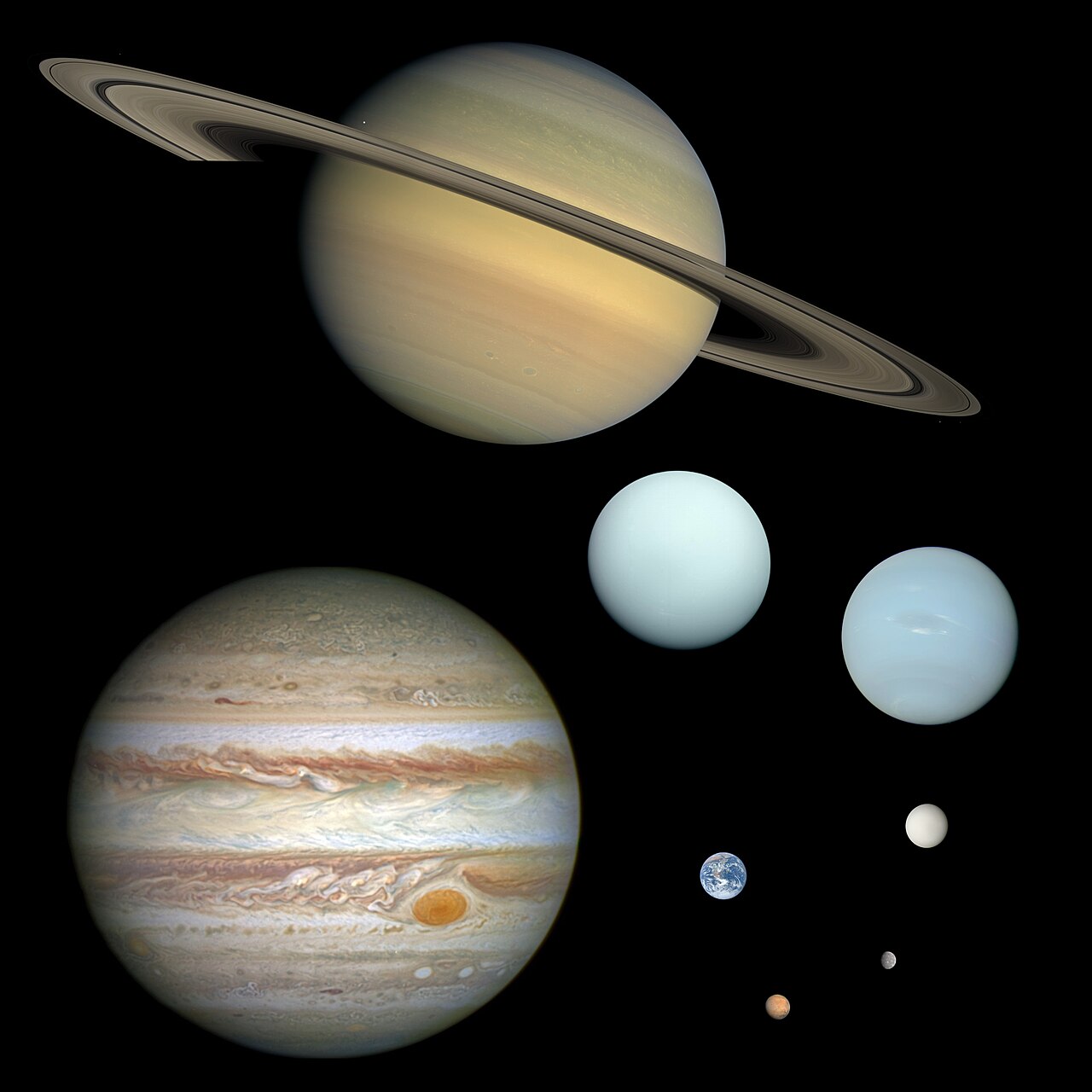
In our solar system, we see a wide range of planetary types. There are small, rocky worlds like Mercury, Venus, Earth, and Mars. These terrestrial planets have solid surfaces and are composed primarily of rock and metal.
Beyond them lie the gas giants, such as Jupiter and Saturn. These enormous planets are made mostly of hydrogen and helium, with no solid surface in the traditional sense. Their immense gravity and thick atmospheres create extreme conditions, including powerful storms and intense pressure.
Further out, we find ice giants like Uranus and Neptune. These planets contain higher proportions of water, ammonia, and methane, giving them unique compositions and striking appearances.
Beyond our solar system, the diversity becomes even more astonishing. Astronomers have discovered thousands of exoplanets orbiting distant stars. Some are “hot Jupiters,” massive gas giants that orbit very close to their stars. Others are rocky super-Earths, larger than our planet but smaller than gas giants. There are even planets that may be covered entirely by oceans or composed largely of exotic materials.
This diversity shows that planets are not limited to a single form. They are shaped by their environments and histories, resulting in a vast range of possibilities.
The Structure of a Planet
Although planets differ widely, many share common structural features. A typical planet consists of layers, each with distinct properties and compositions.
At the center lies the core, which may be solid, liquid, or a combination of both. In rocky planets, the core is often made of metal, such as iron and nickel. In gas giants, the core may be composed of heavier elements surrounded by thick layers of gas.
Above the core is the mantle, a region of material that can flow slowly over time. In terrestrial planets, the mantle plays a key role in geological processes such as volcanic activity and tectonic movement.
The outermost layer is the crust, the surface on which we stand on Earth. This layer can vary in thickness and composition, shaping the planet’s landscapes.
Many planets also have atmospheres, layers of gas that surround them. Atmospheres can influence temperature, weather, and the potential for life. Earth’s atmosphere, for example, provides oxygen for breathing and protects the surface from harmful radiation.
Some planets have magnetic fields, rings, or systems of moons. These features add further complexity to their structure and behavior.
Planetary Motion and Orbits
Planets are constantly in motion. They travel around their stars in paths known as orbits, guided by the force of gravity. These orbits are typically elliptical, meaning they are slightly stretched circles.
The motion of planets follows precise mathematical rules. The speed of a planet depends on its distance from the star. Planets closer to the star move faster, while those farther away move more slowly.
In addition to orbiting their stars, planets also rotate on their axes. This rotation determines the length of a day. On Earth, a full rotation takes about 24 hours, creating the cycle of day and night.
The tilt of a planet’s axis can lead to seasons. Earth’s tilted axis causes different parts of the planet to receive varying amounts of sunlight throughout the year, resulting in changes in temperature and climate.
These motions create rhythms that shape the environment of a planet. They influence weather patterns, temperature variations, and the potential for life.
The Role of Gravity
Gravity is the invisible force that holds planets together and keeps them in orbit. Without gravity, planets would not exist as coherent bodies. They would simply disperse into space.
Gravity pulls material toward the center of a planet, giving it a rounded shape. It also governs the interactions between planets, moons, and stars.
The strength of gravity on a planet depends on its mass and size. Larger planets generally have stronger gravitational pulls. This affects everything from the ability to retain an atmosphere to the way objects fall on the surface.
Gravity also plays a key role in shaping planetary systems. It determines the arrangement of planets, their orbits, and their interactions with one another.
Atmospheres and Climate
A planet’s atmosphere is one of its most defining features. It influences temperature, weather, and the potential for life.
Some planets have thick atmospheres composed of gases like hydrogen and helium. Others have thinner atmospheres made of carbon dioxide, nitrogen, or oxygen. Some planets have almost no atmosphere at all.
Atmospheres can trap heat through a process known as the greenhouse effect. This effect can make a planet warmer than it would otherwise be. On Earth, the greenhouse effect helps maintain a stable climate. On Venus, it has led to extremely high temperatures.
Weather patterns arise from the movement of air within the atmosphere. Winds, storms, and cloud formations are all driven by differences in temperature and pressure.
The study of planetary atmospheres provides valuable insights into climate systems and the potential for habitability.
Moons and Rings
Many planets are not alone. They are accompanied by moons, natural satellites that orbit them. Moons can vary greatly in size and composition, from small rocky bodies to large worlds with complex geology.
Earth has one moon, which influences tides and stabilizes the planet’s rotation. Other planets have dozens of moons, each with its own unique characteristics.
Some planets also have ring systems made of ice, rock, and dust. These rings can be thin and delicate or wide and complex. They are formed from material that has been broken apart by gravitational forces.
Moons and rings add richness to planetary systems, creating dynamic and fascinating environments.
The Search for Other Worlds
One of the most exciting developments in modern astronomy is the discovery of planets beyond our solar system. These exoplanets have expanded our understanding of what planets can be.
Scientists use various methods to detect exoplanets, including observing the dimming of a star’s light as a planet passes in front of it or measuring slight wobbles in a star’s motion caused by gravitational interactions.
The discovery of exoplanets has revealed that planetary systems are common in the universe. It has also raised profound questions about the possibility of life beyond Earth.
Some exoplanets exist in regions known as habitable zones, where conditions may allow liquid water to exist. These worlds are of particular interest because water is considered essential for life as we know it.
Planets and the Possibility of Life
The idea that planets might host life is one of the most compelling aspects of their study. Earth is currently the only known planet with life, but the vast number of planets in the universe suggests that it may not be unique.
The conditions required for life are complex. They include the presence of water, suitable temperatures, and a stable environment. A planet’s distance from its star, its atmosphere, and its geological activity all play important roles.
Scientists are actively searching for signs of life on other planets. This includes studying the atmospheres of exoplanets for chemical signatures that might indicate biological processes.
The discovery of life beyond Earth would be one of the most significant events in human history, fundamentally changing our understanding of our place in the universe.
The Ever-Evolving Concept of Planets
The concept of a planet is not fixed. It has evolved over time and may continue to change as new discoveries are made.
In ancient times, planets were simply wandering stars. Later, they became worlds orbiting the Sun. Today, they are defined by specific physical criteria.
As we explore the universe further, we may encounter objects that challenge our current definitions. New categories of celestial bodies may emerge, prompting scientists to refine or expand the concept of a planet.
This evolving understanding reflects the dynamic nature of science. It shows that knowledge is not static but grows and adapts as we learn more about the universe.
The Emotional Connection to Planets
Beyond their scientific significance, planets hold a special place in human imagination. They inspire stories, myths, and dreams of exploration.
From ancient myths about gods associated with planets to modern visions of space travel, these celestial bodies have captured our curiosity and creativity.
Planets represent possibility. They are distant yet tangible worlds that invite us to imagine what lies beyond our own.
The study of planets connects us to something larger than ourselves. It reminds us that we are part of a vast and intricate universe filled with wonders waiting to be discovered.