Wormholes are among the most thrilling ideas ever imagined by science. They sit at the boundary between proven physics and daring speculation, where mathematics hints at possibilities far beyond ordinary experience. The very word “wormhole” carries a strange magic. It suggests shortcuts through space, tunnels through time, and voyages to distant galaxies without spending thousands of years traveling the slow way.
Science fiction has embraced wormholes as cosmic highways, portals that let spaceships leap between star systems in seconds. But what does real physics actually say? Could wormholes exist? If they do exist, what would happen if a human being—or a spacecraft—entered one?
The honest answer is both exciting and unsettling: physics allows wormholes in theory, but it also suggests that entering one might be extremely dangerous, perhaps impossible. Still, the idea is worth exploring, because wormholes reveal something profound about the universe. They show how space and time might be shaped, stretched, twisted, and connected in ways our everyday minds are not built to imagine.
To understand what happens if you enter a wormhole, we must first understand what a wormhole really is.
The Meaning of a Wormhole in Real Physics
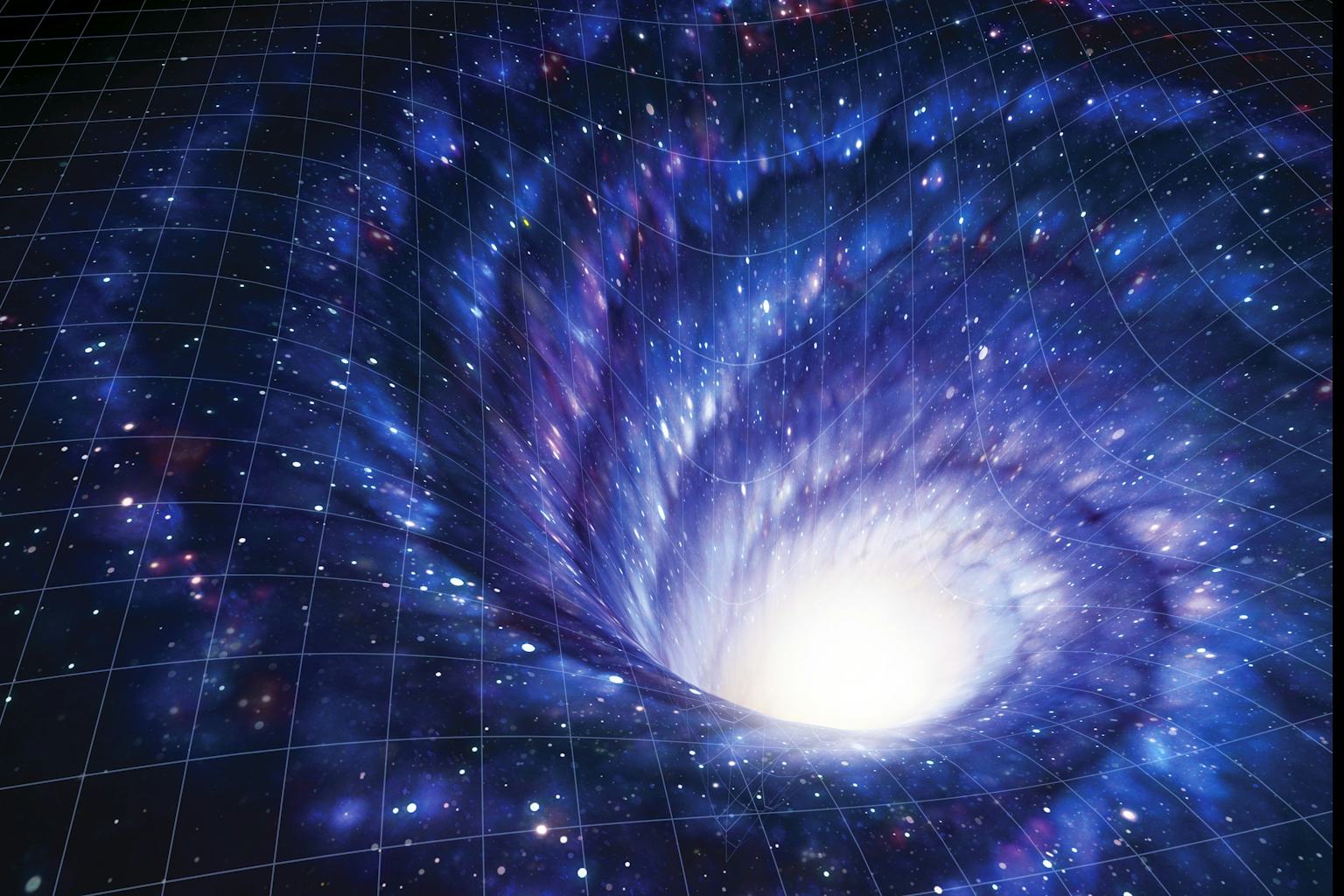
A wormhole is a hypothetical structure connecting two separate regions of spacetime. The key word is spacetime, because in Einstein’s theory of general relativity, space and time are not separate things. They form a four-dimensional fabric that can curve, bend, and warp in response to mass and energy.
In everyday life, we think of distance as a fixed fact. If a star is 1,000 light-years away, then you must travel 1,000 light-years to reach it. But general relativity allows spacetime itself to bend. And if spacetime can bend, then in principle it could fold like a sheet of paper.
Imagine two distant points on a sheet of paper. The straight path between them is long. But if you fold the paper so those points touch, you could punch a hole through the sheet and create a shortcut. A wormhole is the cosmic version of that shortcut.
Instead of traveling across vast distances, you pass through a tunnel in spacetime that links two faraway locations. This tunnel is often called the wormhole throat, and its openings are called mouths.
The mathematics of general relativity permits solutions that resemble wormholes. The most famous early model is called the Einstein–Rosen bridge, proposed in 1935 by Albert Einstein and Nathan Rosen. However, the original Einstein–Rosen bridge was not a traversable wormhole. It collapses too quickly for anything to pass through.
The question is not whether wormholes can exist in equations. They can. The question is whether the universe can actually build one that stays open long enough for a traveler to survive.
Why Wormholes Are So Hard to Keep Open
The biggest problem with wormholes is stability. According to most calculations, a wormhole would collapse almost instantly unless something held it open.
In general relativity, gravity is not a force pulling objects through space—it is the curvature of spacetime itself. If you create a wormhole, you create a region of extreme curvature. And extreme curvature behaves like a gravitational trap. The wormhole throat tends to pinch shut under its own gravity.
To keep a wormhole open, theoretical physicists propose that you would need exotic matter with negative energy density. This is not the same as antimatter. Antimatter has positive mass and positive energy; it would not stabilize a wormhole.
Negative energy density is something stranger. It would act gravitationally in the opposite way from normal matter, pushing spacetime outward instead of pulling it inward. In theory, this could counteract the wormhole’s natural collapse.
The problem is that we do not know whether enough negative energy can exist in the real universe to stabilize a wormhole. Quantum physics does allow small negative energy effects in certain situations, such as the Casimir effect, where quantum fluctuations between two close metal plates create a measurable force that can be interpreted as a region of negative energy.
But these effects are extremely tiny. Stabilizing a wormhole large enough for a person would require an unimaginable quantity of exotic matter, far beyond anything we know how to produce.
So the first accurate scientific point must be made clearly: traversable wormholes are not confirmed to exist, and if they do, they would require physics that might not be achievable by any civilization.
Still, the universe is vast and ancient. It may contain things we have not yet observed. If wormholes exist naturally, the next question becomes much more personal.
What happens if you enter one?
Approaching a Wormhole: What Would You See?
If you could approach a wormhole mouth, it would not look like a glowing doorway the way movies depict it. A real wormhole would be shaped by gravity, meaning it would strongly bend light.
From a distance, the wormhole might resemble a strange spherical distortion in space, like a bubble or a perfectly dark hole surrounded by warped starlight. The background stars would appear stretched, smeared, or duplicated around it.
If the wormhole connected to another region of spacetime, you might see something extraordinary at its opening: a view into another part of the universe.
This would not be a flat picture. It would be like looking through a window into an entirely different starfield, perhaps with unfamiliar constellations. The light from the far side would travel through the wormhole and emerge at your side, making the mouth appear like a circular lens into somewhere else.
Depending on how the wormhole bends spacetime, you might see multiple images of the same distant objects, twisted into rings or arcs. This is similar to gravitational lensing caused by massive galaxies, but far more extreme.
If the wormhole were rotating or dynamically changing, the visual distortions could be horrifyingly complex. Space would seem to ripple. Light would swirl. The universe would appear bent into impossible geometry.
Even before entering, you would know you were near something that should not exist.
Gravity Near the Wormhole Mouth
A wormhole would likely have strong gravitational effects. Whether it would be as deadly as a black hole depends on the wormhole’s mass and structure. Some wormhole models suggest that the mouths could be extremely massive objects, possibly comparable to black holes, while others allow wormholes that are gravitationally mild at the entrance.
If the gravity were intense, you would experience tidal forces. These forces occur because gravity pulls more strongly on the part of your body closer to the massive object than on the part farther away. Near a black hole, tidal forces can stretch an object into a thin strand, a process often called spaghettification.
A stable, traversable wormhole would need to avoid this fate. If tidal forces at the throat are too strong, no human or spacecraft could survive passage. In some theoretical models, it is possible to design wormholes with relatively gentle tidal forces, especially if the wormhole is large. A wormhole with a throat several kilometers wide could, in principle, have tidal forces low enough for safe travel.
But if the wormhole throat were small, the tidal forces could be lethal.
So as you approached the entrance, you might feel nothing at all, or you might feel gravitational stretching that would crush and tear matter apart. The survivability depends entirely on the wormhole’s geometry.
Physics does not guarantee comfort.
Crossing the Event Horizon: Would a Wormhole Have One?
Black holes have an event horizon, the boundary beyond which nothing—not even light—can escape. Wormholes do not necessarily have an event horizon. A traversable wormhole is defined by the ability to pass through and come out again. If it had a true event horizon, it would behave more like a black hole and would trap you permanently.
However, some wormhole-like solutions in relativity involve horizons or structures that resemble them. The difference is crucial.
If you entered a wormhole with an event horizon, you might never return. You could be trapped inside a region of spacetime where the exit is not accessible. You might fall into a singularity, the theoretical point of infinite density at the center of a black hole.
But a traversable wormhole, in theory, allows you to pass through without crossing an irreversible horizon. Instead, the throat would remain open, and you could travel through it like moving through a tunnel.
So if you enter a true traversable wormhole, you would not experience the “point of no return” that defines black holes. You might still face extreme gravitational forces, but escape would remain possible.
That alone makes wormholes more hopeful than black holes.
The Moment You Enter: What Would It Feel Like?
If you entered a stable wormhole with manageable tidal forces, the experience could be surprisingly uneventful in terms of physical sensation. In general relativity, free-fall motion through curved spacetime feels like weightlessness. Astronauts orbiting Earth feel weightless not because gravity is absent, but because they are falling continuously around the planet.
Similarly, if you fell into a wormhole, you might feel as if you were drifting.
However, what you would see could be beyond imagination. Inside the wormhole throat, light paths would curve in strange ways. The tunnel might not look like a smooth cylinder. It could appear as a warped region where the walls are made of distorted images of the universe.
If the wormhole connects two different locations, you might see the sky from both regions at once. The geometry could cause multiple overlapping views, creating a kaleidoscope of stars, galaxies, and light.
Your brain, trained to interpret Euclidean space, might struggle. Inside a wormhole, the geometry is not ordinary. Straight lines may not behave as expected. The sense of “forward” and “sideways” could become meaningless.
Even if your body survives, your mind might be overwhelmed by the visual and spatial confusion.
Time Inside a Wormhole: Does It Take Seconds or Years?
One of the most fascinating aspects of wormholes is their relationship with time. If a wormhole truly creates a shortcut through spacetime, the travel time through it could be far shorter than the travel time through normal space.
For example, two stars might be 1,000 light-years apart in ordinary space. Traveling at the speed of light would still take 1,000 years. But a wormhole could connect those regions with a tunnel only a few kilometers long. If you traveled through the tunnel at a normal spacecraft speed, you might cross it in minutes.
From your perspective, the journey could be quick. But what about observers outside?
In many wormhole models, time behaves normally for travelers and external observers. But relativity allows stranger possibilities. Wormholes might create time dilation effects depending on how the mouths move relative to each other or how they are placed in gravitational fields.
This is where wormholes stop being merely shortcuts through space and begin to flirt with time travel.
Could Entering a Wormhole Send You Into the Future?
According to relativity, time passes differently depending on speed and gravity. If one wormhole mouth is accelerated to near-light speed and then brought back, it could experience less time passing than the other mouth. This is similar to the twin paradox, where a traveling twin ages more slowly than a twin who stays on Earth.
If the mouths of a wormhole experience different time rates, the wormhole could connect two different moments in time. Entering the wormhole from one side might cause you to exit at a later time relative to your starting point.
In other words, you could step into the wormhole and emerge in the future.
This is not just science fiction; it is a theoretical consequence of combining wormholes with relativistic time dilation. If traversable wormholes existed and could be manipulated, they might function as time machines.
However, this raises major problems. Time travel leads to paradoxes, like the famous grandfather paradox. Many physicists suspect that nature prevents such paradoxes through mechanisms we do not fully understand. Stephen Hawking proposed the chronology protection conjecture, the idea that the laws of physics prevent the formation of closed timelike curves that would allow time travel to the past.
Even if wormholes exist, the universe might destroy them the moment they become time machines.
So entering a wormhole could, in theory, send you into the future. But whether the universe permits such a configuration is unknown.
Could a Wormhole Send You Into the Past?
Sending you into the past is even more controversial.
Some wormhole solutions in general relativity suggest that if the mouths are time-shifted relative to each other, you could travel through and emerge before you entered. This would allow backward time travel, potentially creating causal loops.
Most physicists believe something would prevent this from happening. It might be that wormholes cannot be stabilized in the necessary way. It might be that quantum effects cause them to collapse when time travel becomes possible. It might be that the universe is consistent in ways that avoid paradoxes.
But as far as mathematics goes, backward time travel is not automatically forbidden in general relativity. It is deeply unsettling, but not ruled out by the equations.
If you entered such a wormhole, you might step out into your own past, arriving in a world that still contains a younger version of yourself.
If that sounds impossible, you are not alone. Even physicists who study wormholes often treat time travel implications with caution. The universe may be stranger than intuition, but it may also have hidden rules that keep reality consistent.
What Happens to Your Body Inside a Wormhole?
If the wormhole is stable and large, you might survive physically. But many realistic wormhole scenarios would be deadly.
One major danger is tidal stretching. If the curvature of spacetime changes rapidly across your body, your head and feet might experience different gravitational forces. Your body could be stretched, crushed, or torn apart.
Another danger is radiation. Wormholes may trap radiation inside them. If light and particles can orbit within the throat, the wormhole could become a deadly region filled with intense energy. Even if you could pass through quickly, the radiation exposure might be lethal.
There is also the possibility of extreme acceleration. Some wormhole geometries could require enormous acceleration to enter or exit, subjecting you to g-forces far beyond what a human body can endure.
And then there is the strangest danger of all: quantum instability. Quantum fluctuations could cause the wormhole to collapse while you are inside. If the throat pinches shut mid-transit, the results are hard to predict, but they would almost certainly be fatal. You might be crushed by spacetime itself.
So if you entered a wormhole, survival would depend on conditions that are not guaranteed even in theory.
A wormhole is not a gentle tunnel. It is a distortion of the universe’s fabric.
Would You Be Spaghettified Like in a Black Hole?
The term spaghettification is often associated with black holes, but it could also occur in wormholes if the tidal forces are strong.
In a black hole, tidal forces become extreme near the singularity, and in smaller black holes they become extreme even before crossing the event horizon. Wormholes, depending on their design, might avoid singularities entirely. Some traversable wormhole solutions have no singularity at all, just a smooth throat supported by exotic matter.
If the wormhole throat is large enough, the tidal forces could be small. In that case, you would not be spaghettified. You could pass through intact.
But if the throat is narrow or the curvature is sharp, you might be stretched into atoms, then into subatomic particles, and finally into a spray of radiation.
The wormhole would not care that you are human. It would treat you as matter obeying physical laws.
What Happens to Light and Communication?
If you entered a wormhole, would you be able to communicate back to Earth?
If the wormhole is stable, signals could travel through it. In principle, radio waves could pass along the same path you do. That means communication might be possible, at least temporarily.
But wormholes could distort electromagnetic signals. The curvature might cause signals to scatter, shift frequency, or echo in strange ways. You might send a message and receive it back moments later from a different direction, as if space itself were confused.
If the wormhole connects distant regions of the galaxy, your communication might face a deeper challenge: causality. Depending on time dilation effects, your message might arrive at Earth after you are already gone, or even before you left.
If the wormhole functions as a time machine, communication becomes paradoxical. You could potentially send information into the past, which would destabilize the concept of cause and effect.
Physics might prevent such communication through quantum instability or by collapsing the wormhole.
So the answer is: communication might be possible, but it depends heavily on the wormhole’s structure and whether it violates causality.
What Happens When You Exit the Wormhole?
If you survived the passage, the exit could be the most breathtaking moment of your life.
You might emerge into a different part of the galaxy. The stars might look unfamiliar. The sky could be filled with strange nebulae or distant galaxies in a different orientation. If you exited near a different type of star, the light might have a different color, bathing everything in red or blue tones.
You might emerge near a planet you never knew existed, or in interstellar space with no planet nearby at all.
But the exit could also be lethal. You might emerge too close to a star, a black hole, or a region of intense radiation. The wormhole does not guarantee a safe destination. It only guarantees connection.
In some models, the wormhole mouths could drift through space. If one mouth is moving at high speed relative to the other, you might exit with enormous velocity relative to your surroundings, potentially colliding with dust particles at near-relativistic speeds. At such speeds, even a grain of sand becomes a bomb.
Your survival would depend not only on the wormhole itself, but on where and how you exit.
Could You Be Trapped Inside Forever?
Another possibility is that the wormhole could become a prison.
If the wormhole collapses after you enter, you might be trapped inside a region of spacetime with no exit. If the collapse creates an event horizon, you might be sealed inside like a black hole.
If the wormhole is unstable, it could also fluctuate, causing its exit point to shift unpredictably. You might attempt to leave but find the exit leading somewhere else entirely.
Even if the wormhole remains open, you might exit into a region of space so remote that returning is impossible. You would be alive, but lost in a cosmic wilderness.
A wormhole does not promise rescue. It promises only passage.
Would You Meet Another Universe?
Some wormhole theories suggest they might connect not just different regions of our universe, but different universes entirely. This idea comes from certain interpretations of cosmology and quantum physics, where our universe might be one of many in a multiverse.
If such a multiverse exists, wormholes might act as bridges between separate cosmic domains. Entering one could mean leaving our universe altogether.
If that happened, the laws of physics on the other side might not be identical. Fundamental constants might differ. The behavior of atoms could change. Chemistry might not work the same way. Stars might burn differently, or not exist at all.
If you entered a universe where the constants are incompatible with matter as we know it, you might not survive even an instant. Your atoms could become unstable, your molecular bonds could fail, or the environment could be too extreme for any known form of life.
This is highly speculative, but it highlights an important truth: wormholes are not merely tunnels through space. They are tunnels through the structure of reality itself.
If they exist, they might open doors far stranger than interstellar travel.
Could a Wormhole Destroy Earth If Someone Entered It?
A dramatic question arises: if a wormhole opened near Earth, could entering it destabilize it and cause disaster?
In most theoretical models, the act of entering would not collapse the wormhole. Your mass is tiny compared to the energy required to shape spacetime at that scale. But wormholes may be sensitive to disturbances. If the wormhole requires exotic matter to remain stable, adding ordinary matter might disrupt its balance.
Some models suggest that wormholes could collapse if too much mass passes through, or if the exotic matter support is insufficient. If a wormhole collapsed violently, it could release energy, potentially as radiation or gravitational waves.
Would this destroy Earth? Probably not, unless the wormhole itself contained enormous energy comparable to a black hole. But a wormhole of that scale near Earth would already be dangerous simply due to its gravitational influence.
In realistic terms, any wormhole large enough to travel through would likely be associated with immense energy, and its presence near Earth would be a global event.
But the act of entering alone is unlikely to doom the planet. The bigger issue would be the wormhole’s existence in the first place.
The Paradox of Wormhole Travel: Would You Really “Move”?
One of the strangest aspects of wormholes is that you might not feel like you traveled at all.
From your perspective, you might enter the mouth, pass through a short tunnel, and exit almost immediately. It might feel like walking through a doorway.
But from the perspective of ordinary space, you have crossed an enormous distance. You might have traveled thousands of light-years without experiencing anything like the passage of time that would normally be required.
This challenges our basic intuition. We associate travel with time and effort. Wormholes would break that relationship. They would allow you to outrun light in a sense, not by moving faster than light locally, but by taking a shortcut through spacetime geometry.
Importantly, wormholes do not necessarily violate relativity. Relativity forbids objects from moving through space faster than light. It does not forbid spacetime itself from having shortcuts.
In that sense, wormholes are a loophole—not in physics, but in our assumptions.
The Deepest Problem: Do Wormholes Actually Exist?
After all this, the most important question remains.
Do wormholes exist in reality?
So far, there is no observational evidence for wormholes. None have been detected. No gravitational lensing event has conclusively proven a wormhole. No astrophysical object has been confirmed as a wormhole mouth.
General relativity allows wormholes mathematically, but nature is not required to build everything mathematics permits. Many solutions to Einstein’s equations exist that describe strange and unrealistic universes. The real universe selects only certain solutions.
Even if wormholes exist, they may be microscopic, forming and collapsing at quantum scales. Quantum gravity theories suggest spacetime may be turbulent at extremely small distances, with tiny wormhole-like structures appearing briefly. But such wormholes would be far too small for travel.
A human-sized wormhole might require engineering capabilities beyond imagination, perhaps beyond what is physically possible. The exotic matter requirement alone is a massive obstacle.
So while wormholes are scientifically plausible as concepts, they remain unproven as objects.
What Would Happen If You Entered a Wormhole?
If we combine what physics says with what it does not yet know, the answer becomes a spectrum of possibilities.
If the wormhole is unstable, you would likely die almost instantly as it collapses or tears you apart with tidal forces.
If the wormhole is stable but small, tidal forces could spaghettify you.
If the wormhole is stable and large enough, and if exotic matter holds it open, you might survive the passage and emerge somewhere else in the universe.
If the wormhole mouths have different time rates, you might exit in the future, effectively becoming a time traveler.
If the wormhole connects to another universe, you might step into a cosmos with unfamiliar physics, perhaps survivable, perhaps instantly fatal.
If the wormhole behaves unpredictably, you might be trapped, lost, or scattered into radiation.
The unsettling truth is that wormhole travel is not guaranteed to be survivable even in theory. It is not like boarding a plane. It is like stepping into a distortion of spacetime so extreme that the universe itself might reject it.
Yet the possibility remains irresistible.
The Human Meaning of Wormholes
Wormholes are more than a scientific curiosity. They represent something deeply human: our refusal to accept limits. The speed of light feels like a prison wall around the stars, a cosmic law that seems to mock our desire to explore. Wormholes offer a vision of escape, a way to reach the unreachable.
Even if wormholes never become real travel routes, they have already served a purpose. They force us to test our understanding of relativity. They push us to confront quantum physics. They challenge us to think about causality, time, and the structure of the universe.
Wormholes are not just tunnels through space. They are tunnels through our imagination, carved by mathematics and curiosity.
And perhaps that is the most accurate conclusion we can draw.
If you entered a wormhole, you might cross the universe in moments. You might travel through time. You might reach another reality. Or you might be torn apart by forces so violent that your atoms would scatter into the cosmos like dust.
The laws of physics do not promise safety.
They promise only that whatever happens will be astonishingly real.