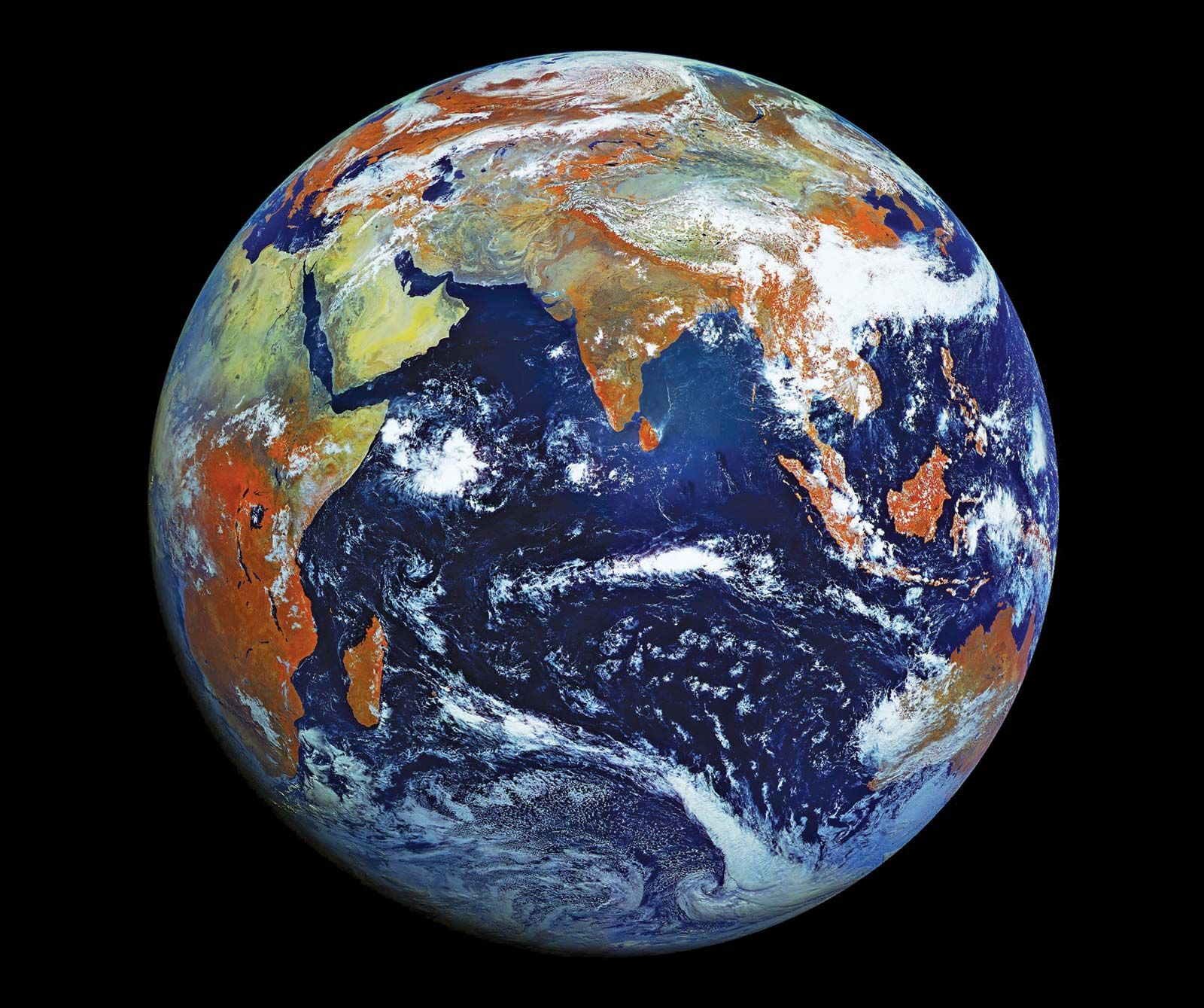
Earth feels solid and still beneath our feet. Mountains stand unmoving, oceans seem calmly contained, and the ground gives us the comforting illusion of permanence. Yet this stability is a kind of illusion. Our planet is not resting in space like a quiet stone. It is a dynamic, restless world in constant motion.
Right now, at this very moment, Earth is spinning at roughly 1,670 kilometers per hour (about 1,040 miles per hour) at the equator. We do not feel it because everything around us—air, oceans, buildings, our own bodies—moves with the planet. It is like being inside a smoothly flying airplane: motion is invisible until it changes.
But what if it did change?
What if Earth stopped spinning?
This question sounds like science fiction, but exploring it reveals just how deeply Earth’s rotation shapes everything we take for granted. Day and night, winds and weather, ocean currents, the shape of the planet, and even the rhythm of life itself are built around the steady turning of Earth. If that rotation suddenly vanished, the world would not simply become quieter. It would become unrecognizable.
To understand what would happen, we have to separate two possibilities: Earth gradually stopping over a long time, and Earth stopping instantly. The difference between those scenarios is the difference between dramatic change and total catastrophe.
Why Earth Spins in the First Place
Earth’s rotation is not accidental. It is a leftover consequence of the violent birth of the solar system.
About 4.5 billion years ago, the Sun formed from a swirling cloud of gas and dust. The remaining material flattened into a rotating disk, and within that disk, countless collisions occurred as particles clumped together into larger bodies. These collisions did not happen perfectly head-on. Most impacts were uneven, like cosmic punches delivered at angles. Each collision transferred angular momentum, slowly building the spin of growing planetary bodies.
Earth inherited its rotation from this chaotic formation process. Later, the massive impact that likely formed the Moon also played a role in shaping Earth’s spin rate.
Today, Earth continues spinning because of inertia. In space, objects in motion tend to stay in motion unless acted on by an outside force. There is no giant brake in the cosmos to stop a planet’s rotation quickly. Earth’s spin is slowly slowing down due to tidal friction caused mainly by the Moon, but the process is extremely gradual. Days are lengthening by about a couple of milliseconds per century.
Earth’s rotation is not fragile. It is deeply embedded in the physics of the planet.
Which makes the question of Earth suddenly stopping so dramatic: it would require an unimaginable force, and the consequences would be equally unimaginable.
The Instant Earth Stops Spinning: The First Seconds of Horror
If Earth stopped spinning instantly, the planet itself would halt, but everything on its surface would not. Inertia would carry the atmosphere, oceans, and all objects forward at the speed they were moving before the stop.
At the equator, that speed is about 1,670 kilometers per hour. That is faster than the speed of sound. Even at mid-latitudes, the speed would still be hundreds or over a thousand kilometers per hour.
The result would be immediate, planet-wide destruction.
Everything not firmly anchored to bedrock would be thrown eastward at extreme velocity. People, animals, vehicles, buildings, forests—everything would become projectiles. The force would be far beyond any hurricane or earthquake. It would be closer to the energy of an asteroid impact spread across the entire surface of Earth.
The atmosphere would keep moving too, producing global winds at supersonic speeds. These winds would not simply knock down buildings. They would tear continents apart with unstoppable pressure, flattening cities as if they were made of paper.
Oceans would surge forward as colossal tsunamis. Entire coastlines would vanish beneath moving walls of water. The seas would not remain in their basins; they would slosh violently across the planet, carrying debris, sediment, and wreckage.
Within minutes, the Earth’s surface would be scoured clean in many regions. It would be one of the most destructive events imaginable—an extinction-level catastrophe far more severe than any known natural disaster.
If Earth stopped instantly, the immediate question would not be “How would life adapt?” It would be “Would anything survive at all?”
Some microorganisms deep underground or in the deep ocean might endure. But complex life on the surface would likely be almost completely erased.
That is the brutal truth: an instant stop is basically planetary doom.
But physics allows another interpretation, one that is less immediate and more intriguing: what if Earth gradually stopped spinning over thousands or millions of years? That scenario reveals a different kind of world-ending transformation, slower but just as profound.
The End of the 24-Hour Day
Earth’s rotation is what creates the cycle of day and night. One full spin equals one day. If Earth stopped spinning, the familiar 24-hour rhythm would disappear.
If Earth completely stopped rotating relative to the Sun, one side of the planet would face the Sun continuously, while the opposite side would face away continuously. Instead of day and night, there would be a permanent day hemisphere and a permanent night hemisphere.
This would be one of the most dramatic changes imaginable for life, because almost every biological system on Earth is tied to the day-night cycle. Plants open and close their stomata based on sunlight. Animals sleep and hunt according to circadian rhythms. Even human hormones follow daily patterns.
Without rotation, the concept of “a day” would become meaningless. Time would still pass, but sunlight would no longer sweep across the surface in a daily cycle.
Instead, Earth would become a world of eternal noon and eternal midnight.
The boundary between these regions, known as the terminator line, would be the only place where the Sun would hover near the horizon.
And that boundary might become the most habitable region on the planet.
A Planet of Fire and Ice
With constant sunlight, the day side of Earth would heat relentlessly. Temperatures would rise far beyond what most ecosystems could handle. The land would bake. Water would evaporate. Deserts would expand into super-deserts.
On the night side, without any sunlight, temperatures would plummet. Heat would radiate into space without being replenished. The atmosphere could begin to freeze out, especially gases like carbon dioxide and water vapor, forming massive ice deposits.
The night side would become a frozen wasteland of darkness, bitter cold, and potentially thick ice sheets miles deep. The oceans on that side could freeze solid at the surface and perhaps deeper depending on atmospheric conditions.
Meanwhile, the day side could become a steaming hellscape, perhaps reaching temperatures similar to those on Venus in the most extreme scenario.
Earth would no longer be a balanced planet. It would become a world divided into two extremes.
This temperature imbalance would drive powerful winds and storms as the atmosphere tried to redistribute heat. The planet would still have air circulation, but it would be unlike anything we experience today.
The weather would become monstrous.
The Collapse and Reinvention of Earth’s Weather System
Earth’s rotation plays a key role in shaping global wind patterns. Because Earth spins, moving air is deflected by the Coriolis effect, which causes winds and ocean currents to curve rather than move in straight lines. This effect is responsible for the swirling structure of hurricanes, the trade winds, and the jet streams.
Without rotation, the Coriolis effect would disappear.
Air would move more directly from high-pressure regions to low-pressure regions. The basic driver of wind—uneven heating—would still exist, but the pattern would change completely.
The day side would become a region of intense heating. Warm air would rise continuously, creating a permanent low-pressure zone. The night side would become cold, with sinking air and high pressure. The atmosphere would attempt to balance this by moving air from the night side toward the day side near the surface, and then back toward the night side higher in the atmosphere.
This would create a massive global circulation system, with constant winds blowing from the dark hemisphere into the bright hemisphere.
The terminator region would become a zone of extreme storms. It would likely experience continuous violent weather, with powerful winds and heavy precipitation as warm moist air from the day side met cold air from the night side.
Instead of seasonal storms and shifting patterns, Earth might develop semi-permanent storm belts.
The weather would not be unpredictable chaos. It would become a stable, brutal machine.
The Oceans Would Move to a New Shape
Earth is not a perfect sphere. Because it spins, it bulges outward at the equator. The equatorial diameter is about 43 kilometers larger than the pole-to-pole diameter. This bulge exists because rotation produces a centrifugal effect that slightly counteracts gravity at the equator, allowing the planet to swell outward.
If Earth stopped spinning, that centrifugal effect would vanish.
Over time, Earth would begin to reshape itself into a more perfect sphere. The equatorial bulge would slowly collapse. This would not happen instantly, but over long geological time, the planet’s crust and mantle would adjust.
But the oceans would respond much faster.
Today, sea level is higher near the equator because of the bulge. If the bulge disappeared, water would flow away from the equator toward the poles. Entire coastlines would shift. Vast regions currently above sea level might flood, while other regions might emerge as new land.
The planet’s geography would be transformed.
Equatorial regions could become higher and drier as water drains poleward. Polar regions could become more submerged, at least initially, until freezing and climate changes complicate the picture.
If Earth stopped spinning, maps would no longer be valid. Continents would not move, but coastlines would be redrawn by the redistribution of water.
Earthquakes and Geological Stress
A spinning Earth experiences different forces than a non-spinning Earth. The gradual loss of rotation would change the distribution of stress in the planet’s crust. As the equatorial bulge collapsed, the crust would need to adjust, and that adjustment would produce enormous geological activity.
Earthquakes would become more frequent and more intense. Volcanic activity could increase as the mantle and crust responded to new pressure conditions. Mountain ranges might shift slightly. Fault lines could awaken in places previously stable.
The planet would be undergoing a slow, grinding transformation, as if Earth were reshaping its own skeleton.
If the stop were sudden, the geological impact would be even worse. The crust could fracture globally. The oceans sloshing across continents would add additional stress, and earthquakes would erupt everywhere.
Earth would not simply be a world without rotation. It would be a world in trauma.
The Moon Would Change Its Relationship With Earth
Earth’s rotation and the Moon’s orbit are linked through tidal forces. The Moon causes tides, and those tides create friction that slowly slows Earth’s spin. At the same time, that energy transfer pushes the Moon slightly farther away over time.
If Earth stopped spinning completely, the tidal relationship would change drastically.
The Moon would still orbit Earth, but Earth would no longer rotate beneath it. The tidal bulges would align differently, and the dynamics of Earth-Moon interaction would become simpler in some ways but more extreme in others.
Tides would still exist, but they would not follow the familiar rhythm of high tide and low tide occurring twice daily. Instead, the tide pattern would depend more purely on the Moon’s orbital motion. Since the Moon takes about 27.3 days to orbit Earth relative to the stars, tides would follow a monthly cycle rather than a daily one.
The oceans would experience slower, longer tidal changes.
However, given the extreme climate conditions likely present, tides might be a secondary concern compared to the more immediate problem of a planet divided between heat and cold.
The Magnetic Field Might Weaken Over Time
Earth’s magnetic field is generated by the geodynamo: the movement of molten iron in Earth’s outer core. This motion is driven by heat escaping from the core and by Earth’s rotation, which organizes the fluid motion into stable patterns.
Rotation is not the only factor that drives the magnetic field, but it plays an important role in stabilizing the dynamo.
If Earth stopped spinning, the core would still convect due to heat, but the structure of that convection could change dramatically. The magnetic field might weaken, become unstable, or fluctuate more frequently.
A weakened magnetic field would expose Earth’s atmosphere to increased erosion by the solar wind. Charged particles from the Sun could strip away lighter atmospheric gases over long timescales, especially hydrogen.
It would not instantly remove the atmosphere, but over millions of years it could make Earth less protected from radiation. It would also increase the frequency and intensity of auroras and radiation storms at the surface.
A weak magnetic field would add another layer of danger to a planet already struggling with extreme climate imbalance.
Would Earth Still Have Seasons?
Seasons are caused primarily by Earth’s axial tilt, not by its rotation speed. Earth is tilted about 23.5 degrees relative to its orbital plane, which causes sunlight to strike different latitudes more directly at different times of the year.
Even if Earth stopped spinning, it would still orbit the Sun. It would still be tilted. That means seasons could still exist, but they would behave differently.
Instead of a rotating Earth where every location experiences day and night while seasons change gradually, you would have a fixed day side and night side that shift slightly with the seasons.
Over the course of a year, the region receiving constant sunlight would shift north and south. During part of the year, the northern hemisphere would receive more direct sunlight, and during the opposite part, the southern hemisphere would.
This would cause the permanent day zone to migrate somewhat, and the permanent night zone to migrate as well. Some regions near the poles might experience periods of sunlight or darkness depending on the season.
However, because rotation is absent, these seasonal shifts would be slow and extreme. Instead of daily heating and cooling, regions would endure months of intense heating or months of deep cold.
Seasonal transitions would be harsh, and ecosystems would struggle to adapt.
What Would Happen to Life?
Life on Earth is not just adapted to temperature and rainfall. It is adapted to rhythm. Almost everything living here is shaped by the 24-hour day.
If Earth stopped spinning slowly, life might have time to adapt, at least partially. But adaptation would not be easy.
On the permanent day side, plants would face constant sunlight. At first, this might sound beneficial, but too much light and heat can destroy biological systems. Photosynthesis has limits. Heat stress can denature proteins and dry out tissues. Many plants would burn, wither, or be unable to reproduce.
On the permanent night side, photosynthesis would become impossible. Plants would die. Food chains would collapse. Animals would starve. The night side would become a realm where only organisms capable of surviving without sunlight could persist—perhaps deep-sea ecosystems near hydrothermal vents, where life is powered by chemistry rather than sunlight.
The most promising region for life would be the terminator zone, the twilight belt between day and night. Here, sunlight would be low and constant, perhaps similar to an endless sunrise or sunset. Temperatures might be moderate enough to allow liquid water. Winds might be extreme, but in sheltered valleys or protected regions, life might endure.
If humans survived, this is likely where civilization would migrate. Cities might cluster along the twilight line, always facing a sky where the Sun sits near the horizon, never rising higher, never setting.
The world would become a narrow band of habitability wrapped around a dead planet.
Earth would still be Earth, but its living surface would shrink into a thin ring.
The Fate of the Oceans and the Water Cycle
Earth’s water cycle depends on sunlight and atmospheric circulation. Water evaporates, rises, cools, condenses into clouds, and falls as rain or snow. Rotation influences where storms form and how winds transport moisture.
On a non-spinning Earth, the day side would experience extreme evaporation. Oceans would release vast amounts of water vapor into the atmosphere. This could create enormous cloud systems. Some areas might experience constant heavy rain, while others might become bone-dry due to atmospheric circulation patterns.
The night side would act like a freezer. Water vapor transported there would condense and freeze, building ice deposits over time. This could slowly trap Earth’s water on the night side as ice.
If enough water became locked in ice, sea levels could fall on the day side, drying out regions even further. Eventually, Earth could develop a water imbalance where oceans shrink dramatically on the sunlit side and grow into frozen reservoirs on the dark side.
This would change climate even more. Less liquid water would mean less heat capacity, which could make temperature extremes worse.
The planet might enter a feedback loop: the night side gets colder and traps more water, while the day side gets hotter and drier.
If Earth truly stopped spinning permanently, it might slowly turn into a world where water exists mainly as ice on the dark hemisphere.
The Sky Would Look Different
Without rotation, the stars would no longer appear to rise and set. The sky would become fixed.
On the day side, the Sun would hang motionless overhead. On the night side, the stars would remain in the same positions night after night. Constellations would not drift across the sky. The Milky Way would become a permanent glowing structure rather than a moving arc.
This would change how humans perceive time and direction. For most of history, Earth’s rotation has been the foundation of navigation and timekeeping. A non-spinning Earth would force civilization to reinvent its relationship with the sky.
On the terminator line, the Sun would sit eternally at the horizon, casting long shadows that never change direction.
The world would feel frozen in time, even as the seasons slowly shifted over months.
Could Earth Stop Spinning Naturally?
In reality, Earth will not suddenly stop spinning. The laws of physics make such an event extremely unlikely without a massive external force. Angular momentum is conserved, and there is nothing in the solar system capable of halting Earth’s rotation quickly without destroying the planet.
Earth’s rotation is slowing, but at an incredibly slow rate. Over billions of years, days will gradually become longer. In the far future, Earth could become tidally locked with the Moon, meaning the same side of Earth would always face the Moon. But Earth would still rotate relative to the Sun because the Moon’s orbit is much shorter than Earth’s year.
Tidal locking with the Sun is even less likely because Earth is too far away and the Sun is too massive for tidal forces to lock Earth efficiently on any reasonable timescale.
So while Earth may slow slightly over geological ages, a complete stop is not something nature is preparing.
The scenario is hypothetical, but it teaches something real: rotation is not a minor detail. It is a pillar of planetary habitability.
What If Earth Never Spun at All?
It is also worth imagining what Earth would be like if it had never spun in the first place. In that case, the planet might have formed into a different shape from the beginning, without the equatorial bulge. The atmosphere and oceans would have evolved under a different climate system. Perhaps life would still emerge, but it would likely look very different.
A planet without rotation might still have habitable regions, especially if it had an atmosphere thick enough to redistribute heat efficiently. Some exoplanets may be tidally locked to their stars, with permanent day and night sides, yet could still support life in twilight zones.
This suggests that a non-spinning Earth would not necessarily be lifeless forever, but the Earth we know—rich, green, and diverse—owes much of its stability to its spin.
Rotation creates balance. It spreads sunlight. It softens extremes. It gives life a rhythm.
Without it, Earth would become a world of harsh contrasts.
Would Humanity Survive?
If Earth stopped spinning instantly, humanity would almost certainly not survive. The immediate destruction would wipe out civilization and likely most surface life.
If Earth slowed gradually over thousands of years, humanity might have time to adapt technologically. Cities could migrate. Agriculture could shift to controlled environments. Massive climate engineering might become necessary. Underground habitats could provide protection from storms and temperature extremes.
Humans are adaptable, but the scale of change would be enormous. The collapse of ecosystems would threaten food supplies. Oceans would change. Weather would become relentless. Coastal regions would flood or dry out. Much of the planet could become uninhabitable.
Survival might be possible, but it would be survival in a world far less forgiving than the one we inherited.
The Earth we know is not guaranteed. It is the result of delicate balances, and rotation is one of them.
The True Lesson of a Spinning Earth
Earth’s spin is so constant that we rarely think about it. But it is one of the most important reasons our planet is livable. Rotation gives us a predictable cycle of day and night. It helps drive winds and ocean currents. It influences climate stability. It shapes the planet’s form and supports the dynamics of its core.
We often imagine habitability as a matter of distance from the Sun. Too close and a planet burns, too far and it freezes. But habitability is far more complex. It depends on atmosphere, magnetic fields, oceans, chemistry, geology, and motion.
Earth is not just a rock in space.
It is a machine in motion, and its rotation is one of its most vital gears.
Conclusion: Would Earth Go Quiet or Would It Break?
If Earth stopped spinning, the planet would not simply become calmer. It would become violent, reshaped, and divided. In the instant-stop scenario, the world would be ripped apart by unstoppable inertia, supersonic winds, and global tsunamis. In the slow-stop scenario, Earth would gradually transform into a planet of eternal daylight and eternal night, with brutal weather, collapsing ecosystems, and a narrow habitable twilight zone.
The Earth would still orbit the Sun. The Moon would still shine. Gravity would still hold everything down. But the familiar rhythm of life—the sunrise, the sunset, the gentle movement of time across the sky—would be gone.
In its place would be a world that feels alien, even though it is the same planet.
Earth’s rotation is one of the quiet miracles of existence. It is invisible, unstoppable, and essential. We rarely notice it, but it is always there, turning beneath our feet, carrying oceans and continents through space with the calm certainty of physics.
And perhaps that is the most astonishing part: Earth is not still.
It never has been.
And if it ever stopped, the world as we know it would end—not in darkness, but in transformation so extreme that the very idea of “Earth” would have to be rewritten.