When the James Webb Space Telescope (JWST) finally unfolded its golden mirrors in space and began returning data, humanity crossed a quiet but monumental threshold. This was not just a new telescope—it was a new way of seeing. Webb does not simply take prettier pictures; it peers deeper in time, sees through cosmic dust, and reads the chemical fingerprints of distant worlds. It allows us to study the universe not as it is now, but as it once was, and in doing so, it reshapes our understanding of where we came from and what else might exist.
In just a short span of scientific operations, the James Webb Space Telescope has already transformed astronomy. Here are seven of its most incredible discoveries so far—each one a doorway into deeper cosmic truth.
1. The Deepest and Sharpest Infrared Image of the Early Universe
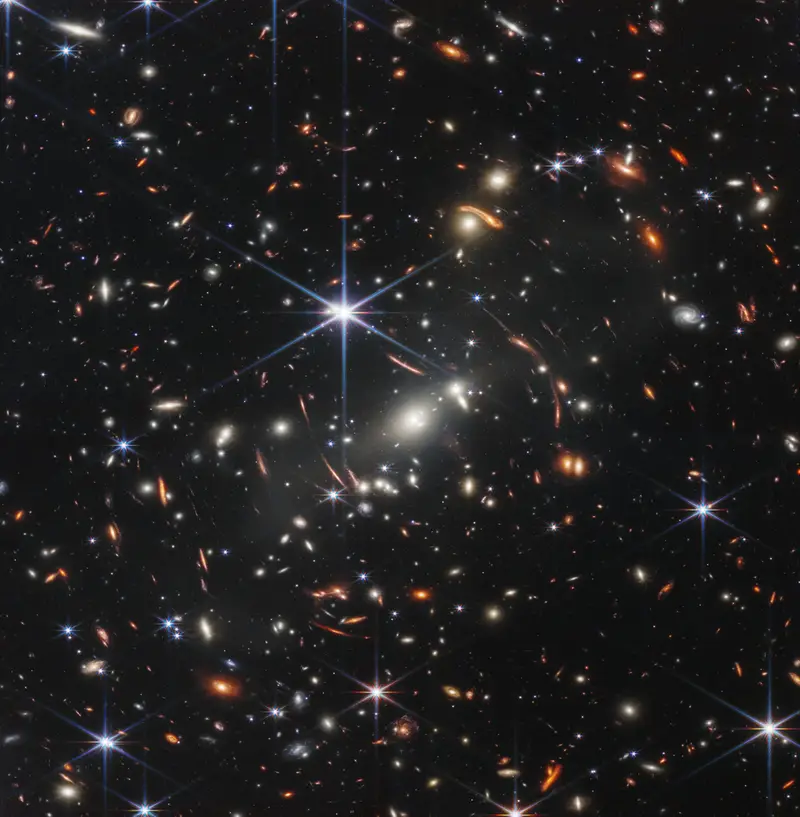
One of the first images released by the James Webb Space Telescope stunned the world: a deep-field view of the galaxy cluster SMACS 0723. At first glance, it looked like a dense scattering of glowing shapes, but this image represented something unprecedented. It was the deepest and sharpest infrared image of the universe ever taken, revealing thousands of galaxies in a tiny patch of sky.
What makes this discovery extraordinary is not just the clarity, but the time it represents. Many of the faint galaxies in this image existed over 13 billion years ago, when the universe was less than a billion years old. Their light traveled across expanding space for nearly the entire age of the cosmos before reaching Webb’s instruments.
Using gravitational lensing—where massive galaxy clusters bend and magnify light from even more distant objects—Webb was able to see galaxies that were previously invisible, even to the Hubble Space Telescope. Some of these galaxies are small, chaotic, and rich in star formation, challenging earlier assumptions that early galaxies were simple or uniform.
Emotionally, this image feels like a cosmic memory. It is not just a picture; it is a time machine. Every faint glow represents billions of stars burning long before Earth existed. For the first time, humanity can study the structure, brightness, and composition of galaxies from the universe’s earliest chapters with astonishing detail.
This discovery laid the foundation for everything that followed, proving that Webb was not merely an upgrade, but a revolutionary leap.
2. The Oldest and Most Distant Galaxies Ever Observed
Building on its deep-field observations, the James Webb Space Telescope quickly identified galaxies that may be the oldest ever seen. Some candidate galaxies appear to have formed just 200 to 300 million years after the Big Bang, far earlier than astronomers previously believed large galaxies could exist.
These galaxies are surprisingly massive and bright for their age. According to earlier models of cosmic evolution, the universe should not have had enough time to assemble such complex structures so soon after its birth. Webb’s observations suggest that galaxy formation may have occurred faster and more efficiently than expected.
By analyzing the infrared light from these galaxies, scientists can estimate their redshift—a measure of how much the universe has expanded since the light was emitted. Some Webb-detected galaxies show redshifts greater than 10, placing them among the earliest known cosmic structures.
This discovery has profound implications. It challenges long-standing theories about how matter clumped together after the Big Bang and how quickly stars and galaxies could form. It suggests that the universe may have been more productive, more dynamic, and more efficient in its youth than we imagined.
Emotionally, these ancient galaxies are humbling. They remind us that complexity arose quickly in the universe, long before planets or life. The cosmos did not linger in simplicity; it rushed toward structure, light, and diversity.
3. Direct Evidence of Atmospheric Chemistry on Exoplanets
For decades, astronomers dreamed of analyzing the atmospheres of planets beyond our solar system. James Webb turned that dream into reality with stunning precision. One of its most important discoveries is the direct detection of atmospheric components in exoplanets, including water vapor, carbon dioxide, carbon monoxide, and even hints of sulfur-based molecules.
Webb achieved this by observing transiting exoplanets—worlds that pass in front of their host stars from our point of view. As starlight filters through a planet’s atmosphere, specific wavelengths are absorbed by different molecules. Webb’s infrared instruments can detect these subtle fingerprints with remarkable clarity.
One landmark observation involved the hot gas giant WASP-39b. Webb detected clear signatures of water vapor, carbon dioxide, sodium, and sulfur dioxide in its atmosphere. The sulfur dioxide detection was especially significant, as it provided the first direct evidence of photochemistry—chemical reactions driven by starlight—on an exoplanet.
This discovery is not just about exotic gas giants. It is a critical step toward analyzing smaller, rocky planets more similar to Earth. Webb’s success demonstrates that we now have the tools to study alien skies in detail, turning distant points of light into tangible worlds with measurable properties.
Emotionally, this marks a shift in humanity’s relationship with the cosmos. We are no longer limited to imagining what other planets are like. We are beginning to know.
4. The Most Detailed View of Star Birth Ever Achieved
Star formation has always been difficult to observe because newborn stars are hidden inside dense clouds of gas and dust. Visible light cannot penetrate these regions—but infrared light can. James Webb’s infrared vision has provided the most detailed and intimate views of stellar nurseries ever captured.
One of the most iconic examples is Webb’s image of the Carina Nebula, particularly the region known as the Cosmic Cliffs. In this image, towering walls of gas and dust are sculpted by radiation from massive young stars. Jets of material shoot out from forming stars, carving paths through the surrounding clouds.
Webb has also observed protostars in unprecedented detail, detecting disks of gas and dust where planets may eventually form. These observations help astronomers understand how stars gain mass, how long the process takes, and how planetary systems emerge as a byproduct of star birth.
What makes this discovery emotionally powerful is its intimacy. These are not abstract processes inferred from theory; they are visible events unfolding in real time. Webb allows us to witness creation—not in a mythic sense, but in a physical, measurable way.
Every star we see in the night sky, including our Sun, was born in a similar environment. Webb’s images are not just portraits of distant nebulae; they are glimpses into our own origins.
5. Unprecedented Insight into Planet Formation Around Young Stars
Beyond star birth itself, the James Webb Space Telescope has revolutionized our understanding of how planets form. Webb has observed protoplanetary disks—vast, rotating disks of gas and dust surrounding young stars—with extraordinary resolution and sensitivity.
In several systems, Webb has detected gaps, rings, and spiral structures within these disks. These features are strong indicators of forming planets, whose gravity sculpts the surrounding material as they grow. Webb has even detected complex organic molecules within some disks, suggesting that the chemical ingredients for life may be common during planet formation.
One remarkable observation involved the star system HL Tauri, where Webb revealed fine details in the disk’s structure that were previously blurred or invisible. These details help scientists refine models of how quickly planets can form and how their compositions vary depending on location within the disk.
This discovery bridges the gap between stars and life. It shows that planets are not rare accidents, but natural outcomes of star formation. The processes that built our solar system appear to be common throughout the galaxy.
Emotionally, this realization is profound. It suggests that the universe is not indifferent to complexity. From the very beginning of a star’s life, the seeds of future worlds are already taking shape.
6. New Understanding of Black Holes in the Early Universe
James Webb has also provided powerful insights into black holes, particularly those that existed in the early universe. Astronomers have long struggled to explain how supermassive black holes—millions or billions of times the mass of the Sun—could form so quickly after the Big Bang.
Webb has detected active galactic nuclei in very young galaxies, indicating the presence of massive black holes much earlier than expected. These observations suggest that black holes may have formed through rapid, direct collapse of massive gas clouds, rather than slowly growing from smaller stellar remnants.
By analyzing the light emitted from matter falling into these black holes, Webb allows scientists to study their growth rates, environments, and influence on surrounding galaxies. The data indicates a close relationship between early black holes and galaxy formation, with each shaping the other’s evolution.
Emotionally, black holes often evoke fear or mystery, but Webb’s discoveries add clarity. They show that black holes are not cosmic anomalies; they are fundamental components of galaxy evolution, present from the universe’s earliest epochs.
Understanding how these dark giants formed brings us closer to understanding the architecture of the cosmos itself.
7. A New Window into the Potential for Life Beyond Earth
Perhaps the most emotionally resonant discoveries made by the James Webb Space Telescope relate to the search for life. While Webb has not detected life itself, it has dramatically advanced our ability to assess habitability on distant worlds.
Webb has begun studying the atmospheres of smaller, potentially rocky exoplanets, particularly those in the habitable zones of their stars. In systems like TRAPPIST-1, Webb is investigating whether these planets retain atmospheres and what those atmospheres contain.
By detecting molecules such as water vapor, carbon dioxide, and methane, Webb helps scientists evaluate whether conditions could support life as we know it. Future observations may even detect biosignatures—chemical combinations that strongly suggest biological activity.
This discovery is not a single moment, but a transformation in capability. For the first time in history, humanity possesses an instrument capable of systematically exploring the atmospheres of Earth-sized exoplanets.
Emotionally, this is a turning point. The question “Are we alone?” has shifted from philosophy to experiment. Webb does not promise answers, but it offers something just as powerful: a method.
A New Era of Cosmic Understanding
The James Webb Space Telescope is still in the early stages of its mission, yet it has already changed astronomy forever. Its discoveries have rewritten textbooks, challenged long-held theories, and expanded humanity’s sense of possibility.
What makes Webb truly extraordinary is not just what it sees, but what it represents. It is a testament to human curiosity, collaboration, and patience. It embodies the idea that understanding the universe is worth decades of effort, billions of dollars, and generations of scientific dedication.
Each discovery is a reminder that the universe is richer, older, and more surprising than we imagined. And with every new observation, James Webb does more than reveal the cosmos—it invites us to rethink our place within it.
The story of Webb is not finished. In many ways, it has only just begun.