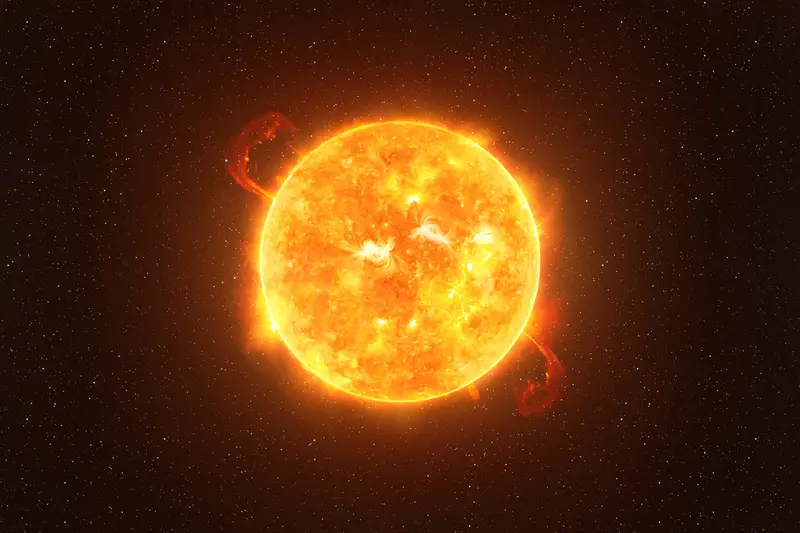
When we look up at the night sky, most stars appear as tiny pinpricks of light—quiet, distant, almost delicate. But this is an illusion created by distance. In reality, some stars are so vast that if they replaced our Sun, their surfaces would swallow the orbits of Mars, Jupiter, or even Saturn. These are the giants of the cosmos: stars so enormous they challenge our understanding of how matter, gravity, and nuclear fire can coexist.
The “biggest” stars are typically measured by radius, not mass. Many of them are red supergiants or hypergiants—aging stars nearing the end of their lives, swollen to unimaginable proportions. Their sizes are not always known with perfect precision, and rankings can shift as measurements improve. Still, these ten stars represent the largest stellar objects currently known or strongly supported by astronomical evidence.
What follows is not just a list of colossal objects, but a journey into extremes—into stars that burn briefly, live violently, and reshape the galaxies around them.
1. UY Scuti
UY Scuti is often cited as the largest known star by radius, and for good reason. Located roughly 9,500 light-years away in the constellation Scutum, this red supergiant is a true cosmic behemoth. Its radius is estimated to be around 1,700 times that of the Sun, though measurements vary slightly depending on method and model.
To grasp the scale emotionally, imagine placing UY Scuti at the center of our solar system. Its outer atmosphere would extend beyond the orbit of Jupiter, approaching Saturn’s path. Light would take hours to travel across its diameter. The Sun, by comparison, would be a tiny dot inside this vast stellar envelope.
UY Scuti is relatively cool by stellar standards, with a surface temperature lower than the Sun’s. Yet its sheer size makes it incredibly luminous—hundreds of thousands of times brighter than our Sun. It is unstable, shedding mass through powerful stellar winds, and astronomers believe it is nearing the end of its life. When it finally explodes as a supernova, it will briefly outshine entire galaxies.
UY Scuti embodies one of the universe’s strangest truths: the biggest stars are not necessarily the hottest or longest-lived. They are fragile giants, burning through their fuel at an unsustainable pace.
2. Stephenson 2-18
Stephenson 2-18 is a red supergiant located in the massive open cluster Stephenson 2, deep within the Milky Way. It has emerged as one of the strongest contenders for the title of largest star ever discovered, with some estimates placing its radius at over 2,000 times that of the Sun.
This star is so distant—over 19,000 light-years away—that measuring it accurately is exceptionally difficult. Interstellar dust obscures direct observation, forcing astronomers to rely on infrared data and complex modeling. Because of this, its exact size remains debated. Some studies suggest a slightly smaller radius, while others push it into truly record-breaking territory.
What makes Stephenson 2-18 emotionally powerful is not just its scale, but its isolation from everyday human experience. It exists in a region of the galaxy few people will ever visualize clearly, burning fiercely in a crowded stellar environment, yet still standing out as something extraordinary.
If Stephenson 2-18 replaced the Sun, it would engulf Jupiter with ease. Its atmosphere is likely unstable and turbulent, with massive convection cells churning material upward and outward. Like other red supergiants, it is expected to end its life in a cataclysmic explosion, leaving behind either a neutron star or a black hole.
3. RSGC1-F01
RSGC1-F01 is another colossal red supergiant, located in a dense star cluster known as RSGC1. It is estimated to have a radius around 1,500 times that of the Sun, placing it firmly among the largest stars known.
Stars like RSGC1-F01 are rare not because they are difficult to form, but because they live such short lives. Massive stars burn through their nuclear fuel quickly, swelling into supergiants and then dying in spectacular supernovae. RSGC1-F01 represents a fleeting phase in stellar evolution, one that lasts only a few hundred thousand years—a blink of an eye on cosmic timescales.
Its luminosity is immense, and its mass loss rate is extreme. Stellar winds carry vast amounts of material into space, enriching the surrounding region with heavy elements. In this way, stars like RSGC1-F01 are creators as well as destroyers, seeding future generations of stars and planets.
Emotionally, RSGC1-F01 reminds us that the universe’s greatest structures are often the most temporary. Immensity does not guarantee endurance.
4. Westerlund 1-26
Westerlund 1-26 resides in the star cluster Westerlund 1, one of the most massive young clusters in the Milky Way. This red supergiant has an estimated radius of around 1,500 times that of the Sun, rivaling many of the largest stars ever identified.
What makes Westerlund 1-26 particularly fascinating is its environment. It exists among dozens of other massive stars, including yellow hypergiants, Wolf–Rayet stars, and blue supergiants. This cluster is a laboratory of extreme stellar physics, where massive stars form, evolve, and die in close proximity.
Westerlund 1-26 is surrounded by a vast cloud of ionized gas, shaped by intense radiation and stellar winds. Its outer layers are loosely bound, and material is constantly being stripped away. The star’s future is violent and inevitable—a supernova that will dramatically alter its surroundings.
In a universe that often feels empty, Westerlund 1-26 stands as proof that stars can live crowded, interconnected lives, influencing one another through gravity, radiation, and explosive death.
5. VY Canis Majoris
VY Canis Majoris is one of the most famous giant stars, both for its size and its dramatic instability. Located about 3,900 light-years away in the constellation Canis Major, this red hypergiant has a radius estimated at roughly 1,400 times that of the Sun.
What sets VY Canis Majoris apart is its chaotic nature. It is surrounded by enormous clouds of expelled gas and dust, evidence of violent mass loss events. Astronomers have observed complex arcs and knots of material around the star, suggesting episodic eruptions rather than a steady wind.
If placed in the solar system, VY Canis Majoris would extend well beyond Jupiter’s orbit. Its luminosity is hundreds of thousands of times greater than the Sun’s, yet its surface temperature is relatively low. This combination makes it glow intensely in infrared wavelengths.
VY Canis Majoris is a star in crisis, living on borrowed time. Its eventual supernova will be one of the most powerful events in our galactic neighborhood, though still far enough away to pose no threat to Earth.
6. WOH G64
WOH G64 is a red supergiant located in the Large Magellanic Cloud, a satellite galaxy of the Milky Way. With a radius estimated between 1,300 and 1,500 times that of the Sun, it ranks among the largest stars known beyond our own galaxy.
This star is particularly intriguing because it is surrounded by a thick torus of dust, likely formed from material ejected during intense mass loss episodes. This dust obscures much of the star’s visible light, making infrared observations essential.
WOH G64 challenges astronomers’ understanding of stellar evolution in environments with different chemical compositions. The Large Magellanic Cloud has lower metallicity than the Milky Way, meaning stars there form with fewer heavy elements. Yet WOH G64 still manages to reach enormous proportions.
Emotionally, WOH G64 expands our sense of cosmic scale beyond our home galaxy. It reminds us that the universe is filled with giants everywhere, not just in familiar stellar neighborhoods.
7. RW Cephei
RW Cephei is a red supergiant located about 3,500 light-years away in the constellation Cepheus. Its radius is estimated at roughly 1,200 to 1,500 times that of the Sun, though its size appears to change over time due to pulsations and mass loss.
This star is known for its dramatic variability. Its brightness fluctuates significantly, likely due to changes in its outer layers and dust formation in its surrounding environment. Observations suggest that RW Cephei is shedding mass at an extraordinary rate.
Stars like RW Cephei exist in a delicate balance between gravity and radiation pressure. As that balance destabilizes, the star swells, contracts, and ejects material, gradually unraveling itself.
There is something deeply human about this instability—a sense of struggle against inevitable collapse. RW Cephei is not quietly fading; it is actively reshaping itself in its final acts.
8. KY Cygni
KY Cygni is another red supergiant that earns its place among the largest stars known, with an estimated radius exceeding 1,400 times that of the Sun. Located in the constellation Cygnus, it is heavily obscured by interstellar dust, making accurate measurements challenging.
Despite these difficulties, infrared observations suggest a truly immense star, one that rivals many more famous giants. Its luminosity is enormous, and its mass loss rate is significant, contributing material back into the interstellar medium.
KY Cygni highlights an important truth about astronomy: many of the universe’s greatest wonders are hidden. Dust, distance, and darkness conceal giants that we are only beginning to understand.
Emotionally, KY Cygni is a reminder that absence of visibility does not equal absence of importance. Some of the largest forces in the universe operate quietly, behind veils.
9. Mu Cephei
Mu Cephei, often called the “Garnet Star” for its deep red color, is one of the most visually striking red supergiants in the sky. With a radius estimated at around 1,200 times that of the Sun, it is smaller than some on this list, but still unimaginably vast.
Located about 2,800 light-years away, Mu Cephei is visible to the naked eye under dark skies. Its reddish hue is caused by its relatively cool surface temperature and the way it emits light.
Mu Cephei has long been studied by astronomers, including William Herschel, who described its color as remarkably intense. Its variability and mass loss suggest it is well into the late stages of stellar evolution.
There is something poetic about Mu Cephei’s visibility. Unlike many giants hidden behind dust, this star announces its presence openly, glowing like a cosmic ember against the dark.
10. Betelgeuse
Betelgeuse may not be the largest star ever measured, but it is one of the most famous and one of the largest that humans can easily observe. Located only about 650 light-years away in the constellation Orion, Betelgeuse has a radius estimated between 700 and 1,000 times that of the Sun.
Its fame comes not just from its size, but from its proximity and behavior. Betelgeuse is a red supergiant nearing the end of its life, and it has shown unusual dimming events that captured global attention. These events are likely caused by massive ejections of material forming dust clouds that temporarily block its light.
If Betelgeuse replaced the Sun, it would engulf Mercury, Venus, Earth, and Mars. Its eventual supernova will be one of the most spectacular astronomical events visible from Earth in human history.
Betelgeuse feels personal. It is close enough to remind us that even the night sky is not static. Change is coming, written into the life cycle of stars.
A Universe of Giants
The biggest stars in the known universe are not just curiosities of scale. They are fundamental actors in cosmic evolution. Through their intense radiation, powerful winds, and explosive deaths, they shape galaxies, create heavy elements, and influence the formation of future stars and planets.
They also carry an emotional message. These stars are reminders that greatness is often unstable, that extremes come with fragility, and that even the largest structures are temporary. They burn bright and fast, leaving behind transformed space in their wake.
When you look up at the night sky, remember that some of those points of light are not modest suns like our own, but titans—stars so vast that human language struggles to contain them. In their brief, brilliant lives, they tell a story of power, impermanence, and cosmic beauty written across unimaginable distances.