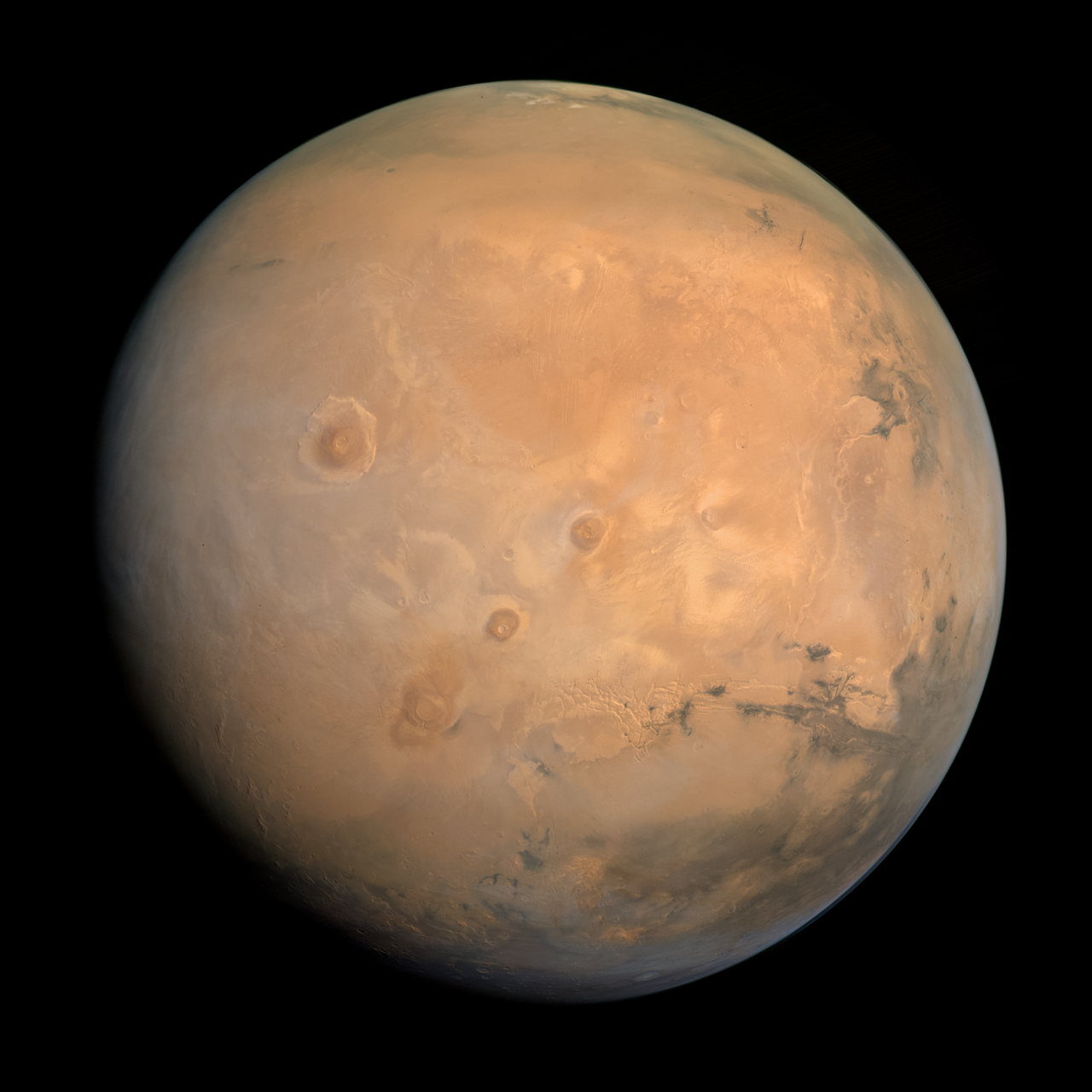
For centuries, Mars has captured the imagination of humanity more than any other planet visible to the naked eye. Its reddish glow stands out in the night sky, appearing both familiar and mysterious. Among all the worlds in our solar system, Mars has long seemed like the most plausible place where life beyond Earth might exist or might once have existed. It shares several striking similarities with Earth: a day only slightly longer than ours, polar ice caps that grow and shrink with the seasons, mountains taller than any on Earth, and landscapes shaped by ancient geological forces.
The search for life on Mars is more than a scientific curiosity. It touches on one of the deepest questions humanity has ever asked: are we alone in the universe? If life emerged independently on Mars, even in microscopic form, it would suggest that life might arise wherever conditions allow it. Conversely, if Mars—so similar to Earth in its early history—never developed life, that would imply that the emergence of life might be extremely rare.
Over the past sixty years, spacecraft, orbiters, landers, and robotic rovers have transformed Mars from a distant mystery into one of the most intensively studied planets in the solar system. With each mission, scientists have gathered new evidence about the planet’s past environment and its potential to host life. Yet despite decades of exploration, the ultimate question remains unanswered.
No mission has yet discovered definitive proof of life on Mars. However, scientists have uncovered compelling evidence that Mars once possessed many of the ingredients necessary for life. Ancient water systems, complex organic molecules, mineral structures associated with biological activity, and possible biosignatures preserved in rocks all suggest that the Red Planet may once have been habitable.
Understanding what we have actually found so far requires tracing the story of Mars exploration—from early telescopic observations to the latest discoveries made by modern rovers exploring ancient Martian landscapes.
Early Observations and the First Speculations
The fascination with Mars began long before space exploration. In the seventeenth century, astronomers such as Galileo Galilei and Christiaan Huygens observed Mars through early telescopes. They noticed that the planet possessed dark surface markings and bright polar caps that changed size with the seasons.
These observations hinted that Mars might be a dynamic world with weather patterns and possibly even water. In the nineteenth century, improvements in telescope technology allowed astronomers to map Mars in greater detail. Some observers believed they could see long straight lines stretching across the planet’s surface, which were interpreted as canals.
The idea that Mars might host an advanced civilization constructing planetary irrigation systems captured the imagination of the public. Astronomer Percival Lowell became one of the most prominent advocates of this theory. He proposed that intelligent Martians built the canals to transport water from the polar caps to the planet’s dry equatorial regions.
However, as telescope technology improved, the canal features disappeared. They were revealed to be optical illusions caused by limitations in early telescopes and the human brain’s tendency to detect patterns where none exist.
Despite the collapse of the canal hypothesis, the idea that Mars might host life did not vanish. Instead, scientists began considering the possibility that Mars might support simpler forms of life such as microorganisms.
The Beginning of Space Exploration
The modern scientific exploration of Mars began in the 1960s during the space race between the United States and the Soviet Union. Early spacecraft missions provided humanity’s first close-up look at the Martian surface.
In 1965, NASA’s Mariner 4 spacecraft performed the first successful flyby of Mars. The images it transmitted showed a heavily cratered surface resembling the Moon. The planet appeared cold, dry, and barren, seemingly hostile to life.
Subsequent missions, including Mariner 6 and Mariner 7, reinforced this bleak impression. However, the narrative changed dramatically in 1971 when the Mariner 9 spacecraft entered orbit around Mars. Mariner 9 revealed enormous volcanoes, massive canyon systems, and most importantly, surface features resembling ancient river channels and flood plains.
These discoveries suggested that Mars had once possessed flowing liquid water. Since water is essential for life as we know it, the possibility that Mars might once have been habitable suddenly became far more plausible.
The Viking Landers and the First Life Experiments
The first direct attempt to search for life on Mars came with NASA’s Viking missions in 1976. Viking 1 and Viking 2 each consisted of an orbiter and a lander equipped with instruments designed to detect biological activity in the Martian soil.
The Viking landers performed several experiments. One experiment added nutrients to Martian soil samples and measured whether gases were released—an indication that microbes might be metabolizing the nutrients. Another experiment attempted to detect organic molecules in the soil.
One of the Viking experiments produced puzzling results. When nutrients were added to the soil, the instrument detected a release of gas, which initially suggested microbial metabolism. However, a separate instrument failed to detect organic molecules in the soil.
Without organic compounds, the gas release was unlikely to be caused by living organisms. Scientists eventually concluded that the results were probably caused by unusual chemical reactions in the Martian soil involving highly reactive oxidizing compounds.
For many years, the Viking results were interpreted as evidence that the Martian surface was sterile. Yet the experiments left open important possibilities. Life might exist underground, protected from radiation. Alternatively, ancient rocks might preserve fossils or chemical traces from a time when Mars was warmer and wetter.
The Discovery of Ancient Water Systems
One of the most important discoveries in the search for Martian life has been the overwhelming evidence that liquid water once existed on the planet’s surface.
Orbital imagery has revealed enormous valley networks carved by flowing water, ancient lake basins, and delta formations where rivers once deposited sediment. These geological features date back more than three billion years.
In addition to visible water channels, scientists have identified minerals that form only in the presence of water. Clay minerals, sulfates, and carbonates are widely distributed across the Martian surface. These minerals form when rock interacts with water over long periods of time.
Recent research has revealed that Jezero Crater—the landing site of NASA’s Perseverance rover—contains multiple mineral types that formed through interactions between water and volcanic rock. These minerals indicate several stages of water activity, including environments with neutral or alkaline conditions that are considered favorable for microbial life.
The presence of such minerals suggests that ancient Mars may have possessed stable bodies of water, including lakes that persisted long enough for life to potentially emerge.
Organic Molecules Discovered on Mars
Another crucial component of life is organic chemistry. Organic molecules are carbon-based compounds that form the chemical foundation of biological systems. However, organic molecules can also be produced by non-biological processes.
For many years, scientists struggled to detect organic compounds on Mars. The Viking missions failed to find them, possibly because oxidizing chemicals in the soil destroyed them during analysis.
This changed dramatically when NASA’s Curiosity rover began exploring Gale Crater. Curiosity detected organic molecules preserved in ancient mudstones formed in a long-dried Martian lake.
More recent analysis of these samples has revealed even more complex molecules. Researchers identified long-chain hydrocarbons—carbon molecules containing up to twelve carbon atoms—in rocks roughly 3.7 billion years old. These compounds may be fragments of fatty acids, which are key components of cell membranes in living organisms on Earth.
Although such molecules can form through non-biological processes, their complexity and preservation over billions of years make them among the most intriguing chemical discoveries on Mars.
Methane in the Martian Atmosphere
Another intriguing clue in the search for Martian life involves methane gas. Methane has been detected in small quantities in the Martian atmosphere, and its concentration appears to fluctuate over time.
On Earth, methane is often produced by microbes known as methanogens that live in oxygen-free environments. However, methane can also be generated through geological reactions involving water and certain types of rock.
NASA’s Curiosity rover detected seasonal variations in methane levels within Gale Crater, suggesting that the gas is being produced or released by an active source on Mars. Scientists have not yet determined whether that source is biological or geological.
Because methane is rapidly destroyed by sunlight and chemical reactions in the atmosphere, its presence suggests that some process is replenishing it. Determining the origin of this methane remains one of the most important challenges in Mars research.
Potential Biosignatures in Martian Rocks
In recent years, the focus of the Mars life search has shifted from detecting living organisms to identifying biosignatures—chemical or structural features that might indicate ancient biological activity.
NASA’s Perseverance rover, which landed in Jezero Crater in 2021, is specifically designed to search for such evidence. The crater once hosted a large lake and river delta, making it an ideal location for preserving traces of ancient life.
In 2024, Perseverance collected a rock sample nicknamed “Cheyava Falls” that contains unusual chemical and mineral patterns. These include organic carbon and minerals such as iron phosphates and iron sulfides that, on Earth, can be associated with microbial activity.
Scientists also observed distinctive textures in the rock that resemble structures created by microbial processes on Earth. However, researchers emphasize that these features are only potential biosignatures and could still be explained by non-biological chemical reactions.
To determine whether these features truly represent evidence of ancient life, scientists will need to analyze the samples in laboratories on Earth.
The Strongest Clues Yet
Recent studies based on Perseverance rover data suggest that Jezero Crater once hosted a calm lake environment rich in organic-related minerals. These rocks contain combinations of minerals and chemical patterns that resemble those produced by microbial activity on Earth.
Scientists consider these findings some of the strongest potential biosignatures yet discovered on Mars. However, they stress that confirmation will require extremely precise laboratory analysis that cannot be performed by rover instruments.
This is why the Perseverance rover is collecting rock cores and sealing them in tubes that will eventually be returned to Earth by a future mission.
Evidence for Long-Lasting Water and Habitable Conditions
Another important recent discovery involves intricate mineral formations created by groundwater circulating through cracks in Martian rocks. These structures show that water may have remained active beneath the surface longer than previously thought.
Such groundwater systems could have provided stable environments for microbial life long after surface conditions became cold and dry.
The presence of clay minerals, carbonates, sulfates, and hydrated minerals across Mars also indicates that water interacted with rocks for extended periods in the planet’s early history. These chemical environments resemble habitats where microbial life thrives on Earth.
The Role of Mars Sample Return
Perhaps the most decisive step in the search for Martian life will be the Mars Sample Return mission. Perseverance has already collected and sealed numerous rock samples from Jezero Crater.
Future spacecraft developed by NASA and the European Space Agency aim to retrieve these samples and transport them back to Earth. Once in terrestrial laboratories, scientists will be able to analyze them with instruments far more powerful than those carried by rovers.
These analyses could reveal microscopic fossils, complex organic molecules, or isotopic signatures that indicate biological activity.
Until these samples are studied in detail, the question of life on Mars will remain open.
What We Truly Know Today
After decades of exploration, scientists have reached several important conclusions about Mars.
Mars was once a wetter and more hospitable world than it is today. Rivers, lakes, and possibly shallow seas existed billions of years ago. The planet possessed the chemical ingredients necessary for life, including organic molecules and minerals formed in water-rich environments.
Recent rover discoveries have revealed complex organic chemistry and potential biosignatures preserved in ancient rocks. Yet none of these discoveries provide definitive proof that life ever existed on Mars.
Instead, they reveal a planet that once had the conditions required for life and may still preserve the traces of that life within its ancient geological record.
The Continuing Mystery
Mars remains one of the most intriguing scientific frontiers of our time. Each new mission uncovers evidence that the planet’s early environment may have been far more Earth-like than previously imagined.
The discovery of complex organic molecules, potential biosignatures, and long-lived water systems suggests that Mars was once capable of supporting life. Yet the final answer remains hidden within ancient rocks waiting to be studied more closely.
Whether Mars once hosted microscopic organisms or remained forever sterile is a mystery that future missions may finally resolve.
When that answer eventually arrives—whether yes or no—it will reshape humanity’s understanding of life in the universe.