Imagine the announcement spreading quietly at first, then exploding across headlines, classrooms, and late-night conversations: liquid water has been found on Venus. Not vapor high in the clouds, not ice locked in some obscure chemical form, but actual liquid water existing stably somewhere on Earth’s so-called twin. For generations, Venus has symbolized a kind of planetary tragedy, a world that might once have been gentle and familiar but instead became hostile beyond imagination. To find liquid water there would feel like discovering a heartbeat where we believed there was none.
This discovery would not simply add a fact to textbooks. It would shake the foundations of planetary science, astrobiology, and our understanding of how worlds live and die. Venus, long considered a cautionary tale, would suddenly become a mystery reborn. The question would no longer be whether Venus is dead, but how something so inhospitable could still shelter one of life’s most essential ingredients.
Venus as We Think We Know It
To understand why liquid water on Venus would be so astonishing, we must first understand what Venus is believed to be today. Venus is wrapped in an atmosphere so thick that sunlight struggles to reach the surface. Temperatures there are hot enough to melt lead, not because Venus is closer to the Sun than Earth by a dramatic margin, but because its atmosphere traps heat with relentless efficiency. The pressure at the surface is crushing, far beyond what the human body could endure. Clouds of sulfuric acid swirl endlessly overhead, reflecting sunlight and hiding the surface from direct view.
Everything about Venus seems designed to destroy water. At such extreme temperatures, liquid water should boil away instantly. Any water vapor that reaches the upper atmosphere is vulnerable to sunlight, which can break it apart, allowing hydrogen to escape into space. Over billions of years, this process should have left Venus dry beyond recovery. That belief has shaped decades of scientific thinking.
And yet, science has learned again and again that nature does not always obey our expectations.
The Emotional Weight of Water
Water is not just a chemical compound to us. It is memory, survival, and possibility. On Earth, wherever we find liquid water, we find life, or at least the conditions that allow life to emerge. Rivers carve landscapes, oceans regulate climate, and rain ties the sky to the ground. Water connects physics, chemistry, biology, and emotion in a way few substances can.
To find liquid water on Venus would feel like discovering familiarity in an alien place. It would force us to confront the idea that life-friendly conditions might persist even in worlds that appear utterly hostile. The emotional impact would be profound, because it would challenge the quiet assumption that Earth is rare not just in being alive, but in being survivable.
Where Could Liquid Water Exist on Venus?
For liquid water to exist on Venus, it could not behave as it does on Earth. The surface is far too hot and pressurized for ordinary liquid water to remain stable. Any realistic scenario would require extraordinary conditions, perhaps in hidden or transient environments.
One possibility would be deep beneath the surface. Venus’s crust might conceal regions where pressure and temperature balance in unexpected ways. If certain minerals trap heat differently, or if subsurface chemistry alters the boiling point of water, pockets of liquid could exist far below the inferno above. These would not be lakes or oceans in the familiar sense, but isolated reservoirs, shielded from the atmosphere’s violence.
Another possibility would lie in the atmosphere itself. Venus’s cloud layers, while acidic, are cooler than the surface. At certain altitudes, temperature and pressure are surprisingly Earth-like. If liquid water droplets could form and persist there, perhaps mixed with other compounds, it would redefine what we mean by habitable environments. Such water would not pool or flow, but drift, suspended in a dynamic, ever-changing sky.
The Chemistry That Would Make It Possible
Scientifically, liquid water on Venus would demand a reevaluation of atmospheric chemistry and thermodynamics. Water’s behavior depends heavily on pressure, temperature, and the presence of dissolved substances. On Earth, salts lower the freezing point of water and raise its boiling point. On Venus, exotic chemistry could push these effects to extremes.
If Venusian water were mixed with sulfur compounds or other chemicals abundant in its atmosphere, it might exist in a form that remains liquid at temperatures otherwise impossible for pure water. This would not make it friendly to life as we know it, but it would still count as liquid water in a physical sense.
Such chemistry would be unfamiliar, but not unthinkable. Earth itself hosts environments once believed impossible for liquid water, from superheated hydrothermal vents to subglacial lakes sealed beneath kilometers of ice. Venus could be teaching us once again that habitability is not a single narrow condition, but a spectrum.
Rewriting the Story of Venus’s Past
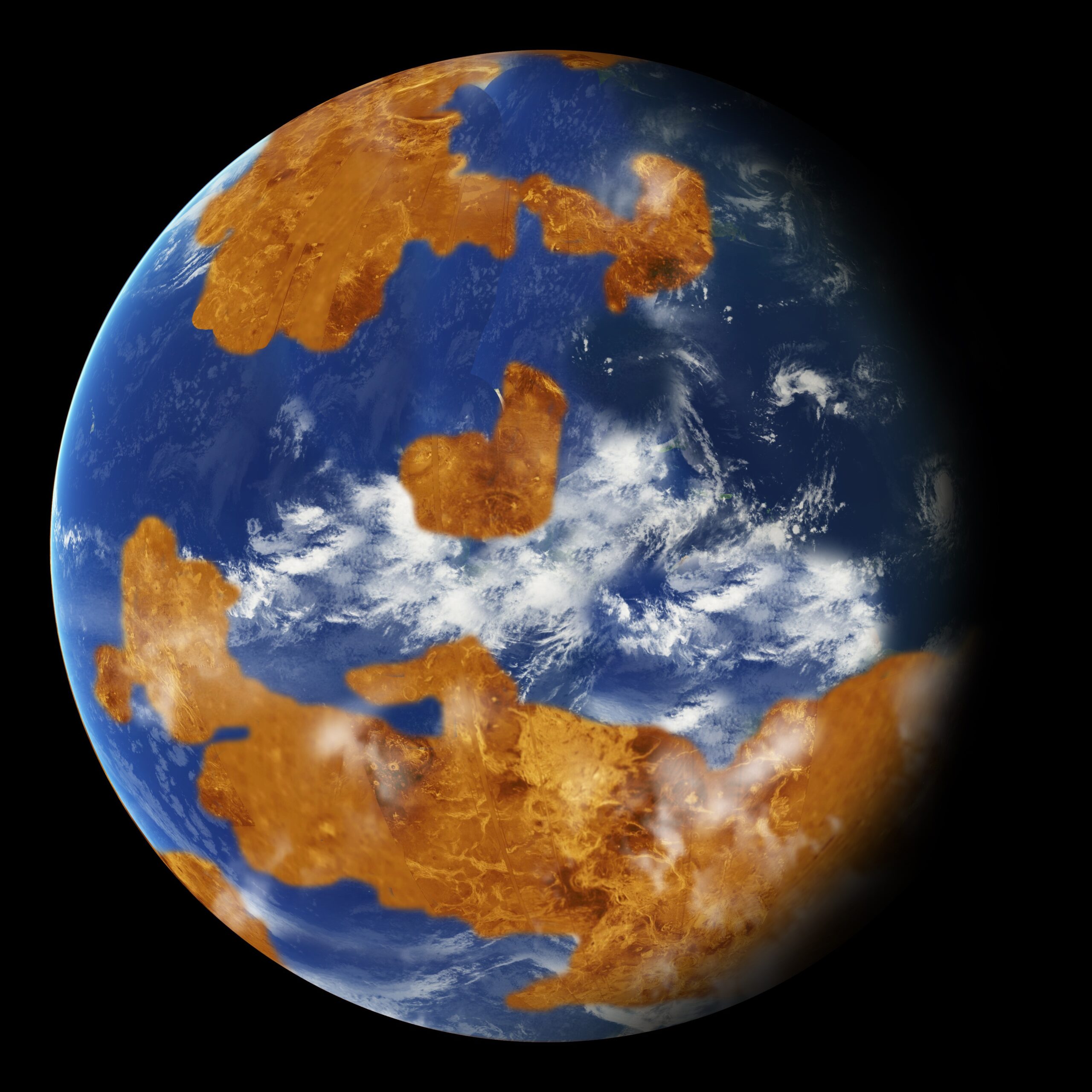
Liquid water on Venus today would inevitably point backward in time. Scientists already suspect that Venus may once have had oceans, perhaps for hundreds of millions or even billions of years. The young Sun was dimmer, and Venus may have been more Earth-like, with moderate temperatures and abundant water.
Finding liquid water now would suggest that Venus did not simply lose all its water in a single catastrophic transition. Instead, it may have retained fragments of its watery past, hidden or transformed but not erased. This would paint Venus not as a world that crossed a clean line into uninhabitability, but as one that changed unevenly, leaving behind relics of what it once was.
This realization would deepen the tragedy of Venus while also making it more relatable. It would become a planet that struggled, adapted, and partially endured, rather than one that simply failed.
The Implications for Life
The moment liquid water is confirmed anywhere beyond Earth, the question of life becomes impossible to ignore. Water alone does not guarantee life, but life as we know it cannot exist without it. On Venus, any life would face conditions far harsher than those faced by even Earth’s toughest extremophiles.
Yet life on Earth has proven astonishingly adaptable. It thrives in acidic lakes, radioactive environments, and crushing pressures. If Venus harbors liquid water, especially in the atmosphere or underground, it would be reasonable to ask whether microbial life could exist there, perhaps in forms radically different from terrestrial organisms.
Such life would not resemble plants or animals. It might not even resemble bacteria in any familiar sense. It could use chemical pathways unknown on Earth, adapted to sulfur-rich environments and extreme heat. Discovering such life would transform biology from a science rooted in Earth to a truly cosmic discipline.
The Challenge of Proving It
Confirming liquid water on Venus would be extraordinarily difficult. Venus is not a welcoming destination for spacecraft. The surface destroys landers within hours. The atmosphere corrodes materials and interferes with instruments. Any detection would require careful interpretation of indirect signals, such as spectral data, chemical anomalies, or temperature profiles.
Scientists would debate fiercely. Alternative explanations would be proposed and tested. Skepticism would be intense, not out of cynicism, but because the claim would be so extraordinary. This process would be a testament to how science works, advancing not through excitement alone, but through careful, often uncomfortable scrutiny.
Only after repeated, independent confirmation would the idea gain acceptance. When it did, it would mark one of the most significant discoveries in planetary science history.
A New Lens on Planetary Habitability
Liquid water on Venus would force scientists to rethink how they define habitable zones around stars. Traditionally, a planet’s distance from its star has been a key factor in determining whether liquid water can exist. Venus lies near the inner edge of our solar system’s habitable zone, often cited as an example of what happens when a planet is just a bit too close.
If Venus can maintain liquid water under any conditions today, it would suggest that habitability is not solely dictated by distance. Atmospheric composition, geological activity, and chemical feedback loops may be just as important. This insight would ripple outward, affecting how scientists evaluate exoplanets orbiting other stars.
Worlds once dismissed as too hot or too hostile might regain interest. The universe could suddenly seem more accommodating to complexity than previously thought.
Venus as a Warning and a Teacher
Even with liquid water, Venus would remain a cautionary tale. Its runaway greenhouse effect demonstrates how delicate planetary balance can be. A small difference in atmospheric composition can lead to enormous consequences over time. Venus shows us how a world can transform from potentially habitable to lethally hostile.
But if water still exists there, Venus also becomes a teacher of resilience. It suggests that planetary systems may preserve niches of stability even amid global catastrophe. This dual role would deepen Venus’s significance, making it not just a warning about climate extremes, but a lesson in persistence.
For Earth, this perspective would be sobering. It would highlight both the fragility and the durability of planetary environments, reminding us that change does not always mean total loss, but that recovery and survival may take unfamiliar forms.
The Psychological Impact on Humanity
Beyond science, the discovery would touch something deeply human. Venus has always loomed large in myth and imagination, often associated with beauty and danger. To learn that it harbors liquid water would soften its image, making it feel less alien, more connected to our own story.
People would wonder what it means for humanity’s place in the universe. Are we truly alone, or simply early? Is life a rare accident, or an outcome that emerges wherever conditions allow? These questions resonate far beyond laboratories and observatories.
The discovery would also reignite dreams of exploration. While Venus would remain inhospitable to human presence, robotic missions would take on new urgency. Each probe would feel like a message sent into a world that might still be quietly active.
Technological and Scientific Transformation
Such a discovery would reshape research priorities. New missions would be designed specifically to study Venus’s water, its chemistry, and its stability. Instruments capable of surviving extreme conditions would become a focus of innovation. International collaboration would intensify, as no single nation could easily tackle the challenge alone.
Astrobiology would gain renewed energy. Funding, talent, and public interest would flow into understanding life’s limits and possibilities. Physics, chemistry, geology, and biology would intersect more deeply, driven by the need to understand a world that defies simple categorization.
This transformation would not be limited to Venus. Lessons learned there would apply to Mars, icy moons, and distant exoplanets, enriching planetary science as a whole.
A New Story of the Solar System
For decades, the solar system has been presented as a collection of distinct worlds, each following a clear narrative. Earth is alive. Mars is frozen and ancient. Venus is hot and dead. Finding liquid water on Venus would blur these boundaries.
The solar system would appear more dynamic, more interconnected, and more surprising. Planets would no longer fit neatly into categories of living or lifeless. Instead, they would exist along a continuum, each shaped by history, chemistry, and chance.
This richer story would reflect a deeper truth about nature: that reality resists simplicity, and that understanding often grows more complex as knowledge increases.
The Possibility of Future Surprises
If liquid water can exist on Venus against all expectations, what else might we be missing? This question would echo through scientific communities. It would encourage humility and curiosity, reminding researchers that absence of evidence is not evidence of absence.
Future discoveries might reveal hidden oceans on distant worlds, unexpected chemistry in extreme environments, or forms of life that challenge our definitions. Venus would stand as a reminder that the universe is not obligated to align with our assumptions.
This mindset would be one of the most valuable outcomes of the discovery, fostering a culture of open-minded inquiry.
The Meaning of Water Beyond Earth
Ultimately, finding liquid water on Venus would deepen the meaning of water itself. It would no longer be just Earth’s lifeblood, but a cosmic phenomenon capable of persisting under astonishing conditions. Water would become a symbol not only of life, but of adaptability.
This expanded meaning would influence how we search for life and how we think about our own planet. It would highlight the preciousness of Earth’s gentle balance while also reminding us that nature’s creativity extends far beyond familiar boundaries.
A Quiet Revolution in Understanding
The discovery would not come with fireworks or instant answers. Instead, it would begin a slow, profound transformation in how we understand planets, life, and ourselves. Papers would be written, debates would unfold, missions would be planned. Over time, the shock would settle into a deeper appreciation of complexity.
Venus would no longer be just a hellish mirror of what Earth could become. It would be a world that challenges our imagination, inviting us to rethink what survival means on a planetary scale.
A Final Reflection
What if we found liquid water on Venus? The question itself reveals how much we still have to learn. It reminds us that certainty in science is always provisional, always open to revision. It invites wonder without abandoning rigor.
In that imagined discovery, we see both a challenge and a gift. A challenge to our models, our assumptions, and our definitions. A gift in the form of renewed curiosity and humility. Venus, long dismissed as a lost cause, would speak again, telling a story of persistence amid extremes.
And in listening to that story, humanity would take another step toward understanding the universe not as a collection of dead rocks and rare miracles, but as a place where complexity, resilience, and surprise are woven deeply into the fabric of reality.