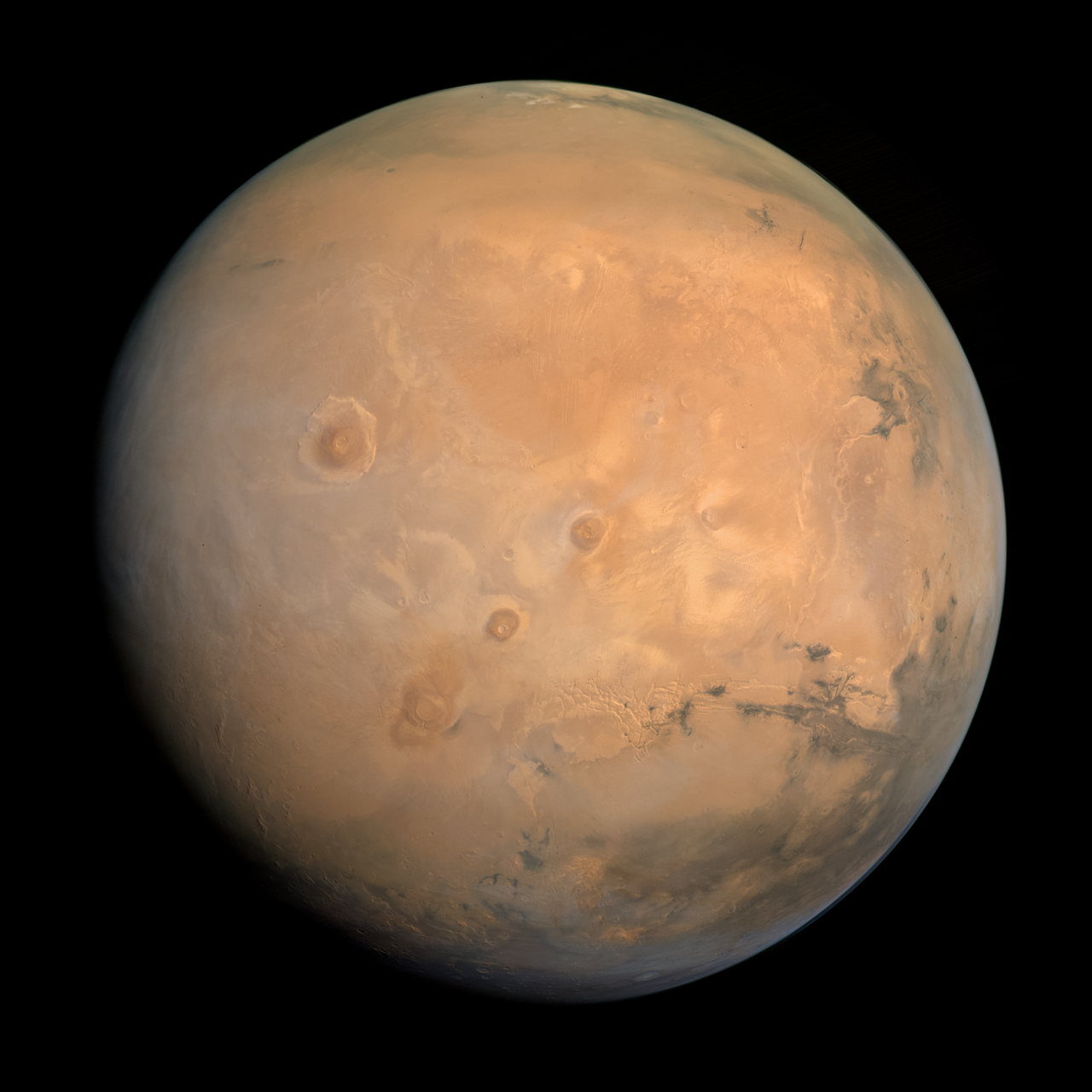
For centuries, Mars has stirred the human imagination. In the night sky, it glows with a faint reddish hue, steady and mysterious among the stars. Ancient civilizations noticed this unusual color and associated the planet with war, blood, and fire. The Romans named it after their god of war, Mars. Yet beneath the mythology and symbolism lies a deeper question that modern science has only recently begun to answer: was Mars ever habitable?
To ask whether Mars was habitable is not the same as asking whether life existed there. Habitability refers to the conditions that could support life as we understand it—liquid water, suitable temperatures, and the chemical ingredients necessary for biological processes. In other words, it asks whether Mars once had environments where life could potentially arise or survive.
Today, Mars is cold, dry, and seemingly barren. Its atmosphere is thin, its surface bombarded by radiation, and its temperatures often plunge far below freezing. But planetary scientists have discovered growing evidence that billions of years ago, Mars was a dramatically different world. Rivers once flowed across its surface. Lakes and perhaps even shallow seas existed in vast basins. Minerals formed in the presence of water lie embedded in ancient rocks. All of this suggests that early Mars may once have possessed the basic conditions needed for habitability.
The story of Mars is therefore not simply the story of a distant planet. It is a story about planetary evolution, about climate change on a cosmic scale, and about the possibility that life might not be unique to Earth. To explore whether Mars was habitable is to explore the deeper question of how common life might be in the universe.
Mars Through the Eyes of Early Astronomers
Long before spacecraft could visit Mars, astronomers tried to understand the planet using telescopes from Earth. By the 17th century, observers such as Christiaan Huygens and Giovanni Cassini had already noted dark and light markings on its surface. These markings seemed to shift over time, suggesting that Mars rotated like Earth.
In the late 19th century, the Italian astronomer Giovanni Schiaparelli mapped Mars and described long linear features that he called “canali,” meaning channels. The word was mistranslated into English as “canals,” implying artificial structures. This translation ignited widespread speculation that intelligent Martian civilizations might have built vast irrigation systems to transport water across a dying world.
American astronomer Percival Lowell became one of the most famous proponents of this idea. In the late 1800s and early 1900s, he built observatories and published detailed maps of Martian canals, arguing that they were evidence of an advanced civilization struggling to survive as the planet dried out.
Although these ideas captured the public imagination, later observations revealed that the canals were optical illusions caused by limitations in telescopes and human perception. Yet the fascination they generated played an important role in shaping humanity’s enduring curiosity about Mars.
By the mid-20th century, improved telescopes suggested that Mars had a thin atmosphere and cold temperatures, making the existence of large bodies of liquid water unlikely. But the true nature of the planet remained uncertain until spacecraft began to explore it directly.
The First Spacecraft Encounters
The first close-up images of Mars arrived in 1965, when NASA’s Mariner 4 spacecraft flew past the planet. Expectations had been high. Some scientists hoped to see signs of rivers or vegetation. Instead, Mariner 4 transmitted images of a heavily cratered surface resembling the Moon.
These early pictures seemed to confirm that Mars was a cold, lifeless desert. Its atmosphere appeared far thinner than Earth’s, composed mostly of carbon dioxide. Surface pressure was so low that liquid water would quickly evaporate or freeze.
For a time, enthusiasm for the idea of Martian habitability faded. The images suggested a world that had been geologically inactive for billions of years. Without active geology, without thick atmosphere, without visible water, Mars appeared inhospitable.
Yet the story did not end there. Later missions began to reveal that the early impressions from Mariner 4 were incomplete.
In 1971, the Mariner 9 spacecraft entered orbit around Mars and began mapping the entire planet. What it discovered transformed scientific understanding of Mars forever. Beneath the dust storms that initially obscured its view, Mariner 9 found enormous volcanoes, vast canyon systems, and dried river valleys etched across the landscape.
Mars was not a static, dead world. It had once been geologically active and dynamic. Most importantly, its surface bore unmistakable signs of flowing water.
The Evidence Written in Ancient Valleys
One of the strongest pieces of evidence for past water on Mars comes from valley networks that cover many regions of the planet. These networks resemble river systems on Earth, with branching tributaries that merge into larger channels.
High-resolution images from orbit show valleys carved deeply into ancient Martian terrain. Their shapes are strikingly similar to river valleys formed by rainfall and surface runoff on Earth. Some channels extend for hundreds of kilometers, indicating that significant volumes of water once flowed across the planet.
These valleys are especially common in the southern highlands, a region of Mars containing some of the planet’s oldest rocks. Their age suggests that water flowed across the Martian surface more than 3.5 billion years ago.
Scientists believe these valleys were formed during a period when Mars had a warmer and wetter climate. Rainfall or melting snow may have fed rivers that carved their way through the landscape, eventually draining into lakes or larger basins.
The presence of these valley networks suggests that liquid water was stable on the surface for extended periods of time. This is one of the key requirements for habitability.
Ancient Lakes and Possible Oceans
Beyond rivers, Mars also appears to have hosted ancient lakes. Evidence for these lakes comes from sediment deposits, shoreline features, and basin-shaped depressions that resemble dried lakebeds.
One of the most famous examples is Gale Crater, where NASA’s Curiosity rover landed in 2012. The crater contains a mountain of layered sediment rising several kilometers high. These layers appear to have been deposited by water in an ancient lake environment.
Chemical analysis of the rocks has revealed clay minerals and other compounds that form in the presence of water. The sediments also suggest that the lake existed for a long time, perhaps millions of years, providing a potentially stable environment where microbial life might have survived.
Even more intriguing is the possibility that early Mars may have had an ocean. The northern hemisphere of Mars contains a vast lowland region that appears smoother and younger than the southern highlands. Some scientists propose that this region may once have been covered by a large ocean billions of years ago.
Certain shoreline-like features have been identified along the boundary between the northern lowlands and the southern highlands. While the evidence remains debated, the idea of a northern Martian ocean remains one of the most fascinating possibilities in planetary science.
If such an ocean existed, it would have dramatically increased the planet’s potential habitability.
The Role of a Thicker Atmosphere
For liquid water to exist on the surface of Mars, the planet must once have had a much thicker atmosphere than it does today. A dense atmosphere would have trapped heat through the greenhouse effect, raising surface temperatures and allowing water to remain liquid.
Evidence suggests that early Mars may indeed have possessed such an atmosphere. Geological features indicate that rivers and lakes existed for extended periods, implying stable conditions that could support liquid water.
Over time, however, Mars lost most of its atmosphere. One of the key reasons appears to be the loss of the planet’s global magnetic field. On Earth, the magnetic field protects the atmosphere from being stripped away by the solar wind. Mars, in contrast, lost its magnetic field billions of years ago.
Without this protective shield, charged particles from the Sun gradually eroded the Martian atmosphere. As the atmosphere thinned, surface pressure dropped and temperatures fell. Water that once flowed across the surface either froze into ice or escaped into space.
Today, Mars retains only a thin atmospheric layer—less than one percent the density of Earth’s atmosphere at sea level. But the geological evidence suggests that in the distant past, the planet may have been far more Earth-like than it appears today.
The Chemistry of Habitability
Habitability depends not only on water and temperature but also on chemistry. Life as we know it requires certain elements, including carbon, hydrogen, oxygen, nitrogen, phosphorus, and sulfur.
Mars appears to possess many of these ingredients. Meteorites from Mars, as well as analyses conducted by rovers and orbiters, reveal that the planet contains a variety of minerals formed in watery environments. These include clays, sulfates, and carbonates.
Clay minerals are particularly important because they form in neutral or mildly alkaline water, conditions that are considered favorable for life. The discovery of widespread clay deposits on Mars suggests that early Martian water environments were not extremely acidic or hostile.
In addition, rovers such as Curiosity have detected organic molecules in Martian rocks. Organic molecules are compounds containing carbon and hydrogen, and they form the basis of all known life.
It is important to note that organic molecules alone do not prove the existence of life. They can form through non-biological processes as well. Nevertheless, their presence indicates that Mars once possessed the chemical building blocks necessary for life.
The Climate Puzzle of Early Mars
Despite the strong evidence for past water, scientists still struggle to fully explain how early Mars remained warm enough for rivers and lakes. The Sun was fainter billions of years ago, emitting less energy than it does today.
With a weaker Sun and a smaller planet farther from the Sun than Earth, Mars should have been cold. Yet geological features clearly indicate the presence of liquid water.
One possible explanation involves greenhouse gases such as carbon dioxide and methane in the early Martian atmosphere. These gases could have trapped heat and raised surface temperatures.
Another possibility is that Mars experienced episodic warming events caused by volcanic activity or asteroid impacts. These events may have temporarily thickened the atmosphere or released greenhouse gases, allowing liquid water to exist for periods of time.
Understanding the climate of early Mars remains one of the central challenges in planetary science. Solving this puzzle will help scientists determine how long habitable conditions may have persisted on the planet.
Searching for Signs of Life
If Mars once had rivers, lakes, and possibly oceans, the next question naturally arises: did life ever exist there?
Scientists have not yet found definitive evidence of past or present life on Mars. However, the search continues with increasing sophistication.
Robotic missions have been designed to explore ancient environments that were once wet and potentially habitable. Rovers analyze rock chemistry, drill into sediment layers, and search for organic molecules.
One of the most promising targets is ancient lakebed sediments, where microbial life—if it ever existed—might have left chemical or structural traces known as biosignatures.
Another area of interest is the Martian subsurface. Even today, conditions beneath the surface may be more stable than those on the surface, potentially allowing microbial life to survive in protected environments.
Future missions aim to collect rock samples from Mars and return them to Earth for detailed laboratory analysis. Such studies could reveal microscopic structures or chemical patterns that might indicate biological activity.
The Lessons of Planetary Evolution
Whether or not life ever existed on Mars, the planet offers a powerful lesson about planetary evolution. Earth and Mars formed around the same time from similar materials in the early solar system. Yet their histories diverged dramatically.
Earth retained a thick atmosphere, abundant liquid water, and active geology driven by plate tectonics. Mars, being smaller, cooled more quickly. Its magnetic field disappeared, its atmosphere thinned, and its surface water vanished.
Studying Mars helps scientists understand the delicate balance required for long-term habitability. It reveals how planetary size, magnetic fields, atmospheric chemistry, and solar radiation interact to shape the fate of worlds.
These insights are not only important for understanding Mars but also for studying exoplanets—planets orbiting other stars. As astronomers discover thousands of such worlds, they seek to identify those that might be habitable.
Mars serves as a natural laboratory for understanding how habitable environments can emerge, evolve, and disappear.
A World That May Have Been Alive With Possibility
Today, Mars appears silent and desolate. Dust storms sweep across its plains. Temperatures plunge far below freezing at night. The thin atmosphere offers little protection from radiation.
Yet the rocks and landscapes of Mars tell a different story about the distant past. They reveal a world where rivers carved valleys, lakes filled craters, and perhaps even oceans lapped against ancient shorelines.
Whether life ever arose there remains unknown. But the evidence increasingly suggests that early Mars possessed many of the ingredients necessary for habitability.
In that sense, Mars is more than just a neighboring planet. It is a reminder that worlds can change profoundly over time. A planet that once may have been warm and wet can become cold and dry. A world that once held promise for life can fall silent.
And yet, Mars still invites exploration. Every rover wheel track, every drilled rock sample, every new image from orbit adds another chapter to the unfolding story of the Red Planet.
The question “Was Mars habitable?” is not merely about the past. It is also about the future of exploration, about the possibility that somewhere within the ancient rocks of Mars lies evidence that life once took hold beyond Earth.
If such evidence is ever found, it will transform our understanding of life in the universe—and our place within it.