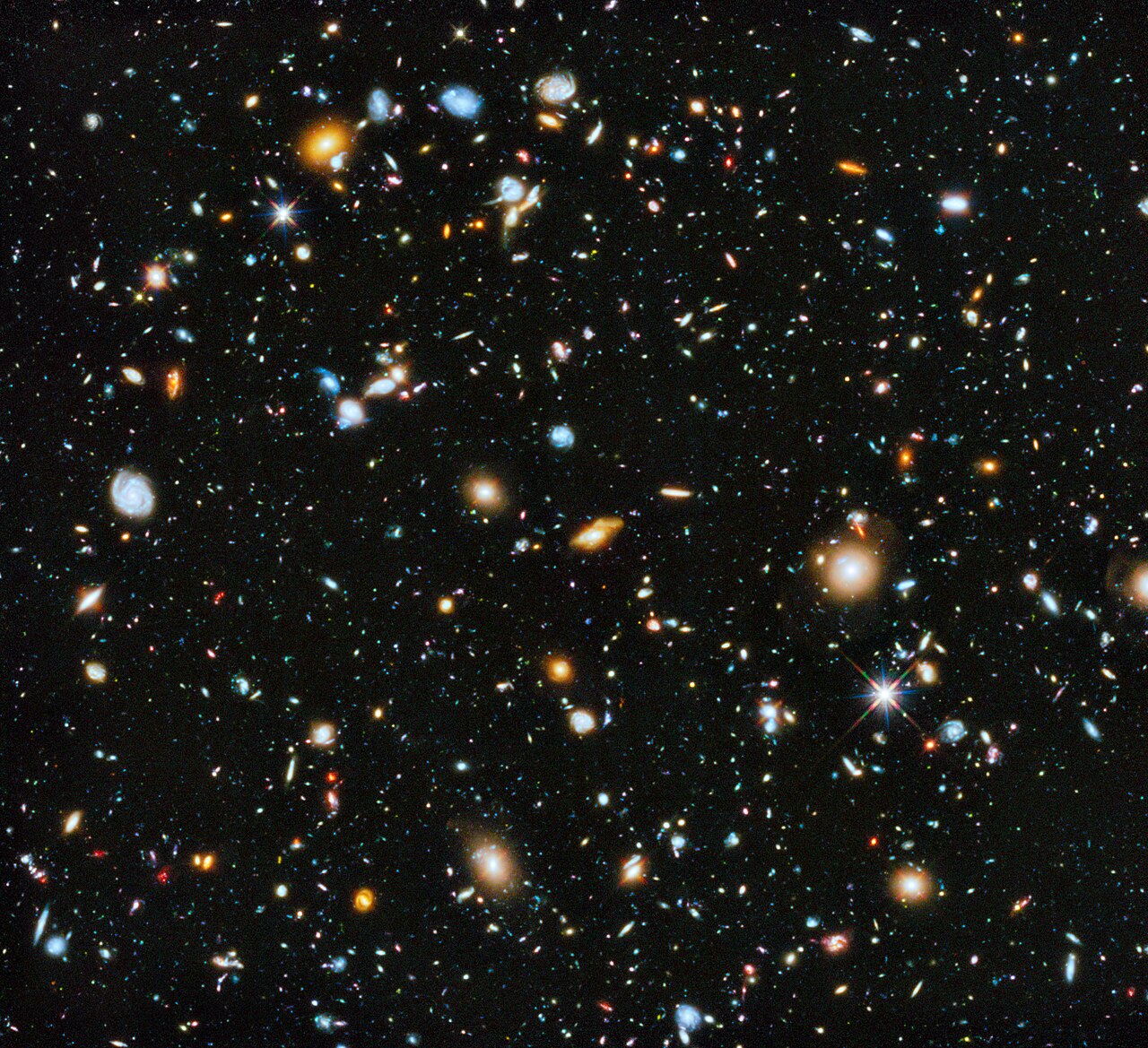
There are questions about the universe that live quietly in the back of our minds. We think them when we look up at the night sky. We feel them when we read about black holes, the Big Bang, or distant galaxies. But sometimes we hesitate to ask them aloud. Some seem too large. Some seem too naive. Some feel almost frightening.
Yet science was born from brave questions. No curiosity is foolish when it seeks truth. The universe is vast, mysterious, and at times deeply unsettling. And the only way to confront that immensity is to ask the questions that matter most.
Here are twenty of those questions—explored with scientific honesty, emotional wonder, and the humility that comes from standing beneath an infinite sky.
1. How Did the Universe Begin?
The leading scientific model for the origin of the universe is the Big Bang theory. According to this model, about 13.8 billion years ago, the universe was in an extremely hot, dense state and began expanding. This expansion continues today.
The Big Bang was not an explosion in space. It was the expansion of space itself. Every region of the universe was once compressed into a state of immense density and temperature. As space expanded, it cooled. Within minutes, the first light elements formed. Hundreds of thousands of years later, atoms emerged. Over millions of years, gravity pulled matter together to form stars and galaxies.
We have strong evidence for this model. The cosmic microwave background radiation is the afterglow of the early universe. The abundance of hydrogen and helium matches predictions. The expansion of galaxies confirms that space is still stretching.
But the ultimate origin—why the Big Bang occurred or what caused it—remains unknown. Our physics breaks down at the earliest moments. We can describe the evolution of the universe from a tiny fraction of a second onward, but the true beginning is still hidden in mystery.
2. What Existed Before the Big Bang?
This question is both natural and complicated. In everyday life, every event has a “before.” But time itself may have begun with the Big Bang. If time started there, then asking what happened before may be like asking what lies north of the North Pole.
Some theoretical models suggest that our universe emerged from a prior collapsing universe in a cosmic bounce. Others propose that quantum fluctuations in a larger multiverse produced our cosmos. There are ideas involving eternal inflation, where new universes constantly bud off from expanding space.
Yet none of these possibilities have been confirmed. At present, physics does not provide a definitive answer. The boundary between known science and speculation lies here.
The most honest answer is this: we do not yet know whether “before” even has meaning.
3. Is the Universe Infinite?
When you look at the night sky, it feels endless. But infinity is not a feeling—it is a mathematical concept.
The observable universe is finite. Because light travels at a finite speed and the universe has a finite age, we can only see as far as light has had time to reach us. That distance defines our cosmic horizon.
Beyond that horizon, the universe may continue. Current observations suggest that on large scales, space is very close to geometrically flat. A perfectly flat universe could be infinite, but it could also be extremely large and finite.
We simply do not yet know. The observable universe may be a small patch of a much larger cosmos.
Infinity may exist beyond what we can ever see.
4. What Is the Universe Made Of?
Surprisingly, the matter that makes up stars, planets, and people is only about 5 percent of the total content of the universe.
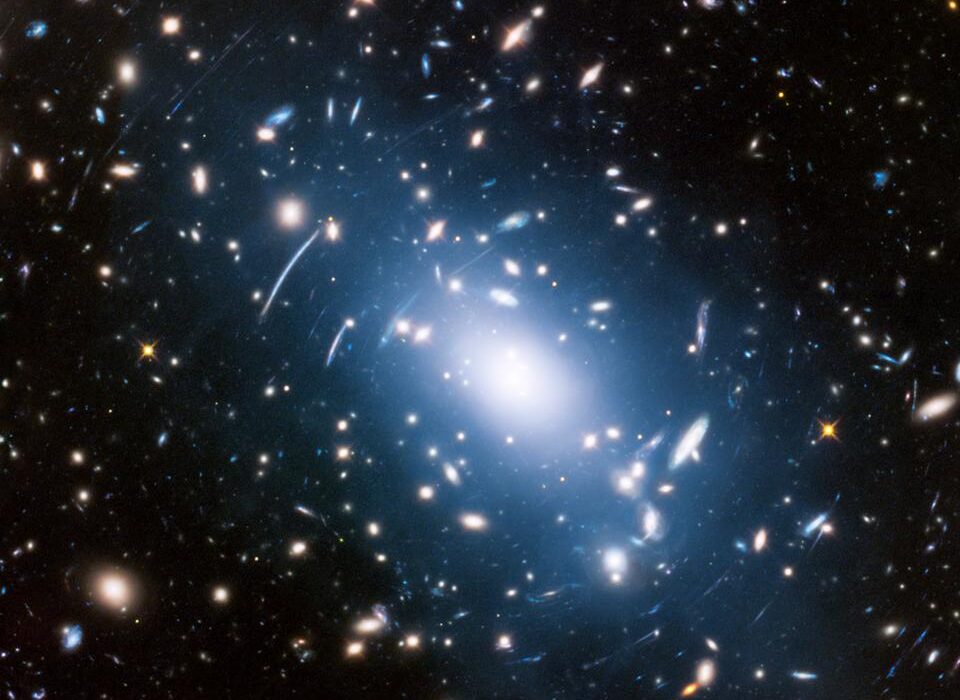
Roughly 27 percent appears to be dark matter—an invisible substance that does not emit or absorb light but exerts gravitational effects. We detect it through the way galaxies rotate and how light bends around massive clusters.
About 68 percent is dark energy, a mysterious force driving the accelerated expansion of the universe.
Ordinary atoms are the minority. Most of reality is composed of things we do not yet understand.
This realization is humbling. We are built from the rarest ingredient in the cosmic recipe.
5. What Is Dark Matter?
Dark matter reveals itself through gravity. Galaxies spin too fast for visible matter alone to hold them together. Clusters of galaxies bend light more than expected. Something unseen is providing extra mass.
We know dark matter is not made of ordinary atoms. It does not interact with light in measurable ways. Leading candidates include hypothetical particles such as WIMPs or axions, but none have been directly detected.
Experiments deep underground and in particle accelerators search for evidence. So far, dark matter remains elusive.
It shapes the structure of the universe, yet we cannot see or touch it. It surrounds us, passes through us, and holds galaxies together.
And we do not know what it is.
6. What Is Dark Energy?
In 1998, astronomers discovered that the expansion of the universe is accelerating. This means some form of energy is pushing space apart.
Dark energy appears to fill space uniformly. It may be the energy of empty space itself, represented by a cosmological constant in Einstein’s equations. But theoretical calculations predict a value vastly larger than what we observe.
Dark energy dominates the cosmos. It determines the ultimate fate of the universe.
And yet, we do not understand its nature.
The fact that most of the universe consists of unknown energy is both astonishing and unsettling.
7. Will the Universe End?
All evidence suggests the universe will not last forever in its current form. Stars burn fuel. Galaxies evolve. Entropy increases.
If dark energy remains constant, expansion will continue indefinitely. Galaxies will drift apart, stars will eventually burn out, and the universe will approach a state of maximum entropy known as heat death.
If dark energy grows stronger, a hypothetical Big Rip could occur, tearing apart galaxies, stars, planets, and eventually atoms.
A reversal into a Big Crunch appears unlikely based on current data, but cosmology always remains open to revision.
The universe had a beginning. It will almost certainly have an end—though that end may lie trillions upon trillions of years in the future.
8. Are We Alone?
The observable universe contains hundreds of billions of galaxies. Many stars host planets. Some planets lie in habitable zones where liquid water could exist.
Statistically, life elsewhere seems plausible.
Yet we have found no confirmed evidence of extraterrestrial organisms. The silence is puzzling. This tension is known as the Fermi paradox.
Perhaps life is rare. Perhaps intelligent civilizations are short-lived. Perhaps we are early in cosmic history.
We do not yet know.
The possibility that we are alone is sobering. The possibility that we are not is transformative.
9. What Happens Inside a Black Hole?
Black holes form when massive stars collapse. Their gravity is so strong that not even light can escape once it crosses the event horizon.
According to general relativity, a singularity forms at the center—a point of infinite density. But infinities usually indicate incomplete theory.
Quantum mechanics suggests information cannot be destroyed, yet black holes seem to erase it. This conflict is known as the black hole information paradox.
We lack a complete theory of quantum gravity to resolve this puzzle.
Inside a black hole, our current physics cannot give a full answer.
10. Can Time Travel Happen?
Time travel to the future is not science fiction. According to relativity, time passes more slowly for objects moving at high speeds or in strong gravitational fields. Astronauts experience tiny amounts of time dilation.
Travel to the past is far more problematic. Certain solutions to Einstein’s equations allow closed timelike curves, but these require exotic conditions not known to exist in reality.
Quantum mechanics and causality raise further complications.
At present, backward time travel remains speculative and unsupported by experimental evidence.
11. Why Does Time Move Forward?
Most physical laws are time-symmetric. Yet we experience a clear arrow of time.
This arrow is linked to entropy. The second law of thermodynamics states that entropy tends to increase in isolated systems. The early universe began in a remarkably low-entropy state.
Why those initial conditions were so special remains unknown.
Time’s direction defines our experience of memory, aging, and causality.
Its ultimate origin remains mysterious.
12. What Is the Smallest Thing in the Universe?
The Standard Model describes fundamental particles such as quarks and leptons. As far as experiments have shown, these particles have no internal structure.
But future discoveries could reveal deeper layers. Some theories propose that particles are tiny vibrating strings or excitations of quantum fields.
At the smallest scales, spacetime itself may not be continuous. Quantum gravity theories suggest a granular structure at the Planck length.
We have reached extraordinary precision in particle physics, but the ultimate building blocks may still lie beyond.
13. Why Is There More Matter Than Antimatter?
The Big Bang should have created equal amounts of matter and antimatter. If that were true, they would have annihilated, leaving only radiation.
Yet we live in a universe dominated by matter.
Small asymmetries in particle interactions exist, but they appear insufficient to explain the imbalance.
Some additional process in the early universe must have favored matter.
Without that imbalance, stars and life would not exist.
14. How Do Galaxies Form?
Galaxies formed from small density fluctuations in the early universe. Dark matter provided gravitational scaffolding, pulling gas together.
Over billions of years, stars ignited, supernovae enriched space with heavy elements, and galaxies evolved through mergers and interactions.
Yet many details remain under study. The role of dark matter, black holes, and feedback from star formation continues to be investigated.
Galaxy formation is a story still being written.
15. What Is the Multiverse?
Some cosmological theories suggest that our universe may be one of many. Eternal inflation could produce countless “bubble universes.” String theory landscapes allow vast numbers of possible physical constants.
But the multiverse remains hypothetical. There is currently no direct observational evidence.
The idea challenges our understanding of uniqueness and cosmic purpose.
It remains an open question at the frontier of theoretical physics.
16. Can the Laws of Physics Change?
So far, physical constants appear stable across space and time within measurement precision.
However, some theories allow for variation. Observational studies search for changes in constants like the fine-structure constant.
If laws varied, it would reshape our understanding of reality.
At present, no confirmed evidence shows that the fundamental laws change.
17. What Is Gravity, Really?
General relativity describes gravity as the curvature of spacetime caused by mass and energy.
Quantum mechanics describes forces in terms of particle exchange. A hypothetical graviton would mediate gravity, but it has not been detected.
Unifying gravity with quantum theory remains one of physics’ greatest challenges.
We can measure gravity with extraordinary precision. Yet we do not have a complete quantum description of it.
18. What Is Consciousness in a Cosmic Context?
Consciousness arises from physical processes in the brain, according to neuroscience. Yet its subjective nature raises deep philosophical questions.
Physics does not currently require consciousness as a fundamental force. Quantum mechanics does not depend on human awareness for measurement in standard interpretations.
Still, the emergence of conscious observers in a vast universe invites reflection.
We are the part of the cosmos that can ask questions about itself.
19. Could the Universe Be a Simulation?
The simulation hypothesis proposes that advanced civilizations might simulate universes. If so, we could inhabit such a simulation.
This idea is philosophical rather than experimentally testable at present.
Physics has not found evidence that our universe is computational in origin, though some speculate about digital structures in spacetime.
Without empirical support, the hypothesis remains speculative.
20. Why Is There Something Rather Than Nothing?
Perhaps the deepest question of all.
Physics can describe how quantum fluctuations might produce particles from vacuum states. But the existence of the laws themselves remains unexplained.
Why does the universe exist at all? Why do physical laws exist?
Science may one day offer deeper insights, but this question sits at the boundary between physics and philosophy.
It is the question that lingers after all others.
Standing Beneath the Stars
These twenty questions are not admissions of failure. They are signposts of progress. Every mystery listed here exists because science has advanced far enough to identify it.
The universe is not obligated to be simple. It is vast, ancient, and layered with complexity. Yet we have learned extraordinary truths: that galaxies form from gravity, that atoms arise from quantum fields, that spacetime bends, that the cosmos expands.
We are small in scale, but immense in curiosity.
To ask these questions is not to fear the universe. It is to embrace it.
The night sky is not just darkness. It is an invitation.
And the questions you were once afraid to ask are the very ones that bring us closer to understanding everything.