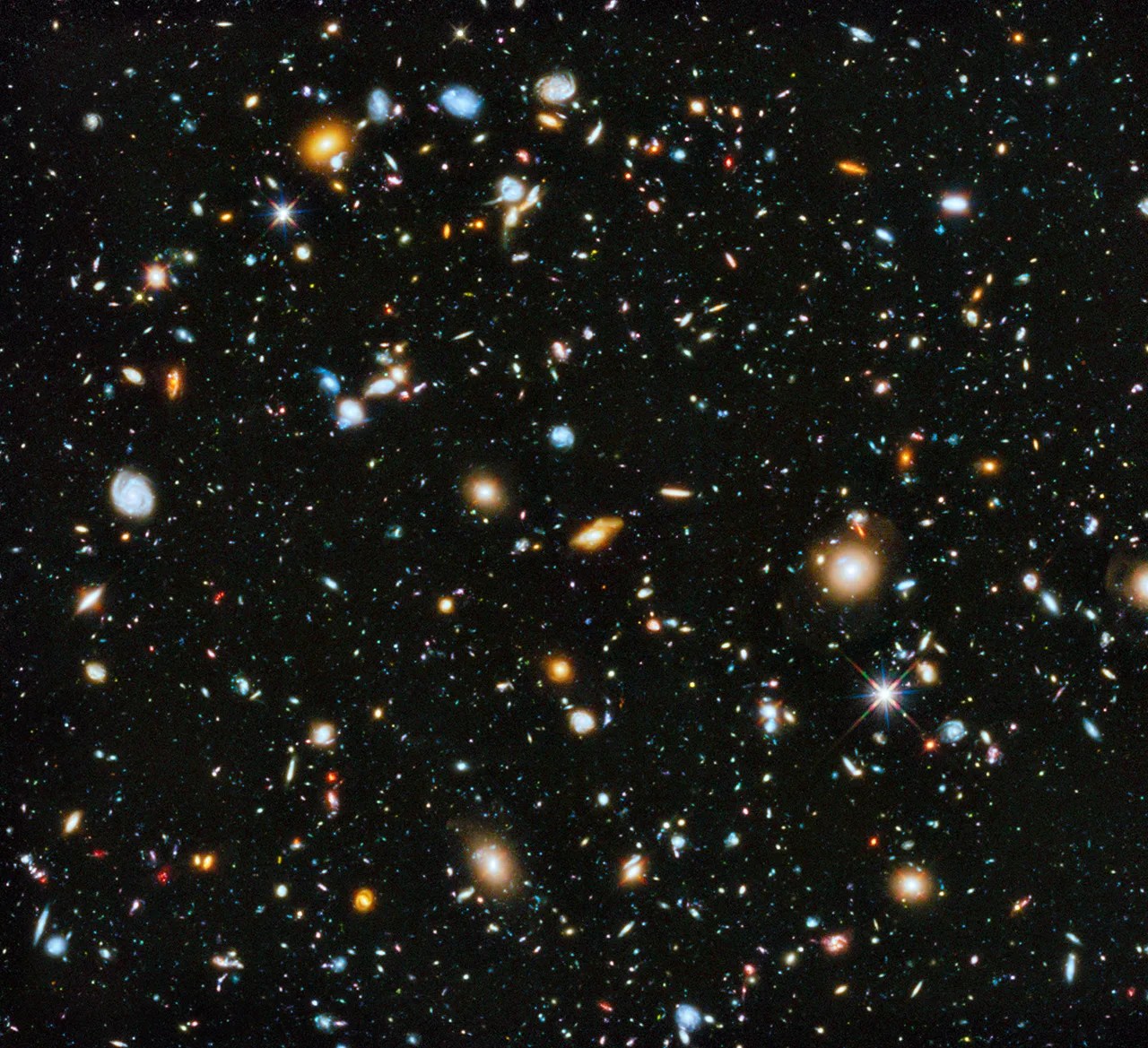
There are questions that hover at the edges of science like distant stars—visible, luminous, yet impossibly far from our grasp. Among them, one stands out in its audacity and simplicity: Why does anything exist at all? Why is there something rather than nothing? And if everything we see—from galaxies to grains of sand—requires energy, where did that energy come from? Is there an eternal source behind it all, a cosmic well that never runs dry?
These questions are not new. They have echoed through human thought for thousands of years. But today, they stand at the frontier of physics and cosmology, sharpened by mathematical precision and astronomical discovery. To approach them, we must travel across the vast landscape of modern science—from the explosive birth of the universe to the subtle flicker of quantum fields, from the relentless expansion of space to the deep symmetry of physical law.
The search for existence is not merely philosophical. It is profoundly physical.
The Universe as an Energy Story
Modern physics tells us something both startling and beautiful: everything is energy.
This insight is captured in the famous equation E = mc², introduced by Albert Einstein. Mass, the solid substance of stars and stones, is a condensed form of energy. Matter is not separate from energy; it is energy in a different guise. Every atom in your body is a tightly bound knot of energy, shaped by the rules of quantum fields and fundamental forces.
Energy flows through the cosmos in countless forms—radiation from stars, kinetic motion of galaxies, thermal vibrations in molecules. But according to the first law of thermodynamics, energy cannot be created or destroyed. It can only change form.
If that is true, a profound question emerges: where did the universe’s energy originate?
To answer, we must step back to the beginning.
The Birth of the Cosmos
Observations of distant galaxies reveal that the universe is expanding. This discovery, first interpreted by Edwin Hubble, showed that galaxies are moving away from one another, implying that space itself is stretching. If we trace this expansion backward in time, we reach a moment when the universe was extraordinarily hot, dense, and compact.
This origin event is known as the Big Bang. Approximately 13.8 billion years ago, the observable universe emerged from a state of extreme density and temperature. It was not an explosion in space; it was an expansion of space itself.
In the earliest fractions of a second, energy dominated everything. Matter had not yet formed as we know it. The universe was a seething ocean of radiation and fundamental particles, continuously transforming under the laws of quantum mechanics and relativity.
As the universe cooled, energy condensed into particles. Quarks formed protons and neutrons. Electrons joined nuclei to create atoms. Stars ignited, forging heavier elements through nuclear fusion. Planets assembled. Life emerged.
The cosmos evolved, but the total energy content remained governed by physical law.
Yet this does not fully answer the deeper mystery. If energy cannot be created or destroyed, what does that mean for the universe’s beginning? Did the Big Bang create energy, or did energy already exist in some deeper form?
The Possibility of a Zero-Energy Universe
At first glance, the idea of a universe arising from “nothing” seems impossible. But modern cosmology offers a subtle twist.
Gravity has negative energy. When you lift an object against gravity, you increase its gravitational potential energy. Conversely, gravitational binding energy can be considered negative relative to separated components.
Some physicists have proposed that the total energy of the universe may be exactly zero. The positive energy of matter and radiation could be balanced by the negative energy of gravity. In such a scenario, the universe could arise without violating conservation laws, because the net energy would remain zero.
This idea was explored by physicists such as Stephen Hawking. If the total energy is zero, then the universe might not require an external “eternal energy source.” It could be a self-contained system, where positive and negative contributions cancel perfectly.
In this view, existence does not require an infinite reservoir. It requires a delicate balance.
But what about the origin of space and time themselves?
Quantum Fluctuations and the Vacuum
When we imagine “nothing,” we often picture empty space. Yet in quantum physics, empty space is not truly empty. It is filled with fluctuating fields and temporary particle-antiparticle pairs that appear and vanish in accordance with the uncertainty principle.
This restless baseline is known as the quantum vacuum.
According to quantum field theory, fields permeate all of space. Particles are excitations of these fields. Even in the lowest-energy state—the vacuum—fields retain zero-point energy, a residual energy that cannot be eliminated.
Some cosmological models suggest that the universe could have originated from a quantum fluctuation in a pre-existing vacuum state. In such models, space and time themselves may emerge from quantum processes.
However, it is important to clarify what scientists mean by “nothing.” The quantum vacuum is not philosophical nothingness. It is a structured physical state governed by mathematical laws. Thus, when physicists propose that the universe emerged from “nothing,” they often mean from a quantum vacuum—a far cry from absolute nonexistence.
The mystery deepens. If the vacuum exists, why does it exist? If quantum laws operate, where do they come from?
The Role of Physical Laws
Energy does not act randomly. It behaves according to precise mathematical rules. Gravity curves spacetime as described by general relativity. Quantum fields evolve according to Schrödinger’s equation. The constants of nature—such as the speed of light and Planck’s constant—have specific values.
Why these laws? Why these constants?
Some physicists explore the idea that our universe is one among many in a vast multiverse. In certain inflationary models, the early universe underwent rapid exponential expansion, possibly spawning multiple regions with different physical parameters. This concept is associated with work by scientists such as Alan Guth, who developed the theory of cosmic inflation.
In a multiverse framework, the laws and constants we observe might not be uniquely determined. They might be one realization among many possibilities. Our universe would then exist because its conditions allow stable structures and observers to arise.
This does not eliminate the question of ultimate origin. It shifts it to a deeper level: why does the multiverse exist? Why is there a meta-law governing all possible universes?
The Arrow of Time and Entropy
Another layer of the mystery involves time. Why does time flow forward? Why did the universe begin in a low-entropy state, enabling complexity to grow?
The second law of thermodynamics states that entropy, a measure of disorder, tends to increase in an isolated system. The early universe was remarkably uniform and low in entropy. Over billions of years, gravity amplified tiny fluctuations, forming stars and galaxies.
The arrow of time is intimately connected to this increase in entropy. Without it, processes would be reversible and structure would not evolve in the way we observe.
Why did the universe start in such an ordered state? This remains one of the deepest unsolved questions in physics. Some proposals suggest that inflation naturally produces a low-entropy beginning. Others argue that our understanding of initial conditions is incomplete.
What is clear is that energy alone is not enough. The configuration of energy—the arrangement of matter and fields—determines the unfolding story of existence.
Dark Energy and the Expanding Cosmos
In 1998, observations of distant supernovae revealed a shocking result: the expansion of the universe is accelerating. This discovery, made by independent teams including researchers like Saul Perlmutter, pointed to the existence of dark energy.
Dark energy appears to permeate space, exerting a repulsive gravitational effect. It constitutes roughly 68 percent of the universe’s total energy content. Unlike matter and radiation, dark energy does not dilute significantly as space expands.
If dark energy is associated with the vacuum itself, then empty space contains intrinsic energy. This raises profound implications. The vacuum may not be a passive stage but an active participant in cosmic evolution.
Is dark energy constant, as described by the cosmological constant in Einstein’s equations? Or does it evolve over time? Current evidence favors a constant value, but the question remains open.
The presence of dark energy intensifies the mystery of existence. If space itself contains energy, then the fabric of reality is not inert. It hums with latent power.
The Search for a Unified Theory
One of the grand goals of physics is to unify general relativity and quantum mechanics into a single framework. General relativity describes gravity and large-scale structure. Quantum mechanics governs particles and fields. Yet these theories are mathematically incompatible under extreme conditions, such as inside black holes or at the Big Bang.
Efforts to reconcile them include string theory and loop quantum gravity. String theory proposes that fundamental particles are not point-like but tiny vibrating strings, whose modes of vibration determine particle properties. Loop quantum gravity attempts to quantize spacetime itself.
A successful theory of quantum gravity might reveal new insights into the origin of energy and spacetime. It might show that what we call existence emerges from deeper, more abstract structures.
But even a unified theory may not answer why there is something rather than nothing. It would describe how existence behaves, not necessarily why it is there at all.
Eternal Inflation and Cyclic Universes
Some cosmological models suggest that our universe is not unique in time. In eternal inflation, new regions of space continuously undergo expansion, generating “bubble universes” without end. In cyclic models, the universe undergoes repeated phases of expansion and contraction.
If the cosmos is eternal in some form, then the energy that fills it may also be eternal. In such frameworks, there may be no absolute beginning—only transitions from one phase to another.
However, current observational evidence does not conclusively support a cyclic past. The Big Bang marks the earliest epoch for which we have reliable data. Beyond a certain point, our equations break down.
The boundary of knowledge is not proof of impossibility. It is a horizon waiting to be explored.
Existence and Human Perspective
Amid equations and cosmic background radiation, it is easy to forget that this mystery is also personal. You exist. Your consciousness arises from patterns of energy in neural networks. The atoms in your brain were forged in ancient stars. The energy that powers your thoughts originated in nuclear fusion within the Sun.
Existence is not abstract. It pulses in your heartbeat and flickers in your awareness.
Physics does not yet explain consciousness fully. It describes the physical processes underlying brain activity, but the subjective experience of being remains philosophically complex. Nevertheless, the energy that sustains life obeys the same laws as the energy that drives galaxies.
In this sense, we are not separate from the cosmos. We are local expressions of universal processes.
The Limits of Explanation
Science excels at describing mechanisms. It tells us how the universe evolves, how particles interact, how energy transforms. It can trace the cosmic timeline back to fractions of a second after the Big Bang.
But the question “Why does everything exist?” may extend beyond purely scientific explanation. Physics can explore whether a universe can arise from quantum fluctuations, whether total energy sums to zero, whether spacetime is emergent. It can test hypotheses against observation.
Yet ultimate origin may involve conceptual challenges that blur the boundary between physics and philosophy.
Does “nothing” even make sense as a physical state? Are the laws of physics necessary or contingent? Could there have been no laws at all?
These are not failures of science. They are frontiers.
The Eternal Energy Source Reconsidered
Is there an eternal energy source?
Current physics suggests that energy conservation holds within the framework of spacetime. If spacetime itself emerged from a quantum process, then the concept of “before” the universe may be meaningless. Time itself began with the Big Bang, according to standard cosmology.
If there is no “before,” then asking what preceded the universe may be like asking what lies north of the North Pole. The question presupposes a dimension that does not exist.
In some models, the universe does not require an external source of energy. Its total energy may be zero. Its structure may arise naturally from quantum laws. Its expansion may be driven by vacuum energy inherent in spacetime.
In this sense, existence might not need an eternal fuel tank. It might be self-contained.
But self-contained does not mean fully understood.
Wonder at the Edge of Knowledge
The deeper physics digs, the more astonishing reality becomes. Space is dynamic. Time is flexible. Matter is energy. The vacuum is restless. The cosmos is expanding faster with each passing billion years.
And still, the ultimate “why” remains luminous and elusive.
Perhaps the mystery is not a gap to be closed but a horizon to approach. Each discovery—gravitational waves, the Higgs boson, cosmic microwave background radiation—reveals more of the tapestry, yet the question of existence continues to shimmer at its edge.
Why does everything exist?
Because the laws of physics allow it? Because quantum fluctuations make it possible? Because the total energy balances to zero? Because the vacuum itself contains potentiality?
We do not yet know.
But we do know this: the universe is intelligible. Its patterns can be discovered. Its energy can be measured. Its history can be reconstructed. From a tiny, hot beginning, complexity blossomed. Stars ignited. Planets formed. Life emerged. Minds awakened and began to ask why.
In that act of questioning, the universe reflects upon itself.
The mystery of existence is not only about distant galaxies or quantum fields. It is about the astonishing fact that anything is here at all—that energy dances, that matter organizes, that consciousness wonders.
Physics does not diminish this wonder. It deepens it. It shows that behind every sunrise and supernova lies a structure of astonishing coherence.
Whether or not there is an eternal energy source in some metaphysical sense, the energy that fills the cosmos follows laws of breathtaking precision. It transforms but does not vanish. It flows but does not exhaust itself.
And in that continuity—in the conservation of energy across billions of years—there is something almost poetic. The light that warms your face began as nuclear fusion in the Sun. The atoms in your bones were forged in stellar cores. The energy in your thoughts is part of an unbroken chain stretching back to the earliest moments of cosmic time.
Everything exists because the universe permits it. Because its laws do not forbid structure. Because energy, balanced and transformed, gives rise to matter, stars, and life.
The mystery endures. But so does the search.
And perhaps that is the most extraordinary fact of all.