There is a question that has haunted humanity for as long as we have looked up at the night sky: why is there something rather than nothing? Why does the universe exist at all? Before galaxies spun in silence, before stars ignited, before atoms formed and life stirred—what was there?
For much of history, the answer seemed to lie beyond physics, beyond measurement, beyond experiment. “Nothing” was imagined as an empty void, a complete absence of existence. But modern physics has reshaped this idea in profound and surprising ways. In the strange and subtle world of quantum mechanics, nothingness is not truly empty. It trembles. It seethes. It fluctuates.
These tiny, restless tremors are known as quantum fluctuations. And according to some of our best scientific theories, they may have played a decisive role in the birth of the universe itself.
The Classical Idea of Nothing
In everyday language, “nothing” means the absence of anything. An empty box contains nothing. A silent room holds no sound. A vacuum, in classical physics, was thought to be a completely empty region of space—no particles, no light, no matter.
Isaac Newton’s vision of space was that of a vast, rigid stage upon which matter moved. If you removed all matter, space would still remain. It would be empty, but it would exist as a passive container.
Later, in the 19th century, James Clerk Maxwell unified electricity and magnetism and showed that light is an electromagnetic wave. Even then, many physicists believed these waves required a medium—a kind of invisible substance called the “aether”—to travel through. When experiments failed to detect such a medium, the idea was abandoned.
The early 20th century brought a deeper shift. With the arrival of quantum mechanics, the concept of empty space itself changed dramatically.
The Quantum Vacuum: Not Empty After All
In quantum field theory, which combines quantum mechanics with special relativity, the fundamental ingredients of reality are not particles but fields. Every type of particle corresponds to a field that exists everywhere in space. There is an electron field, a photon field, a quark field, and so on.
Even in a perfect vacuum—where no real particles are present—these fields do not vanish. They remain, filling all of space. And because of the principles of quantum mechanics, they cannot remain perfectly still.
One of the most important principles in quantum mechanics is the uncertainty principle, introduced by Werner Heisenberg. It states that certain pairs of physical quantities cannot both be known with perfect precision. Most famously, the more precisely you know a particle’s position, the less precisely you can know its momentum, and vice versa.
There is a related uncertainty between energy and time. Over very short intervals of time, the energy of a system can fluctuate. This does not violate the conservation of energy, because the fluctuations are fleeting. They borrow energy briefly, then return it.
As a result, even the vacuum is not quiet. Tiny fluctuations in energy constantly occur. These fluctuations can briefly create pairs of particles and antiparticles that pop into existence and then annihilate each other almost immediately. These are called virtual particles.
This restless activity is what physicists call quantum fluctuation.
Virtual Particles and the Dance of Nothingness
Imagine a calm lake on a windless day. From afar, its surface appears perfectly smooth. But look closer, and you see ripples, tiny disturbances, constant motion. The quantum vacuum is similar. From a macroscopic perspective, it seems empty. But at the smallest scales, it is alive with activity.
Virtual particles are not directly observable in the same way as ordinary particles. They cannot be captured or stored. They exist within the mathematical framework of quantum field theory as temporary excitations of fields. Yet their effects are measurable.
One striking example is the Casimir effect. When two uncharged metal plates are placed extremely close together in a vacuum, they experience a tiny attractive force. This force arises because quantum fluctuations of the electromagnetic field are slightly altered between the plates compared to outside them. The difference in fluctuations creates a measurable pressure.
Experiments have confirmed the Casimir effect with remarkable precision. It is evidence that the vacuum is not empty but structured by quantum activity.
Quantum fluctuations also contribute to subtle shifts in atomic energy levels, known as the Lamb shift, first measured in hydrogen atoms. Again, the restless vacuum leaves its fingerprint on measurable reality.
Nothingness, it turns out, has texture.
From Fluctuations to the Early Universe
How could such tiny fluctuations have anything to do with the birth of the entire cosmos?
To answer this, we must step into cosmology—the study of the universe as a whole.
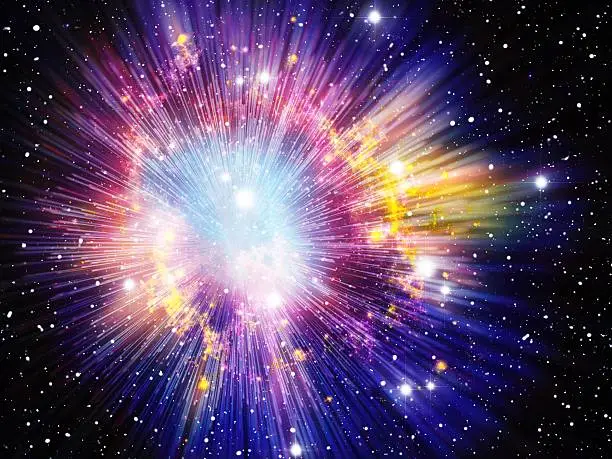
Observations show that the universe is expanding. Galaxies are moving away from one another, and the farther they are, the faster they recede. Tracing this expansion backward leads to a time about 13.8 billion years ago when the universe was extremely hot and dense. This is the Big Bang model.
The Big Bang was not an explosion in space. It was an expansion of space itself. Every region of space was once compressed into an extraordinarily dense state.
But the Big Bang model raises questions. Why is the universe so uniform on large scales? Why does it have the specific distribution of galaxies we observe? Where did the tiny irregularities that later grew into stars and galaxies come from?
In the early 1980s, physicist Alan Guth proposed a bold idea called cosmic inflation. According to inflation theory, a fraction of a second after the Big Bang began, the universe underwent an extremely rapid exponential expansion. In an unimaginably short time, space stretched by an enormous factor.
Inflation explains why the universe appears so smooth and flat. But more astonishingly, it provides a mechanism for how quantum fluctuations could shape cosmic structure.
During inflation, microscopic quantum fluctuations in fields were stretched to astronomical scales. Tiny variations in energy density—once confined to subatomic dimensions—were blown up to sizes larger than galaxies. When inflation ended, these amplified fluctuations became the seeds of all cosmic structure.
Over billions of years, gravity amplified these slight differences. Regions that were slightly denser attracted more matter, eventually forming galaxies, stars, and planets.
In this view, the large-scale structure of the universe traces back to quantum fluctuations in the earliest moments of cosmic history.
Evidence Written in the Sky
This idea is not mere speculation. It is supported by detailed observations.
In 1965, Arno Penzias and Robert Wilson discovered the cosmic microwave background radiation, a faint glow permeating the universe. This radiation is the afterglow of the early hot universe, released about 380,000 years after the Big Bang when atoms first formed and light could travel freely.
Precise measurements of this radiation, especially by satellites such as Wilkinson Microwave Anisotropy Probe and Planck spacecraft, revealed tiny temperature variations across the sky. These variations correspond to slight differences in density in the early universe.
The statistical properties of these fluctuations match the predictions of inflationary theory remarkably well. The patterns are consistent with quantum fluctuations stretched by rapid expansion.
In other words, we can see the imprint of quantum fluctuations in the oldest light in the universe.
Did the Universe Come from Nothing?
Now we arrive at the most provocative question. If quantum fluctuations can create particles in a vacuum, and if inflation can magnify tiny fluctuations into cosmic structures, could the entire universe have emerged from a quantum fluctuation?
Some theoretical models suggest that under certain conditions, a universe could spontaneously arise from a quantum process. In these scenarios, “nothing” does not mean absolute nonexistence. It refers to a quantum vacuum governed by physical laws.
One proposal, developed by physicists such as Alexander Vilenkin, suggests that the universe could have tunneled into existence from a state with no classical space and time. Quantum tunneling is a well-established phenomenon in which particles pass through energy barriers they could not cross classically. Applied to cosmology, the idea is that spacetime itself could emerge through a similar process.
Another approach involves the concept of a zero-energy universe. The total energy of matter and radiation is positive, but gravitational energy is negative. In some models, these contributions balance exactly, meaning the total energy of the universe is zero. If so, creating a universe does not require net energy input.
These ideas remain theoretical. They are grounded in known physics but extend it into regimes not yet fully understood. They do not claim that the universe came from absolute nothingness in a philosophical sense. Rather, they explore whether quantum laws allow for the spontaneous emergence of spacetime under certain conditions.
It is crucial to be scientifically precise here. Physics can describe how a universe might arise from a quantum state. It does not yet explain why the laws of quantum mechanics exist, or why there is a quantum vacuum rather than true nothingness. The question of ultimate origins may extend beyond current physical theory.
The Limits of Knowledge
When discussing the origin of the universe, we approach the limits of our understanding. Our best theories—quantum mechanics and general relativity—work extraordinarily well in their respective domains. But they are not yet unified into a complete theory of quantum gravity.
At extremely small scales and high energies, such as those present at the very beginning, both quantum effects and gravitational effects are crucial. A full description likely requires a theory that merges these frameworks. Candidates include string theory and loop quantum gravity, but no final theory has been experimentally confirmed.
Until such a theory is established, any description of the universe’s ultimate origin remains provisional.
Still, what we do know is astonishing. The structure of galaxies, the distribution of cosmic radiation, and the behavior of fundamental particles all point toward a universe shaped by quantum fluctuations.
A Universe Born of Uncertainty
There is something profoundly poetic in the idea that everything we see—mountains and oceans, stars and civilizations—traces back to tiny fluctuations in an ancient quantum field.
Quantum mechanics teaches us that uncertainty is woven into the fabric of reality. Not ignorance, but intrinsic indeterminacy. The vacuum is not static. It quivers with possibility.
From that trembling sea of potential, structure can emerge. From minute variations, complexity can grow. The cosmos itself may be the grandest expression of this principle.
Yet the story is not mystical. It is grounded in equations tested in laboratories and observations made with telescopes. It is constrained by evidence and shaped by measurement.
Quantum fluctuations are not metaphors. They are measurable consequences of quantum field theory. Their cosmic imprint is written across the sky in the cosmic microwave background.
The Meaning of Nothing
So what is quantum fluctuation? It is the unavoidable jitter of quantum fields, arising from the uncertainty principle. It is the spontaneous, temporary variation in energy that occurs even in empty space.
And how did the universe emerge from nothing? According to some scientific models, it may have arisen from a quantum state where fluctuations gave birth to spacetime itself, amplified by cosmic inflation into the vast universe we inhabit.
But the word “nothing” must be handled with care. In physics, nothing often means a quantum vacuum governed by laws and fields. It is not the absence of all existence. The deeper philosophical question—why there are laws at all—remains open.
What physics offers is not final metaphysical certainty, but a framework grounded in observation. It tells us that emptiness is dynamic. That fluctuations are real. That the seeds of galaxies were once microscopic ripples in a primordial field.
In the silence before stars, there was not stillness, but motion. Not void, but vibration. And from those subtle tremors, stretched across the expanding fabric of space, emerged everything we know.
The atoms in your body, the light from distant galaxies, the structure of the cosmic web—all may trace their origins to quantum fluctuations in the earliest fraction of a second.
The universe, in all its immensity, may have begun as a whisper of uncertainty.