There are moments when astronomy stops feeling like science and begins to feel like art. A telescope points toward the dark, patient sky, gathers photons that have traveled for millions of years, and suddenly an image appears—swirls of sapphire and crimson, glowing arcs, delicate spirals traced in starlight. It looks like a painting, something dreamed into existence by a cosmic artist with an infinite palette.
And yet, these visions are real. They are galaxies: vast gravitational cities of stars, gas, dust, dark matter, and time. Each contains billions or even trillions of suns. Each is shaped by gravity, rotation, collision, and cosmic history. Their beauty is not decoration. It is physics made visible.
Below are seven galaxies whose forms are so breathtaking that they seem to transcend science and enter the realm of fine art. Yet every curve, every color, every luminous knot is rooted in astrophysical truth.
1. The Whirlpool Galaxy (Messier 51)
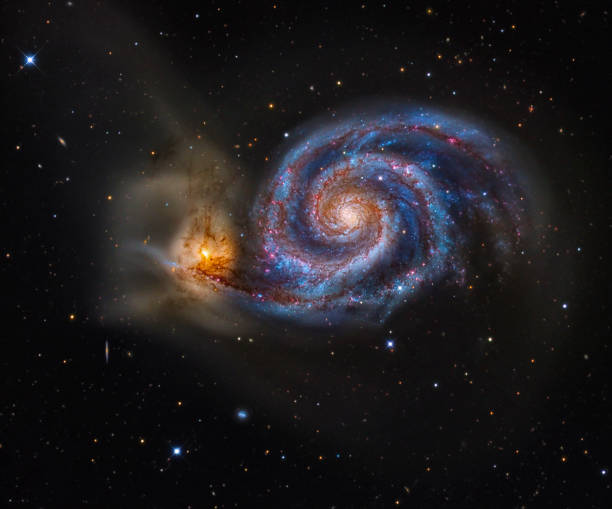
Few galaxies capture the imagination as immediately as the Whirlpool Galaxy, formally known as Messier 51. Located roughly 23 million light-years away in the constellation Canes Venatici, this grand-design spiral galaxy is one of the most photogenic objects in the sky.
At first glance, it resembles a luminous seashell floating in black water. Two majestic spiral arms curve outward from a bright central core, wrapping around in a near-perfect symmetry. The arms are traced with glowing pink regions—vast clouds of hydrogen gas where new stars are being born. Between them lie dark lanes of interstellar dust, like brushstrokes of shadow cutting across brilliant light.
The Whirlpool’s elegance is not accidental. Its shape is partly sculpted by a smaller companion galaxy, NGC 5195, which appears to tug at one side of the spiral. This gravitational interaction enhances the structure of the spiral arms, triggering waves of star formation as gas clouds compress under tidal forces.
In astrophysical terms, Messier 51 is a textbook example of a grand-design spiral galaxy. Density wave theory helps explain why spiral arms can persist over cosmic timescales. Rather than being static structures made of fixed stars, the arms are regions of higher density that move through the galactic disk, much like traffic jams moving along a highway.
The result is a galaxy that looks like it was carefully composed on a canvas—yet its beauty emerges naturally from gravity and motion.
2. The Sombrero Galaxy (Messier 104)
The Sombrero Galaxy, Messier 104, appears almost architectural in its symmetry. Seen edge-on from Earth, it presents a brilliant central bulge glowing like a polished pearl, encircled by a sharp, dark band of dust that slices across its middle.
Located about 31 million light-years away in the constellation Virgo, this galaxy looks strikingly like the wide-brimmed hat from which it gets its nickname. But beneath that playful resemblance lies a fascinating structure.
The Sombrero Galaxy is classified as an unbarred spiral galaxy, though its massive central bulge makes it appear somewhat elliptical at first glance. That bulge contains an enormous concentration of older stars and likely harbors a supermassive black hole at its core.
The dark lane that defines its dramatic profile is composed of cold dust and gas. Within this material, new stars are born. The contrast between the bright central region and the absorbing dust lane creates the impression of depth and layering, as if the galaxy were carved from luminous marble and shadow.
Observations across different wavelengths reveal even more complexity. Infrared imaging penetrates the dust, exposing hidden stellar populations. X-ray observations detect high-energy processes near the galactic center.
The Sombrero Galaxy’s beauty lies in its clean lines and bold contrast. It is a cosmic silhouette—minimalist, dramatic, unforgettable.
3. The Pinwheel Galaxy (Messier 101)
If the Whirlpool Galaxy feels intimate and compact, the Pinwheel Galaxy, Messier 101, feels expansive and delicate. Located about 21 million light-years away in the constellation Ursa Major, it is a vast spiral galaxy nearly twice the diameter of the Milky Way.
Its spiral arms are loose and sprawling, reaching outward in sweeping arcs like the blades of a windmill caught mid-turn. These arms are dotted with brilliant star-forming regions that shine in shades of pink and blue, contrasting against darker dust clouds.
Messier 101 is a face-on spiral galaxy, giving us a direct view of its structure. This orientation allows astronomers to study its star formation patterns in remarkable detail. The galaxy’s arms are not evenly distributed; some are more pronounced, possibly due to past gravitational interactions with neighboring galaxies.
The Pinwheel’s asymmetry gives it character. It does not feel rigid or mechanical. Instead, it resembles a living organism—dynamic, evolving, expressive.
At its heart lies a dense core of older stars. Surrounding it is a disk rich in gas, fueling ongoing star birth. Massive young stars illuminate nearby hydrogen clouds, causing them to glow. These glowing nebulae add splashes of color, like pigments on a spinning canvas.
The Pinwheel Galaxy reminds us that scale does not diminish beauty. Even at nearly 170,000 light-years across, it retains intricate detail and grace.
4. The Black Eye Galaxy (Messier 64)
The Black Eye Galaxy, Messier 64, carries an air of quiet mystery. Located about 17 million light-years away in the constellation Coma Berenices, it appears at first to be a typical spiral galaxy. But a closer look reveals something striking: a dark band of absorbing dust that partially obscures its bright nucleus, creating the appearance of a cosmic bruise.
This dark feature gives the galaxy its evocative nickname. Yet it is not merely aesthetic. The Black Eye Galaxy has an unusual internal structure. Observations show that the gas in its outer regions rotates in the opposite direction to the gas in its inner regions.
Such counter-rotation suggests a violent past, likely involving the merger with a smaller galaxy. When galaxies collide and merge, their gas and stars can settle into complex motions, preserving the memory of ancient interactions.
The dust lane near the core is rich in star-forming material. In some images, the glowing central region seems to peer through shadow, as if light were struggling to escape from beneath a veil.
The Black Eye Galaxy is a portrait of cosmic transformation. It is beautiful not because it is serene, but because it reveals the layered history of gravitational drama.
5. The Cartwheel Galaxy
The Cartwheel Galaxy is one of the most visually striking galaxies ever observed. Located about 500 million light-years away in the constellation Sculptor, it looks less like a traditional spiral and more like a luminous ring suspended in space.
Its structure resembles a wagon wheel: a bright outer ring filled with young, massive stars; a fainter inner ring; and spokes of material connecting them. This extraordinary shape is the result of a collision.
Astronomers believe that a smaller galaxy passed directly through the center of a larger disk galaxy. The gravitational shock sent waves rippling outward, compressing gas and triggering intense star formation in a ring-like structure.
The outer ring glows with clusters of hot, blue stars, while the inner regions contain older stellar populations. The contrast between youth and age, between motion and aftermath, gives the Cartwheel Galaxy a sense of frozen explosion.
Collisions between galaxies are common over cosmic timescales, but the precise alignment required to produce such a clean ring structure is rare. The Cartwheel Galaxy captures a transient moment in galactic evolution—an impact transformed into art.
6. The Antennae Galaxies
The Antennae Galaxies are not a single structure but a pair of interacting galaxies in the process of merging. Located about 45 million light-years away in the constellation Corvus, they appear tangled together, their spiral arms stretched and distorted into long, sweeping arcs that resemble insect antennae.
This is cosmic choreography at its most dramatic. Two massive galaxies are colliding, their gravitational fields pulling stars and gas into elongated tidal tails that extend far into space.
Within the overlapping region between the two galactic cores, intense star formation is taking place. Massive clusters of young stars blaze with ultraviolet light, illuminating clouds of gas and dust.
Although galaxy collisions sound catastrophic, individual stars rarely collide directly because of the vast distances between them. Instead, gravity reshapes entire systems over hundreds of millions of years.
The Antennae Galaxies are a preview of our own future. In several billion years, the Milky Way is expected to merge with the Andromeda Galaxy in a similar dance of tidal forces and starbursts.
Their beauty is wild and chaotic—an abstract sculpture formed by gravity’s invisible hands.
7. The Andromeda Galaxy (Messier 31)
The Andromeda Galaxy is our nearest large galactic neighbor, located about 2.5 million light-years away. On clear, dark nights, it is visible to the naked eye as a faint smudge in the constellation Andromeda.
Through telescopes, Andromeda reveals itself as a vast spiral galaxy, similar in structure to the Milky Way but even larger. Its disk spans roughly 220,000 light-years. Billions of stars swirl around its luminous center, framed by dark dust lanes that trace elegant curves across its arms.
Andromeda is not just beautiful. It is monumental. It contains approximately one trillion stars, more than double the number estimated in our own galaxy.
Observations show that Andromeda has absorbed smaller galaxies in the past. Streams of stars wrap around it, remnants of ancient mergers. These stellar streams are faint but profound, like subtle brushstrokes that hint at hidden layers beneath a painting.
In about 4 to 5 billion years, Andromeda will collide with the Milky Way. The night sky of Earth—if Earth still exists—will transform into a tapestry of overlapping galactic arms.
The Andromeda Galaxy is both a neighbor and a destiny. Its beauty is personal.
When Science Meets Awe
Each of these galaxies is shaped by gravity, governed by physics, and explained through careful observation. There is nothing supernatural about their forms. Yet their appearance evokes emotion—wonder, humility, even a sense of longing.
Spiral arms are not decorative patterns but density waves of stars and gas. Dust lanes are not artistic shading but cold molecular clouds blocking light. Bright pink regions are hydrogen atoms glowing under ultraviolet radiation from massive young stars.
What we perceive as beauty arises from natural laws operating on unimaginable scales.
Galaxies evolve. They collide, merge, form new stars, exhaust their gas, and sometimes fall silent. Their colors shift as stellar populations age. Their shapes distort under tidal forces. Over billions of years, even the most graceful spiral can transform into an elliptical giant.
And yet, in snapshots captured by telescopes, they appear timeless—frozen in luminous perfection.
We live inside one such galaxy. From within the Milky Way, we cannot easily photograph its full structure. But when we look outward at these distant systems, we see reflections of our own cosmic home.
They are not just distant objects. They are chapters in a larger story—the story of matter organizing itself under gravity, of stars igniting, of elements forming, of planets emerging, of life contemplating the universe.
The galaxies above look like works of art because the universe itself operates with a kind of structural elegance. Symmetry, contrast, rhythm, texture—these are not exclusively artistic principles. They are consequences of physical laws.
When we study galaxies, we do not merely catalog objects in space. We witness the grand architecture of the cosmos.
And perhaps the most extraordinary fact of all is this: the atoms in our bodies were forged in stars within galaxies like these. The iron in our blood, the carbon in our cells, the oxygen we breathe—all born in stellar furnaces.
We are not separate from this beauty. We are made of it.
The universe paints in light across billions of light-years, and for a brief moment in cosmic time, we have learned how to see it.