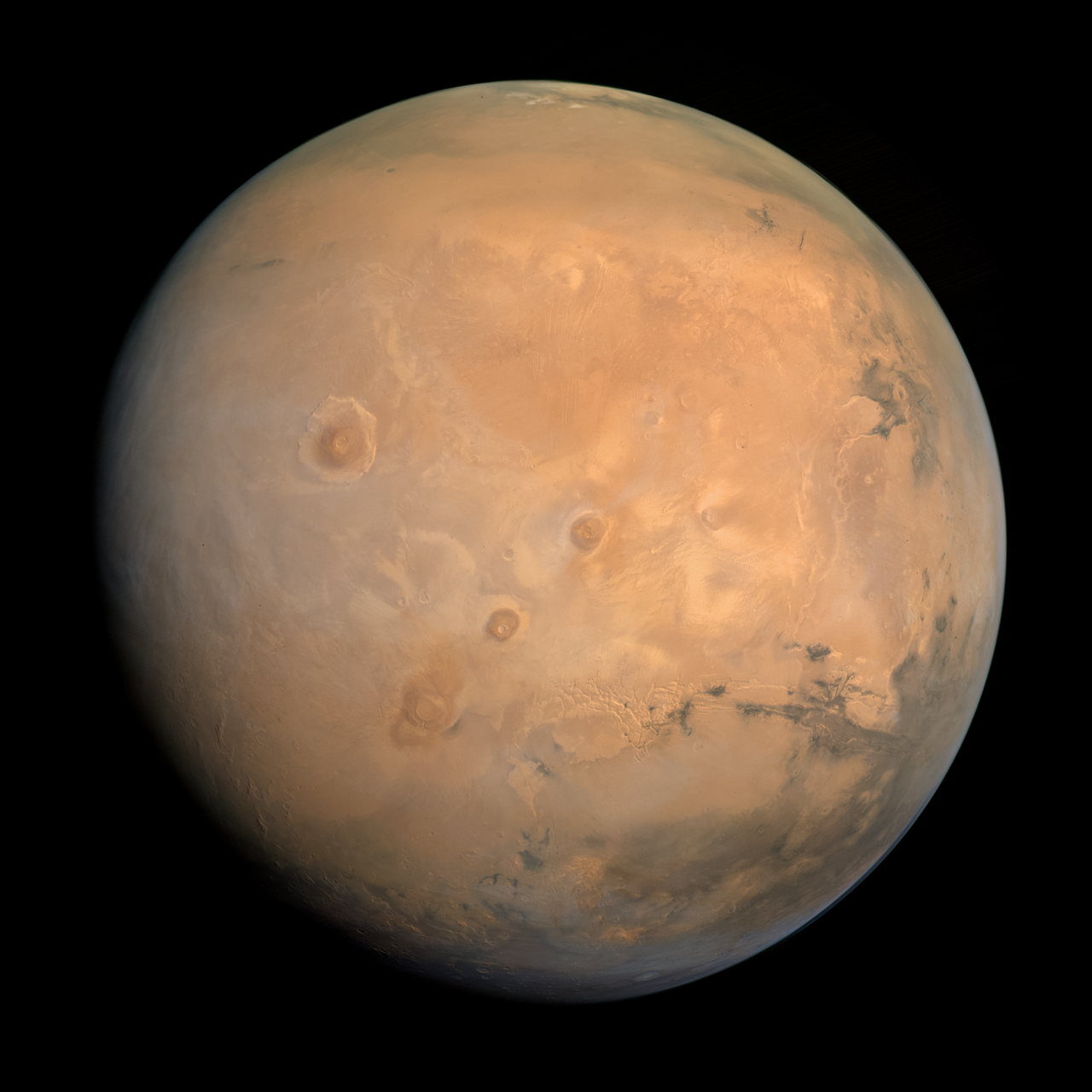
For centuries, humanity has looked up at the night sky and noticed a small reddish point of light wandering among the stars. Ancient civilizations associated this glowing object with war, fire, and mystery because of its blood-like color. The Romans named it after their god of war: Mars.
Today we know that this wandering red star is not a star at all but a world—an entire planet orbiting the Sun, cold and dusty, yet filled with landscapes that rival the most dramatic features on Earth. That planet is Mars.
Mars has fascinated astronomers, writers, and dreamers for generations. It has inspired stories of alien civilizations, visions of human colonies, and some of the most ambitious space missions ever launched. Robotic explorers have rolled across its deserts, flown through its thin skies, and drilled into its rocks searching for clues about its past.
The more we learn about Mars, the more astonishing it becomes. Beneath its rusty surface lies a story of volcanoes larger than any on Earth, canyons deeper than the Grand Canyon, ancient rivers that once flowed across vast plains, and mysteries that continue to challenge scientists.
Here are ten fascinating facts about Mars that reveal just how extraordinary our neighboring world truly is.
1. Mars Has the Largest Volcano in the Solar System
If you could stand on Mars and look toward the horizon in a certain region called the Tharsis Plateau, you would see something that dwarfs every volcano on Earth.
Towering above the Martian surface is Olympus Mons.
Olympus Mons is colossal. It rises about 22 kilometers above the surrounding plains—nearly three times the height of Mount Everest. Its base stretches roughly 600 kilometers across, making it wider than many countries. From space, it resembles a gigantic shield, formed by countless layers of lava that slowly built up over millions of years.
The reason Olympus Mons could grow so large lies partly in Mars’s weaker gravity. The planet’s gravity is only about 38 percent that of Earth’s, allowing volcanic structures to rise higher before collapsing under their own weight. Mars also lacks active plate tectonics, which on Earth move volcanic hotspots across the surface and prevent mountains from growing endlessly in one place.
On Earth, volcanoes such as those in Hawaii eventually drift away from their magma sources as tectonic plates shift. On Mars, however, the crust remains relatively fixed. Lava repeatedly erupted from the same region for hundreds of millions of years, gradually building Olympus Mons into the giant we see today.
The volcano’s summit contains a massive caldera—actually several overlapping collapse craters—formed when magma chambers emptied and the surface sank. From rim to rim, the caldera spans about 80 kilometers.
Standing on Olympus Mons would be an eerie experience. The slopes are so gradual that you would barely notice you were climbing. The summit would lie above much of Mars’s thin atmosphere, and the horizon would curve far below you.
In sheer scale, Olympus Mons reminds us that Mars once possessed immense geological power.
2. Mars Contains the Largest Canyon in the Solar System
While Olympus Mons rises skyward, another Martian feature plunges dramatically into the planet’s crust.
Stretching across the equatorial region of Mars is a vast canyon system called Valles Marineris.
Valles Marineris is staggering in scale. It extends more than 4,000 kilometers across the planet—roughly the distance from New York to Los Angeles. In places, it reaches depths of up to 7 kilometers and widths exceeding 200 kilometers.
To put this into perspective, Earth’s Grand Canyon is about 446 kilometers long and just over 1.6 kilometers deep. Valles Marineris is far larger.
The canyon system likely formed as the Martian crust stretched and cracked billions of years ago. The immense weight of nearby volcanic regions, including Olympus Mons, may have caused the surface to bulge and fracture. Over time, landslides, erosion, and perhaps ancient water flows widened and deepened the chasms.
Satellite images reveal towering cliffs, collapsed terrain, and layered rock formations that record the geological history of Mars. Some sections show evidence that water or ice may once have shaped the landscape.
If Valles Marineris existed on Earth, it would dominate an entire continent. On Mars, it stretches across a significant portion of the planet like a scar carved into its surface.
This colossal canyon tells a story of tectonic tension and ancient geological drama on a world that now appears quiet and frozen.
3. Mars Once Had Flowing Rivers and Lakes
Today, Mars is a cold desert. Liquid water cannot remain stable on the surface for long because of the planet’s low atmospheric pressure and frigid temperatures.
But the surface of Mars tells a different story about its past.
Orbital images reveal dried river channels, branching valley networks, and fan-shaped deltas that strongly resemble river systems on Earth. These features indicate that billions of years ago, liquid water once flowed across the Martian landscape.
One of the most compelling examples is the Jezero Crater, where the rover Perseverance is currently exploring. This crater contains an ancient river delta formed when sediment-laden water entered a standing lake and slowed down, depositing layers of material.
The existence of such deltas suggests that Mars once possessed a thicker atmosphere capable of supporting stable liquid water on the surface.
Evidence from orbiters and rovers also indicates the presence of minerals that typically form in water, including clays and sulfates. These minerals record chemical interactions between rock and liquid water.
The early Martian environment may have included rainfall, flowing rivers, lakes, and perhaps even shallow seas.
Why did this watery world disappear?
Scientists believe Mars gradually lost its atmosphere over billions of years. Without a strong global magnetic field to shield it from the solar wind, atmospheric gases were stripped away into space. As the atmosphere thinned, surface water evaporated or froze.
Yet the evidence of ancient rivers remains etched across the planet, whispering of a time when Mars may have been far more hospitable than it is today.
4. Mars Experiences Giant Planet-Wide Dust Storms
Mars may appear calm from a distance, but its atmosphere is capable of producing enormous dust storms.
Sometimes these storms grow so large that they engulf the entire planet.
Martian dust storms begin when sunlight heats the surface, causing air to rise and carry fine dust particles upward. Once airborne, these particles absorb additional heat, further warming the atmosphere and intensifying winds. The process can quickly escalate into massive regional storms.
In some years, these storms expand until they cover nearly all of Mars, forming a global haze that blocks sunlight from reaching the surface.
One such storm occurred in 2018. It grew so intense that it enveloped the entire planet and lasted for months. Solar-powered spacecraft operating on the surface, including the rover Opportunity, were unable to generate enough energy to survive. Opportunity eventually lost power and ceased communication.
Despite the thin Martian atmosphere—only about 1 percent as dense as Earth’s—the fine dust particles are extremely effective at remaining suspended in the air.
These storms dramatically alter the planet’s appearance from orbit. Dark surface features disappear beneath layers of airborne dust, and the entire world takes on a pale, hazy glow.
Dust storms also play a major role in shaping the Martian environment. They redistribute sediments, carve dunes, and influence atmospheric circulation patterns.
Mars may be cold and quiet compared to Earth, but when the winds rise, the entire planet can disappear beneath a swirling shroud of dust.
5. A Day on Mars Is Almost the Same as a Day on Earth
Despite its alien appearance, Mars shares some surprisingly familiar rhythms with Earth.
One of the most intriguing is the length of its day.
A single rotation of Mars—called a sol—lasts approximately 24 hours and 39 minutes. That is remarkably close to Earth’s 24-hour day.
This similarity has practical advantages for scientists operating robotic missions on the planet. When rovers like Curiosity conduct experiments and travel across the terrain, their schedules are often organized according to the Martian day rather than Earth time.
Engineers on Earth sometimes adjust their own sleep cycles to align with the Martian sol while managing rover operations. During early mission phases, this can mean going to work roughly 40 minutes later each day.
Mars also experiences seasons similar to those on Earth because its rotational axis is tilted by about 25 degrees. Earth’s tilt is approximately 23.5 degrees.
As a result, Mars has spring, summer, autumn, and winter. However, because Mars takes 687 Earth days to complete one orbit around the Sun, each Martian season lasts roughly twice as long as a season on Earth.
The familiar rhythm of day and night on Mars adds to the growing sense that this distant planet may someday feel almost like a second home for human explorers.
6. Mars Has Blue Sunsets
On Earth, sunsets glow with warm reds and oranges. The colors arise because Earth’s atmosphere scatters shorter wavelengths of light—blues and violets—more effectively than longer wavelengths.
Mars behaves differently.
Because of the fine dust suspended in its atmosphere, Martian sunsets often appear blue around the Sun while the surrounding sky turns reddish.
The dust particles scatter red light across the sky while allowing blue light to concentrate near the Sun’s disk as it approaches the horizon.
Images taken by rovers such as Spirit and Curiosity have captured these unusual sunsets in remarkable detail.
Watching a sunset on Mars would feel strangely inverted. The sky might appear butterscotch or dusty pink during the day, then transition into a cool blue glow as the Sun disappears behind the horizon.
It is one of the many subtle ways Mars reminds us that familiar processes can produce very different experiences on another world.
7. Mars Has Two Strange Moons
Unlike Earth, which has one large Moon, Mars is accompanied by two small and oddly shaped moons.
These moons are called Phobos and Deimos.
They were discovered in 1877 by the American astronomer Asaph Hall.
Phobos is the larger of the two, though still tiny compared with Earth’s Moon. It measures only about 22 kilometers across and orbits extremely close to Mars—just about 6,000 kilometers above the surface.
Because of this proximity, Phobos races across the Martian sky. It rises in the west and sets in the east, completing an orbit in only about 7 hours and 39 minutes.
Deimos is smaller and more distant, orbiting Mars every 30 hours.
Both moons have irregular, potato-like shapes rather than the spherical appearance typical of larger celestial bodies. Their origins remain a subject of scientific debate. They may be captured asteroid fragments or remnants of a larger moon that broke apart long ago.
Phobos is gradually spiraling inward toward Mars due to tidal forces. In tens of millions of years, it may either crash into the planet or break apart to form a temporary ring around Mars.
These strange little moons add another layer of mystery to the Martian system.
8. Mars Has Enormous Polar Ice Caps
Mars possesses vast polar ice caps that grow and shrink with the seasons.
These caps are composed primarily of water ice, but they also contain frozen carbon dioxide—commonly known as dry ice.
During the Martian winter, temperatures drop low enough for carbon dioxide from the atmosphere to freeze and accumulate on the poles. As spring and summer arrive, sunlight warms the region and the dry ice sublimates, turning directly from solid into gas.
This seasonal process causes the polar caps to expand and contract dramatically each year.
The permanent ice beneath these seasonal layers contains enormous reserves of water. Scientists estimate that if the ice in the polar caps melted, it could cover the entire planet in a layer of water several tens of meters deep.
In addition to the poles, large quantities of water ice are buried beneath the Martian surface at mid-latitudes.
These frozen reserves are of immense interest for future human exploration. Water is essential for drinking, growing food, producing oxygen, and even manufacturing rocket fuel through chemical processes.
Mars may appear dry and barren, but hidden beneath its frozen poles lies a vast storehouse of one of the most valuable resources for life.
9. Mars May Have Had Conditions Suitable for Life
One of the most compelling reasons scientists study Mars is the possibility that it may once have supported life.
Evidence from orbiters and rovers indicates that early Mars possessed liquid water, a thicker atmosphere, and potentially stable environments such as lakes and hydrothermal systems.
These conditions resemble environments on Earth where microbial life thrives.
Rovers have discovered organic molecules—carbon-based compounds that can be associated with life—in ancient Martian rocks. While these molecules do not prove that life existed, they demonstrate that the chemical building blocks for life were present.
In addition, methane gas has occasionally been detected in the Martian atmosphere. On Earth, methane can be produced by geological processes or by microbial life. The origin of Martian methane remains uncertain.
The rover Perseverance is currently collecting rock samples that may eventually be returned to Earth through future missions. These samples could contain chemical or structural signatures indicating whether microscopic life once existed on Mars.
Even if Mars never hosted life, studying its history helps scientists understand how planets evolve and what conditions allow life to arise.
If life did exist there long ago, it would mean that life can emerge independently on more than one world in our solar system—a discovery that would profoundly change our understanding of biology and the universe.
10. Humans May One Day Walk on Mars
For thousands of years, Mars was simply a point of light in the sky.
Today, it is the destination of one of humanity’s greatest ambitions: sending people to another planet.
Space agencies and private companies are developing technologies that could one day make human exploration of Mars possible. Astronauts would face enormous challenges, including long travel times, radiation exposure, extreme cold, and the need to produce food and oxygen in a hostile environment.
Yet the idea is no longer science fiction.
Future missions may build habitats on the Martian surface, extract water from underground ice, and use local resources to create fuel and building materials.
If humans eventually establish a presence on Mars, it will mark one of the most significant milestones in the history of exploration.
For the first time, our species would become truly interplanetary.
The Red Planet’s Endless Allure
Mars has captivated human imagination for centuries because it feels both alien and strangely familiar. It has deserts, mountains, valleys, seasons, and polar ice caps—features that echo landscapes on Earth, yet appear in grander and more dramatic forms.
Every robotic mission reveals new clues about its past. Each discovery raises deeper questions about climate evolution, planetary geology, and the potential for life beyond Earth.
Mars is not merely another planet. It is a world that tells a story about planetary change, atmospheric loss, and the fragile conditions required for habitability.
In many ways, studying Mars also teaches us about Earth—about how climates evolve, how geological processes shape landscapes, and how delicate the balance of a life-supporting environment can be.
And perhaps one day, when humans finally set foot on that rusty soil and look up at a blue Martian sunset, the Red Planet will no longer be just a distant mystery.
It will become a new chapter in the human story.