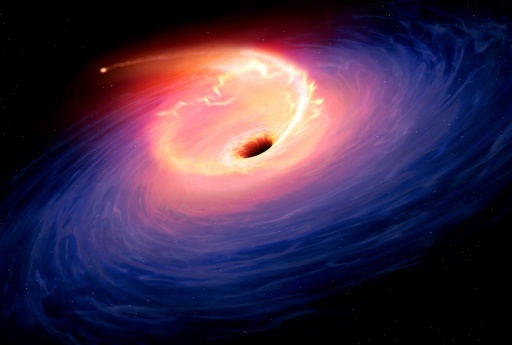
Black holes have a reputation that feels almost mythological. They are the monsters of space, the ultimate cosmic traps—regions where gravity becomes so intense that not even light can escape. For decades, black holes were described as eternal. Once one formed, it would remain forever, quietly feeding on surrounding matter and growing without limit, like an immortal shadow carved into the universe.
But modern physics tells a stranger story.
According to one of the most surprising discoveries in theoretical science, black holes are not eternal at all. They can lose mass. They can shrink. Given enough time, they can evaporate completely and disappear from existence. A black hole, in other words, can die.
The mechanism behind this cosmic death is called Hawking radiation, a phenomenon that seems almost impossible at first glance. It combines quantum mechanics, relativity, and thermodynamics into a single breathtaking idea: even the darkest object in the universe is not perfectly black.
This is the strange truth about black holes. They are not just destroyers of matter. They are also, slowly and quietly, victims of the universe’s deeper laws.
The Classic Idea of a Black Hole: A One-Way Door
To understand why Hawking radiation is so shocking, we first need to understand how black holes were originally thought to behave.
A black hole forms when matter is squeezed into an extremely small region, creating gravity so powerful that escape becomes impossible. The boundary around this region is called the event horizon. If you cross the event horizon, you can never return. Not because something blocks you, but because space and time themselves curve inward so strongly that every possible path leads deeper inside.
The event horizon is not a physical surface. It is more like a point of no return, a border in spacetime.
In classical physics, a black hole was considered perfectly absorbing. Anything that fell in would add mass and energy to the black hole. Nothing could ever escape. That meant a black hole could only grow or remain the same. It could never shrink.
This gave black holes an almost supernatural quality: they seemed to violate the ordinary rules of the universe. Most objects can lose energy, radiate heat, cool down, and change. But a black hole, by definition, was a cosmic prison. A final destination. A permanent sink.
Then Stephen Hawking changed everything.
Quantum Physics Enters the Darkness
In the 1970s, physicist Stephen Hawking began exploring what happens when quantum mechanics is applied to black holes.
Quantum mechanics is the physics of the very small, where nature behaves in ways that seem bizarre compared to everyday experience. In the quantum world, particles can appear and disappear. Energy can fluctuate. Empty space is not truly empty.
According to quantum field theory, what we call a “vacuum” is actually filled with constant activity. Pairs of particles and antiparticles spontaneously pop into existence and then annihilate each other almost immediately. These are called virtual particles. They are not directly observable under normal conditions because they vanish too quickly.
But near a black hole, Hawking realized, the story changes.
The event horizon creates an extreme gravitational environment, warping spacetime so dramatically that quantum fluctuations can have real consequences. The black hole’s gravity can separate these particle pairs before they annihilate, allowing one particle to escape into space while the other falls into the black hole.
The escaping particle becomes real. It carries energy away from the black hole.
And energy loss means mass loss.
This is the essence of Hawking radiation: black holes emit radiation because of quantum effects near their event horizons.
This was a revolutionary conclusion. It meant black holes are not perfectly black. They glow faintly. They leak energy. They are slowly evaporating.
What Exactly Is Hawking Radiation?
Hawking radiation is often described using the image of particle-antiparticle pairs forming near the event horizon. One falls in, the other escapes. This picture is useful, but it is a simplified metaphor. The deeper explanation involves quantum fields in curved spacetime.
In quantum field theory, particles are excitations in fields that fill space. When spacetime is curved, the definition of what counts as a “particle” can depend on the observer. A state that looks like empty vacuum to one observer can look like a warm bath of particles to another.
Near a black hole, the intense curvature of spacetime changes the behavior of these quantum fields. Hawking showed that the black hole should emit thermal radiation, as if it had a temperature.
This is not radiation coming from inside the black hole. Nothing escapes from the singularity. Instead, the radiation originates just outside the event horizon, created by quantum effects in the vacuum itself.
The black hole behaves like a hot object.
And if it has a temperature, it must also obey thermodynamics.
That is where the strangest consequences begin.
Black Holes Have Temperature, and That Changes Everything
In everyday life, temperature is tied to the motion of particles. Hot objects have atoms and molecules vibrating faster, producing thermal energy that radiates outward.
But black holes have no solid surface and no normal matter structure. So how can they have a temperature?
Hawking’s calculations revealed that black holes possess an effective temperature determined by their mass. The smaller the black hole, the hotter it is. The larger the black hole, the colder it is.
This relationship is one of the most counterintuitive results in physics. A supermassive black hole, millions or billions of times the Sun’s mass, has a temperature incredibly close to absolute zero. It emits almost no Hawking radiation. It is nearly “frozen.”
A tiny black hole, on the other hand, would be extremely hot and would radiate energy intensely.
This leads to a remarkable conclusion: as a black hole loses mass, it becomes hotter, which makes it radiate faster, which makes it lose mass even more quickly. The evaporation accelerates over time.
A black hole’s death is not a slow fading into nothingness. It begins slowly, but toward the end it becomes violent.
The Idea of Black Hole Evaporation
Because Hawking radiation carries energy away, it causes black holes to shrink. Over unimaginably long timescales, a black hole will evaporate.
This process is called black hole evaporation.
At first, the evaporation is extremely slow. For a black hole with the mass of our Sun, the time required to evaporate is around 10⁶⁷ years. That is a number so large it dwarfs the age of the universe, which is about 13.8 billion years.
For supermassive black holes, the timescale is even more absurd. A black hole with billions of solar masses could take around 10¹⁰⁰ years or more to fully evaporate.
These numbers are far beyond any human timeframe. They stretch beyond the lifespan of stars, galaxies, and perhaps even the structured universe as we know it.
But the key point is not how long it takes. The key point is that black holes are not eternal. Given enough time, they disappear.
This means that even the darkest, most powerful objects in existence are temporary.
The universe does not allow perfect permanence.
Do Black Holes Actually Lose Mass Today?
Yes, but in most cases, the effect is practically irrelevant.
A black hole radiates energy through Hawking radiation, but it can also gain energy by absorbing surrounding matter and radiation. In the modern universe, space is filled with cosmic microwave background radiation, the faint afterglow of the Big Bang. This radiation has a temperature of about 2.7 Kelvin.
Most black holes are colder than that, meaning they absorb more energy from the cosmic background than they emit through Hawking radiation. They are currently growing rather than shrinking.
For a black hole to truly evaporate, the universe would need to cool further, which will happen over cosmic time as expansion continues and background radiation becomes weaker.
So black hole evaporation is real, but it is mostly a phenomenon of the far future universe.
Right now, black holes are still feeding.
The Final Moments: What Happens When a Black Hole Dies?
As a black hole shrinks, its temperature increases. As its temperature increases, the Hawking radiation becomes stronger. As the radiation becomes stronger, the black hole loses mass faster.
Eventually, in the final stage, the black hole becomes extremely small and extremely hot. It begins emitting intense bursts of radiation, including high-energy gamma rays and other particles.
In theory, the final moments could resemble an enormous explosion, sometimes described as a “black hole burst.” The black hole releases the last of its mass-energy in a final flash, then vanishes.
However, the exact details of the final stage are uncertain. At very small sizes, quantum gravity effects become important, and physicists do not yet have a complete theory of quantum gravity. The last fraction of a second of a black hole’s life is still mysterious.
It is possible that instead of completely vanishing, a black hole could leave behind a stable remnant, an extremely small leftover object. Some speculative theories suggest this. But the standard prediction from Hawking’s original calculation is complete evaporation.
If Hawking radiation works the way physics currently expects, then black holes truly die.
They do not leave a corpse.
They simply fade into radiation.
Hawking Radiation and the Most Shocking Idea: Black Holes Have Entropy
Hawking radiation led to another revelation: black holes must have entropy.
Entropy is a measure of disorder or the number of possible internal states of a system. In thermodynamics, entropy is closely related to information. A system with higher entropy can be arranged in more possible ways.
Before Hawking’s work, it was unclear how black holes could fit into thermodynamics. If they only swallowed things and never released anything, they seemed to break the second law of thermodynamics, which says entropy tends to increase.
Physicist Jacob Bekenstein proposed that black holes must have entropy proportional to the area of their event horizons. Hawking’s discovery confirmed this idea mathematically.
This was astonishing because it suggested that the event horizon is not just a boundary. It encodes information.
A black hole’s entropy is enormous. In fact, black holes are the most entropic objects in the universe. If you compress enough mass into a small region, you create an object with an event horizon that represents an immense number of possible internal configurations.
Black holes, it turns out, are not simple objects. They are information-rich.
This discovery changed physics profoundly, because it suggested that spacetime and gravity are deeply connected to information theory.
It was a clue that reality might be fundamentally computational in nature.
The Information Paradox: Does a Dying Black Hole Destroy Information?
Here is where the story becomes truly strange.
Quantum mechanics has a rule: information cannot be destroyed. Even if matter changes form, the full quantum information about its state must remain in the universe. This principle is tied to the mathematical structure of quantum theory and is considered one of its deepest laws.
But black holes seemed to violate this.
If you throw an object into a black hole, its information appears to vanish behind the event horizon. If the black hole later evaporates through Hawking radiation, what happens to that information?
Hawking originally argued that the radiation emitted by the black hole is purely thermal, meaning it carries no detailed information about what fell in. If the black hole evaporates completely, the information would be lost forever.
That would mean the universe is not reversible at the quantum level. It would mean quantum mechanics breaks down.
This conflict is known as the black hole information paradox, and it has been one of the most important unsolved problems in theoretical physics for decades.
The paradox is not just a technical detail. It is a fundamental crisis. It forces physicists to ask whether quantum mechanics is incomplete, whether black holes behave differently than expected, or whether spacetime itself hides deeper rules.
The death of a black hole is not just an astronomical event. It is a test of the universe’s logic.
The Modern View: Information Probably Escapes
Over the years, the physics community has increasingly come to believe that information is not destroyed. Instead, it is somehow encoded in the Hawking radiation.
This does not mean the radiation is simple. It means that subtle correlations in the emitted particles could carry the information outward, even if it appears random at first glance.
The idea is similar to burning a book. When paper burns, the text is destroyed in a practical sense, but in principle, the information is still contained in the smoke, heat, and light, encoded in microscopic details. It would be nearly impossible to reconstruct, but it is not fundamentally lost.
A black hole may work similarly. The Hawking radiation may appear thermal, but deep quantum entanglement effects could allow information to leak out slowly over time.
Recent theoretical developments, including work involving holographic principles and quantum gravity calculations, support the idea that black hole evaporation is consistent with information preservation.
If this is correct, then black holes do die, but they do not erase the universe’s memory. They release it back into space in a scrambled form.
In this sense, the death of a black hole is not an ending. It is a cosmic recycling of information.
The Holographic Principle: A Universe Written on Surfaces
One of the most mind-bending ideas connected to black hole physics is the holographic principle.
This principle suggests that the information contained within a volume of space can be described entirely by information encoded on its boundary. In other words, a three-dimensional region may be fully described by a two-dimensional surface.
Black holes inspired this idea because their entropy depends on surface area, not volume. That is unusual. Most objects have entropy proportional to volume. But black holes seem to store information on the event horizon.
This has led physicists to propose that the universe itself may behave like a hologram, where the deepest physical information is encoded on cosmic boundaries.
This is not science fiction. It is a serious idea in theoretical physics, supported by mathematical models such as the AdS/CFT correspondence in string theory.
If the holographic principle is true, then black holes are not anomalies. They are hints—windows into how spacetime is constructed.
The fact that black holes can evaporate may be connected to the deeper truth that reality itself is fundamentally about information and geometry.
Why Hawking Radiation Is So Hard to Detect
Hawking radiation is one of the most famous predictions in physics, but it has never been directly observed from an astrophysical black hole.
The reason is simple: Hawking radiation from large black holes is incredibly weak. A stellar-mass black hole emits radiation at a temperature far lower than the cosmic microwave background. Its Hawking glow is drowned out by the universe’s ambient heat.
To detect Hawking radiation directly, scientists would likely need to observe a very small black hole. Such black holes do not form naturally in the modern universe through ordinary stellar collapse.
There is a possibility that tiny black holes could have formed shortly after the Big Bang. These are called primordial black holes. If any exist, some may be small enough to be evaporating today, potentially producing bursts of gamma rays that could be detectable.
So far, no confirmed evidence of primordial black hole evaporation has been found.
But physicists have tested Hawking-like effects in laboratory analog systems, such as experiments involving sound waves in fluids or light in special materials. These analog experiments do not prove Hawking radiation exists in real black holes, but they show that similar mathematics can produce radiation-like behavior.
The theory remains strongly supported because it is consistent with quantum mechanics, relativity, and thermodynamics—three pillars of modern physics.
Hawking radiation is widely accepted as real, even if it has not yet been directly seen.
Can a Black Hole Die if It Keeps Eating?
In the current universe, many black holes are actively feeding. They consume gas, dust, stars, and even other black holes. Some supermassive black holes sit at the centers of galaxies, surrounded by glowing disks of infalling matter. These disks heat up and emit enormous amounts of radiation, making active galaxies some of the brightest objects in the universe.
In such environments, black holes are gaining mass far faster than they lose it through Hawking radiation.
So can they die?
Yes, eventually. Even the largest black hole will stop growing once it runs out of fuel. Stars will burn out. Galaxies will age. Over unimaginable timescales, the universe will become colder and emptier. Matter will become increasingly spread out. The cosmic microwave background will continue to cool.
In that far future, black holes will be isolated. They will no longer have enough surrounding energy to feed on. At that point, Hawking radiation will dominate, and they will begin their long evaporation.
Black holes may be the last surviving structures in the universe, persisting long after stars are dead. But even they will fade.
Their death may mark the final major chapter of cosmic evolution.
What Does a Universe Without Black Holes Look Like?
If black holes eventually evaporate, then in the farthest future, the universe could become a place with no stars, no planets, and no black holes—only thin radiation and scattered particles drifting through expanding space.
This is sometimes described as a “heat death” universe, where everything reaches maximum entropy and no usable energy gradients remain.
Black hole evaporation fits naturally into this picture. Black holes, as ultra-efficient entropy machines, slowly convert their mass into radiation, increasing entropy further until nothing structured remains.
In this scenario, black holes are not eternal prisons. They are temporary storage units of mass-energy, slowly releasing it back into the cosmos.
The universe becomes simpler and colder with time.
Not because something destroys it, but because the laws of thermodynamics gently pull it toward equilibrium.
Hawking Radiation and the Philosophical Shock
The idea that a black hole can die is emotionally unsettling in a way that few scientific facts are.
Black holes feel like cosmic permanence. They feel like the ultimate finality, the universe’s deepest graveyards. The idea that even they are temporary makes the universe feel less stable, more fragile, and more alive.
It suggests that nothing lasts forever—not stars, not galaxies, not even the darkest giants of spacetime.
But there is another way to see it.
Hawking radiation is not merely destruction. It is transformation. It is the universe refusing to allow perfect isolation. Even an event horizon cannot fully seal itself off from the quantum world. Even the most extreme gravity cannot prevent the restless fluctuations of the vacuum from producing change.
In this sense, Hawking radiation is a quiet triumph of quantum mechanics. It shows that the universe has deeper layers of law, and those laws apply everywhere, even at the edge of a black hole.
It is one of the rare ideas in science that feels almost poetic: the universe is so dynamic that even darkness must glow.
Could Humans Ever Harness Hawking Radiation?
In practical terms, Hawking radiation is not a useful energy source for humanity. Large black holes emit radiation far too weak to matter. A black hole with the mass of the Sun emits less power than a tiny lightbulb, and its radiation is extremely cold.
A small black hole, however, would emit intense radiation and could theoretically be used as a power source. Some speculative science-fiction concepts imagine artificially creating microscopic black holes and using their Hawking radiation to generate energy or even propel spacecraft.
But creating and controlling such an object is far beyond current technology. It would require unimaginable energy densities and extremely precise containment systems. The dangers would be enormous, and the engineering challenges might be insurmountable.
Still, the fact that such an idea is even theoretically possible shows how strange Hawking radiation truly is. It turns black holes from pure sinks into potential engines.
Physics has a habit of making monsters useful.
What Hawking Radiation Means for the Nature of Reality
Hawking radiation is not just a fact about black holes. It is a bridge between the deepest theories we have.
It links general relativity, which describes gravity and spacetime, with quantum mechanics, which describes the microscopic world. These two theories usually operate separately, and they do not fully agree in extreme conditions.
Hawking radiation is one of the rare phenomena where both theories must be used together.
That is why it matters so much. It is a glimpse of quantum gravity, the missing theory that physicists hope will unify all fundamental forces and explain the structure of spacetime itself.
Black hole evaporation forces us to confront questions like: What is space? What is time? What is information? Is the universe fundamentally continuous or discrete? Does reality emerge from deeper quantum processes?
The death of a black hole is not just an astrophysical event. It is a philosophical event. It challenges the meaning of permanence, the nature of causality, and the role of information in physics.
Few discoveries have shaken scientific thought as profoundly as Hawking radiation.
Can a Black Hole Truly Die?
So, can a black hole die?
According to modern physics, yes.
A black hole is not eternal. It is not an unchanging cosmic pit. It is an object with temperature and entropy, an object that obeys thermodynamics, and an object that emits radiation through quantum effects. Over immense timescales, it loses mass. It shrinks. It becomes hotter. Its evaporation accelerates. And eventually, it vanishes, leaving behind only radiation and the scrambled remnants of what it once consumed.
That is the strange truth of Hawking radiation: black holes are mortal.
They may be the longest-living objects in the universe, surviving far beyond stars and galaxies, but they are still temporary.
Even gravity’s most extreme creations cannot escape the universe’s deepest rule: everything changes.
And perhaps that is the most haunting, beautiful lesson Hawking radiation offers. The universe is not built on eternal darkness. Even the blackest holes must eventually give something back.
In the end, even the abyss fades.