The Solar System feels permanent. The Sun rises with dependable certainty. The planets follow their ancient paths. Even the night sky seems stable, as if the universe itself has agreed to keep our corner of space calm. But the cosmos is not designed for comfort. It is filled with strange objects drifting silently through darkness—dead stars, rogue planets, clouds of ice, and, in rare cases, the most unsettling traveler of all: a black hole.
A black hole is not a monster in the mythical sense. It does not roam the universe hunting planets. It is simply a region of space where gravity has become so intense that nothing—not even light—can escape once it crosses a boundary called the event horizon. Yet the idea of a black hole passing through our Solar System triggers a deep, instinctive fear, because gravity is not something we can fight. If a black hole entered our neighborhood, would it swallow the Sun? Would it devour Earth? Would everything be torn apart in a cosmic disaster?
The answer is both less dramatic and more terrifying than many people imagine. A black hole passing through the Solar System would not necessarily consume everything like a vacuum cleaner, but it could still unleash gravitational chaos on a scale that would rewrite the history of our planetary home.
To understand what would happen, we must first understand what a black hole truly is—and what it is not.
What a Black Hole Really Is
A black hole forms when matter becomes compressed into an extremely small volume. In most cases, black holes are created when massive stars reach the end of their lives. When such a star runs out of fuel, it can no longer support itself against gravity. The core collapses. If the remaining mass is large enough, it collapses beyond the point where any known force can stop it. The result is a black hole.
Despite their terrifying reputation, black holes are not magical objects with infinite pulling power. Their gravity follows the same laws as any other mass. If the Sun were magically replaced by a black hole of equal mass, the planets would continue orbiting almost exactly as they do now. The Solar System would become colder and darker, but the orbits would remain stable.
The danger comes not from the existence of a black hole itself, but from its motion, proximity, and mass. A black hole passing through the Solar System would be like a massive invisible object flying through a delicate gravitational clockwork. Even if it never touched a planet, its gravitational influence could be enough to disrupt the entire system.
And unlike an asteroid, you would not see it coming with your eyes.
How Likely Is It That a Black Hole Could Enter the Solar System?
The universe contains many black holes. Most of them are far away. The nearest known black holes are dozens or hundreds of light-years from Earth, which is unimaginably distant in human terms. The Milky Way galaxy likely contains millions of stellar-mass black holes, but space is so vast that the chance of one wandering into our Solar System is extremely small.
However, “extremely small” does not mean “impossible.” Black holes are objects with mass, and mass moves. Some black holes may drift through the galaxy after being kicked away by supernova explosions. Others may travel as part of binary systems or hidden gravitational companions. There is also the theoretical possibility of primordial black holes, hypothetical black holes formed shortly after the Big Bang, which could range from tiny to massive.
If a black hole did pass through our Solar System, it would not be because it was aiming for us. It would be because gravity and motion sometimes create rare cosmic intersections.
Still, because the question is “what would happen,” not “will it happen,” we can explore the physics of such an event.
The First Sign: Strange Motion in the Outer Solar System
If a black hole entered the Solar System, the first evidence would likely come from subtle changes in the orbits of distant objects. The Solar System is surrounded by a vast population of icy bodies in the Kuiper Belt and the even more distant Oort Cloud. These objects are weakly bound to the Sun and are extremely sensitive to gravitational disturbances.
A black hole passing through would act like a gravitational intruder. Even if it remained far from the inner planets, its presence could shift the orbits of comets and dwarf planets. Astronomers might notice unexpected deviations in the motion of distant objects. They might detect gravitational anomalies that cannot be explained by known planets.
This would not look like a dramatic event at first. It would appear as strange mathematics: orbit calculations failing, models breaking, predictions no longer matching observation.
But in physics, when the equations stop working, it often means something massive is hiding in the dark.
If the black hole were close enough, its gravitational influence could also affect the motion of the outer planets, such as Neptune and Uranus. Their orbital paths might shift slightly, and those tiny deviations could be detected with precision instruments.
In this way, the Solar System would begin to whisper that something enormous had arrived.
Would We Be Able to See the Black Hole?
A black hole emits no light of its own. If it is not actively feeding on gas or dust, it can be nearly invisible. But that does not mean it is undetectable.
A black hole passing through the Solar System might reveal itself through gravitational lensing, a phenomenon predicted by general relativity. When a massive object passes between Earth and distant stars, its gravity bends the path of light. Stars behind it may appear to shift position or brighten temporarily.
Astronomers already use gravitational lensing to detect invisible objects in space, including black holes. A passing black hole could produce unusual lensing effects that would raise immediate alarm among scientists.
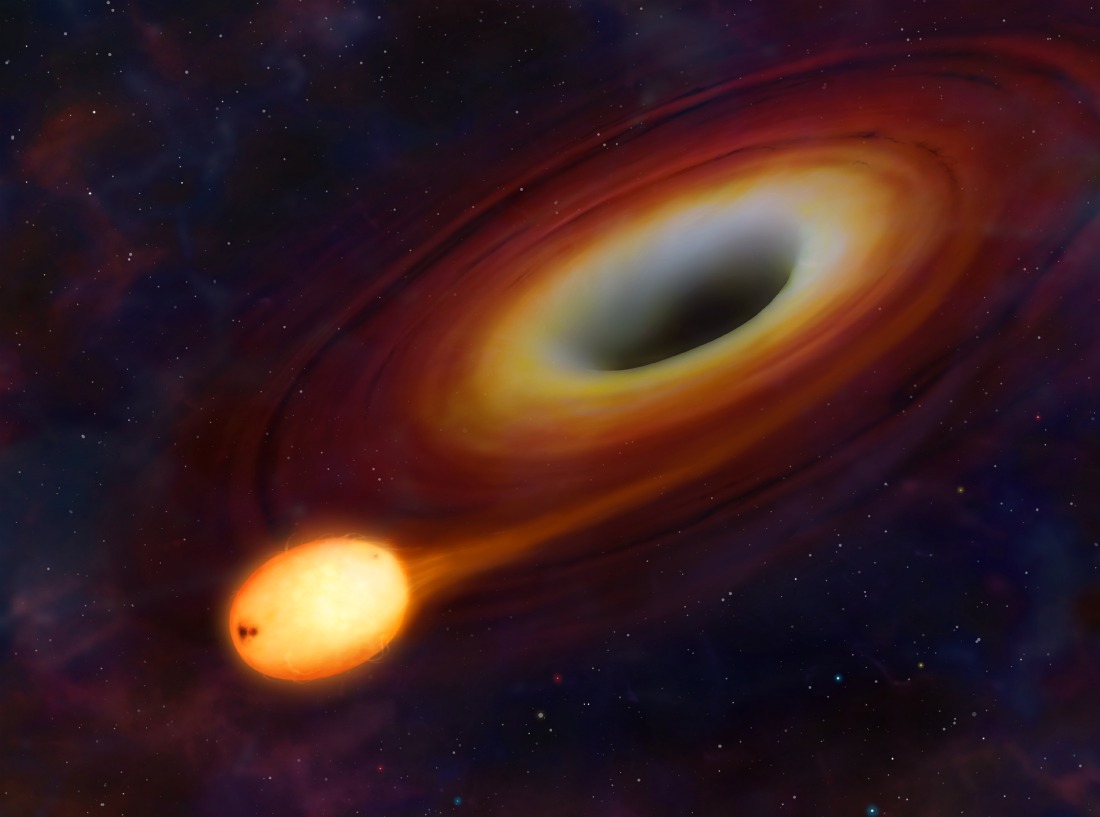
Another clue could come from accretion, the process of matter falling into the black hole. If the black hole passed through regions with gas or dust—perhaps near the Sun’s outer atmosphere or in the dense plane of the Solar System—it might pull in material. As that material spiraled inward, it would heat up and emit X-rays and other radiation.
However, the Solar System is relatively empty compared to the gas-rich environments near galactic centers. A black hole passing through might remain mostly “quiet,” consuming very little.
The terrifying reality is that the most dangerous black hole could be almost completely invisible, announcing itself only through gravitational disruption.
Would the Black Hole Swallow the Sun?
This is the first catastrophic image most people imagine: a black hole approaching the Sun, devouring it like a cosmic predator. Could that happen?
Yes, but only under specific circumstances.
Whether the Sun would be swallowed depends on how close the black hole passes and how massive it is. If a stellar-mass black hole—say, ten times the mass of the Sun—passed near the Sun, the Sun would feel a powerful gravitational pull. The Sun itself could be dragged into a new orbit around the black hole, or the two objects could become gravitationally bound in a chaotic dance.
If the black hole passed extremely close, it could pull matter away from the Sun, stripping gas from its outer layers. The Sun would not be instantly consumed, but it could lose mass in a violent tidal interaction. Some of that gas might spiral into the black hole, producing intense radiation.
If the black hole actually collided with the Sun, the Sun could be partially swallowed. But even then, “swallowed” does not mean instant disappearance. The black hole would pass through the Sun, accreting matter as it went. A stellar-mass black hole is tiny in physical size compared to the Sun, even though its mass is enormous. The event horizon of a ten-solar-mass black hole is only about 30 kilometers across.
That means the black hole could travel through the Sun like a bullet through fog, consuming some material but not immediately destroying the entire star. The real destruction would come from the gravitational disruption, heating, and shockwaves triggered by the passage.
Still, if a black hole became trapped inside the Sun, repeatedly passing through its interior, the Sun’s structure could be destabilized. Over time, the Sun could lose significant mass or even be torn apart.
But such a direct hit is extremely unlikely. The Solar System is vast, and the Sun occupies only a tiny region of it. A passing black hole would be far more likely to fly through without directly striking the Sun.
Yet even without swallowing the Sun, it could still cause catastrophe.
What Would Happen to Earth’s Orbit?
Earth’s survival depends on orbital stability. We exist in a narrow band around the Sun where temperatures allow liquid water. If Earth’s orbit changed significantly, the planet could freeze, burn, or become geologically unstable.
If a black hole passed through the Solar System, Earth could experience one of several outcomes depending on the black hole’s trajectory and distance.
If the black hole passed far away, perhaps beyond Neptune, Earth might barely notice. The effects would be limited to distant comets and minor orbital disturbances.
If it passed within the inner Solar System, Earth’s orbit could be altered. The black hole’s gravity could tug Earth into a slightly different path. Even a small shift in orbital distance could change climate over time. A larger shift could push Earth into a radically different environment.
In a more extreme scenario, Earth could be ejected from the Solar System entirely. If the black hole passed close enough and at the right speed, it could give Earth a gravitational slingshot effect, accelerating it to escape velocity. Earth would become a rogue planet, drifting through interstellar space with no Sun.
This is one of the darkest possibilities. Earth would not explode. It would not be swallowed. It would simply be thrown away, like a stone kicked out of a cosmic garden.
Without the Sun, the surface would rapidly cool. Oceans would freeze. The atmosphere might partially collapse. Life would retreat underground or near geothermal vents, where Earth’s internal heat could provide limited energy.
Civilization, dependent on sunlight and agriculture, would likely collapse within years. Humanity might survive temporarily in artificial habitats, but the long-term prospects would be grim.
The planet would not be destroyed, but it would become a wandering frozen world.
Could Earth Be Pulled Into the Black Hole?
Yes, but this would require an extremely close encounter.
If the black hole passed near Earth, the gravitational attraction could draw Earth into a new orbit around the black hole. Depending on the speed and direction, Earth might spiral inward over time.
But a direct capture would be rare. Black holes are not like magnets pulling everything in from a distance. Earth would only fall into it if its trajectory brought it close enough for gravity to dominate.
However, if Earth did pass dangerously close, a far worse effect would occur before the planet ever reached the event horizon.
That effect is tidal force.
Spaghettification: The Tidal Destruction of a Planet
Black holes produce extreme tidal forces. Tidal forces occur because gravity is stronger closer to the black hole and weaker farther away. This difference can stretch objects dramatically.
Near a black hole, tidal forces can become so intense that they tear apart stars and planets. This process is sometimes called spaghettification, because objects are stretched into long, thin streams.
If Earth passed close enough to a stellar-mass black hole, the planet would begin to deform. The side closer to the black hole would be pulled more strongly than the far side. The crust would crack. The oceans would surge into towering waves. Earthquakes would shake the entire planet. Volcanoes could erupt as the mantle is disturbed.
As Earth approached further, the stretching could exceed the planet’s structural strength. The planet could be torn apart, broken into fragments that would form a ring of debris around the black hole. That debris would heat up due to collisions and friction, glowing like a disk of molten rock and vapor.
This would be the true end of Earth as a planet.
But again, it would require an extremely close pass. The black hole would have to come far closer than the distance between Earth and the Sun. If it did, the Solar System would already be in chaos long before Earth reached this fate.
What Would Happen to the Moon?
The Moon is gravitationally bound to Earth. If Earth’s orbit were disturbed, the Moon’s orbit would also be affected. In a close encounter with a black hole, the Moon might be stripped away from Earth.
The Moon could be flung into a separate orbit around the Sun, or it could be ejected into space. It could even collide with Earth if gravitational forces destabilized its orbit.
A Moon collision would be catastrophic. The impact energy would be enough to melt much of Earth’s crust, vaporize oceans, and potentially reset the planet’s surface environment. Ironically, Earth’s Moon is thought to have formed from a massive collision early in Earth’s history. A black hole encounter could potentially trigger another such event, but it would be a violent end rather than a creative beginning.
If Earth were ejected from the Solar System, the Moon might follow—or it might be left behind. The Earth-Moon system could be torn apart like a thread snapped under tension.
The Fate of the Other Planets
The Solar System is a gravitational ecosystem. Each planet influences the others, especially the massive gas giants like Jupiter and Saturn. A black hole passing through would disrupt this balance.
Jupiter, the most massive planet, would play a major role in how the Solar System responds. Jupiter’s gravity dominates the orbits of many asteroids and comets. If Jupiter’s orbit were altered, the entire architecture of the Solar System could shift.
A black hole passing near Jupiter could sling Jupiter into a new orbit or eject it entirely. If Jupiter moved inward, it could destabilize the inner planets, potentially sending asteroids and comets into Earth-crossing trajectories. If Jupiter moved outward, the asteroid belt might shift, and the pattern of impacts in the inner Solar System could change.
Saturn, Uranus, and Neptune could also be displaced or ejected. Some planets might end up orbiting the black hole instead of the Sun. Others might be thrown into interstellar space.
In extreme cases, the Solar System could be dismantled entirely, its planets scattered like marbles struck by a speeding cannonball.
The Sun might remain, but it would be surrounded by emptiness.
The Oort Cloud: A Delayed Catastrophe
Even if the black hole passed through the Solar System without directly affecting the inner planets, it could still trigger disaster centuries or millennia later.
The Oort Cloud is a vast spherical shell of icy bodies extending tens of thousands of astronomical units from the Sun. These objects are the source of many long-period comets. Their orbits are extremely fragile, disturbed by passing stars and gravitational tides from the Milky Way.
A black hole passing through the outer Solar System would strongly disturb the Oort Cloud, sending countless comets inward. This would not happen instantly. It would unfold over thousands or even millions of years, as comets slowly fall toward the inner Solar System.
The result could be a prolonged period of increased comet impacts, potentially raising the risk of civilization-ending collisions. Earth might face repeated bombardments, similar to the chaotic early era of the Solar System when impacts were frequent.
This is one of the most chilling aspects of the black hole scenario: the danger might not end when the black hole leaves. It could plant a time bomb in the distant icy outskirts of our system, ensuring that destruction continues long after the visitor has passed.
Would We Feel the Black Hole’s Gravity on Earth?
If the black hole passed close enough, the gravitational effects would be noticeable even before any orbital changes became obvious.
Earth’s tides could be altered. The Moon causes tides because its gravity pulls more strongly on the side of Earth facing it. A black hole passing closer than the Moon would create tidal forces far stronger than anything Earth has ever experienced.
The oceans could rise and fall violently. Coastal regions could be devastated. The stresses on Earth’s crust could trigger earthquakes on a global scale. The planet might become geologically unstable for years.
Even if the black hole never approached Earth directly, its influence on the Sun and other planets could still produce subtle but dangerous effects. Orbital resonances could shift. Gravitational interactions could cascade through the Solar System.
The Solar System is stable because it has been stable for billions of years. But stability is not indestructibility. A single massive intruder could break the pattern.
Could a Black Hole Destroy the Sun’s Planets Without Touching Them?
Yes, and this is perhaps the most scientifically realistic catastrophic scenario.
A black hole does not need to swallow planets to destroy them. It only needs to disturb their orbits enough to trigger collisions or ejections.
If Earth’s orbit were shifted inward, it could collide with Venus or Mercury. If shifted outward, it could intersect Mars. If the orbits of multiple planets were destabilized, collisions could occur throughout the Solar System.
Such collisions would release unimaginable energy. A collision between Earth and another planet would likely vaporize oceans, melt the crust, and throw debris into space. It would be an extinction event far beyond anything in recorded history.
Even without collisions, planets could be thrown into eccentric orbits, leading to extreme seasonal changes, unstable climates, and long-term environmental collapse.
The black hole could leave, but the Solar System would remain broken.
Would Earth Go Dark?
If Earth survived physically but was ejected from the Solar System, then yes—Earth would effectively go dark.
The Sun provides almost all the energy that drives life and climate. Without sunlight, the surface temperature would drop rapidly. Within days, the upper atmosphere would cool. Within months, much of the surface would become frozen. Within a few years, the oceans could freeze over, forming a thick shell of ice.
There would still be some heat. Earth’s core would remain hot. Radioactive decay in the mantle would continue producing geothermal energy. Deep beneath the surface, near hydrothermal vents, some ecosystems could survive, similar to those in Earth’s deep oceans today.
But the world of forests, oceans open to the sky, agriculture, and sunlight-based ecosystems would vanish.
Civilization would not survive such a transition without extraordinary preparation. Humanity would face a brutal test of engineering and social stability. Food production would collapse. Most species would go extinct. The planet would become a cold wandering sphere, carrying only faint traces of life in its hidden depths.
In that sense, Earth would not merely go dark—it would become a cosmic orphan.
What About a Small Black Hole?
Not all black holes are equal. The scenario changes dramatically depending on the black hole’s mass.
A stellar-mass black hole, perhaps 5 to 20 times the mass of the Sun, would be devastating if it passed close enough. Its gravity could strongly disrupt planetary orbits.
But what if the black hole were much smaller? A hypothetical primordial black hole could have the mass of an asteroid, a mountain, or even less. Such a black hole would have far weaker gravitational influence at a distance.
If a small black hole passed through the Solar System, it might not disturb planetary orbits much. But if it passed through Earth itself, it could cause severe local damage.
A tiny black hole passing through Earth would still have enormous density. It would fall through the planet, consuming a small amount of matter along its path and generating intense heat. It could create earthquakes, volcanic eruptions, and shockwaves. Depending on its mass, it could even punch through Earth like a bullet through fruit, leaving a trail of destruction.
However, if the black hole were truly tiny, it might pass through with minimal interaction, because the event horizon would be microscopic. It would not “eat” Earth in the dramatic way people imagine. It would simply pass through and continue on its path.
The most dangerous black holes are not necessarily the smallest ones. The greatest threat comes from massive black holes that can reshape the gravitational structure of the Solar System.
Would We Have Warning?
This depends on how fast the black hole is moving and how well we are observing space.
If a black hole were drifting through the galaxy at typical stellar speeds, it could approach over thousands or tens of thousands of years. But we might not detect it until much later because it emits little to no light.
Still, modern astronomy is increasingly capable of detecting gravitational anomalies. If a black hole entered the outer Solar System, we might notice unexpected orbital disturbances long before it reached the inner planets. Gravitational lensing surveys might also reveal its presence.
If it were moving unusually fast, our warning time could shrink. But even then, as it approached, its gravitational effects on distant objects could provide clues.
The harsh truth is that even with warning, there would be little we could do. We cannot push planets back into orbit. We cannot deflect a black hole. We could only observe, calculate, and prepare for the consequences.
The most advanced civilization would still be helpless against such a visitor.
The True Scale of the Disaster
If a black hole passed through our Solar System at a safe distance, it might be an astronomical curiosity rather than a catastrophe. It could disturb comets, cause minor orbital shifts, and then disappear into interstellar space.
But if it passed within the region of the planets, the effects could be apocalyptic.
Orbits could destabilize. Planets could collide. Worlds could be ejected into darkness. The Sun itself could be disturbed, stripped of mass, or forced into a new gravitational relationship.
And even if Earth survived the immediate chaos, the long-term consequences could still be deadly. Comet storms could follow. Climate could shift. The Solar System could become a far more dangerous place for millions of years.
It would not be a single moment of destruction. It would be a chain reaction.
A black hole would not just destroy planets. It would destroy stability.
Why This Probably Won’t Happen
The good news is that the Solar System is not an easy target. Space is vast beyond comprehension. The distance between stars is measured in light-years. Even if the Milky Way contains millions of black holes, the odds of one passing close enough to cause catastrophic disruption are extraordinarily low.
Our Solar System has existed for about 4.6 billion years. In that time, it has survived countless cosmic events. It has orbited the galaxy many times. It has passed through spiral arms, encountered interstellar clouds, and endured asteroid bombardments. If black hole intrusions were common, the Solar System might not still be here.
This suggests that while black holes are real and powerful, the galaxy is not a constant battlefield of wandering gravitational destroyers. Most black holes remain far from us, silent and distant.
The universe is dangerous, but it is also statistically forgiving.
A Final Reflection: The Fragility of Our Cosmic Home
The thought of a black hole passing through our Solar System is unsettling because it reminds us how much our existence depends on stability. We live because Earth stays in its orbit. We thrive because sunlight arrives at the right intensity. Our entire history is built on a cosmic arrangement that could, in theory, be disrupted by forces far beyond human control.
A black hole would not be evil. It would not come with intent. It would simply be gravity in its purest, most extreme form, moving through space without emotion.
If it passed close enough, the Solar System would not explode in cinematic fire. Instead, it would unravel. The orbits that have held steady for billions of years could twist into chaos. Planets could be thrown outward. Collisions could reshape worlds. Earth might be ripped apart—or worse, it might survive only to drift forever in frozen darkness.
So what would happen if a black hole passed through our Solar System?
If it stayed far away, we might witness a strange gravitational event and survive.
If it came close, the Solar System could be permanently damaged.
And if it passed close enough to Earth, the planet could be destroyed, ejected, or transformed into a lifeless wandering world.
Earth would not necessarily be swallowed.
But the light we depend on—the light of the Sun, the stability of seasons, the predictable rhythm of life—could be lost.
And that would be the truest darkness of all.