For most of human history, oceans meant Earth’s oceans—vast, blue, life-filled expanses that shape climate, carve continents, and cradle evolution. But in the last few decades, planetary science has revealed something astonishing: Earth is not the only world with oceans. In fact, our solar system may be crowded with them.
These are not surface oceans glittering beneath open skies. They are hidden oceans—buried beneath kilometers of ice, locked inside dwarf planets, or concealed under frozen crusts orbiting distant giants. They are dark, pressurized, and sunless. If life exists within them, it would resemble Earth’s deep-sea ecosystems more than coral reefs. It would feed on chemistry, not sunlight. It would evolve in silence, beneath crushing pressure.
When we speak of “deep-sea monsters,” we do not mean fantasy beasts with glowing eyes and snapping jaws—though nature is capable of startling creativity. We mean something far more scientifically profound: large, complex, possibly multicellular organisms adapted to alien oceans, evolving independently from Earth’s life.
Could such organisms exist? Science does not yet know. But it does know that these ocean worlds possess liquid water, chemical energy, and long-term stability—key ingredients for biology.
Below are nine ocean worlds that might be hiding something extraordinary beneath their frozen shells.
1. Europa
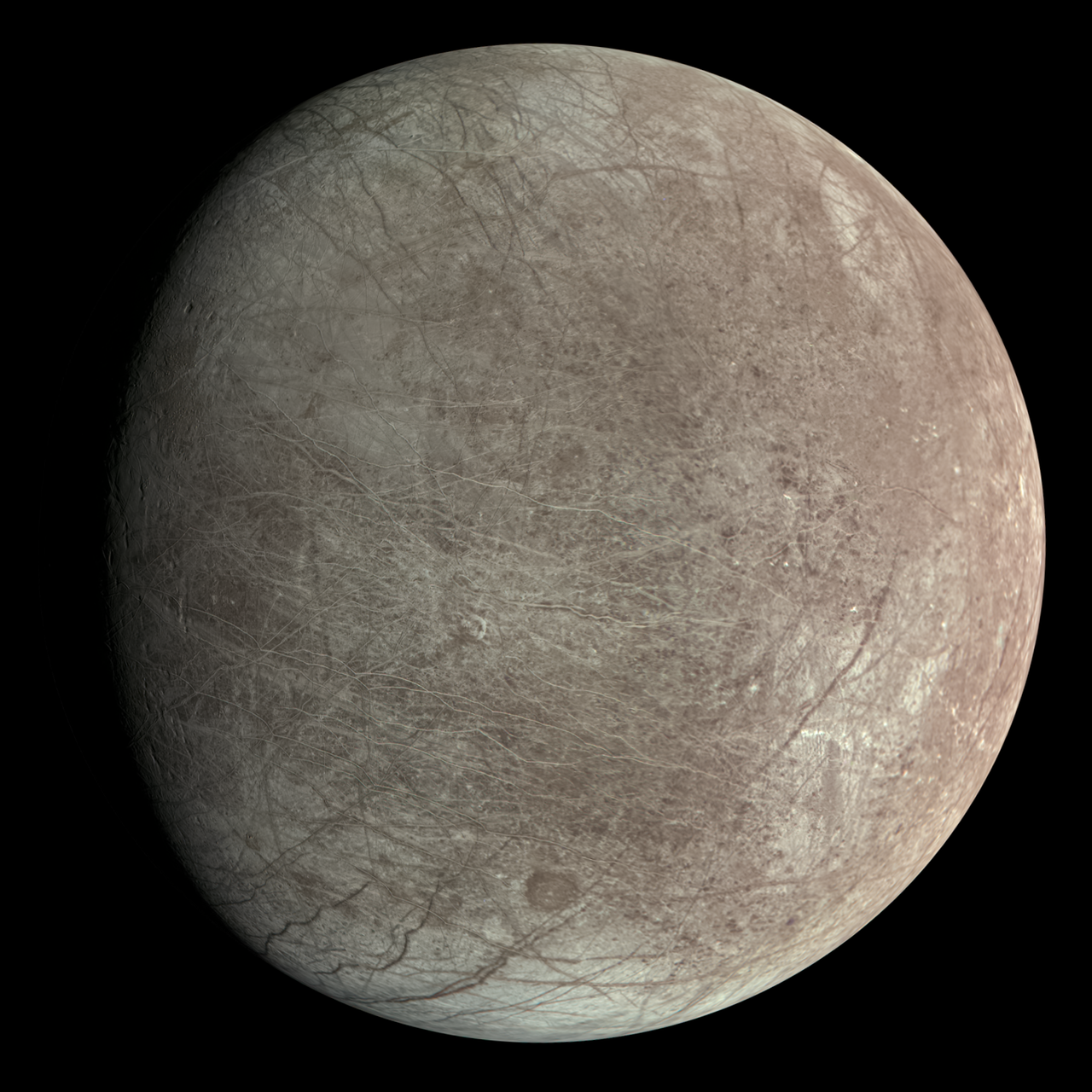
Among all ocean worlds, Europa stands as one of the most compelling. Orbiting Jupiter, Europa appears at first glance as a bright, smooth sphere crisscrossed by dark fractures. But beneath its icy crust lies a global ocean.
Strong gravitational tides from Jupiter stretch and squeeze Europa as it orbits, generating heat inside the moon. This tidal heating prevents the subsurface ocean from freezing solid, even though surface temperatures plunge far below freezing.
The ocean may be 100 kilometers deep—deeper than Earth’s oceans—and contain more total water than our planet. Beneath that ocean likely lies a rocky seafloor.
On Earth, where water meets rock at hydrothermal vents, life thrives without sunlight. Entire ecosystems cluster around these vents, supported by chemical reactions between water and minerals. If similar hydrothermal systems exist on Europa’s ocean floor, they could provide stable energy sources for life.
Could such an environment support complex organisms? Theoretically, yes—if life originated and had enough time to evolve. Europa is believed to have maintained its ocean for billions of years. That is a vast timescale for evolution.
Any Europan “deep-sea monster” would be adapted to darkness, pressure, and perhaps icy chemistry. It would navigate an ocean sealed beneath ice, in eternal night. It would not resemble terrestrial sea creatures exactly—but the possibility of something large and mobile swimming in Europa’s depths is not scientifically impossible.
Europa’s cracked ice shell may one day reveal whether anything moves below.
2. Enceladus
Enceladus, a small moon of Saturn, was once thought to be insignificant. Then spacecraft observed plumes erupting from its south pole—towering jets of water vapor and ice spraying into space.
These plumes originate from fractures in the ice crust. Beneath them lies a global subsurface ocean.
Analysis of plume material has revealed water, salts, simple and complex organic molecules, and molecular hydrogen—a chemical often associated with hydrothermal activity. The presence of hydrogen suggests that water is reacting with rock deep inside the moon, producing chemical energy.
On Earth, similar chemical reactions power ecosystems at hydrothermal vents. Microbes feed on hydrogen and other compounds, forming the base of food webs that include tube worms, crabs, and fish.
Enceladus is smaller than Europa, but its ocean appears to be in contact with a rocky core. That contact is critical. It allows water-rock chemistry that can generate energy gradients—essential for life.
If life exists in Enceladus’ ocean, it might begin as microbial. But if conditions remained stable over geological time, evolution could theoretically produce more complex organisms.
Any such creatures would live in a pitch-black ocean beneath ice perhaps tens of kilometers thick. They would rely on chemical energy rising from the seafloor. The geysers we observe might even carry traces of their existence into space.
Enceladus invites us to imagine alien ecosystems in miniature—quiet, self-contained, and hidden beneath frozen crust.
3. Titan
Titan is one of the most extraordinary worlds in the solar system. Larger than Mercury, Titan orbits Saturn and possesses a thick nitrogen atmosphere. On its surface lie rivers and lakes—but they are filled with liquid methane and ethane, not water.
Beneath Titan’s icy crust, however, evidence suggests a vast subsurface ocean of water mixed with ammonia. Ammonia lowers water’s freezing point, allowing the ocean to remain liquid at Titan’s cold temperatures.
Titan’s surface chemistry is complex. Sunlight interacting with atmospheric nitrogen and methane creates organic molecules that rain down to the surface. Some of these compounds may eventually sink through the ice crust or interact with the subsurface ocean.
If Titan’s ocean contacts a rocky interior, chemical reactions could provide energy similar to hydrothermal vents on Earth. The thick atmosphere protects Titan from radiation, offering long-term stability.
Could Titan harbor large, ocean-dwelling organisms? If life originated and evolved for billions of years, complexity might arise. However, Titan’s ocean may be separated from its rocky core by layers of high-pressure ice, potentially limiting energy exchange.
Still, Titan’s combination of water, organic chemistry, and geological time makes it one of the most intriguing candidates.
If something swims beneath Titan’s ice, it would inhabit one of the strangest seas in the solar system.
4. Ganymede
Ganymede, Jupiter’s largest moon, is the largest moon in the solar system—bigger even than Mercury. Unlike most moons, Ganymede has its own magnetic field, suggesting a dynamic interior.
Measurements indicate that Ganymede likely contains multiple subsurface ocean layers trapped between ice layers. The total volume of water may exceed Earth’s oceans.
The challenge for habitability is whether these oceans are in direct contact with rock. If thick ice layers separate liquid water from the rocky mantle, chemical energy may be limited. However, some models suggest that deeper ocean layers could interact with rock.
If energy sources exist, Ganymede’s ocean could host life. The immense scale of its ocean leaves room for complex ecological systems—if the necessary ingredients are present.
Any hypothetical organisms would navigate a layered ocean world, possibly adapted to varying salinity and pressure. The idea of large, blind creatures drifting through Ganymede’s hidden seas stretches imagination—but does not violate physics.
5. Callisto
Callisto, another moon of Jupiter, appears ancient and heavily cratered. It lacks the dramatic surface features of Europa. Yet beneath its battered exterior, magnetic data suggest a subsurface ocean.
Callisto experiences less tidal heating than Europa, but radioactive decay in its interior could maintain liquid water below the ice shell.
The potential limitation is energy. If the ocean is isolated from the rocky core, chemical gradients may be weak. Still, even limited energy can support microbial life in extreme environments.
If life did take hold and persist over billions of years, evolution could operate slowly in stable conditions. The idea of deep-sea organisms in Callisto’s dark ocean is speculative—but scientifically within the realm of possibility.
Callisto reminds us that quiet worlds may hide profound secrets.
6. Triton
Triton, Neptune’s largest moon, is geologically active despite its great distance from the Sun. It has geysers that erupt nitrogen gas and dark material onto its icy surface.
Triton likely formed elsewhere in the solar system and was captured by Neptune’s gravity. This capture would have generated intense tidal heating in its past, potentially creating a subsurface ocean.
Some models suggest that an ocean could still exist beneath Triton’s frozen crust, sustained by residual heat and radioactive decay.
If Triton’s ocean is in contact with rock, it could provide energy sources similar to other ocean worlds. Though sunlight is weak at Neptune’s distance, life in subsurface oceans does not depend on sunlight.
Triton’s unusual history makes it especially intriguing. If it formed in a different region and later migrated, it may carry a unique chemical signature.
In the deep, cold reaches of the solar system, Triton may conceal an ancient ocean.
7. Pluto
Once considered merely a frozen relic at the solar system’s edge, Pluto surprised scientists when spacecraft revealed signs of geological activity. Its heart-shaped region, Sputnik Planitia, appears to be a basin filled with nitrogen ice—but its behavior suggests internal heat.
Models indicate that Pluto may possess a subsurface ocean insulated by a thick ice shell. The presence of ammonia in surface ices supports the possibility of a liquid layer below.
Despite its distance from the Sun, Pluto’s interior may retain heat from radioactive decay. If liquid water persists beneath the crust, chemical interactions with rock could provide energy.
The idea of deep-sea organisms beneath Pluto’s icy plains feels almost poetic—a hidden ocean beneath a distant dwarf planet. While evidence for life remains entirely speculative, the existence of a subsurface ocean is scientifically plausible.
Pluto teaches us that even the coldest worlds may not be entirely frozen within.
8. Ceres
Ceres, the largest object in the asteroid belt, is a dwarf planet that once appeared unremarkable. But bright salt deposits and evidence of cryovolcanism revealed a more dynamic interior.
Data suggest that Ceres once hosted a subsurface ocean and may still contain pockets of briny liquid water beneath its crust. Organic molecules have been detected on its surface.
If briny reservoirs remain liquid today, they could provide microhabitats where life might survive. The small size of Ceres means its ocean would be limited compared to Europa or Enceladus—but size does not preclude habitability.
While the idea of large “monsters” in Ceres’ ocean is less likely given its scale, microbial ecosystems are within scientific consideration.
Even in the asteroid belt, ocean worlds may have briefly flourished.
9. Dione
Dione, another moon of Saturn, shows evidence of tectonic fractures and possible subsurface activity. Gravity measurements suggest that it may contain a subsurface ocean beneath its icy shell.
Though less studied than Enceladus or Titan, Dione’s internal structure indicates that liquid water may exist at depth.
If so, Dione joins the growing list of ocean-bearing moons orbiting the gas giants. Each additional ocean world increases the probability that life could arise somewhere in our solar system.
Should energy sources and chemical gradients exist within Dione’s ocean, even this relatively overlooked moon might harbor hidden ecosystems.
The silent satellites of Saturn may conceal more than we imagine.
The Reality of Deep-Sea Life Beyond Earth
The phrase “deep-sea monsters” stirs the imagination, but scientific caution is essential. We have not yet detected life beyond Earth—not even microbial life. The existence of large, complex organisms in alien oceans remains hypothetical.
Yet on Earth, life has demonstrated astonishing adaptability. Organisms thrive in crushing pressures at the bottom of our oceans, in boiling hydrothermal vents, in acidic pools, and beneath Antarctic ice.
If similar energy sources and chemical conditions exist in extraterrestrial oceans—and evidence suggests they might—then life is not implausible.
Complex life requires long-term stability, abundant energy, and evolutionary time. Some ocean worlds, such as Europa and Enceladus, may have maintained liquid oceans for billions of years. That is time enough for evolution to experiment.
If alien oceans harbor life, it may begin with microbes. But over immense timescales, ecosystems could diversify. The resulting organisms would not resemble Earth’s fish or whales—but they might swim, feed, and interact within their dark seas.
The Expanding Map of Habitability
The discovery of ocean worlds has transformed planetary science. Habitability is no longer confined to the “Goldilocks zone” where sunlight warms a planet’s surface. Tidal heating, radioactive decay, and chemical reactions can sustain liquid water far from the Sun.
Our solar system may contain more liquid water beneath ice than exists in all of Earth’s oceans combined.
The question is no longer whether water exists beyond Earth. It does. The question is whether biology followed.
Each of these nine ocean worlds offers a laboratory for studying life’s potential. Missions are being planned and launched to explore them. Instruments will search for biosignatures—chemical fingerprints of life.
One day, perhaps within this century, a spacecraft may sample the plume of Enceladus or drill into Europa’s ice and detect something unmistakable.
A cell. A chemical pattern. A movement in the dark.
If that day comes, the idea of deep-sea monsters will no longer belong solely to imagination. It will belong to biology—alien, ancient, and hidden beneath the frozen skins of distant worlds.
Until then, the oceans beyond Earth remain silent. But they are no longer invisible. And somewhere, in those vast and hidden seas, possibility waits.