Red supergiants are among the most awe-inspiring and emotionally charged objects in the cosmos. They are colossal, luminous, and unstable, glowing like cosmic embers at the edge of extinction. These stars represent one of the final chapters in the lives of the most massive stars ever born, stars so large that their deaths reshape galaxies and seed the universe with the elements needed for planets, oceans, and life itself. To understand red supergiants is to witness stellar life at its most dramatic and fragile, where creation and destruction are inseparably intertwined.
When astronomers look at a red supergiant, they are not merely observing a star. They are watching a moment of cosmic transition, a brief and turbulent phase in a star’s life when time is running out. These stars burn with a quiet intensity, their surfaces bloated and cool, their cores raging with nuclear reactions. They are massive beyond imagination, yet precariously balanced, like giants standing on the edge of a cosmic cliff.
The Birth of a Giant Star
The story of a red supergiant begins long before it turns red or enormous. It starts in vast clouds of gas and dust drifting through galaxies, cold and dark, barely noticeable against the blackness of space. Within these molecular clouds, gravity slowly gathers material into denser regions. When enough gas accumulates, the pressure and temperature at the center rise until nuclear fusion ignites. A star is born.
Only the most massive of these newborn stars are destined to become red supergiants. Their initial masses are typically many times that of the Sun. This excess mass is the key to their dramatic future. Massive stars live fast and burn fiercely, consuming their nuclear fuel at an astonishing rate. From the moment they ignite, they are locked into a race against time.
In their youth, these stars shine as hot, blue stars on the main sequence, fusing hydrogen into helium in their cores. Their enormous mass creates immense gravitational pressure, driving nuclear reactions at a furious pace. The light they emit is intense, bathing surrounding space in radiation that sculpts nebulae and influences the birth of other stars. Yet even in this early stage, the seeds of their eventual transformation are already present.
Leaving the Main Sequence
As hydrogen in the core is gradually exhausted, the delicate balance between gravity and outward pressure begins to shift. Fusion slows in the core, reducing the energy pushing outward against gravity. The core starts to contract, growing hotter and denser, while the outer layers respond in a dramatic way. They expand.
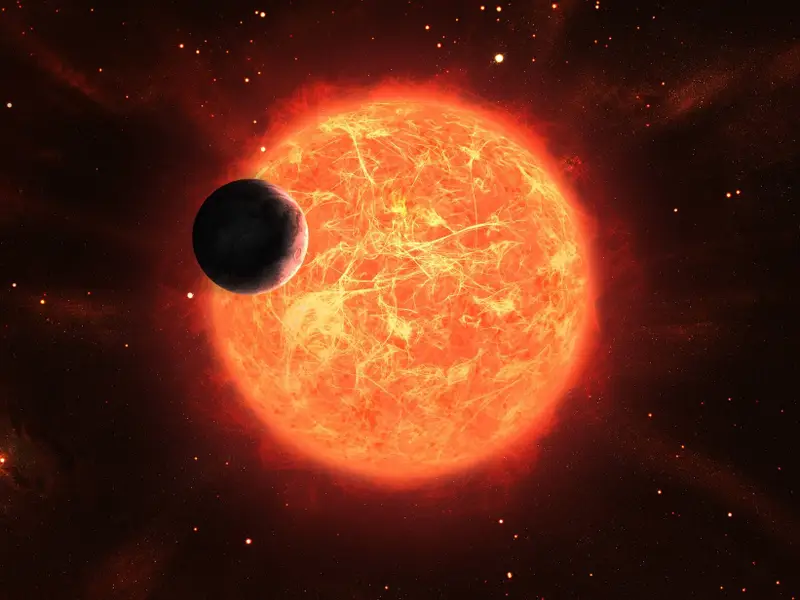
This expansion marks the star’s departure from the main sequence and the beginning of its transformation into a red supergiant. As the outer layers swell, the star’s surface temperature drops, causing its color to shift toward red. The star becomes enormous, often expanding to hundreds or even over a thousand times the radius of the Sun.
Despite their cooler surfaces, red supergiants are extraordinarily luminous. Their sheer size means they radiate immense amounts of energy, even though each square meter of their surface emits less heat than a smaller, hotter star. From a distance, they glow like smoldering coals, immense and quietly powerful.
The Anatomy of a Red Supergiant
Inside a red supergiant, the structure of the star becomes layered, almost like an onion. The core continues to contract and heat up, igniting new stages of nuclear fusion. Helium fuses into carbon and oxygen, then carbon into heavier elements, progressing through increasingly complex reactions.
Each new stage of fusion produces energy that temporarily supports the star against gravitational collapse, but each stage also consumes fuel more quickly than the last. While hydrogen fusion can last millions of years, the later stages occur on much shorter timescales. The star’s core becomes a furnace of extreme temperatures and pressures, while the outer layers grow unstable and turbulent.
The surface of a red supergiant is anything but calm. Massive convection cells churn within the star, carrying energy outward in enormous, slow-moving currents. These convective motions can cause the star’s brightness to vary and its surface to appear mottled and uneven. The atmosphere of a red supergiant is extended and tenuous, with gas drifting far from the star before escaping entirely.
Colossal Size and Fragile Stability
The sheer scale of red supergiants defies ordinary imagination. If one were placed at the center of our solar system, its outer atmosphere could engulf the orbits of the inner planets and extend well beyond. Yet despite their size, these stars are surprisingly fragile. Their outer layers are only loosely bound by gravity, making them prone to violent mass loss.
Powerful stellar winds flow outward from red supergiants, carrying vast quantities of material into space. Over time, these winds can strip away a significant fraction of the star’s mass. The surrounding region becomes enriched with gas and dust, forming complex nebulae that glow faintly in the light of the star.
This mass loss plays a crucial role in the star’s fate. By shedding material, the star alters its internal structure and influences how its final collapse will unfold. The material lost during this phase does not vanish; it becomes part of the interstellar medium, contributing to the formation of future stars and planets.
A Brief and Turbulent Phase
Although red supergiants appear ancient and slow-moving, their existence is fleeting on cosmic timescales. This phase may last only a few hundred thousand years, a blink of an eye compared to the millions or billions of years of smaller stars. The brevity of this stage adds to its poignancy. When we observe a red supergiant, we are catching it in a rare and transient moment.
During this time, the star teeters on the edge of catastrophe. The balance between fusion and gravity grows increasingly unstable as heavier elements accumulate in the core. Iron eventually forms, and this marks the beginning of the end. Iron fusion does not release energy; instead, it consumes it. Once an iron core develops, the star can no longer support itself through nuclear reactions.
The Approach of Death
As the iron core grows, it reaches a critical mass beyond which it cannot withstand gravity. The core collapses in a fraction of a second, falling inward at a significant fraction of the speed of light. This sudden collapse triggers one of the most violent events in the universe: a core-collapse supernova.
The collapse halts abruptly when the core becomes incredibly dense, forming a neutron star or, in some cases, a black hole. The rebounding shock wave, combined with intense neutrino emissions, blasts the star’s outer layers into space. For a brief moment, the explosion can outshine an entire galaxy.
The red supergiant is destroyed, but its death is also an act of creation. The supernova synthesizes heavy elements such as gold, uranium, and many others, scattering them across space. These elements become the raw material for new stars, planets, and eventually living beings. In this way, the dying gasps of a red supergiant help shape the future of the universe.
Famous Red Supergiants in the Night Sky
Some red supergiants are visible to the naked eye, their immense luminosity allowing them to be seen across vast distances. One of the most famous is Betelgeuse, a bright red star marking the shoulder of the constellation Orion. Betelgeuse has captured the imagination of astronomers and the public alike, especially as its brightness has varied noticeably in recent years.
Observing such stars is an exercise in cosmic patience. Astronomers know that Betelgeuse will eventually explode as a supernova, but “eventually” could mean tomorrow or tens of thousands of years from now. This uncertainty underscores the unpredictability of stellar evolution and reminds us of the immense timescales involved.
These nearby red supergiants offer invaluable opportunities to study the late stages of massive stellar evolution. By analyzing their light, spectra, and surrounding material, scientists can probe the processes occurring deep within these stars, gaining insight into how massive stars live and die.
Red Supergiants and Galactic Ecology
Red supergiants play a vital role in the ecological cycle of galaxies. Their strong winds and eventual supernova explosions inject energy and material into the interstellar medium. This activity influences star formation by compressing nearby gas clouds or dispersing them, shaping the structure of galaxies over time.
The elements forged in red supergiants and released in supernovae are essential for the chemistry of the universe. Carbon, oxygen, and other heavy elements are necessary for rocky planets and organic molecules. Without generations of massive stars living and dying as red supergiants, the universe would be a far simpler and less hospitable place.
In this sense, red supergiants are both destroyers and benefactors. Their violent ends may seem catastrophic, but they are part of a larger cycle that makes complexity possible. The atoms in our bodies were once inside stars like these, forged in nuclear furnaces and scattered across space by explosions long before Earth existed.
The Emotional Weight of Stellar Death
There is something profoundly moving about red supergiants. They embody impermanence on a cosmic scale, reminding us that even the largest and most powerful entities are subject to change and decay. Their immense size contrasts with their vulnerability, creating a sense of tragic grandeur.
When astronomers study red supergiants, they are not merely gathering data. They are confronting questions about time, mortality, and transformation. These stars challenge the human tendency to think in static terms, showing instead a universe in constant motion, where endings are inseparable from beginnings.
The light from a red supergiant that reaches Earth today may have left the star thousands of years ago. In some cases, the star may already be gone, having exploded in a supernova whose light has not yet arrived. This delay adds a haunting dimension to our observations, as we look into a past that no longer exists.
Modern Research and Unanswered Questions
Despite decades of study, red supergiants still hold many mysteries. Astronomers continue to investigate how mass loss occurs, what determines the exact timing of a supernova, and why stars of similar mass can follow different evolutionary paths. Advances in telescopes and computational models are shedding new light on these questions, but the complexity of these stars ensures that surprises remain.
Observations across multiple wavelengths, from visible light to infrared and radio waves, reveal different aspects of red supergiants and their environments. Infrared observations are particularly important, as they can penetrate the dust surrounding these stars, providing a clearer view of their extended atmospheres and winds.
As technology improves, astronomers are beginning to resolve the surfaces of nearby red supergiants, mapping their convective patterns and tracking changes over time. These detailed studies are bringing us closer to understanding the final stages of massive stellar evolution.
Red Supergiants in the Broader Cosmic Story
Red supergiants occupy a unique place in the grand narrative of the universe. They are both endpoints and transition points, linking the birth of stars to the creation of elements and the shaping of galaxies. Their lives illustrate the dynamic nature of the cosmos, where stability is temporary and change is fundamental.
By studying red supergiants, we gain insight into the forces that have shaped the universe over billions of years. We learn how matter cycles through different forms, how energy drives transformation, and how complex structures arise from simple physical laws. These insights extend beyond astronomy, influencing our understanding of physics, chemistry, and even biology.
The Legacy of the Universe’s Giants
When a red supergiant finally explodes, its light may briefly dominate the sky, announcing the death of a star that has existed for millions of years. Long after the light fades, its legacy endures in the enriched gas drifting through space and in the new generations of stars and planets that form from that material.
In a very real sense, red supergiants are ancestors. They are part of the lineage that made the universe as we know it possible. Their dying gasps echo through cosmic history, shaping the conditions that allow life to emerge and evolve.
To contemplate red supergiants is to confront both the vastness of the universe and our intimate connection to it. These colossal stars, burning brightly on borrowed time, remind us that destruction and creation are two sides of the same cosmic coin. In their final, spectacular acts, red supergiants affirm a profound truth of the universe: that from endings come beginnings, and from the ashes of giants, new worlds are born.