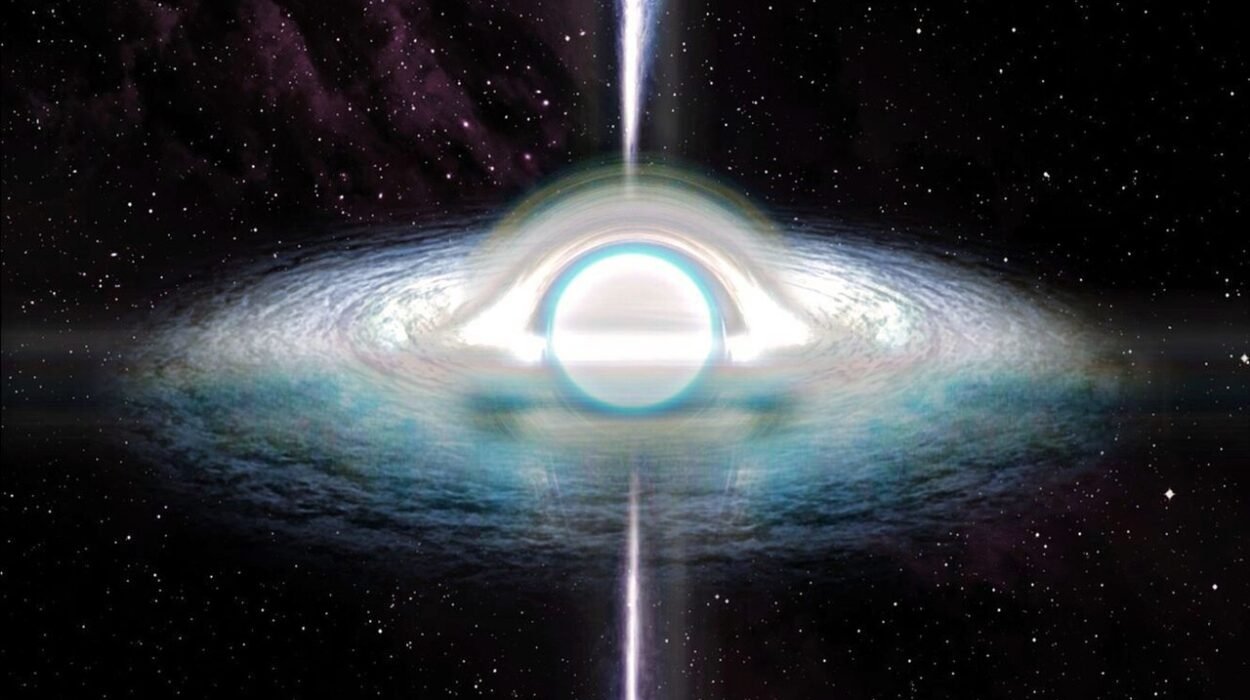
A black hole is one of the strangest objects the universe has ever produced. It is invisible, yet it can outshine entire galaxies by tearing apart stars. It is unimaginably dense, yet it is not a solid object in the usual sense. It is a region of space where gravity becomes so extreme that escape becomes impossible—not only for matter, but even for light.
But perhaps the most unsettling truth about black holes is not that they swallow stars or distort space. It is that they distort time itself.
Near a black hole, time slows down. It stretches. It becomes uneven, as if reality has been warped into a deep gravitational pit. The closer you get, the more time behaves like something physical—like a substance being pulled and dragged. At a certain boundary, time becomes so distorted that the future seems to narrow into a single unavoidable direction: inward.
This is why black holes feel like traps, not just for objects, but for time. They do not merely pull you in. They reshape the flow of time so that falling in becomes as inevitable as tomorrow.
To understand why this happens, we need to travel into one of the deepest ideas ever discovered: gravity is not just a force. Gravity is geometry. And black holes are the most extreme distortion of that geometry.
The Hidden Truth: Gravity Is Not What You Think It Is
Most people grow up imagining gravity as an invisible pulling force. Something like a cosmic magnet that attracts masses. That idea is close enough for everyday life, but it is not the full truth.
In Albert Einstein’s theory of general relativity, gravity is not treated as a force in the traditional sense. Instead, gravity is the curvature of spacetime itself.
Spacetime is the combined fabric of space and time, woven together into a four-dimensional structure. Matter and energy do not merely sit inside spacetime—they shape it. They bend it. And that bending determines how objects move.
A planet or star creates a dent in spacetime. Objects nearby follow paths through this curved geometry. What we experience as “gravity pulling downward” is actually our motion along the curved structure of spacetime.
This is why astronauts orbit Earth. They are not being pulled by a simple force in the Newtonian sense. They are following the natural curved paths—called geodesics—around a massive object that has warped spacetime.
Now imagine a dent so deep that spacetime collapses inward beyond a point of no return.
That is a black hole.
Why Time Is Part of the Trap
To understand why black holes bend time, we must accept something that feels deeply unnatural: time is not separate from space.
In everyday experience, space is something you can move through freely, but time moves in one direction no matter what you do. You can walk north or south, but you cannot walk into yesterday. Time feels like a constant background flow.
Einstein revealed that time is not an independent river. It is part of the same fabric as space, and it can be stretched and warped by gravity.
This means gravity does not only curve space. It curves time too.
The stronger the gravity, the more time slows down compared to regions of weaker gravity. This is called gravitational time dilation, and it has been confirmed through countless experiments.
Even on Earth, time moves slightly slower at sea level than it does on a mountain. The difference is tiny, but real. Atomic clocks placed at different altitudes tick at different rates because Earth’s gravity slightly warps spacetime.
If Earth can slow time by a small amount, imagine what a black hole can do.
A black hole does not just bend time a little. It bends time into a near standstill.
Gravitational Time Dilation: The Clock That Loses the Race
The simplest way to think about gravitational time dilation is to imagine two identical clocks.
One clock is far away from a black hole, where gravity is weak. The other clock is closer to the black hole, where gravity is stronger. To the distant observer, the clock near the black hole appears to tick more slowly.
This is not because the clock is malfunctioning. It is because time itself is running slower in that region.
If a person were standing near the black hole, they would not notice anything unusual about their own clock. Their heartbeat would feel normal. Their thoughts would seem to move at the usual pace. But compared to someone far away, their time would be slipping behind.
If they stayed near the black hole for a while and then returned, they could find that decades or centuries had passed for distant observers while only a few years passed for them.
This effect becomes extreme as you approach the event horizon—the boundary of a black hole.
Near the event horizon, time dilation becomes so intense that, from the viewpoint of a distant observer, the falling person appears to slow down, freeze, and fade away. Their clock seems to stop.
This is why black holes look like time traps from the outside. Objects appear to get stuck at the edge, never quite crossing.
But this is only part of the story. The truth becomes stranger.
The Event Horizon: The Boundary Where Escape Becomes Meaningless
The event horizon is often described as the surface of a black hole, but it is not a physical surface. It is not made of matter. It is a boundary in spacetime.
It marks the point where the gravitational pull becomes so intense that the escape velocity equals the speed of light.
Escape velocity is the speed you need to break free from an object’s gravity. For Earth, it is about 11.2 kilometers per second. For the Sun, it is about 617 kilometers per second.
For a black hole, the escape velocity at the event horizon is 299,792 kilometers per second—the speed of light.
And because nothing can travel faster than light, nothing inside the event horizon can escape. Not a rocket. Not a beam of light. Not a radio signal. Not even information, according to the classical interpretation of relativity.
This is why the event horizon is a point of no return. It is not just that escape is difficult. Escape is forbidden by the structure of spacetime.
But why does this make time behave like a trap?
Because at the event horizon, space and time begin to exchange roles in a horrifying way.
The Terrifying Geometry: Inside the Event Horizon, “Forward” Means Inward
Outside a black hole, you can choose where to go in space. You can move away from the black hole or toward it. Space has freedom.
Time, however, always moves forward.
Inside the event horizon, this changes.
In the mathematics of general relativity, the direction toward the black hole’s center becomes time-like. That means moving inward is no longer a spatial option. It becomes as inevitable as moving into the future.
Outside the horizon, you can choose to step toward the black hole or away from it. Inside the horizon, you cannot choose to avoid the center. Avoiding it would be like trying to avoid tomorrow.
This is what makes black holes such perfect traps. They do not simply “pull” you inward with force. They reshape spacetime so that all possible future paths lead inward.
In a normal region of space, you can always point your rocket in the opposite direction and try to escape. Inside a black hole, no matter where you point, the future is still toward the singularity.
Even light cannot avoid this fate. Light always moves at the speed of light through spacetime, but inside the horizon, all light rays still head inward. The geometry itself guides them like rails.
This is not a matter of weakness. It is the structure of reality.
The trap is not a wall. The trap is time.
Why Time Slows Near a Black Hole: The Cost of Climbing Out of Gravity
There is another way to understand why time slows down near massive objects, and it comes from the relationship between gravity and energy.
In relativity, gravity affects the flow of time because being deeper in a gravitational field means being in a region of lower gravitational potential. When light climbs out of gravity, it loses energy. This loss shows up as a shift in frequency, called gravitational redshift.
A beam of light emitted near a black hole is stretched as it escapes, shifting toward longer wavelengths. Its frequency decreases. Since frequency is tied to time—how many wave peaks pass per second—the slowing of frequency reflects the slowing of time.
This means that as you approach a black hole, any signal you send outward becomes increasingly redshifted and weakened. Your radio transmissions stretch and fade. Your light becomes dimmer and more delayed.
To an outside observer, your time appears to slow because every signal carrying information about your motion becomes stretched.
Eventually, near the event horizon, your signals become so redshifted that they disappear into darkness. It is as if time itself is being drained away.
This is why black holes appear black. Not only does light struggle to escape, but even the light that does escape becomes distorted beyond recognition.
The Distant Observer’s View: The Frozen Fall
One of the most famous images in black hole physics is the idea that a falling astronaut appears to freeze at the event horizon.
From the perspective of a distant observer, the astronaut never quite crosses. Their movement slows. Their clock slows. Their body seems suspended at the edge, growing dimmer and redder until it vanishes.
This is not an illusion caused by poor eyesight. It is a real consequence of how time works in strong gravity.
The distant observer measures time using their own clock far from the black hole. Compared to that clock, the falling astronaut’s clock ticks slower and slower. The closer the astronaut gets to the horizon, the slower their time appears to move.
In fact, mathematically, the astronaut takes an infinite amount of time to reach the horizon according to the distant observer.
This is deeply unsettling because it suggests that black holes never swallow anything, at least from the outside point of view. Everything gets stuck at the edge forever.
But the astronaut experiences something completely different.
The Falling Observer’s View: Crossing the Horizon Feels Normal
From the perspective of the astronaut falling toward the black hole, time feels normal. Their body does not freeze. Their watch ticks normally. Their thoughts continue.
They cross the event horizon in a finite amount of time. In many cases, if the black hole is large enough, they may not even notice the moment they pass the boundary.
This is because the event horizon is not a physical surface. It is not a glowing shell or a wall. It is a region where spacetime’s structure changes, but locally it can feel ordinary.
If the black hole is supermassive, like the one at the center of our galaxy, the tidal forces at the horizon might be weak enough that the astronaut is not immediately torn apart. They could pass through without being crushed at the boundary.
But once they cross, there is no going back. Every future path leads deeper inward.
The astronaut may have minutes or hours before reaching the center, depending on the black hole’s mass. But the ending is unavoidable.
And this is where the time trap becomes complete.
Spaghettification: When Gravity Tears You Apart
The closer you approach a black hole, the stronger the gravitational gradient becomes. Gravity is not the same strength everywhere. It is stronger closer to the mass.
If your feet are closer to the black hole than your head, gravity pulls more strongly on your feet. This difference stretches your body. The effect is called tidal force.
Near a small black hole, tidal forces near the event horizon are extreme. They can stretch you into a long thin shape like spaghetti, hence the term spaghettification.
Your body would be torn apart, molecule by molecule.
Near a supermassive black hole, tidal forces at the event horizon might be relatively gentle, but as you fall deeper, the tidal forces grow stronger. Eventually, no matter the black hole’s size, you are destroyed.
This is not just a dramatic physical death. It reflects the deeper truth that black holes are regions where the laws of physics become extreme.
And at the center lies the most mysterious concept of all.
The Singularity: Where Time Ends
According to general relativity, the center of a black hole contains a singularity, a point where density becomes infinite and spacetime curvature becomes infinite.
In such a place, the equations of relativity break down. Physics loses its ability to predict. The known laws of nature no longer make sense.
It is important to understand that singularities may not be literal physical points of infinite density. Many physicists believe that quantum gravity effects would prevent true infinity and replace the singularity with some unknown quantum structure. But until a complete theory of quantum gravity is confirmed, the singularity remains the predicted endpoint.
What is truly haunting is how time behaves in this region.
Inside the horizon, the singularity is not just a place in space. It is a moment in the future. Every object inside is moving toward it in time.
In that sense, the singularity is like the end of time itself for anything that falls in.
Once you cross the horizon, you do not have the option to remain safely inside forever. You do not have the option to orbit endlessly. The singularity is ahead of you in time.
Just as you cannot stop yourself from reaching tomorrow, you cannot stop yourself from reaching the center.
This is why black holes feel like time traps. They turn inward motion into destiny.
Why Can’t You Escape If You Have a Powerful Rocket?
It is tempting to imagine a futuristic spaceship with enormous engines capable of escaping anything. Surely, if you had enough power, you could fight your way out.
But a black hole is not like a planet with strong gravity. The problem is not that you lack fuel. The problem is that spacetime itself has been bent into a shape that makes escape impossible.
Outside the event horizon, escape is possible if you accelerate hard enough. Inside, no matter how hard you accelerate, you cannot change the fact that all possible paths through spacetime lead inward.
The reason is tied to the speed of light. To escape, you would need to travel faster than light relative to spacetime itself, not merely relative to other objects.
But relativity forbids that.
Inside the horizon, even light cannot escape. Since nothing can outrun light, nothing can escape.
A rocket does not break physics. It is trapped inside it.
Black Holes and the Flow of Time in the Universe
Black holes do not just slow time for objects near them. They reshape the way time is experienced in the universe.
If you were near a black hole and watching the outside universe, you would see distant time speeding up. Stars would evolve faster. The galaxy would appear to age rapidly. You might see thousands of years pass outside while only a short time passes for you.
This effect is real and is mathematically predicted by relativity.
It is also not limited to black holes. Any strong gravitational field causes time dilation. But black holes push it to the extreme, turning time into a distorted landscape.
In a way, black holes reveal the truth that time is not universal. There is no single clock ticking for the entire cosmos. Each region of spacetime has its own rhythm.
Black holes are like deep wells in that rhythm, where time slows almost to silence.
The Photon Sphere: Where Light Itself Can Orbit
Another mind-bending feature of black holes is the photon sphere, a region outside the event horizon where gravity is strong enough that light can orbit the black hole.
Normally, light travels in straight lines. But in curved spacetime, straight lines become curved paths. Near a black hole, spacetime is bent so sharply that light can follow circular orbits.
This does not happen because light is being “pulled” like a physical object. It happens because the geometry of spacetime is so curved that the natural path of light loops around.
This means a black hole does not just trap matter. It can trap light in unstable orbits. A slight disturbance can send the light either escaping outward or falling inward.
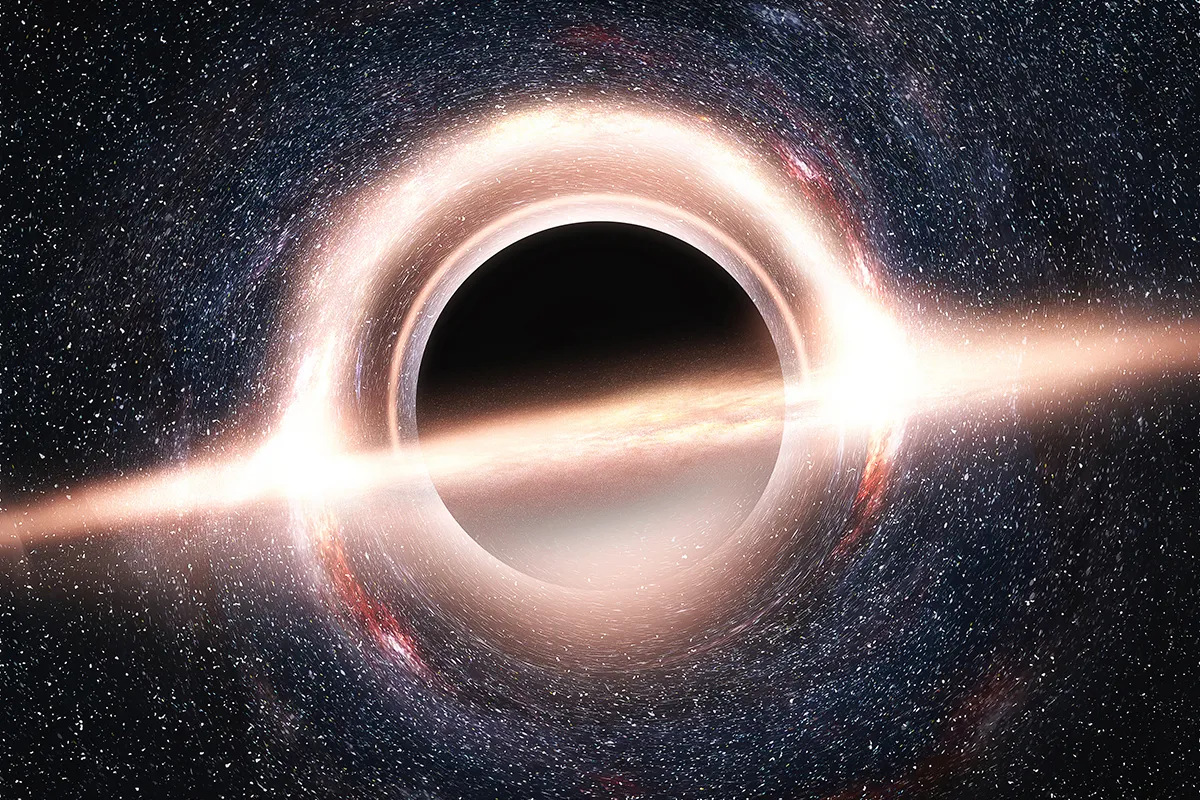
The photon sphere is part of why black holes create dramatic gravitational lensing effects. Light from background stars can be bent around the black hole, creating rings, arcs, and distorted images.
Even vision becomes unreliable near such an object, because the geometry of space itself is warped.
And if space is warped, time is warped too.
Time as a Physical Dimension: The Deeper Explanation
To truly grasp why black holes bend time, it helps to understand that in relativity, time behaves like a dimension, similar to the dimensions of space.
You can describe an event in the universe by giving its coordinates in spacetime: where it happened and when it happened. This means time is part of the coordinate system of reality.
When mass-energy is present, spacetime curves. That curvature affects all dimensions, including time.
This curvature changes the way objects move through spacetime. In relativity, everything is always moving through spacetime at a kind of combined speed. If you move faster through space, you move slower through time, and vice versa. This is why high-speed travel causes time dilation in special relativity.
In strong gravity, something similar happens: the structure of spacetime forces your trajectory to tilt toward the black hole’s center. As you get closer, the “time direction” becomes increasingly aligned with inward motion.
The closer you are, the more your future points inward.
That is not poetry. It is geometry.
Black holes bend time because time is woven into the fabric of spacetime, and black holes are the deepest curvature that fabric can take without tearing apart the universe.
The Illusion of the Trap Versus the Reality of the Trap
There is a subtle but important difference between how black holes trap objects and how they appear to trap them.
From far away, you see an object slow down and freeze at the event horizon. You might imagine it stuck there forever, trapped on the boundary.
But in the falling object’s own time, the crossing happens quickly. They pass through the horizon and continue inward.
This difference comes from the fact that different observers experience time differently in curved spacetime. The event horizon is a region where the gap between these perspectives becomes extreme.
So the trap is not a physical snare. It is a separation of realities.
The outside universe can never truly see what happens inside. Signals cannot escape. Information cannot return. The horizon creates a one-way division in spacetime.
It is not simply a place where objects disappear.
It is a place where the universe stops sharing its story.
Do Black Holes Actually “Stop Time”?
People often say time stops at the event horizon. This statement is partly true and partly misleading.
From the perspective of a distant observer, time appears to stop for an object approaching the horizon. The object’s clock seems to tick slower and slower, approaching a halt.
But from the object’s own perspective, time does not stop. Their clock ticks normally, and they cross the horizon without experiencing an infinite delay.
So time does not universally stop at the horizon. Instead, time becomes radically distorted between observers.
The deeper truth is that the event horizon is where spacetime becomes so warped that communication with the outside world becomes impossible. That is what makes the horizon feel like the end of time from the outside perspective.
In practice, it is the end of shared time.
Black Holes as Nature’s Ultimate Time Machines
Black holes are sometimes described as time machines because of their extreme time dilation. In theory, you could orbit a black hole and experience time passing slowly while the rest of the universe ages rapidly.
If you returned to Earth, you could find that centuries had passed. This is a kind of one-way time travel into the future.
However, this is not the science fiction version of time travel where you can visit the past. Black holes do not allow you to step backward in time. Relativity does contain solutions that involve closed time-like curves under exotic conditions, but those scenarios require unrealistic configurations such as negative energy densities or infinitely long rotating cylinders.
For real astrophysical black holes, the time effects allow future travel, not past travel.
Still, even the ability to “skip” centuries by lingering near a black hole is mind-blowing. It shows that time is not fixed. It can stretch and compress depending on gravity.
Black holes are proof that time is not absolute.
What Black Holes Teach Us About Reality
Black holes are not just cosmic monsters. They are laboratories for the laws of physics.
They test general relativity to its limits. They may hold clues about quantum gravity. They challenge our understanding of information, entropy, and the nature of reality itself.
One of the biggest unsolved puzzles in physics is the black hole information paradox. Quantum mechanics suggests that information cannot be destroyed, but classical black hole theory suggests that anything falling into a black hole is lost forever. This contradiction remains unresolved, though many theories propose that information is somehow encoded on the event horizon or released through Hawking radiation.
Hawking radiation itself is another astonishing concept: black holes may not be eternal. Quantum effects near the event horizon may cause them to slowly lose mass and evaporate over enormous spans of time.
This means black holes are not only time traps for objects. They may also be temporary structures in the long history of the universe, slowly dissolving into the background.
Even in their darkness, black holes are not static. They are part of the universe’s evolution.
Why the Trap Feels So Deeply Unfair
There is something psychologically disturbing about a black hole because it seems to violate our deepest instincts.
We are used to thinking of danger as something we can fight. Fire can be extinguished. A storm can be outrun. Even gravity can be escaped with enough speed, as rockets prove.
But a black hole feels like a betrayal of freedom. It is not merely strong gravity. It is a rewriting of the rules.
Once you cross the horizon, you are not just trapped in space. You are trapped in time. Your future has been bent into a direction you cannot avoid.
It is as if the universe has created a place where choice collapses.
That is why black holes inspire both fear and fascination. They are physical proof that reality can be shaped into forms far beyond ordinary experience.
The Final Answer: Why Do Black Holes Bend Time Like a Trap?
Black holes bend time like a trap because gravity is not simply a pulling force—it is the curvature of spacetime itself. When a massive object collapses into a black hole, it warps spacetime so extremely that time slows down near it, especially near the event horizon.
From the outside, this makes objects appear to freeze in time as they approach the boundary. From the inside, crossing the horizon happens normally, but the geometry of spacetime changes so drastically that moving toward the center becomes unavoidable. Inside the horizon, the direction inward is not just a path through space—it is the direction of the future.
That is the true trap.
A black hole does not simply pull you inward with strength. It bends spacetime so deeply that time itself points inward, forcing everything inside to fall toward the singularity as surely as every moment falls into the next.
Black holes are not just holes in space.
They are distortions of reality where time becomes a one-way road, and the future is a descent.
In the presence of a black hole, the universe reveals a terrifying truth: time is not a background stage. It is part of the structure of nature, and under extreme gravity, it can be bent into a cage.
And once you understand that, the darkness of a black hole no longer feels like emptiness.
It feels like gravity has captured time itself.