Black holes are among the most haunting creations of the universe. They are invisible, silent, and unimaginably powerful. They bend light, warp time, and swallow entire stars without leaving behind anything but darkness. In movies and science fiction novels, black holes are rarely treated as simple cosmic objects. They are depicted as gateways—portals to other galaxies, tunnels through space, or doorways into entirely different universes.
It is an irresistible idea. A black hole seems like the perfect entrance to the unknown: a place where the normal rules of reality collapse, where time stops making sense, and where the universe appears to hide its deepest secrets. Even the name itself sounds like a passageway. A “hole” suggests an opening. A “black” one suggests something beyond vision.
But science does not operate on what feels right or what makes a good story. Physics is mercilessly honest. It asks whether the laws of nature allow black holes to function as portals, whether such a thing could exist in reality, and whether anything could survive the journey.
The answer is complex. Some parts of physics suggest that “portal-like” structures are mathematically possible. Other parts strongly suggest they are physically unstable or practically impossible. And the deeper we go, the more the truth becomes stranger than any fiction.
So, are black holes actually portals? What does real physics say?
What a Black Hole Really Is
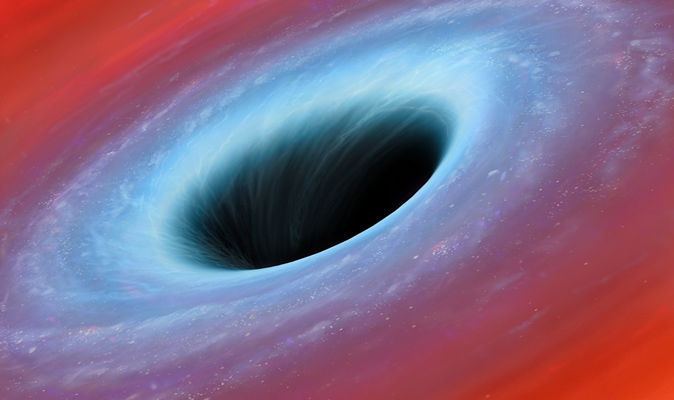
A black hole is not an object in the ordinary sense. It is a region of space where gravity becomes so intense that nothing—not even light—can escape once it crosses a boundary called the event horizon.
The event horizon is not a solid surface. It is a mathematical boundary in spacetime. You could, in theory, cross it without noticing anything immediate if the black hole were large enough. There would be no wall, no glowing edge, no sudden crash. But once you cross that line, escape becomes impossible. Every possible path you could take leads inward, toward the center.
At the center of a classical black hole lies what is called a singularity, a point where density becomes infinite and the known laws of physics break down. Whether singularities truly exist in nature or whether they are artifacts of incomplete theories is still an open question. But in Einstein’s general relativity, the singularity is unavoidable: everything that enters must fall into it.
Black holes form when massive stars collapse at the end of their lives, or when enormous quantities of matter accumulate in one place. The supermassive black holes at the centers of galaxies can contain millions or billions of times the mass of the Sun.
They are not cosmic vacuum cleaners sucking in everything around them. They behave like any other gravitational object at a distance. If the Sun were replaced by a black hole of the same mass, Earth’s orbit would remain nearly unchanged. The difference would be that the Sun’s light would vanish, and Earth would freeze. Gravity would still follow the same laws.
The true terror of a black hole begins only when you get too close.
Why Black Holes Feel Like Portals
The idea of a portal comes naturally when people talk about black holes because black holes are fundamentally about broken intuition. They distort space and time so dramatically that ordinary logic seems to fail.
Near a black hole, time slows down relative to distant observers. From far away, someone falling toward a black hole appears to move more slowly as they approach the event horizon. Their light becomes redder and dimmer, stretched by gravity. Eventually, they seem to freeze at the edge, fading away like a ghost.
But from the perspective of the falling person, nothing magical happens at the horizon. They continue inward. Their own clock ticks normally. Their body moves normally—at least at first. The sense that time itself behaves differently depending on who is watching is deeply unsettling. It feels like a doorway between worlds.
Black holes also have an eerie relationship with information. If something falls in, does its information vanish forever? That question has triggered decades of debate and led to some of the deepest conflicts between general relativity and quantum mechanics.
When the universe presents a place where matter disappears and the laws of physics collide, it is easy to imagine that the missing matter must go somewhere else. Maybe it exits into another universe. Maybe it tunnels through spacetime. Maybe it re-emerges somewhere distant.
In other words, maybe it becomes a portal.
The question is not foolish. In fact, the mathematics of relativity contains solutions that resemble tunnels through spacetime. These structures are called wormholes.
Wormholes: The Mathematical Basis for Cosmic Portals
A wormhole is a hypothetical structure that connects two distant points in spacetime. If you imagine spacetime as a sheet of paper, traveling across it normally means moving along the surface. But if you fold the paper and punch a hole through it, you can create a shortcut from one side to the other. That shortcut is a wormhole.
Wormholes arise naturally as solutions to Einstein’s field equations, the core equations of general relativity. The earliest theoretical wormhole model was the Einstein-Rosen bridge, proposed in 1935 by Albert Einstein and Nathan Rosen. They discovered that the mathematics describing a black hole could also be interpreted as a bridge connecting two different regions of spacetime.
This was one of the first moments when physics seriously entertained the possibility of a cosmic portal.
However, there is an immediate catch: the Einstein-Rosen bridge is not traversable. It collapses too quickly. Any attempt to pass through would fail because the tunnel pinches off before anything can cross.
The mathematics suggests a bridge, but nature seems to slam the door shut.
Still, the concept of wormholes remained alive. Later theoretical work explored the possibility of traversable wormholes—wormholes that remain open long enough for matter or information to travel through.
This is where physics becomes both thrilling and brutal.
The Problem With Traversable Wormholes
A traversable wormhole requires something unusual to prevent it from collapsing. Gravity naturally wants to pinch the wormhole shut. To keep it open, the wormhole would need some form of “negative energy” or “exotic matter,” something that produces gravitational repulsion rather than attraction.
In ordinary physics, energy is positive. Matter has positive mass, and gravity pulls things together. Negative energy is not something we encounter in daily life. Yet quantum physics does allow small, temporary regions of negative energy under certain conditions, such as in the Casimir effect, where quantum fluctuations create a measurable force between metal plates.
But the amount of negative energy available through known quantum effects is extremely tiny. To stabilize a wormhole large enough for a human, or even a spaceship, would require negative energy on a scale that seems impossible with any known technology or natural process.
Even if exotic matter exists in the universe, there is no evidence that it can form in the required quantities or configurations to create stable wormholes.
So while the equations of relativity permit wormholes, physics strongly suggests that they are not practical objects in our universe.
They may exist only as mathematical possibilities, like imaginary creatures that live inside equations but not in the real cosmos.
Are Black Holes and Wormholes the Same Thing?
Not exactly. A black hole is a region where spacetime curves so strongly that escape becomes impossible. A wormhole is a tunnel-like structure connecting two regions of spacetime. They are related in the sense that some wormhole solutions resemble black hole geometries, but they are not identical.
Some theoretical models propose that a black hole could contain a wormhole-like interior. The black hole might act as an entrance, and somewhere else in spacetime there could be an exit.
This idea has fueled decades of speculation, both scientific and fictional. But the key issue is whether such an exit could exist without violating the laws of physics.
In most realistic models, if a wormhole forms from a black hole, it collapses too quickly. Or it contains conditions so extreme that anything entering would be destroyed before reaching the other side.
A black hole is certainly a one-way door. Whether it can ever be a two-way tunnel remains unknown.
The deeper we go, the more we encounter a harsh truth: even if black holes are connected to wormholes, that does not mean they are usable portals.
What Happens If You Fall Into a Black Hole?
To understand whether a black hole could function as a portal, we must ask a more basic question: could anything survive the journey?
The answer depends on the size of the black hole.
For small black holes, the gravitational gradient near the event horizon is enormous. This means that different parts of your body would experience drastically different gravitational forces. Your feet would be pulled far more strongly than your head. This effect is called spaghettification. You would be stretched into a long thin strand and torn apart before even reaching the horizon.
For supermassive black holes, the event horizon is much larger, and the gravitational gradient at the horizon is gentler. In that case, you could cross the event horizon without being torn apart immediately. You might not even notice the exact moment you crossed.
But survival would be temporary. As you fall deeper, the tidal forces would grow. Eventually, you would be destroyed long before reaching the singularity.
In classical relativity, once inside the event horizon, the future points toward the singularity in the same way that the future points toward tomorrow outside a black hole. You cannot choose to avoid it. It is not a place you can steer away from. It is a destination built into the structure of spacetime.
This creates a grim conclusion: a black hole is not like a tunnel you can navigate. It is more like a waterfall in spacetime. Once you go over the edge, you are carried inward with no return.
That does not sound like a portal. It sounds like an end.
The Singularity: Where Physics Stops Speaking Clearly
The singularity is one of the most mysterious concepts in all of physics. According to general relativity, the collapse of matter inside a black hole leads to a point of infinite density. Space and time become infinitely curved. The equations produce nonsensical infinities, which is usually a sign that the theory is incomplete.
Most physicists believe that singularities do not truly exist in nature. Instead, they suspect that quantum gravity—an as-yet incomplete theory combining quantum mechanics and general relativity—would prevent infinite collapse. Something else would happen at extremely small scales.
But we do not yet know what that “something else” is.
This uncertainty is exactly why black holes are sometimes treated as possible portals. If physics breaks down at the singularity, perhaps matter is not destroyed. Perhaps it passes into another region of spacetime. Perhaps it emerges somewhere else.
Yet we must be careful. “Physics breaks down” does not mean “anything can happen.” It simply means our current theories are insufficient.
A black hole singularity is not a proven doorway. It is an unsolved problem.
Hawking Radiation and the Slow Evaporation of Black Holes
In the 1970s, Stephen Hawking introduced a revolutionary idea: black holes are not truly black. Quantum effects near the event horizon allow black holes to emit radiation, now known as Hawking radiation. Over immense timescales, this radiation causes black holes to lose mass and eventually evaporate.
This discovery reshaped black hole physics. It suggested that black holes are not eternal prisons. They have lifetimes.
But Hawking radiation also deepened the mystery of black holes as portals. If a black hole evaporates, what happens to the information contained in everything that fell in?
Quantum mechanics insists that information cannot be destroyed. Yet if a black hole evaporates completely, and all that remains is random thermal radiation, it appears that information has been lost.
This contradiction is called the black hole information paradox, and it remains one of the most important puzzles in theoretical physics.
Some proposed solutions suggest that information is somehow encoded on the event horizon, like a hologram. Others suggest it escapes through subtle correlations in Hawking radiation. Still others suggest that black holes might connect to other regions of spacetime, allowing information to escape elsewhere.
The information paradox has encouraged some physicists to consider that black holes might have deeper structures than classical relativity suggests.
Not necessarily portals in the science-fiction sense, but perhaps bridges between different descriptions of reality.
The ER=EPR Idea: A Modern Link Between Wormholes and Quantum Entanglement
One of the most fascinating modern ideas in theoretical physics is the proposal known as ER=EPR.
ER refers to Einstein-Rosen bridges, wormholes. EPR refers to Einstein-Podolsky-Rosen entanglement, a quantum phenomenon where two particles become linked so that measuring one instantly influences the state of the other, no matter how far apart they are.
The ER=EPR conjecture, proposed by physicists including Juan Maldacena and Leonard Susskind, suggests that quantum entanglement and wormholes may be connected. In a sense, entangled particles might be linked by tiny non-traversable wormholes at the quantum level.
If true, this would mean wormholes are not just exotic theoretical objects but may be woven into the fabric of quantum reality itself. It would imply that spacetime geometry and quantum entanglement are deeply related.
This is not proof that black holes are portals. But it is a hint that the universe may connect distant things in ways that are more subtle than we once believed.
In this view, black holes could be connected through wormhole-like structures, but these structures may not allow travel. They may only represent a deep mathematical connection between gravity and quantum physics.
It is an idea that feels like science fiction, yet it emerges from serious equations.
Could a Black Hole Lead to Another Universe?
Another popular portal idea is that black holes might be gateways to other universes.
Some speculative models in cosmology suggest that black holes could create “baby universes” inside them. In this scenario, the collapse inside a black hole does not end in a singularity but instead bounces into a new expanding region of spacetime—a new universe disconnected from ours.
This idea has been explored in certain approaches to quantum gravity, including loop quantum gravity, where spacetime may have a discrete structure and collapse might be prevented by quantum effects. Instead of infinite density, the core could rebound, somewhat like a compressed spring releasing energy.
If such a bounce occurred, it could theoretically resemble the Big Bang inside the black hole, creating a new expanding cosmos.
From our perspective, the black hole would remain a black hole. We would never see the new universe. But from the inside, it could appear as a new beginning.
This is one of the most poetic possibilities in physics: every black hole could be the seed of a new universe, and our own universe might have begun inside a black hole in a larger parent universe.
But we must emphasize what science demands: there is no observational evidence for this idea. It remains speculative. It is a possibility suggested by incomplete theories, not a confirmed fact.
Physics allows the question, but it does not yet provide an answer.
Why Portals Are Hard: The Problem of One-Way Travel
Even if a black hole connected to another region of spacetime, there is a major practical issue: the event horizon is a one-way boundary.
Once you cross it, you cannot return. Even light cannot escape. That means if a black hole is a portal, it is not a portal you can use like a door. It is a trapdoor.
A science-fiction portal is usually something you can enter and exit, perhaps even travel back through. But a black hole does not behave that way. It behaves like a region where the structure of spacetime forces all possible futures inward.
Even if there were an exit somewhere else, the act of reaching it would require surviving immense tidal forces and navigating a region where time and space swap roles. Inside the horizon, the direction toward the center becomes as inevitable as time itself.
This is one of the reasons physicists hesitate to call black holes portals. A portal implies control. A black hole implies surrender.
The Firewall Hypothesis: Could the Event Horizon Destroy Everything?
Classical general relativity predicts that crossing the event horizon of a sufficiently large black hole could be uneventful. But quantum physics complicates this.
Some theoretical work has proposed that black holes might have a “firewall” at the event horizon—a region of extremely high-energy particles that would instantly destroy anything falling in. The firewall idea arose as one possible solution to the information paradox.
If firewalls exist, then black holes are even less like portals. They would be cosmic incinerators, not gateways.
However, the firewall hypothesis is controversial. Many physicists believe it is unlikely or that it indicates our understanding of quantum gravity is incomplete. The question remains unsettled.
Still, the firewall debate highlights an important point: we do not fully understand what happens at the event horizon. The border of a black hole is not just a gravitational boundary. It may be a boundary where the deepest principles of physics clash.
If black holes are portals, the key lies at the horizon. And the horizon remains one of the most mysterious surfaces in the universe.
Rotating Black Holes and the Idea of an Exit
Not all black holes are simple. Most black holes likely rotate, because the stars that form them rotate. Rotating black holes are described by the Kerr solution in general relativity, and their structure is far more complex than non-rotating black holes.
A Kerr black hole has an event horizon, but it also has an inner horizon and a region called the ergosphere, where spacetime itself is dragged around by the black hole’s rotation. This phenomenon is known as frame dragging.
Some interpretations of the Kerr geometry suggest that it could allow paths leading to other regions of spacetime, perhaps even to a white hole—a hypothetical opposite of a black hole that ejects matter instead of swallowing it.
In the mathematics, a Kerr black hole can contain a passage to another universe or another region of spacetime. This is one of the strongest reasons black holes have been linked to portal ideas.
But again, the physics is harsh. These paths require ideal conditions. They assume a perfectly stable black hole with no disturbances. In the real universe, black holes are surrounded by matter, radiation, and gravitational perturbations. These likely destabilize the inner horizon and destroy any hypothetical tunnel.
The Kerr solution is elegant mathematics, but nature is messy.
So while rotating black holes offer intriguing portal-like possibilities, most physicists believe real black holes would not allow safe passage.
Wormholes, Time Travel, and the Universe’s Built-In Defenses
If wormholes were stable and traversable, they could potentially allow time travel. A wormhole connecting two points in spacetime could be manipulated so that one end experiences time differently than the other, creating a time offset. Traveling through it could allow you to emerge in the past.
This possibility alarms physicists because it creates paradoxes: the famous “grandfather paradox,” where a time traveler prevents their own existence, or causal loops where effects occur before causes.
Some physicists, including Stephen Hawking, suggested that the universe might have a “chronology protection” mechanism that prevents time travel. The laws of physics might make traversable wormholes impossible precisely because they would break causality.
If this is true, it means the universe itself resists portal-like structures. Wormholes might be mathematically allowed, but physically forbidden by deeper laws we do not yet fully understand.
In that sense, black holes might tempt us with the appearance of a doorway, but reality may enforce a rule: no shortcuts, no escape routes, no rewriting the timeline.
What Observations Tell Us About Black Holes
Science ultimately depends on observation. Theoretical possibilities are interesting, but nature must confirm them.
So far, every observation of black holes supports the idea that they behave like the objects predicted by general relativity. We have detected black holes through gravitational waves, through the motion of stars orbiting invisible masses, and through the glowing accretion disks of hot matter spiraling inward.
We have even captured images of black hole shadows, such as the famous Event Horizon Telescope images of the black hole in galaxy M87 and the supermassive black hole at the center of our own galaxy, Sagittarius A*.
These observations do not show any sign of portals. They show gravity behaving exactly as expected. Matter falls in, heats up, radiates energy, and disappears beyond the horizon.
If black holes are connected to other universes, the connection is hidden so completely that it leaves no obvious trace.
Physics does not rule out exotic interiors, but observation has not revealed them.
Could We Ever Prove That Black Holes Are Portals?
This is one of the most difficult questions imaginable because the defining feature of a black hole is that information cannot escape from inside the event horizon.
If something goes in and comes out elsewhere, how would we know? If it exits in another universe, we cannot observe that universe. If it exits far away in our universe, we would need a way to link the exit to the entry.
Some theoretical work suggests that subtle patterns in Hawking radiation could encode information about what fell in. If scientists could decode those patterns, it might reveal something about the interior structure of black holes. But Hawking radiation is incredibly weak for large black holes, making it nearly impossible to measure in practice.
Another possibility is that quantum gravity effects could create observable deviations from general relativity near the horizon. If future observations detect such deviations, it could hint at deeper structures like wormholes or other exotic phenomena.
But at the moment, black holes remain observationally silent about their deepest secrets.
They are like locked doors without keyholes.
What Physics Says Right Now
So, are black holes actually portals?
The most scientifically accurate answer is that black holes are not known to be portals, and the kind of portal travel depicted in science fiction is extremely unlikely under current physics.
General relativity allows mathematical solutions that resemble wormholes, and black holes can be linked to these solutions in theory. But known wormholes are either non-traversable or require exotic matter that has not been observed in usable quantities. The interior of a real black hole is expected to be violently destructive, and the event horizon acts as a one-way boundary.
Modern theoretical ideas, including ER=EPR and quantum gravity proposals, hint that black holes may be connected to deeper structures of spacetime that resemble wormholes at a fundamental level. Some speculative models even suggest black holes could seed new universes.
But none of these ideas are confirmed. They remain hypotheses on the frontier of physics.
The portal concept is not completely forbidden by mathematics, but it is unsupported by evidence and faces enormous physical obstacles.
Why Black Holes Still Feel Like Gateways
Even if black holes are not portals in the literal sense, they remain gateways in another way.
They are gateways to the limits of human knowledge.
They force us to confront the conflict between relativity and quantum mechanics. They push us toward the search for quantum gravity. They challenge our understanding of space, time, causality, and information.
A black hole is the closest thing the universe offers to a laboratory for extreme physics. It is a region where nature becomes so intense that our current laws begin to fray.
In that sense, black holes truly are portals—not to other galaxies, but to deeper understanding.
They are places where the universe invites us to look beyond the comfortable surface of reality and ask whether the cosmos is stranger than we ever dared imagine.
The Final Verdict: Portals or Cosmic Traps?
Black holes are real. They exist throughout the universe, from stellar-mass black holes formed by dying stars to supermassive giants anchoring galaxies. Their gravity shapes the cosmos, and their physics has been confirmed through observation.
Wormholes are possible in theory, but they remain unproven and likely unstable.
If a black hole contains a tunnel to somewhere else, it is not a tunnel we can currently use, and it may not even be a tunnel that can remain open. Physics suggests that anything falling into a black hole is doomed, not transported.
So black holes are not portals in the practical sense.
But they are still the universe’s most dramatic reminder that reality is not fully understood. They stand as cosmic enigmas—silent, dark, and unimaginably deep—forcing us to admit that even with all our science, the universe still holds places where the map ends.
And perhaps that is the most powerful truth of all.
Black holes may not be doorways to other worlds, but they are doorways to the edge of physics itself.