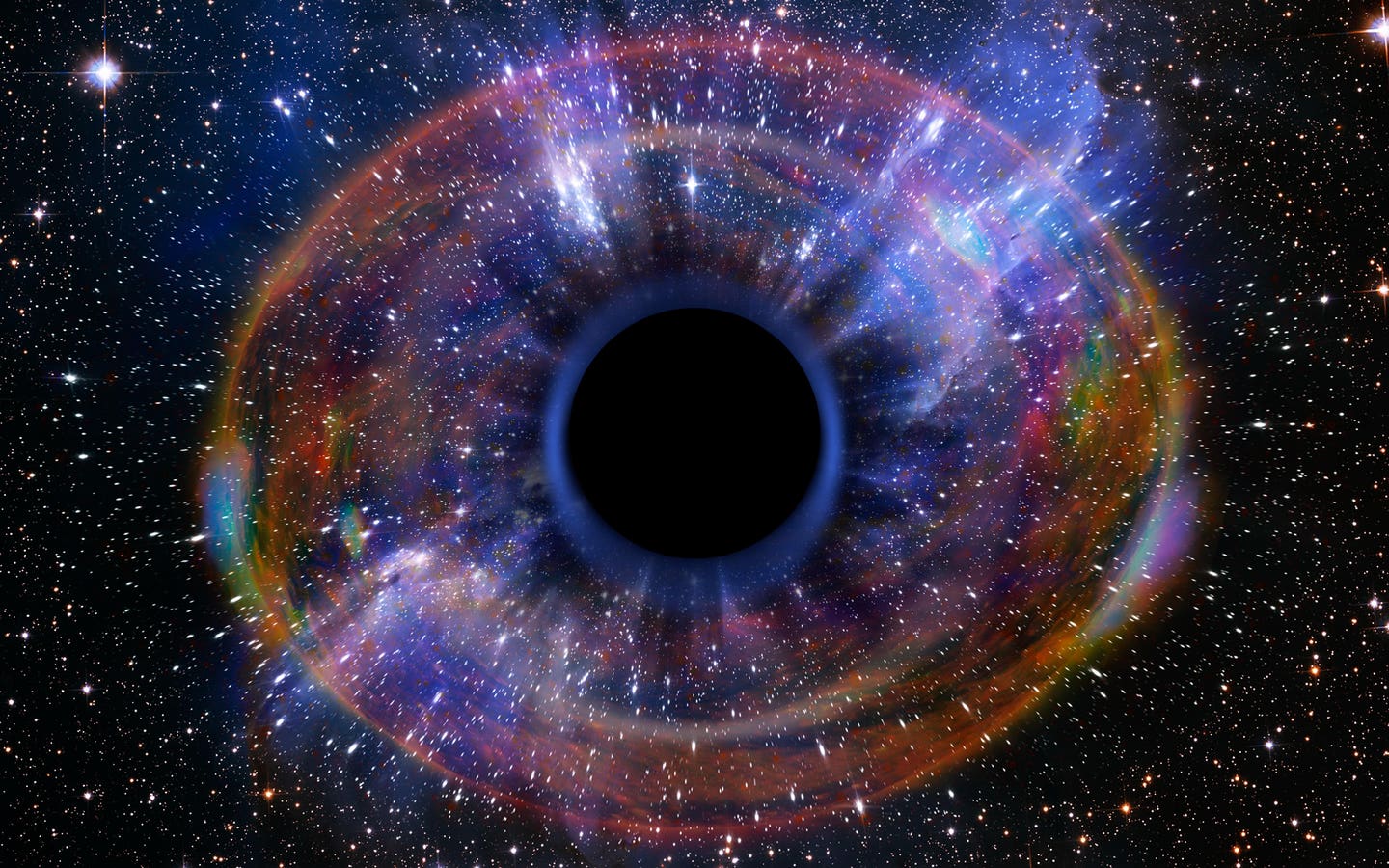
Imagine waking up one ordinary morning, stepping outside, and noticing that the sunlight feels the same, the sky is still blue, and the world seems normal. Then, without warning, the greatest object in our sky—the Sun—vanishes. Not in an explosion. Not in flames. It simply becomes something else, something that does not shine, something that swallows light itself.
A black hole.
It is one of the most chilling cosmic “what if” questions ever asked. The Sun is the anchor of our solar system. It is the source of nearly all energy on Earth. It shapes the orbits of planets, feeds ecosystems, and drives every sunrise that has ever painted the horizon. The idea of the Sun becoming a black hole sounds like instant doom, the kind of disaster that would rip Earth apart in seconds.
But the real answer is far stranger—and in some ways even more terrifying—because it is not about immediate destruction. It is about silence. It is about darkness that slowly becomes absolute.
If the Sun turned into a black hole today, Earth would not be torn apart. The planet would not be sucked in like a vacuum cleaner swallowing dust. The truth is that gravity, orbit, and survival would behave in ways most people don’t expect.
To understand what would happen, we have to explore what black holes really are, what the Sun is capable of becoming, and what Earth’s future would look like if the heart of our solar system suddenly stopped shining.
Could the Sun Actually Become a Black Hole?
Before imagining the consequences, we should confront the reality: the Sun cannot naturally become a black hole.
Black holes form when extremely massive stars collapse at the end of their lives. Typically, a star needs to have at least around 20 times the mass of the Sun to collapse into a black hole after a supernova. Stars with lower mass, including the Sun, end their lives differently. The Sun is expected to expand into a red giant, shed its outer layers, and leave behind a white dwarf—an Earth-sized remnant slowly cooling for trillions of years.
The Sun simply does not have enough mass to crush itself into a black hole. Its gravity is not strong enough to overcome the pressure resisting collapse at the necessary level.
So if the Sun became a black hole “today,” it would require a bizarre, impossible transformation—something outside known physics. But since this is a thought experiment, we can assume that by some cosmic magic, the Sun is instantly replaced by a black hole of the same mass.
And that detail matters more than anything else.
A black hole with the Sun’s mass would not be a supermassive monster. It would be a stellar-mass black hole, about one solar mass, with an event horizon only about 3 kilometers in radius.
That means the Sun’s entire mass would be compressed into something smaller than a city.
The solar system would still be there. Earth would still be in space. But the Sun as a glowing star would be gone.
Would Earth Be Sucked Into the Black Hole?
This is the first fear most people have: if the Sun became a black hole, would Earth immediately spiral inward and be consumed?
Surprisingly, the answer is no.
Gravity depends on mass, not on whether that mass is a star or a black hole. If the Sun suddenly became a black hole with the exact same mass, the gravitational pull Earth feels would remain essentially unchanged.
Earth orbits the Sun because it is falling through space around it. That orbital motion depends on the Sun’s mass and Earth’s distance, not on the Sun’s size or brightness. So if the Sun were replaced by a black hole of equal mass, Earth would continue orbiting almost exactly as it does now.
The year would still be about 365 days long. Earth would still follow its familiar elliptical path. The planets would remain in their orbits, because the gravitational center of the solar system would still contain the same amount of mass.
A black hole is not a cosmic vacuum cleaner that sucks everything nearby. Objects only fall into it if they get too close, crossing the event horizon. From far away, a black hole’s gravity behaves just like any other object of the same mass.
In fact, if you replaced the Sun with a black hole without changing its mass, the orbit of Earth would not even notice the difference at first.
But something else would change instantly.
Light would vanish.
The Moment the Sun Disappears: Eight Minutes of Normal Life
There is a haunting delay in this scenario. The Sun is about 150 million kilometers away, and sunlight takes about 8 minutes and 20 seconds to reach Earth.
That means if the Sun transformed into a black hole, Earth would not know right away. For just over eight minutes, everything would appear normal. The sky would still glow. Birds would still fly. The oceans would still shimmer. Solar panels would still generate electricity. Plants would still photosynthesize.
Then the last photons would arrive.
And the sunlight would stop.
At that moment, the world would begin to change in ways no civilization has ever experienced. Not gradually. Not over centuries. But immediately, as if the universe flipped a switch.
Day would become night.
Not a gentle sunset. Not a fading twilight. But a rapid plunge into darkness, with only the Moon, the stars, and artificial lights remaining.
And suddenly, humanity would realize something terrifying: the Sun was never just a bright object in the sky. It was Earth’s heartbeat.
What Would the Sky Look Like?
Once the Sun’s light vanished, the sky would no longer be blue.
Earth’s blue sky exists because sunlight scatters through the atmosphere. Without sunlight, there is nothing to scatter. The daytime sky would become black, even if it were noon. Stars would become visible immediately. The Milky Way would stretch across the heavens like a glowing scar. The planets would shine more brightly. The Moon would still reflect sunlight—except there would be no sunlight.
So the Moon would also go dark, except for faint illumination from Earth’s own artificial lights and atmospheric glow. Lunar eclipses would become meaningless because the Moon would no longer be lit by a central star.
The night sky would be breathtaking and horrifying. It would feel as if the entire universe suddenly revealed itself.
For a short time, city lights would still shine, casting an eerie glow upward. But soon, those lights would become fragile, threatened by the collapse of power systems.
The sky would not merely be dark. It would be alien.
What Happens to Temperature Immediately?
One of the most common misconceptions is that Earth would instantly freeze solid the moment sunlight disappeared. In reality, Earth has thermal inertia. The oceans store enormous heat. The atmosphere retains warmth. The planet does not lose all its energy in a few hours.
But cooling would begin quickly.
Within the first day, global temperatures would start dropping noticeably. Without the Sun heating the surface, the atmosphere would cool, and winds would shift unpredictably. Weather patterns would begin collapsing because weather is driven by solar energy. Storm systems would weaken. Rainfall patterns would change. The hydrological cycle would slow.
Within a week, average global temperatures could fall below freezing in many regions. Tropical areas would become cold. Frost would spread across continents.
Within a month, much of Earth’s surface could become uninhabitable for exposed life. Lakes and rivers would begin freezing over. Snow would fall in places that have never seen it.
Within a year, average surface temperatures could drop to around -40°C or lower. Over longer periods, Earth could approach -100°C or colder at the surface.
The cooling would not be uniform. Areas near geothermal hotspots might remain warmer. Deep oceans would retain heat longer. But the overall trend would be unstoppable: Earth would become a frozen world drifting through darkness.
The Sun’s absence would not just make Earth cold. It would rewrite the planet’s identity.
The Collapse of Photosynthesis and the End of Green Earth
The Sun is not only heat. It is life’s fuel.
Plants, algae, and cyanobacteria use sunlight to perform photosynthesis, turning carbon dioxide and water into sugars and oxygen. This process forms the base of nearly all food chains on Earth.
Once sunlight disappears, photosynthesis stops almost immediately. Plants would not die instantly, but they would begin starving. Some could survive for days or weeks using stored energy. But without light, growth halts, leaves wilt, and ecosystems begin to collapse.
Ocean phytoplankton, which produce a large fraction of Earth’s oxygen, would also stop photosynthesizing. Marine food webs would collapse rapidly. Fish populations would crash. Larger animals would starve.
The most dramatic early effect would be mass extinction—not from cold at first, but from starvation.
Animals that depend on plants would die. Predators would follow. Entire ecosystems would unravel like threads pulled from a tapestry.
Earth’s forests, once green and alive, would slowly become silent skeletons frozen in place.
The planet would still have oxygen for a long time—years to centuries—because Earth’s atmosphere is vast. But the system that replenishes oxygen would be broken. Over long timescales, oxygen levels would begin to decline.
Without sunlight, Earth would not just lose warmth. It would lose the engine of biology itself.
Would Gravity Change? Would Orbits Collapse?
If the Sun became a black hole with exactly the same mass, the gravitational structure of the solar system would remain mostly stable. Earth and other planets would continue orbiting as before.
However, there is a deeper subtlety. The Sun is currently losing mass over time through solar wind and radiation. If it suddenly became a black hole, that mass loss would stop. Over extremely long timescales, this could slightly alter planetary orbits compared to what they would have been.
But these changes would be small.
The main gravitational difference would come if the Sun’s transformation involved losing mass in the process. If the Sun somehow exploded or shed mass before collapsing into a black hole, Earth’s orbit could become more distant or unstable. If more than half the Sun’s mass vanished, the planets could even escape the solar system entirely.
But in the pure thought experiment where the Sun becomes a black hole instantly without losing mass, Earth remains in orbit.
The tragedy is that Earth would still be held in the same cosmic dance, circling a center that no longer shines.
It would be like orbiting a grave.
Would Earth Still Have Day and Night?
Earth’s rotation would not stop. The planet would continue spinning once every 24 hours. But without the Sun, the concept of “day” and “night” would lose meaning.
There would still be a side facing the black hole and a side facing away, but neither side would be lit. The planet would be in constant darkness, except for artificial lighting and faint starlight.
Temperatures might still vary slightly between the side facing the black hole and the side facing deep space, but over time the entire planet would cool toward equilibrium.
The sky would no longer provide timekeeping cues. The biological rhythms of life would collapse. Many species depend on sunlight cycles for migration, reproduction, feeding, and sleep.
Even humans would struggle psychologically. Darkness is not merely an absence of light. It is a presence of fear, disorientation, and existential dread.
The Earth would still spin, but its rotation would feel pointless, like a clock ticking in an abandoned house.
What Happens to Earth’s Atmosphere?
As temperatures drop, Earth’s atmosphere would begin to change dramatically.
Water vapor would condense and freeze. Snow would cover much of the planet. Eventually, carbon dioxide would begin to freeze out of the atmosphere as dry ice, forming layers on the surface. This would reduce greenhouse warming, accelerating cooling even further.
Over long periods, much of the atmosphere could collapse. Nitrogen and oxygen would remain gaseous longer because they freeze at much lower temperatures, but as Earth’s surface cooled to extreme levels, even these gases could begin to liquefy and freeze.
In the distant future, Earth might resemble Titan or Pluto—an icy world with a thin or partially frozen atmosphere.
However, Earth has internal heat. Radioactive decay in the mantle and core generates geothermal energy. This heat would continue. It would not keep the surface warm, but it would prevent Earth from becoming completely dead.
Deep underground, the planet would remain warm enough for liquid water to exist in some places.
The atmosphere would shrink and settle, and the sky would become clearer and darker, with fewer clouds and less weather. The Earth would grow silent.
Could Humans Survive?
The question of human survival is brutal but not hopeless.
Humans cannot survive long-term on Earth’s surface without sunlight. Agriculture would fail within weeks to months. Temperatures would become lethal in most regions within a year. Ecosystems would collapse.
But humans are not limited to surface survival.
If humanity had preparation, survival would be possible through underground habitats powered by nuclear energy, geothermal energy, or other stored energy sources. Artificial lighting could support hydroponic farming. Heat could be maintained through reactors. Water could be obtained by melting ice.
Civilization would shrink dramatically. Billions would perish without infrastructure and preparation. But a small fraction of humanity could survive in enclosed systems, similar to space station environments, but underground.
Over time, humans might adapt culturally and technologically to a Sunless Earth. The planet could become a world of subterranean cities, where the surface is a frozen wasteland and the true human world exists below.
This is not fantasy. It is an extension of known technology. Nuclear reactors can provide power for decades. Underground construction is possible. Hydroponics can produce food. The main challenge would be scale, speed, and resources.
If the Sun vanished without warning, survival would be far harder. Panic, economic collapse, and resource wars would likely erupt long before underground stability could be achieved.
The disappearance of the Sun would not just be a physical crisis. It would be a social collapse.
What About Animals and Other Life?
Most surface life would not survive long. Plants would die. Herbivores would starve. Predators would follow. The oceans would eventually freeze from the top down, trapping marine life below. Some deep-sea ecosystems could persist longer because they rely on geothermal vents rather than sunlight.
The most resilient life forms would be microbes. Bacteria living deep underground or near hydrothermal vents could continue thriving. Some extremophiles can survive without sunlight, feeding on chemical energy from Earth’s interior.
In fact, Earth would still be habitable in certain hidden pockets. It would not become sterile. It would become a different kind of planet—one where life retreats inward.
If humans survived, they might share the planet with a new biosphere dominated by subterranean microbes and organisms adapted to darkness.
The Earth would not be dead.
But it would no longer be the living, green world we recognize.
Would the Solar System Become Invisible?
The Sun is not only the source of light but also the source of illumination for everything in the solar system. Without it, the planets would become nearly invisible except through infrared radiation.
Jupiter and Saturn might still glow faintly because they emit internal heat. The gas giants generate more heat than they receive from the Sun, due to gravitational contraction and leftover formation energy. They would still shine in infrared wavelengths.
But to the human eye, the planets would be lost in darkness. Even Earth itself would not reflect sunlight anymore. The solar system would become a shadowy collection of cold objects orbiting an invisible gravitational center.
From a distance, the solar system would no longer look like a bright star with planets. It would become a dark system wandering through the galaxy.
It would still exist, but it would be hidden.
Would We Notice the Black Hole in the Sky?
A solar-mass black hole would not be visible directly. It would not emit light unless matter fell into it and heated up in an accretion disk. But in this scenario, the black hole would not have much to consume. Most of the solar system’s matter is in stable orbits.
Still, some material—dust, comets, asteroids—might eventually spiral inward and be consumed, producing bursts of radiation. The black hole might develop a faint accretion glow, but it would be nothing like the Sun.
Earth would orbit a darkness so complete it could not be seen, only felt.
However, the black hole’s gravity would still shape the paths of objects. Astronomers would detect it through orbital motions. It would also act as a gravitational lens, bending light from background stars passing behind it.
In the sky, it might create subtle distortions, like a cosmic fingerprint.
But for ordinary humans on the ground, the Sun would simply be gone. No glowing disk. No warmth. No sunrise.
Only stars.
What Happens to the Inner Planets?
Mercury and Venus would cool quickly. Mercury already experiences extreme temperature swings, but without solar heating, it would plunge into deep cold. Venus, despite its thick greenhouse atmosphere, would eventually cool as well. Its atmosphere might condense and settle.
Mars, already cold, would become even more frozen. Its thin atmosphere could collapse entirely.
The asteroid belt would become an even more lifeless region of rock and ice.
The gas giants would remain relatively warm internally, but their atmospheres would cool as well. Their moons, some of which contain subsurface oceans, could remain active for longer periods. Europa, Enceladus, and Titan might continue to harbor liquid water beneath ice, powered by tidal forces and internal heating.
Ironically, in a Sunless solar system, the most promising places for life might become the moons of Jupiter and Saturn rather than Earth’s surface.
Earth, once the jewel of habitability, would be reduced to an ice-covered tomb with hidden pockets of warmth underground.
Would Earth Eventually Drift Away?
Earth’s orbit would remain stable for a long time. But over extremely long timescales, gravitational interactions between planets can create chaos. Even in our current solar system, the orbits are not perfectly stable forever. Over billions of years, small gravitational tugs can accumulate.
With the Sun as a black hole, the solar system would still experience the same gravitational interactions, and long-term instability could still occur. A passing star could also disturb the system. Over millions or billions of years, Earth might be ejected into interstellar space.
If that happened, Earth would no longer orbit anything. It would become a rogue planet, drifting through the galaxy.
But even then, Earth would not be completely frozen inside. The core would remain warm for billions of years, and subsurface habitats could persist.
A rogue Earth would be an island of rock and ice traveling through eternal night.
The Psychological Horror of a Sunless World
There is a unique terror in this scenario that goes beyond physics.
The Sun is not just energy. It is meaning. Human cultures have worshipped it, measured time by it, built myths around it. Every day begins with its rise. Every season is shaped by its position. Every field of crops, every ocean current, every warm breeze owes its existence to sunlight.
To lose the Sun would be to lose the rhythm of life.
Even if humans survived underground, the surface would become a symbol of loss. A frozen desert where no wind carries warmth, where no bird sings, where the sky is always black. The psychological impact would be overwhelming.
Generations would be born who never saw a sunrise. Children would grow up hearing stories of a blue sky that sounds like fantasy. The surface might become sacred, a forbidden world of ice where the old Earth is buried.
In a strange way, humanity might survive physically but suffer a deep cultural mourning, living inside a planet that feels like a tomb.
Would Earth Eventually Become Like Pluto?
In many ways, yes.
Over long timescales, Earth’s surface would resemble the icy dwarf worlds of the outer solar system. Water would be solid rock-hard ice. Carbon dioxide would freeze. The atmosphere would thin or collapse. The planet would become a frozen sphere with a faint haze.
But Earth would still be different from Pluto because it is geologically active. Pluto has little internal heat. Earth has a molten core and tectonic activity. Volcanoes might still erupt beneath ice. Geothermal vents could remain active under frozen oceans.
Earth would become something like an enormous icy moon—an object with a frozen crust and hidden internal warmth.
It would still have a magnetic field for a long time, generated by its spinning molten core, though that field would weaken over geological timescales.
The Earth would not become dead like a rock.
It would become hidden.
Would the Black Hole Eventually Eat the Solar System?
Over incredibly long timescales, yes, the black hole could consume some matter. But it would not rapidly devour the planets.
Planets in stable orbits will not fall into a black hole unless something disturbs their trajectory. Gravity does not pull orbiting bodies straight inward; it keeps them moving around the center.
However, interactions between planets, passing stars, or collisions could send objects into the black hole. Comets could fall inward. Asteroids could spiral closer. Dust could gradually feed it.
The black hole would grow slowly, perhaps over trillions of years, but it would not quickly swallow everything.
The solar system would persist as a dark, gravitationally bound system for a very long time.
Final Reality: Earth Would Not Be Destroyed, But It Would Become a Frozen Shadow
If the Sun turned into a black hole today, the most shocking truth is that Earth would not be torn apart by gravity. It would not be instantly swallowed. The planet would continue orbiting almost normally, trapped in a familiar path around an object that has become invisible.
But the loss of sunlight would be devastating.
Within minutes, daylight would vanish. Within days, temperatures would begin plummeting. Within months, ecosystems would collapse. Within a year, much of the surface would become lethally cold. Oceans would begin freezing. The atmosphere would slowly collapse. Life would retreat underground or underwater, surviving only where geothermal energy provides warmth.
Civilization would collapse unless humanity could rapidly transition to enclosed, artificial environments powered by nuclear or geothermal energy.
Earth would not be destroyed.
It would be abandoned by the light.
And that may be the most terrifying kind of apocalypse: not fire, not explosion, not impact—but silence. A world still spinning, still orbiting, still existing, but no longer alive in the way we understand.
The Sun is not merely a star.
It is Earth’s permission to live.
If it became a black hole, Earth would not fall into darkness because it was swallowed.
Earth would go dark because the universe simply stopped shining on it.