Electricity feels ordinary because it surrounds us constantly. It lights our homes, charges our phones, keeps hospitals alive, and silently powers the digital world. Yet electricity itself remains one of the strangest and most misunderstood forces in nature. It is invisible, intangible, and yet powerful enough to kill, heal, communicate, and create entire civilizations. Beneath its everyday familiarity lies a world of surprising truths that most people never stop to consider.
Here are ten scientifically accurate, deeply fascinating things about electricity that reveal just how bizarre, beautiful, and emotionally charged this force truly is.
1. Electricity Is Not Energy Flowing Through Wires the Way You Think
Most people imagine electricity as energy racing through wires like water through a pipe. This mental image is comforting—and mostly wrong. What actually moves rapidly through the wire is not energy itself, but an electromagnetic signal. The electrons inside a wire drift extremely slowly, often moving less than a millimeter per second. Yet when you flip a light switch, the bulb turns on almost instantly.
This happens because the electric field propagates through the circuit at nearly the speed of light, pushing energy through the space around the wire, not inside it. The electrons merely pass the “push” along, like tightly packed balls transmitting force through a line.
This means the energy powering your device is carried by fields surrounding the wire, not by electrons zooming through it. The wire is more like a guide for energy than a pipeline. It’s a counterintuitive truth that turns our everyday understanding of electricity inside out.
2. Lightning Is Hotter Than the Surface of the Sun
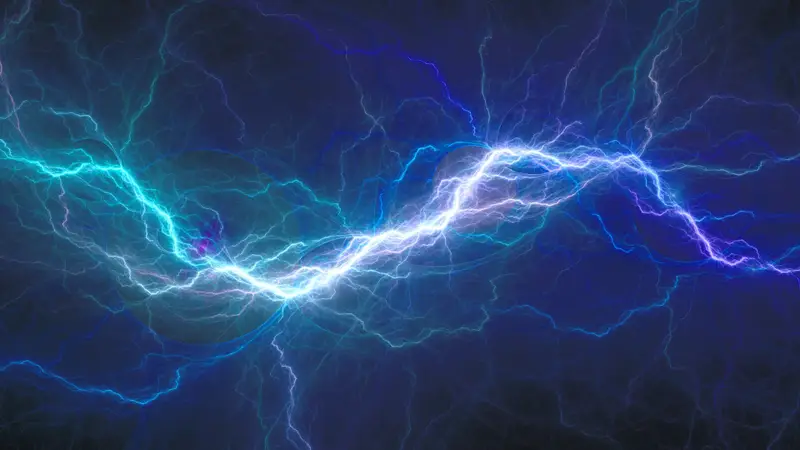
Lightning feels distant, dramatic, and momentary—but during its brief flash, it becomes one of the hottest natural phenomena on Earth. A lightning bolt can reach temperatures of around 30,000 degrees Celsius, which is roughly five times hotter than the surface of the Sun.
This intense heat is created when electrical charge builds up between clouds and the ground, releasing energy in a violent discharge. The surrounding air is heated so rapidly that it explodes outward, creating thunder. That cracking sound you hear is the air itself being torn apart and snapping back together.
Lightning reminds us that electricity is not gentle. It is raw, primal, and capable of releasing enormous energy in an instant. Every thunderstorm is a reminder that nature still holds forces far beyond human control.
3. Your Body Runs on Electricity Too
Electricity is not just something humans harness—it is something life itself depends on. Your nervous system operates through tiny electrical signals. Every thought, movement, emotion, and memory depends on electrical impulses traveling through neurons.
These signals are created by the movement of charged ions across cell membranes, generating electrical differences that propagate along nerve fibers. Your heart beats because of rhythmic electrical pulses. Your brain functions because billions of neurons communicate electrically every second.
Even your sense of touch, pain, and pleasure relies on electrical activity. In a very real sense, you are an electrical being, animated by currents too small to feel but powerful enough to define who you are.
This realization carries emotional weight. Your memories, personality, and consciousness are not abstract ideas floating in space—they are physical electrical patterns dancing inside living tissue.
4. Static Electricity Can Be Stronger Than Household Electricity
Static electricity feels harmless—until it doesn’t. The small shock you feel after walking across a carpet can involve voltages of several thousand volts. That number sounds shocking, but it’s the current that determines danger. Static electricity has extremely low current, which is why it usually doesn’t cause serious harm.
Still, the voltage involved is enormous compared to household electricity, which typically runs at much lower voltage but higher current. The crackle, spark, and snap of static electricity reveal how easily charge can build up and discharge violently when conditions are right.
Static electricity is also responsible for lightning, dust clinging to surfaces, and even damage to sensitive electronics. It shows that electricity doesn’t always flow politely through wires—it can leap, explode, and surprise.
5. Electricity Always Takes Every Possible Path, Not Just One
When electricity flows through a circuit, it doesn’t choose a single path like a traveler picking a road. Instead, it distributes itself across all available paths simultaneously. The amount of current through each path depends on resistance, but no viable route is ignored.
This principle explains why electricity can be so dangerous. If your body becomes part of a circuit, electricity does not “choose” whether to go through you—it simply does. If you provide a path with less resistance than air or insulation, current will flow through your tissues.
This behavior also explains how complex electronic systems work, allowing electricity to divide, recombine, and distribute itself in precise ways. Electricity is democratic in its movement, responding only to physical laws, not intention or morality.
6. Power Lines Don’t Kill Birds—but Electricity Still Can
You may have noticed birds sitting calmly on power lines without being electrocuted. This seems miraculous, but the explanation is simple. Electricity only flows when there is a difference in electrical potential. A bird touching only one wire has no potential difference across its body, so no current flows through it.
The danger arises when an animal touches two points with different electrical potentials, such as two wires or a wire and the ground. In that case, electricity flows through the body, often with fatal results.
This illustrates an important truth: electricity is not inherently dangerous. It becomes dangerous when conditions allow current to flow through living tissue. The same electricity that lights a city can silently kill—or harmlessly coexist—depending entirely on how it’s encountered.
7. Electricity Was Used by Nature Long Before Humans Discovered It
Humans didn’t invent electricity—we discovered how to use it. Long before power grids and batteries, nature was already exploiting electrical phenomena. Electric eels generate powerful electric fields to stun prey and navigate murky waters. Some fish communicate using weak electrical signals. Even plants use electrical signaling internally to respond to injury and environmental changes.
Storms, volcanic activity, and atmospheric interactions have produced electrical effects for billions of years. Earth itself has a global electric circuit, with continuous electrical currents flowing between the surface and the ionosphere.
Electricity is not a modern invention. It is a fundamental aspect of the universe that life learned to harness long before humans ever understood it.
8. Electricity Can Exist Without Electrons Moving at All
One of the strangest truths about electricity is that it doesn’t always require electrons to physically move through space. In certain materials and systems, electrical effects can occur through the movement of holes, ions, or even shifts in electric fields without particle transport.
In capacitors, energy is stored in an electric field between two plates without electrons crossing the gap. In alternating current systems, electrons oscillate back and forth rather than traveling long distances, yet energy still flows efficiently.
This challenges the intuition that electricity must involve particles racing through wires. Sometimes electricity is more about relationships between charges than about motion itself. It exists as structure, tension, and potential—a stored promise waiting to be released.
9. Electricity Can Create Light Without Heat
For most of human history, light meant fire. Flames produce light by heating matter until it glows. But electricity made it possible to produce light without intense heat. Light-emitting diodes, or LEDs, generate light through electronic transitions within materials rather than thermal radiation.
This makes them far more efficient than traditional bulbs. They waste less energy as heat, last longer, and transform electricity into light with remarkable precision. The gentle glow of an LED is the result of quantum interactions, not burning or incandescence.
This shift has quietly transformed the world. Cities glow differently now. Screens dominate daily life. Light has become cleaner, cooler, and more controllable—an emotional and cultural transformation driven by a deeper understanding of electricity.
10. Electricity and Magnetism Are the Same Force
One of the most profound discoveries in physics is that electricity and magnetism are not separate phenomena. They are two aspects of a single electromagnetic force. A changing electric field creates a magnetic field, and a changing magnetic field creates an electric field.
This unity explains how electric motors, generators, radios, and wireless communication work. It also explains why light itself is an electromagnetic wave—an oscillation of electric and magnetic fields moving through space.
This realization reshaped our understanding of reality. It showed that invisible forces shape the universe in elegant, interconnected ways. Electricity is not isolated. It is woven into the fabric of space, time, and energy itself.
Electricity as the Nervous System of Civilization
Electricity is more than a scientific concept. It is the nervous system of modern civilization. It carries information, power, emotion, and connection. It allows voices to cross oceans, images to travel instantly, and ideas to spread at the speed of light.
Yet despite its familiarity, electricity remains mysterious. It is unseen but deeply felt. It can nurture life or end it. It can comfort or terrify. It bridges the microscopic world of atoms with the vast scale of cities and planets.
Understanding electricity is not just about knowing how devices work. It is about recognizing how deeply this force is embedded in nature, life, and human identity. Every time a light turns on, a heart beats, or a thought forms, electricity is there—quietly shaping the world in ways we are only beginning to fully understand.