Gravity is the most familiar force in the universe and, at the same time, the most mysterious. You feel it every moment of your life. It anchors your feet to the ground, keeps the air wrapped around Earth, and holds oceans in their basins. And yet, gravity is so subtle and strange that even today, physicists admit they do not fully understand it. It shapes the cosmos on the grandest scales while quietly guiding every heartbeat, every fall, every orbit.
What makes gravity truly mind-bending is not just what it does, but how differently it behaves compared to everything else in nature. It bends space, slows time, reaches across unimaginable distances, and refuses to fit neatly into our most successful theories of reality. Below are six astonishing facts about gravity that challenge intuition, stretch imagination, and reveal how deeply strange the universe truly is.
1. Gravity Is Not Really a Force in the Way You Think
For most of human history, gravity was understood as a force, an invisible pull between objects with mass. Isaac Newton described it as a mutual attraction acting instantly across space, and his equations worked so well that they guided science for centuries. But in the early twentieth century, Albert Einstein revealed something far more unsettling. Gravity, according to his theory of general relativity, is not a force at all.
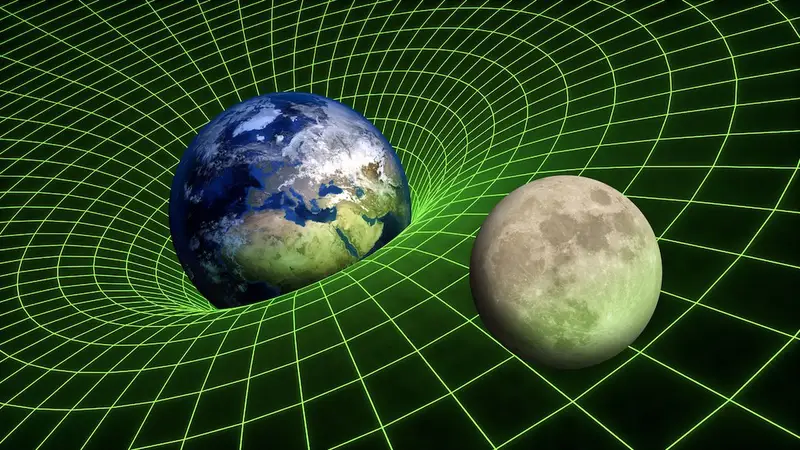
Instead, gravity is the curvature of spacetime itself. Massive objects like planets and stars do not “pull” on other objects in the traditional sense. They warp the fabric of spacetime around them. When an object moves through this curved spacetime, it follows the straightest possible path available, which appears to us as gravitational attraction.
This idea overturns common sense. When you drop an apple, it is not being pulled downward by a mysterious force. It is following a curved path through spacetime created by Earth’s mass. From the apple’s perspective, it is simply moving naturally. The ground rushes up to meet it because the Earth is embedded in that same curved geometry.
This becomes even stranger in space. Astronauts orbiting Earth are not “escaping gravity.” They are constantly falling, but missing the ground because of their forward motion. In their frame of reference, they are weightless because they are in free fall through curved spacetime.
The emotional impact of this realization is profound. Gravity is not something acting upon space. It is space itself responding to mass and energy. The universe is not a passive stage where events unfold; it is an active participant, shaping motion, time, and destiny.
2. Gravity Affects Time, Not Just Space
One of the most astonishing consequences of gravity is its effect on time. According to general relativity, time does not flow at the same rate everywhere. The stronger the gravitational field, the more slowly time passes.
Near massive objects like Earth, time ticks slightly slower than it does farther away. This effect is tiny in everyday life, but it is very real and measurable. Atomic clocks placed at higher altitudes run faster than identical clocks on the ground. Even your head ages infinitesimally faster than your feet because it is slightly farther from Earth’s center of gravity.
Near extremely massive objects, such as neutron stars or black holes, this effect becomes dramatic. To a distant observer, time near a black hole appears to slow to a crawl. At the event horizon, time effectively stops relative to the outside universe. An object falling in would seem frozen in place, never quite crossing the boundary.
This connection between gravity and time challenges our deepest intuitions. Time feels universal and steady, yet gravity reveals it to be flexible, local, and fragile. The passage of time depends on where you are and how deeply you are embedded in spacetime’s curvature.
This is not just theoretical. Modern technology depends on it. GPS satellites orbit Earth at high altitudes where gravity is weaker and orbital speeds are high. Both effects alter the rate at which their onboard clocks tick. Without correcting for gravitational time dilation, GPS errors would accumulate rapidly, making accurate navigation impossible.
Gravity does not merely shape the universe; it sculpts time itself, weaving duration into the fabric of space.
3. Gravity Is Incredibly Weak, Yet It Rules the Cosmos
One of the strangest facts about gravity is how weak it is compared to other fundamental interactions. Gravity is vastly weaker than electromagnetism, the force that governs chemistry, electricity, and light. A small magnet can easily lift a paperclip against the gravitational pull of the entire Earth.
At the level of particles, gravity is almost negligible. Two electrons repel each other electromagnetically with a force that is unimaginably stronger than their gravitational attraction. This weakness has puzzled physicists for decades.
And yet, gravity dominates the universe on large scales. It shapes galaxies, binds solar systems, and governs the evolution of the cosmos itself. The reason lies in gravity’s unique properties. Unlike electric charge, which can be positive or negative and cancel out, mass and energy only add. Gravity is always attractive.
Over vast distances and enormous quantities of matter, gravity accumulates. The combined mass of stars, gas, and dark matter creates gravitational fields powerful enough to sculpt galaxies and bend light across cosmic expanses.
This paradoxical nature makes gravity deeply mind-bending. It is the weakest force we know, yet it determines the large-scale structure of everything. It is fragile and unstoppable at the same time.
Emotionally, this teaches a quiet lesson about influence and scale. Power does not always come from strength. Sometimes it comes from persistence, universality, and the inability to cancel out. Gravity’s weakness makes its dominance even more mysterious and profound.
4. Gravity Can Bend Light and Make the Invisible Visible
Light has no mass, yet gravity affects it. This seems impossible under classical thinking, but in Einstein’s view, it makes perfect sense. Light follows the curvature of spacetime, and when spacetime is warped by massive objects, light’s path bends.
This phenomenon, known as gravitational lensing, allows gravity to act like a cosmic magnifying glass. When light from a distant galaxy passes near a massive object like another galaxy or a cluster of galaxies, its path curves. To observers on Earth, the distant object may appear stretched, duplicated, or arranged in luminous arcs and rings.
Gravitational lensing has become one of the most powerful tools in modern astronomy. It allows scientists to detect objects that emit little or no light, such as dark matter. By observing how light bends around unseen mass, physicists can map the invisible structure of the universe.
In extreme cases, gravity can trap light entirely. Black holes are regions where spacetime is curved so intensely that not even light can escape once it crosses the event horizon. These objects are not just massive; they represent a complete breakdown of ordinary geometry.
The fact that gravity can bend light reveals how deeply interconnected reality is. Space, time, matter, and radiation are not separate domains. They are facets of a single, dynamic structure.
There is something poetic about this. Gravity allows us to see what cannot be seen. It transforms darkness into knowledge and turns absence into evidence.
5. Gravity Might Be a Symptom of Something Deeper
Despite its central role in the universe, gravity remains the least understood of the fundamental interactions. While physicists have developed successful quantum theories for electromagnetism and nuclear forces, gravity stubbornly resists quantization.
This has led some scientists to suspect that gravity is not fundamental at all. Instead, it may emerge from deeper microscopic processes, much like temperature emerges from the motion of atoms or pressure emerges from countless molecular collisions.
Some theoretical frameworks suggest that gravity arises from the collective behavior of spacetime’s underlying degrees of freedom. In these views, spacetime itself may not be fundamental but emergent, arising from more basic informational or quantum structures.
If this is true, gravity is not a primary actor but a consequence, a macroscopic effect of something more profound happening beneath reality’s surface. This idea challenges the way we think about forces, particles, and even existence.
Emotionally, this possibility is unsettling and exhilarating. It suggests that what we perceive as the bedrock of reality may be a surface phenomenon, a shadow cast by deeper laws we have yet to grasp.
Gravity’s refusal to fit neatly into our theories is not a failure of science but an invitation. It points toward new physics, new concepts, and new ways of understanding the universe.
6. Gravity Shapes the Past, Present, and Future of the Universe
Gravity is not just a local phenomenon affecting falling objects and planetary orbits. It is the architect of cosmic history. From the earliest moments after the universe’s birth, gravity has been shaping the distribution of matter and energy.
Tiny fluctuations in the early universe were amplified by gravity, causing matter to clump together. Over billions of years, these clumps grew into stars, galaxies, and vast cosmic webs. Without gravity, matter would remain evenly spread, and structure would never form.
Gravity also determines the fate of the universe. The balance between gravitational attraction and cosmic expansion governs whether the universe will expand forever, slow down, or collapse. Even the formation and death of stars are controlled by gravity’s relentless pull.
On smaller scales, gravity shapes the conditions for life. It keeps planets in stable orbits, maintains atmospheres, and drives geological processes. The very existence of complex structures depends on gravity’s delicate influence.
There is a quiet awe in realizing that gravity connects every moment in time. It links the birth of the universe to the formation of galaxies, the evolution of life, and the fall of a leaf from a tree.
Gravity is not just a force or a curvature. It is a thread woven through the entire story of existence.
Gravity and the Human Perspective
What makes gravity truly mind-bending is not just its physics, but its intimacy. It is the only fundamental interaction you experience directly every moment of your life. You do not feel electromagnetic fields or nuclear forces in your daily existence, but gravity never lets you forget it is there.
Yet gravity also humbles us. It reminds us that our intuitive understanding of the world is limited. What feels solid and obvious often hides deeper truths that defy common sense.
Gravity shows us that reality is not made of rigid structures and fixed rules, but of dynamic relationships. Space bends. Time stretches. Light curves. Weakness becomes dominance. Simplicity gives way to profound complexity.
In studying gravity, humanity has learned not only about the universe, but about itself. We have learned that curiosity can reveal invisible forces, that imagination can reshape understanding, and that the universe is stranger and more beautiful than we ever expected.
Gravity holds us down, but it also lifts our minds outward, toward the stars and beyond.